
Fiber Optical Cable Global Market Opportunities And Strategies To 2035
By Fiber Material (Glass Optical Fiber, Plastic Optical Fiber), By Product Type (Single-Mode Cable, Multi-Mode Cable), By Application (Telecom, Oil And Gas, Military And Aerospace, BFSI, Medical, Imaging, Railway, Other Applications), And By Region, Opportunities And Strategies – Global Forecast To 2035
Fiber Optical Cable Market Definition
Fiber optical cables refer to specialized cables that use strands of glass or plastic fibers to transmit data in the form of light signals over long distances with high speed and minimal signal loss. These cables are a core component of modern telecommunications and data transmission infrastructure, enabling high-bandwidth communication for internet services, television broadcasting, and enterprise networking. The fiber optical cable market consists of sales of fiber optical cable by entities (organizations, sole traders and partnerships) that manufacture and supply optical fiber-based communication cables for data transmission. Fiber optic cables are used by telecommunications companies, internet service providers, government agencies, enterprises, and various industries that require reliable, high-speed data transfer. They are typically used in scenarios requiring high data capacity, such as broadband internet delivery, data center interconnections, industrial automation systems, and advanced communication networks.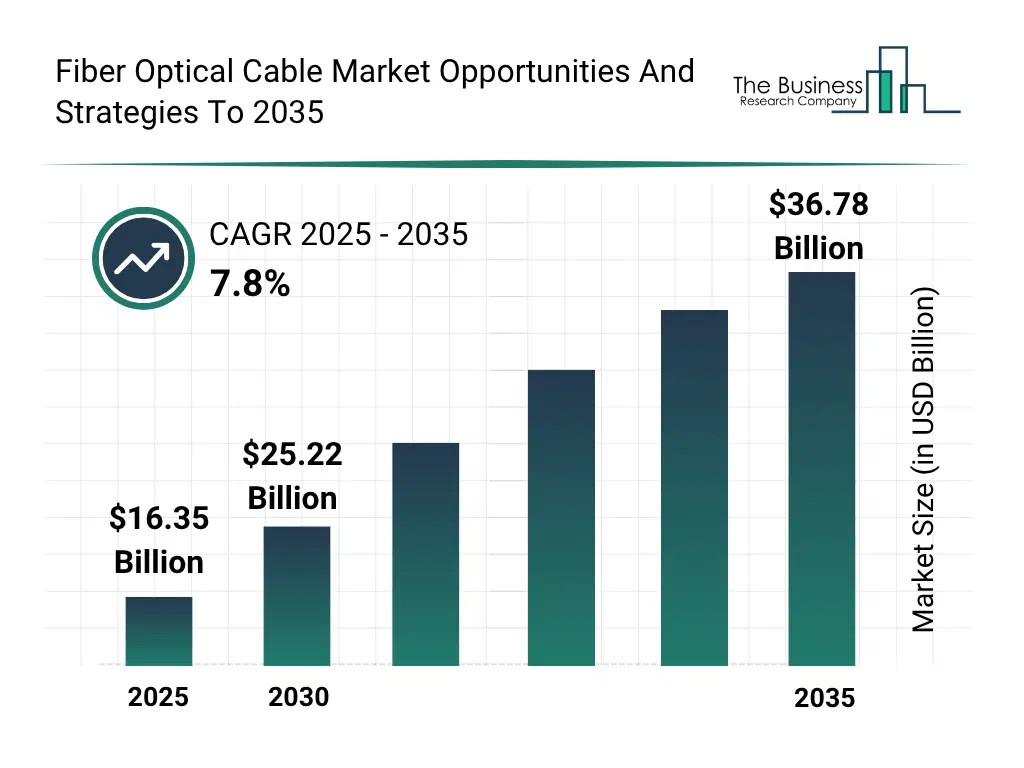
Fiber Optical Cable Market Size
Growth in the historic period resulted from increasing expansion of data centers, increasing investments in telecommunications infrastructure, rising cross-border data traffic and increasing digital transformation across industries. Factors that negatively affected growth in the historic period were high upfront capital investment for network deployment and shortage of skilled workforce. Going forward, rising demand for high-speed internet connectivity, rising deployment of 5G infrastructure networks, increasing adoption of fiber-to-the-home connections, government-led broadband expansion programs will drive the growth. Factors that could hinder the growth of the fiber optical cable market in the future include supply chain disruptions for raw materials, high maintenance and repair costs and impact of trade wars and tariffs. Market trends for the fiber optical cable market include prioritizing advanced fiber technologies and intelligent network solutions; prioritizing the Internet of Things (IoT), smart infrastructure, and connected ecosystems; prioritizing Industry 4.0 and intelligent manufacturing; prioritizing artificial intelligence-enabled network solutions and high-density fiber technologies; and prioritizing sustainability, circular economy practices, and eco-friendly materials.
Fiber Optical Cable Market Segmentation
The fiber optical cable market is segmented by fiber material, by product type and by application.By Fiber Material –
The fiber optical cable market is segmented by fiber material into:
- a) Glass Optical Fiber
- b) Plastic Optical Fiber
By Product Type –
The fiber optical cable market is segmented by product type into:
- a) Single-Mode Cable
- b) Multi-Mode Cable
By Application –
The fiber optical cable market is segmented by application into:
- a) Telecom
- b) Oil And Gas
- c) Military And Aerospace
- d) BFSI
- e) Medical
- f) Imaging
- g) Railway
- h) Other Applications
By Geography - The fiber optical cable market is segmented by geography into:
- China
- India
- Japan
- Australia
- Indonesia
- South Korea
- USA
- Canada
- Brazil
- France
- Germany
- UK
- Italy
- Spain
- Russia
-
o Asia Pacific
o Africa