
Fiber-Reinforced Polymer (FRP) Rebars Market Report 2026
Global Outlook – By Material Type (Glass Fiber Reinforced Polymer Rebars (GFRP), Carbon Fiber Reinforced Polymer Rebars (CFRP), Basalt Fiber Reinforced Polymer Rebars (BFRP), Aramid Fiber Reinforced Polymer Rebars, Hybrid Fiber Reinforced Polymer Rebars), By Resin Type (Vinyl Ester, Polyester, Epoxy, Other Resins), By Manufacturing Process (Pultrusion, Filament Winding, Hand Layup), By Application (Highways, Bridges And Buildings, Marine Structures And Waterfronts, Water Treatment Plants, Magnetic Resonance Imaging (MRI) Rooms), By End-User Industry (Infrastructure, Residential Construction, Commercial Construction, Industrial Facilities) – Market Size, Trends, Strategies, and Forecast to 2030
Fiber-Reinforced Polymer (FRP) Rebars Market Overview
• Fiber-Reinforced Polymer (FRP) Rebars market size has reached to $1.41 billion in 2025 • Expected to grow to $2.45 billion in 2030 at a compound annual growth rate (CAGR) of 11.7% • Growth Driver: High Annual Infrastructure Corrosion Costs Fueling The Market Growth Due To Rising Demand For Corrosion?Resistant Reinforcement • North America was the largest region in 2025 and Asia-Pacific is the fastest growing region.What Is Covered Under Fiber-Reinforced Polymer (FRP) Rebars Market?
The fiber reinforced polymer (FRP) rebars are high-strength reinforcement bars made from continuous fibers—such as glass, carbon, or basalt—embedded in a polymer matrix. They provide excellent corrosion resistance, lightweight properties, and high tensile strength compared to traditional steel rebars. FRP rebars are widely used in construction projects exposed to moisture, chemicals, or harsh environments, such as bridges, marine structures, and water treatment facilities. The main material types of fiber reinforced polymer (FRP) rebars include glass fiber reinforced polymer rebars (GFRP), carbon fiber reinforced polymer rebars (CFRP), basalt fiber reinforced polymer rebars (BFRP), aramid fiber reinforced polymer rebars, and hybrid fiber reinforced polymer rebars. Glass Fiber Reinforced Polymer Rebars refer to composite reinforcement bars made from glass fibers embedded in a polymer matrix, providing strength and corrosion resistance. The resin types include vinyl ester, polyester, epoxy, and others. The manufacturing processes include pultrusion, filament winding, and hand layup. The applications include highways, bridges, and buildings, marine structures and waterfronts, water treatment plants, and magnetic resonance imaging (MRI) rooms. The key end-user industries include infrastructure, residential construction, commercial construction, and industrial facilities.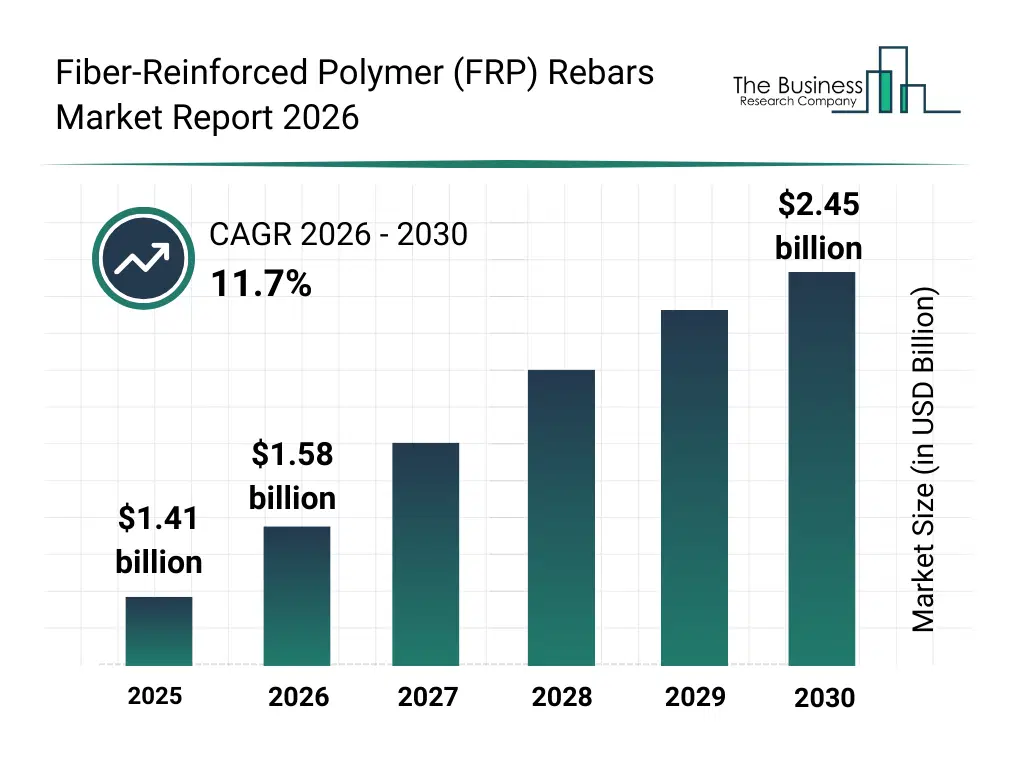
What Is The Fiber-Reinforced Polymer (FRP) Rebars Market Size and Share 2026?
The fiber reinforced polymer (FRP) rebars market size has grown rapidly in recent years. It will grow from $1.41 billion in 2025 to $1.58 billion in 2026 at a compound annual growth rate (CAGR) of 12.0%. The growth in the historic period can be attributed to increasing adoption in corrosion-prone environments, growing demand for lightweight construction materials, rising use in infrastructure and bridge projects, expanding awareness of durability advantages over steel, increasing focus on long-lasting concrete reinforcement.What Is The Fiber-Reinforced Polymer (FRP) Rebars Market Growth Forecast?
The fiber reinforced polymer (FRP) rebars market size is expected to see rapid growth in the next few years. It will grow to $2.45 billion in 2030 at a compound annual growth rate (CAGR) of 11.7%. The growth in the forecast period can be attributed to growing investment in sustainable and green construction, increasing adoption in marine and coastal structures, rising demand for high-strength and non-corrosive rebars, expanding use in high-rise and industrial buildings, growing emphasis on maintenance-free and cost-effective reinforcement solutions. Major trends in the forecast period include technology advancements in high-performance fiber composites, innovations in hybrid frp reinforcement systems, developments in manufacturing automation and quality control, research and development in fire-resistant and ultra-durable rebars, advancements in smart frp monitoring and structural health assessment.
Global Fiber-Reinforced Polymer (FRP) Rebars Market Segmentation
1) By Material Type: Glass Fiber Reinforced Polymer Rebars (GFRP), Carbon Fiber Reinforced Polymer Rebars (CFRP), Basalt Fiber Reinforced Polymer Rebars (BFRP), Aramid Fiber Reinforced Polymer Rebars, Hybrid Fiber Reinforced Polymer Rebars 2) By Resin Type: Vinyl Ester, Polyester, Epoxy, Other Resins 3) By Manufacturing Process: Pultrusion, Filament Winding, Hand Layup 4) By Application: Highways, Bridges And Buildings, Marine Structures And Waterfronts, Water Treatment Plants, Magnetic Resonance Imaging (MRI) Rooms 5) By End-User Industry: Infrastructure, Residential Construction, Commercial Construction, Industrial Facilities Subsegments: 1) By Glass Fiber Reinforced Polymer Rebars (GFRP): Pultruded Glass Fiber Rebars, Sand-Coated Glass Fiber Rebars, Helical-Wrapped Glass Fiber Rebars, Braided Glass Fiber Rebars, Vinylester-Based Glass Fiber Rebars 2) By Carbon Fiber Reinforced Polymer Rebars (CFRP): High-Strength Carbon Fiber Rebars, Sand-Coated Carbon Fiber Rebars, Epoxy-Based Carbon Fiber Rebars, Braided Carbon Fiber Rebars, Pultruded Carbon Fiber Rebars 3) By Basalt Fiber Reinforced Polymer Rebars (BFRP): Pultruded Basalt Fiber Rebars, Sand-Coated Basalt Fiber Rebars, Basalt-Vinylester Rebars, Twisted Basalt Fiber Rebars, High-Temperature Basalt Fiber Rebars 4) By Aramid Fiber Reinforced Polymer Rebars: Pultruded Aramid Fiber Rebars, Epoxy-Based Aramid Fiber Rebars, Braided Aramid Fiber Rebars, High-Strength Aramid Fiber Rebars, Corrosion-Resistant Aramid Fiber Rebars 5) By Hybrid Fiber Reinforced Polymer Rebars: Glass–Carbon Hybrid Rebars, Basalt–Glass Hybrid Rebars, Carbon–Aramid Hybrid Rebars, Glass–Aramid Hybrid Rebars, Multi-Fiber Composite Hybrid RebarsWhat Are The Drivers Of The Fiber-Reinforced Polymer (FRP) Rebars Market?
The high annual infrastructure corrosion costs are expected to propel the growth of the fiber-reinforced polymer (FRP) rebars market going forward. High annual infrastructure corrosion costs refer to the economic losses incurred due to corrosion damage in reinforced concrete structures, particularly where steel reinforcement deteriorates from environmental exposure. These annual infrastructure corrosion costs are rising as aging infrastructure and exposure to deicing salts, moisture, and aggressive environments accelerate deterioration, creating higher maintenance and repair expenses. The FRP rebars supports corrosion‑resistant reinforcement by providing composite rebars made from glass, carbon, or basalt fibers in a polymer matrix that resist rust, reduce long-term maintenance needs, and extend the service life of concrete structures compared with traditional steel rebars. For instance, in April 2025, according to the Association for Materials Protection and Performance, a US-based professional organization focused on corrosion prevention and materials protection, the annual global cost of corrosion exceeds $2.5 trillion, and adopting proven corrosion control practices could reduce these costs by up to 35% through improved asset protection and maintenance efficiency. Therefore, the high annual infrastructure corrosion costs are driving the growth of thefiber-reinforced polymer (FRP) rebars market. The growing infrastructure development projects are expected to propel the growth of the fiber-reinforced polymer (FRP) rebars market going forward. Infrastructure development projects refer to large-scale construction initiatives such as bridges, highways, tunnels, and urban development that require high-strength and long-lasting reinforcement materials for concrete structures. The rise in infrastructure development projects is due to increasing government investments and urbanization, rising urbanization, as expanding cities require improved transportation, water supply, and housing facilities to meet the needs of growing populations. FRP rebars support infrastructure development projects by offering corrosion-resistant, lightweight, and high-strength alternatives to traditional steel reinforcement, extending the lifespan of structures and reducing maintenance costs. For instance, in July 2024, according to the Office for National Statistics, a UK-based government department, total general government investment in infrastructure reached $17.25 billion (£13.8 billion) in 2023, marking a 3.9% increase from 2022. Therefore, the growing infrastructure development projects are driving the growth of the fiber-reinforced polymer (FRP) rebars industry.Key Players In The Global Fiber-Reinforced Polymer (FRP) Rebars Market
Major companies operating in the fiber-reinforced polymer (frp) rebars market are Owens Corning Inc., Dextra Group, Schoeck International, Hughes Brothers Inc., Armastek Co., Shandong Safety Industries, Pultrall Inc., Sireg Geotech S.r.l., B&B FRP Manufacturing Inc., Nanjing Fenghui Composite, Kodiac Fiberglass Rebar LLC, BP Composites Ltd., Agni Fiber Boards Pvt. Ltd., MST Rebar Inc., MRG Composites, Mateenbar Limited, Galen Composites, Neuvokas Corporation, Aslan FRP, FiReP Rebar Technology GmbH, Marshall Composite Technologies LLC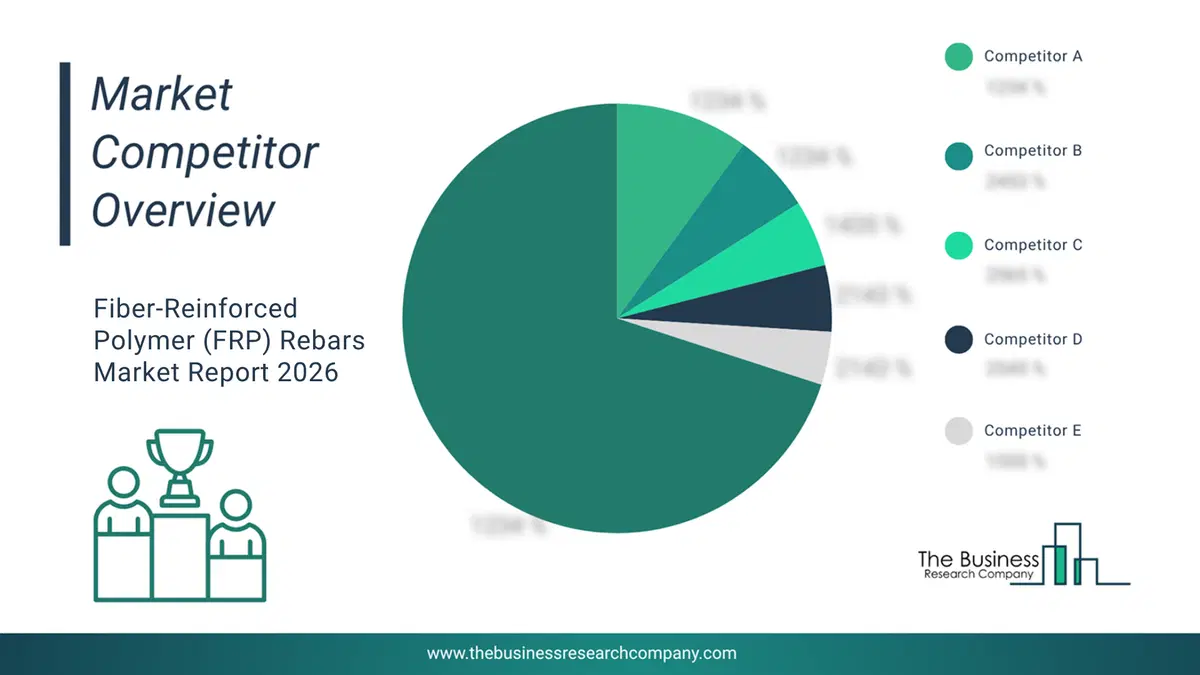
This chart is for illustrative purposes; the full report includes a detailed competitor analysis and comprehensive overview of the top 10 companies in the market.
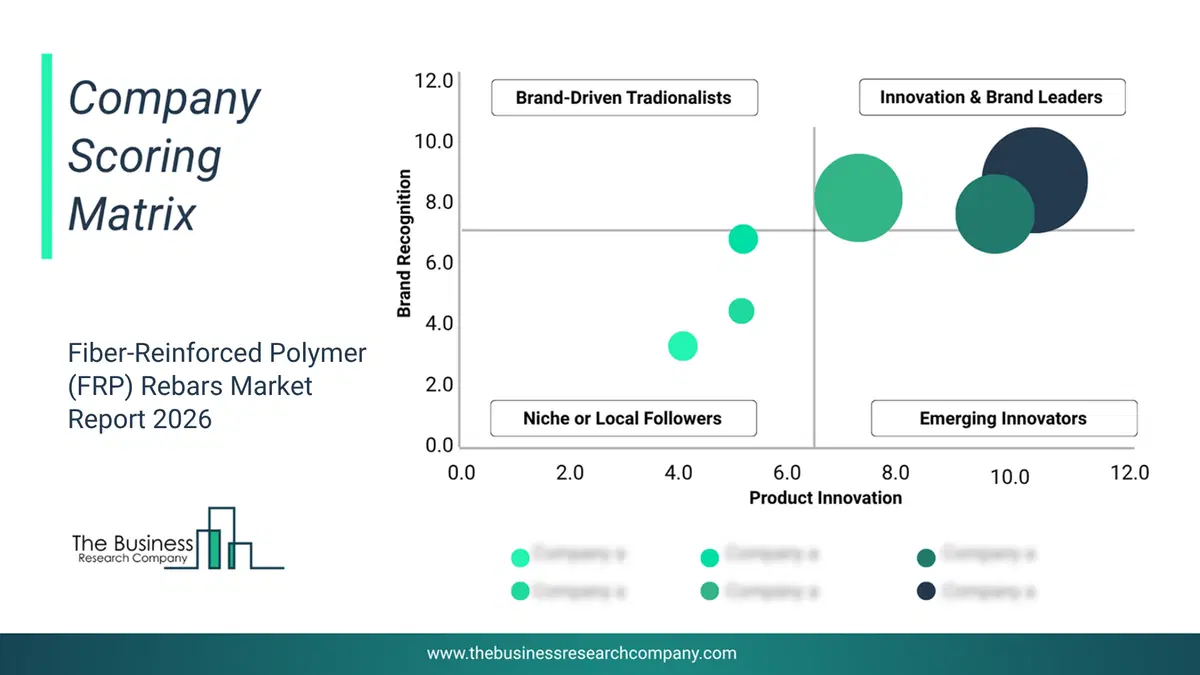
This chart maps companies by product innovation and brand strength, with bubble size indicating relative revenue, helping identify market leaders, challengers, and niche players. This is an illustrative chart; the full report provides a complete and accurate competitive analysis.
Regional Insights
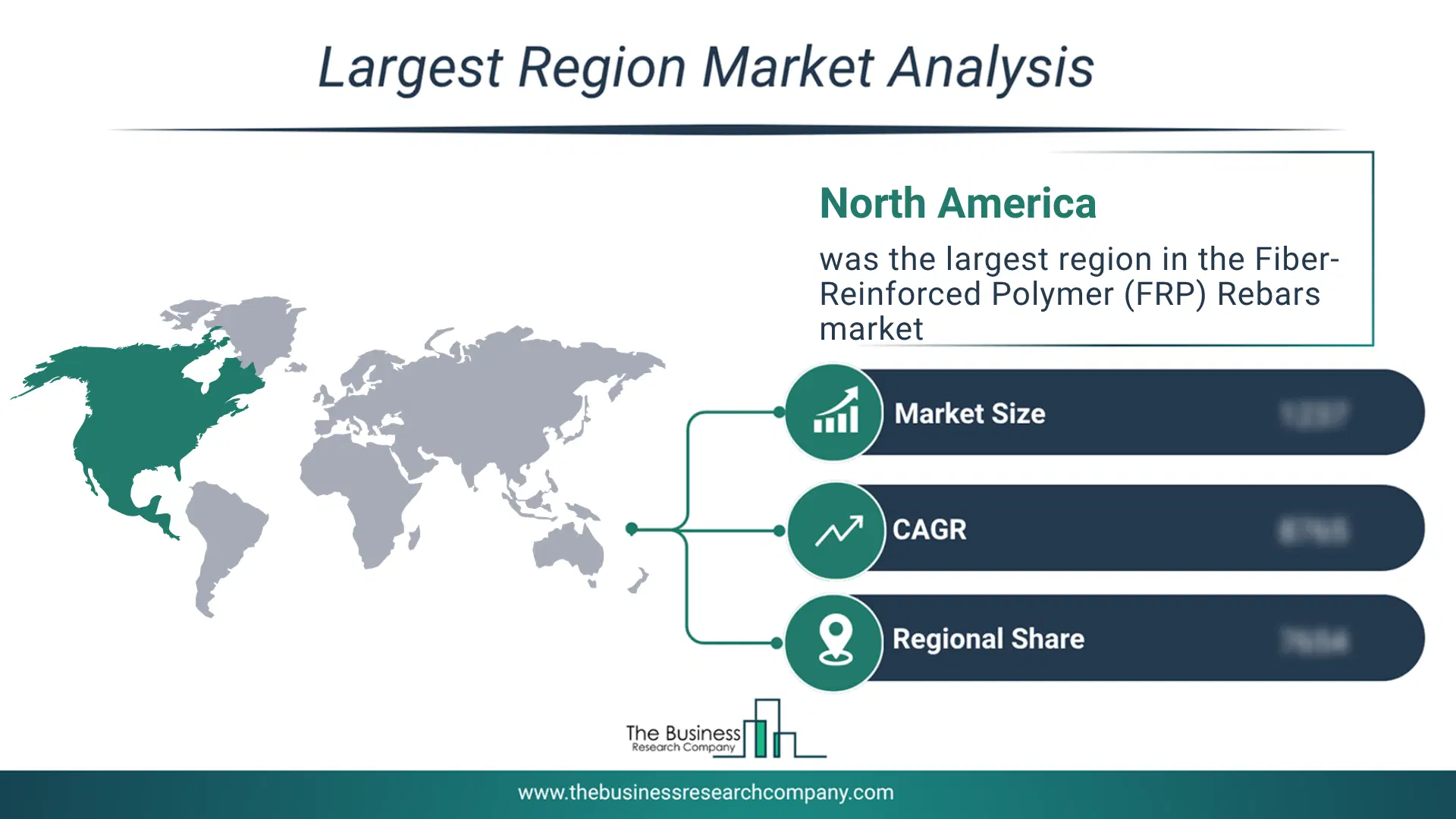
North America was the largest region in the fiber reinforced polymer (FRP) rebars market in 2025. Asia-Pacific is expected to be the fastest-growing region in the forecast period. The regions covered in this market report are Asia-Pacific, South East Asia, Western Europe, Eastern Europe, North America, South America, Middle East, Africa. The countries covered in this market report are Australia, Brazil, China, France, Germany, India, Indonesia, Japan, Taiwan, Russia, South Korea, UK, USA, Canada, Italy, Spain.What Defines the Fiber-Reinforced Polymer (FRP) Rebars Market?
The fiber reinforced polymer (FRP) rebars market consists of sales of glass fiber reinforced polymer rebars, carbon fiber reinforced polymer rebars, basalt fiber reinforced polymer rebars, aramid fiber reinforced polymer rebars, and hybrid fiber reinforced polymer rebars. Values in this market are ‘factory gate’ values, that is, the value of goods sold by the manufacturers or creators of the goods, whether to other entities (including downstream manufacturers, wholesalers, distributors, and retailers) or directly to end customers. The value of goods in this market includes related services sold by the creators of the goods.How is Market Value Defined and Measured?
The market value is defined as the revenues that enterprises gain from the sale of goods and/or services within the specified market and geography through sales, grants, or donations in terms of the currency (in USD unless otherwise specified). The revenues for a specified geography are consumption values that are revenues generated by organizations in the specified geography within the market, irrespective of where they are produced. It does not include revenues from resales along the supply chain, either further along the supply chain or as part of other products.
This chart presents market attractiveness based on a quantitative evaluation of growth, competition, strategic alignment, and risk, offering a clear view of opportunity areas for decision-making. This chart is for illustrative purposes; the full report contains the complete analysis.

This chart highlights the Total Addressable Market (TAM) by estimating the maximum revenue opportunity using an assumption-driven approach, supporting strategic planning and opportunity sizing across markets. The chart is illustrative; the full report provides a more comprehensive analysis.
What Key Data and Analysis Are Included in the Fiber-Reinforced Polymer (FRP) Rebars Market Report 2026?
The fiber-reinforced polymer (frp) rebars market research report is one of a series of new reports from The Business Research Company that provides market statistics, including industry global market size, regional shares, competitors with the market share, detailed market segments, market trends and opportunities, and any further data you may need to thrive in the fiber-reinforced polymer (frp) rebars industry. The market research report delivers a complete perspective of everything you need, with an in-depth analysis of the current and future state of the industry.Fiber-Reinforced Polymer (FRP) Rebars Market Report Forecast Analysis
| Report Attribute | Details |
|---|---|
| Market Size Value In 2026 | $1.58 billion |
| Revenue Forecast In 2030 | $2.45 billion |
| Growth Rate | CAGR of 12.0% from 2026 to 2030 |
| Base Year For Estimation | 2025 |
| Actual Estimates/Historical Data | 2020-2025 |
| Forecast Period | 2026 - 2030 |
| Market Representation | Revenue in USD Billion and CAGR from 2026 to 2030 |
| Segments Covered | Material Type, Resin Type, Manufacturing Process, Application, End-User Industry |
| Regional Scope | Asia-Pacific, Western Europe, Eastern Europe, North America, South America, Middle East, Africa |
| Country Scope | The countries covered in this market report are Australia, Brazil, China, France, Germany, India, Indonesia, Japan, Taiwan, Russia, South Korea, UK, USA, Canada, Italy, Spain |
| Key Companies Profiled | Owens Corning Inc., Dextra Group, Schoeck International, Hughes Brothers Inc., Armastek Co., Shandong Safety Industries, Pultrall Inc., Sireg Geotech S.r.l., B&B FRP Manufacturing Inc., Nanjing Fenghui Composite, Kodiac Fiberglass Rebar LLC, BP Composites Ltd., Agni Fiber Boards Pvt. Ltd., MST Rebar Inc., MRG Composites, Mateenbar Limited, Galen Composites, Neuvokas Corporation, Aslan FRP, FiReP Rebar Technology GmbH, Marshall Composite Technologies LLC |
| Customization Scope | Request for Customization |
| Pricing And Purchase Options | Explore Purchase Options |