
Fifth Generation (5G) Radio Access Network Market Report 2026
Global Outlook – By Component (Hardware, Software, Services), By Architecture Type (Centralized Radio Access Network (CRAN), Open Radio Access Network (ORAN), Virtualized Radio Access Network (VRAN)), By Deployment (Indoor, Outdoor), By End-User (Telecom Operators, Enterprises) – Market Size, Trends, Strategies, and Forecast to 2030
Fifth Generation (5G) Radio Access Network Market Overview
• Fifth Generation (5G) Radio Access Network market size has reached to $23.31 billion in 2025 • Expected to grow to $59.05 billion in 2030 at a compound annual growth rate (CAGR) of 20.4% • Growth Driver: Rising Demand For High-Speed Internet Driving Market Growth Due To Increased Digital Connectivity • Market Trend: Technological Advancements In 5G RAN Platforms Driving Network Performance and Flexibility • Asia-Pacific was the largest region in 2025.What Is Covered Under Fifth Generation (5G) Radio Access Network Market?
Fifth-generation (5G) radio access networks is the part of a mobile network responsible for connecting user devices to the core network. 5G RAN supports high-speed data transmission, ultra-low latency, and enhanced connectivity for a wide range of devices. It is key to delivering the improved bandwidth and reliability promised by 5G networks. The main component types of fifth-generation (5G) radio access networks are hardware, software, and services. Hardware comprises physical infrastructure such as antennas, base stations, and small cells, enabling ultra-fast wireless communication. It provides various architecture types such as centralized radio access network (CRAN), open radio access network (ORAN), and virtualized radio access network (VRAN) for different deployments, including indoor and outdoor. These are used by various end users, such as telecom operators and enterprises.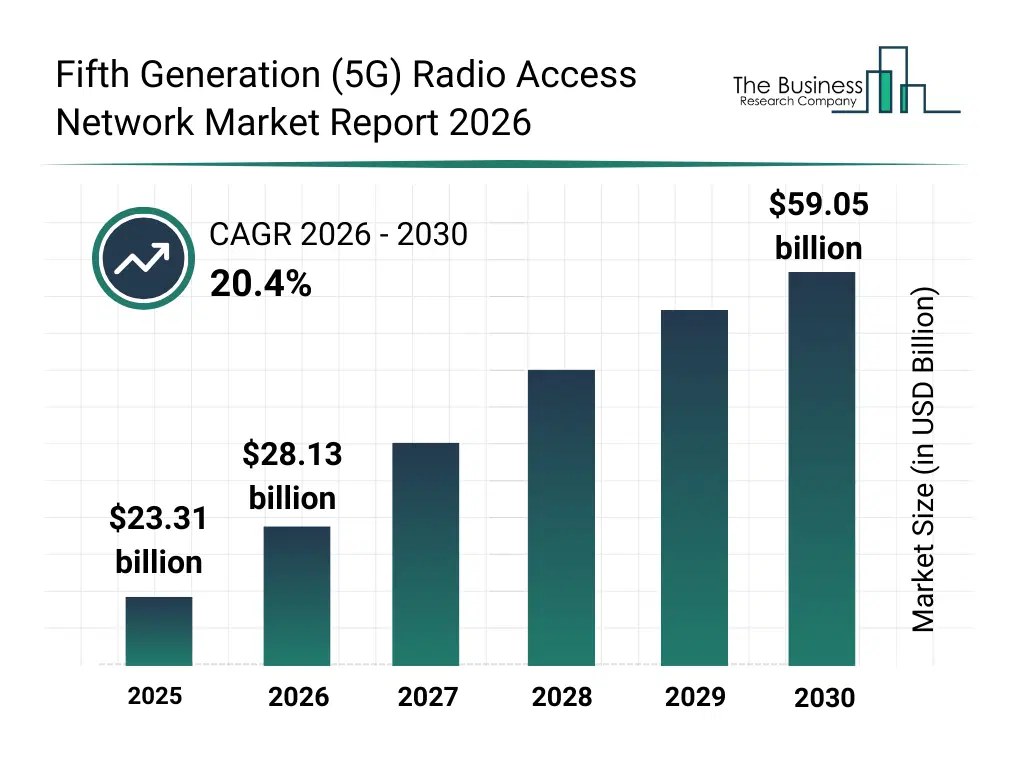
What Is The Fifth Generation (5G) Radio Access Network Market Size and Share 2026?
The fifth generation (5g) radio access network market size has grown exponentially in recent years. It will grow from $23.31 billion in 2025 to $28.13 billion in 2026 at a compound annual growth rate (CAGR) of 20.7%. The growth in the historic period can be attributed to growth in mobile data traffic, early LTE network congestion, increasing smartphone penetration, demand for higher network capacity, initial 5G infrastructure investments.What Is The Fifth Generation (5G) Radio Access Network Market Growth Forecast?
The fifth generation (5g) radio access network market size is expected to see exponential growth in the next few years. It will grow to $59.05 billion in 2030 at a compound annual growth rate (CAGR) of 20.4%. The growth in the forecast period can be attributed to private 5G network expansion, smart city infrastructure growth, massive IoT connectivity demand, edge integrated RAN architectures, increasing spectrum availability. Major trends in the forecast period include open ran architecture adoption, virtualized ran deployment, small cell network densification, AI based network optimization, cloud native ran solutions.
Global Fifth Generation (5G) Radio Access Network Market Segmentation
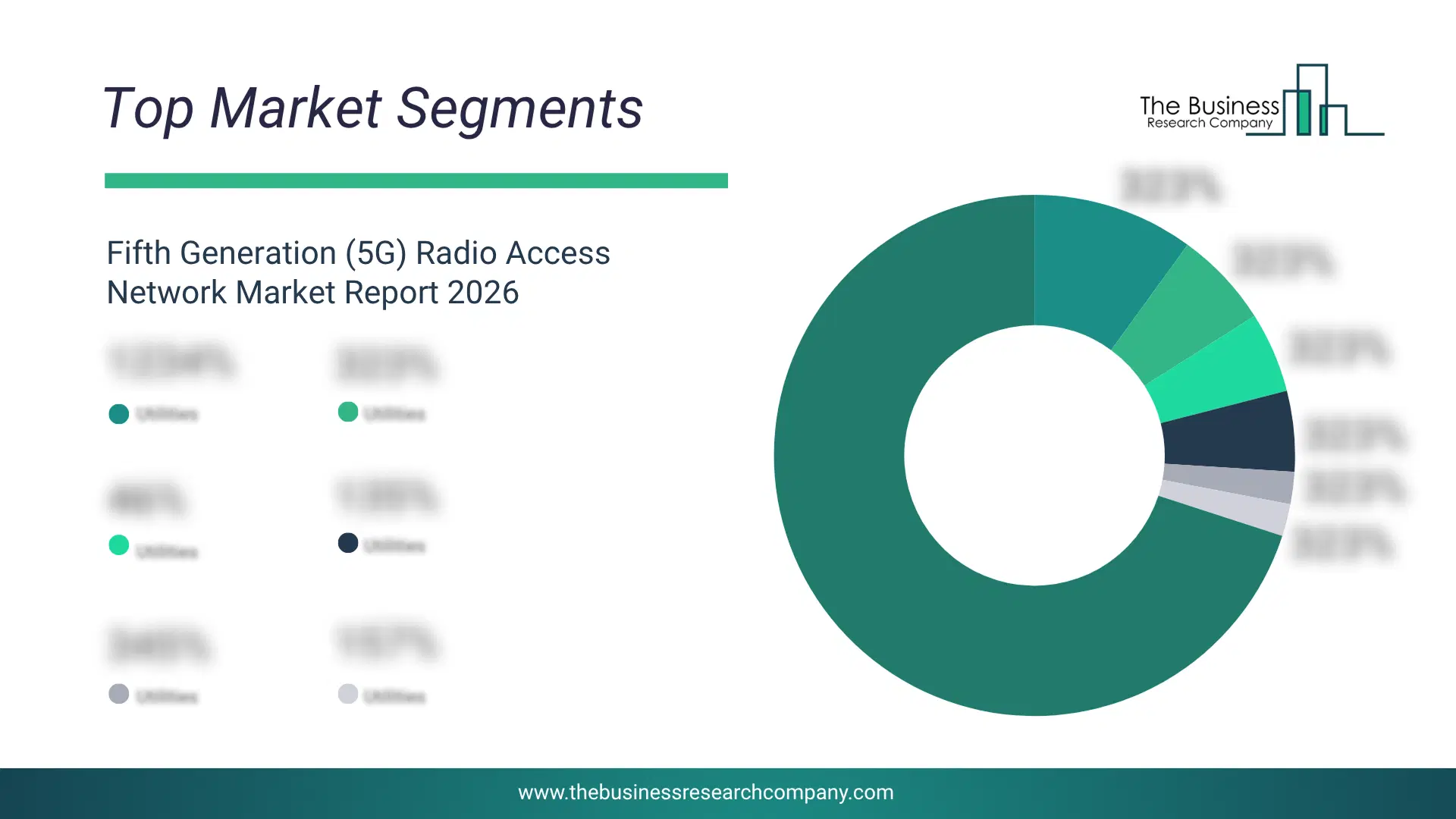
1) By Component: Hardware, Software, Services 2) By Architecture Type: Centralized Radio Access Network (CRAN), Open Radio Access Network (ORAN), Virtualized Radio Access Network (VRAN) 3) By Deployment: Indoor, Outdoor 4) By End-User: Telecom Operators, Enterprises Subsegments: 1) By Hardware: Radio Units (RU), Distributed Antenna Systems (DAS), Small Cells (Femtocells, Picocells, Microcells), Massive MIMO Antennas, Baseband Units (BBU) 2) By Software: Network Virtualization Software, Cloud RAN (C-RAN) Software, AI-Based Network Optimization Software, Network Slicing Software, SDN (Software-Defined Networking) Solutions 3) By Services: Deployment And Integration Services, Network Optimization And Maintenance Services, Managed Services, Consulting And Advisory Services, Training And Support ServicesWhat Is The Driver Of The Fifth Generation (5G) Radio Access Network Market?
The growing need for high-speed internet is expected to propel the growth of the fifth-generation (5G) radio access networks market going forward. High-speed internet refers to an internet connection that provides fast data transfer rates, allowing for quick downloads, smooth streaming, and efficient browsing with minimal lag or buffering. The need for high-speed internet is rising due to the increasing reliance on seamless digital connectivity for efficient communication, access to information, and the smooth functioning of various online services in daily life. High-speed internet enhances the 5G radio access network by improving data transmission speeds, reducing latency, increasing network capacity, ensuring reliable connectivity, and supporting advanced applications such as IoT, autonomous systems, and high-definition streaming. For instance, in September 2025, according to Innovation, Science and Economic Development Canada (ISED), a Canada-based government department, the Government of Canada is connecting 98% of Canadians to high-speed Internet by 2026 and 100% of Canadians by 2030. Therefore, the growing need for high-speed internet is driving the fifth-generation (5G) radio access networks market.Key Players In The Global Fifth Generation (5G) Radio Access Network Market
Major companies operating in the fifth generation (5g) radio access network market are Samsung Electronics Co. Ltd., Verizon Communications Inc., Huawei Technologies Co. Ltd., Intel Corporation, Cisco Systems Inc., Qualcomm Technologies Inc., Fujitsu Limited, Telefonaktiebolaget LM Ericsson, Nokia Corporation, NEC Corporation, ZTE Corporation, TE Connectivity, Corning Inc., Juniper Networks Inc., Arm Limited, Mavenir, Comba Telecom Systems Holdings Limited, Comarch SA, Parallel Wireless, Rakuten Symphony Singapore Pte. Ltd.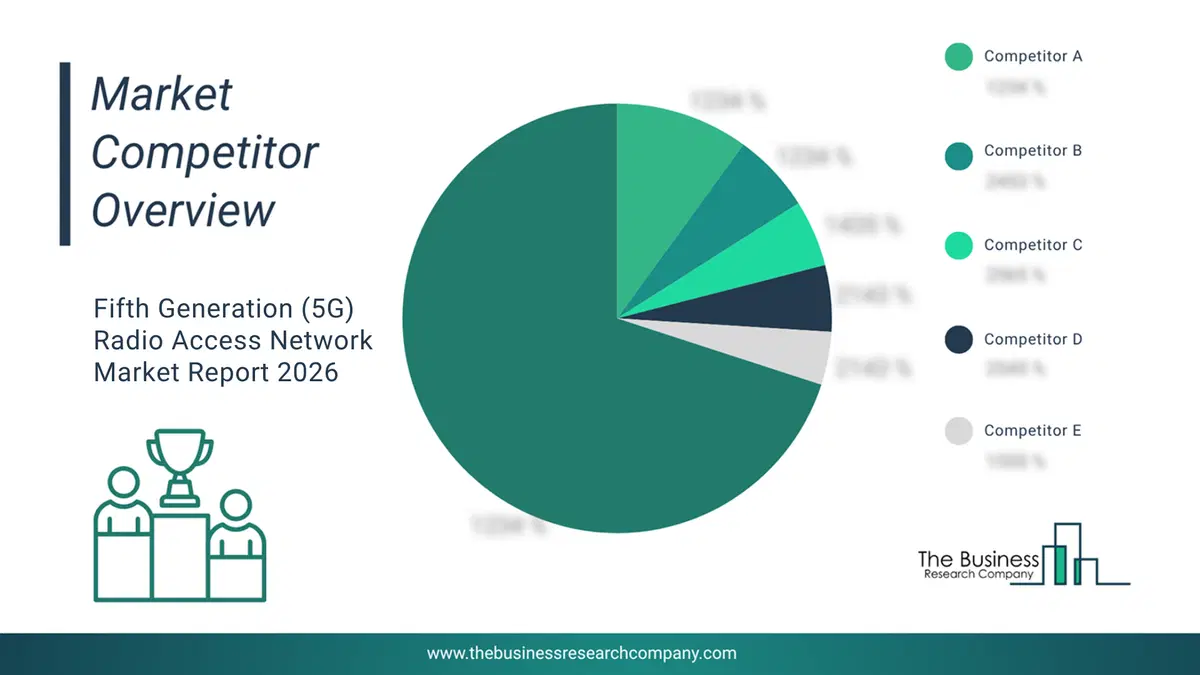
This chart is for illustrative purposes; the full report includes a detailed competitor analysis and comprehensive overview of the top 10 companies in the market.
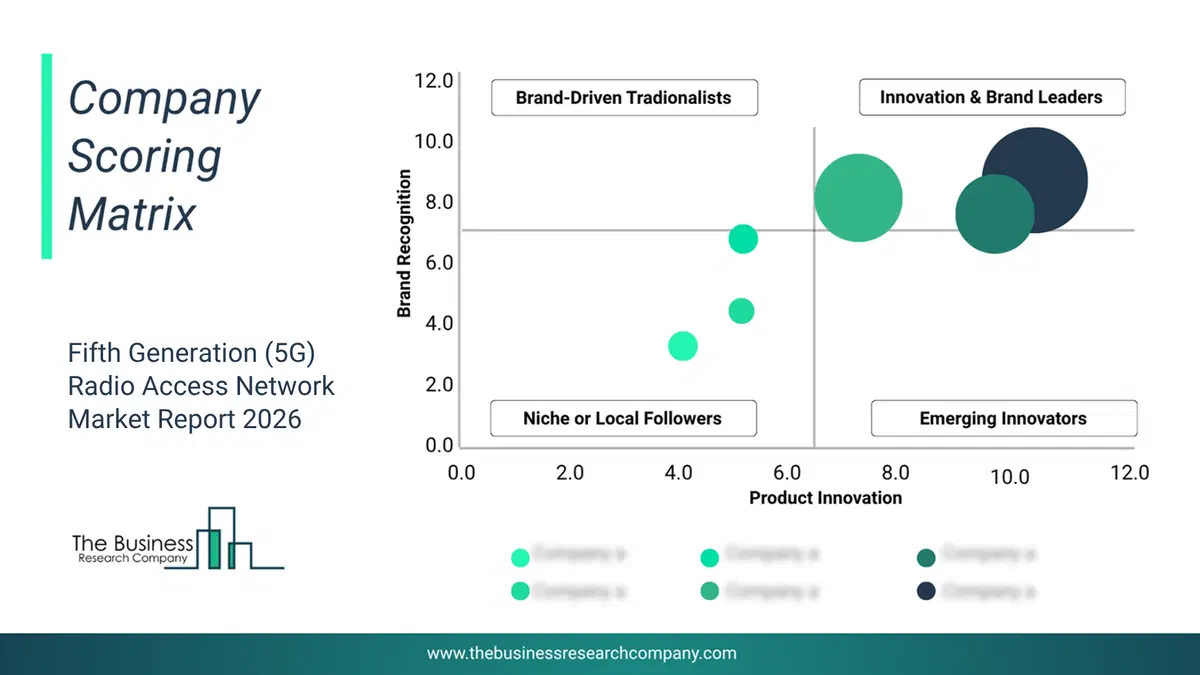
This chart maps companies by product innovation and brand strength, with bubble size indicating relative revenue, helping identify market leaders, challengers, and niche players. This is an illustrative chart; the full report provides a complete and accurate competitive analysis.
Global Fifth Generation (5G) Radio Access Network Market Trends and Insights
Major companies operating in the fifth-generation (5G) radio access networks market are focusing on developing advanced commercial 5G radio access network (RAN) platforms to enhance network performance. Commercial 5G RAN platforms are comprehensive hardware and software solutions that help mobile operators deploy, control, and enhance 5G networks, ensuring high-speed performance, low latency, and large-scale device connectivity. For instance, in November 2024, Viettel, a Vietnam-based telecom company, launched the Open Radio Access Network (O-RAN) 5G Network. It's the first Open RAN (O-RAN) 5G network utilizing Qualcomm Technologies' 5G RAN platforms. This milestone marks Viettel as a leading advocate in the O-RAN community and one of the largest carriers to launch a commercial O-RAN network. The network features key equipment developed in-house by Viettel and will deploy over 300 sites across Vietnamese provinces by early 2025, with plans for further expansion. This collaboration with Qualcomm aims to deliver cost-effective, high-quality 5G solutions while fostering a sustainable vendor ecosystem.What Are Latest Mergers And Acquisitions In The Fifth Generation (5G) Radio Access Network Market?
In July 2024, Telecom Egypt, an Egypt-based telecommunications operator, partnered with Nokia Corp. to accelerate nationwide 5G deployment and enhance advanced mobile broadband services across Egypt. With this partnership, the companies aim to expand 5G coverage, modernize network infrastructure, and enable high-capacity, low-latency connectivity to support emerging use cases such as IoT, smart cities, and enterprise digital transformation. Nokia Corp. is a Finland-based telecommunications company specializing in network infrastructure and advanced wireless technologies.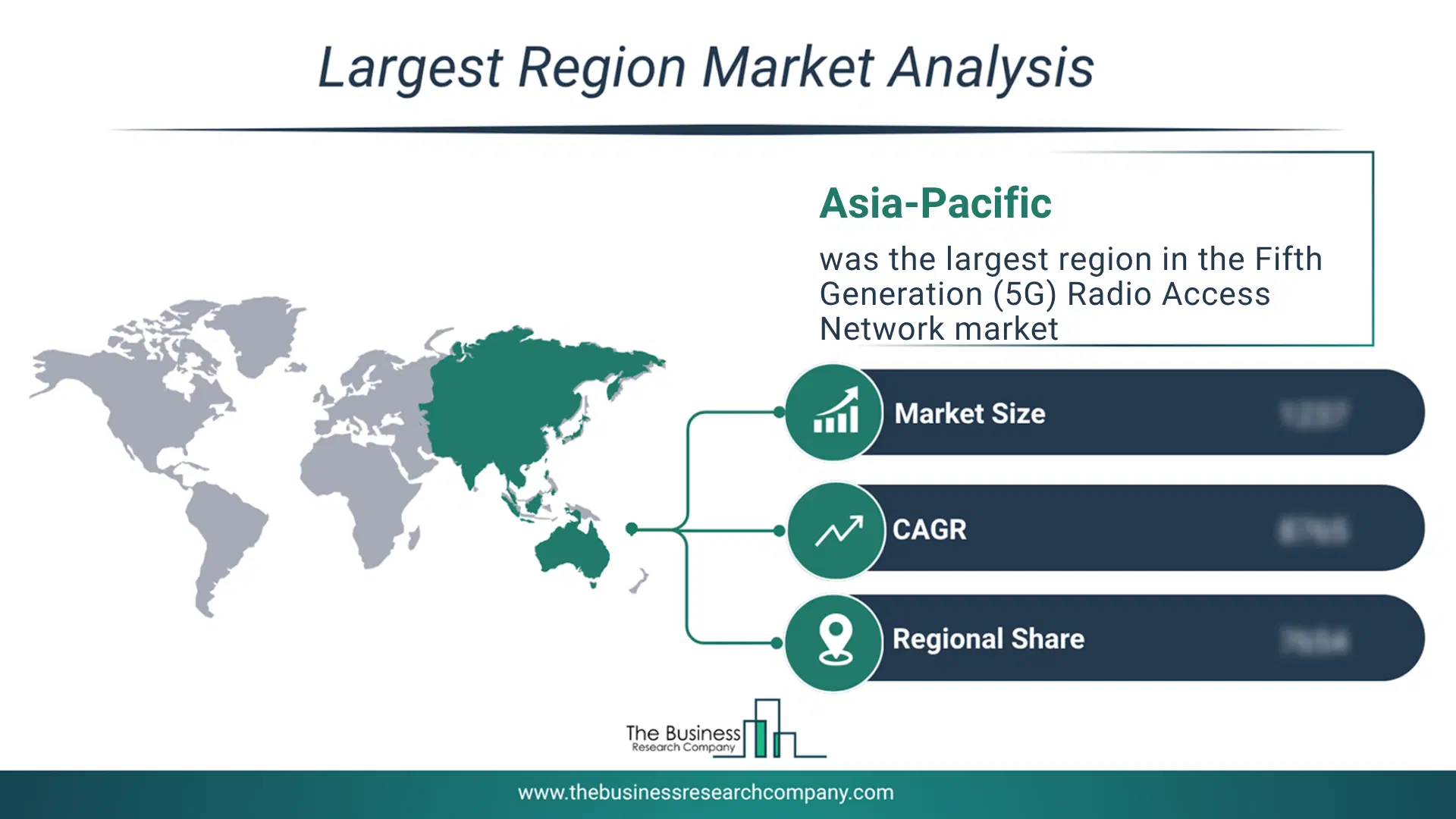
Regional Insights
Asia-Pacific was the largest region in the fifth-generation (5G) radio access networks market in 2025. The regions covered in this market report are Asia-Pacific, South East Asia, Western Europe, Eastern Europe, North America, South America, Middle East, Africa. The countries covered in this market report are Australia, Brazil, China, France, Germany, India, Indonesia, Japan, Taiwan, Russia, South Korea, UK, USA, Canada, Italy, Spain.What Defines the Fifth Generation (5G) Radio Access Network Market?
The fifth-generation (5G) radio access networks market consists of revenues earned by entities providing services such as planning and deployment services, network optimization services, and managed services. The market value includes the value of related goods sold by the service provider or included within the service offering. The 5G radio access network market also includes sales of AI and automation software, baseband processing unit (BBU), and radio units (RU). Values in this market are ‘factory gate’ values, that is, the value of goods sold by the manufacturers or creators of the goods, whether to other entities (including downstream manufacturers, wholesalers, distributors, and retailers) or directly to end customers. The value of goods in this market includes related services sold by the creators of the goods.How is Market Value Defined and Measured?
The market value is defined as the revenues that enterprises gain from the sale of goods and/or services within the specified market and geography through sales, grants, or donations in terms of the currency (in USD unless otherwise specified). The revenues for a specified geography are consumption values that are revenues generated by organizations in the specified geography within the market, irrespective of where they are produced. It does not include revenues from resales along the supply chain, either further along the supply chain or as part of other products.
This chart presents market attractiveness based on a quantitative evaluation of growth, competition, strategic alignment, and risk, offering a clear view of opportunity areas for decision-making. This chart is for illustrative purposes; the full report contains the complete analysis.

This chart highlights the Total Addressable Market (TAM) by estimating the maximum revenue opportunity using an assumption-driven approach, supporting strategic planning and opportunity sizing across markets. The chart is illustrative; the full report provides a more comprehensive analysis.
What Key Data and Analysis Are Included in the Fifth Generation (5G) Radio Access Network Market Report 2026?
The fifth generation (5g) radio access network market research report is one of a series of new reports from The Business Research Company that provides market statistics, including industry global market size, regional shares, competitors with the market share, detailed market segments, market trends and opportunities, and any further data you may need to thrive in the fifth generation (5g) radio access network industry. The market research report delivers a complete perspective of everything you need, with an in-depth analysis of the current and future state of the industry.Fifth Generation (5G) Radio Access Network Market Report Forecast Analysis
| Report Attribute | Details |
|---|---|
| Market Size Value In 2026 | $28.13 billion |
| Revenue Forecast In 2030 | $59.05 billion |
| Growth Rate | CAGR of 20.4% from 2026 to 2030 |
| Base Year For Estimation | 2025 |
| Actual Estimates/Historical Data | 2020-2025 |
| Forecast Period | 2026 - 2030 |
| Market Representation | Revenue in USD Billion and CAGR from 2026 to 2030 |
| Segments Covered | Component, Architecture Type, Deployment, End-User |
| Regional Scope | Asia-Pacific, Western Europe, Eastern Europe, North America, South America, Middle East, Africa |
| Country Scope | The Countries Covered In This Market Report Are Australia, Brazil, China, France, Germany, India, Indonesia, Japan, Taiwan, Russia, South Korea, Uk, Usa, Canada, Italy, Spain. |
| Key Companies Profiled | Samsung Electronics Co. Ltd., Verizon Communications Inc., Huawei Technologies Co. Ltd., Intel Corporation, Cisco Systems Inc., Qualcomm Technologies Inc., Fujitsu Limited, Telefonaktiebolaget LM Ericsson, Nokia Corporation, NEC Corporation, ZTE Corporation, TE Connectivity, Corning Inc., Juniper Networks Inc., Arm Limited, Mavenir, Comba Telecom Systems Holdings Limited, Comarch SA, Parallel Wireless, Rakuten Symphony Singapore Pte. Ltd. |
| Customization Scope | Request for Customization |
| Pricing And Purchase Options | Explore Purchase Options |