
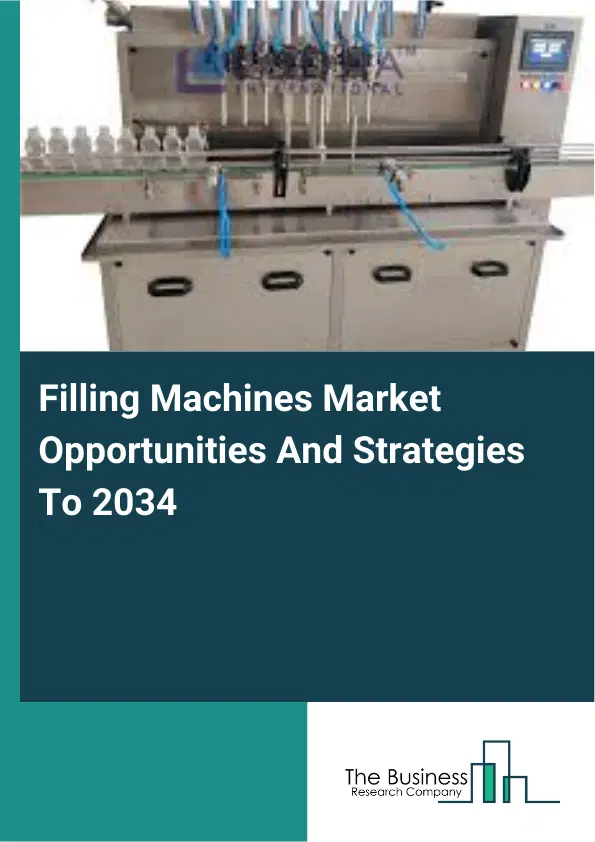
Filling Machines Market 2026
By Type (Rotary Fillers, Volumetric Fillers, Aseptic Fillers, Net Weight Fillers, Other Types), By Process (Manual, Semi-Automatic, Automatic), By Application (Food and Beverage, Pharmaceutical, Cosmetic, Other Applications), And By Region, Opportunities And Strategies – Global Forecast To 2035
Filling Machines Market Definition
Filling machines are industrial equipment designed to accurately dispense and package liquids, powders, granules, or pastes into containers such as bottles, cans, pouches, or tubes. These machines operate using various technologies, such as volumetric, gravimetric, piston, or vacuum filling, and are essential components in automated packaging lines. The primary purpose of filling machines is to ensure precise, efficient, and hygienic product filling while minimizing waste and maintaining consistency. The filling machines market consists of sales by entities (organizations, sole traders and partnerships) of filling machines are essential to a wide range of industries including food and beverage, pharmaceuticals, cosmetics and various industrial applications. The users of filling machines include manufacturing companies that require accurate and efficient packaging processes to maintain productivity, ensure product safety and comply with regulatory requirements.
Filling Machines Market Size
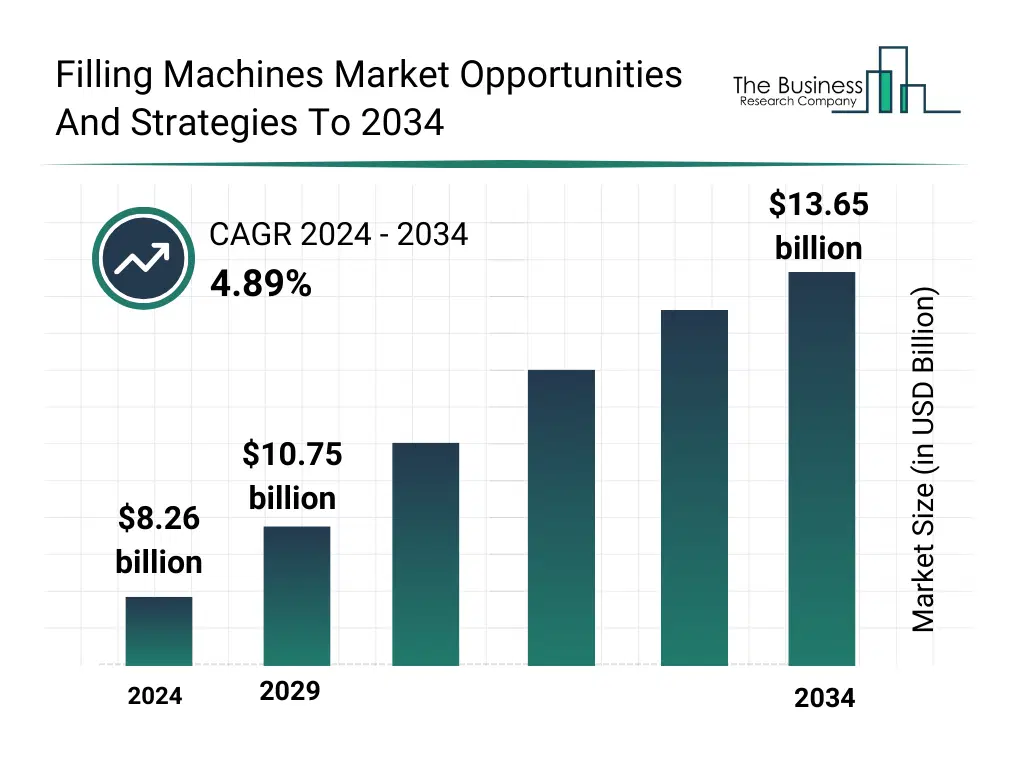
The global filling machines market reached a value of nearly $8,263.37 million in 2024, having grown at a compound annual growth rate (CAGR) of 4.23% since 2019. The market is expected to grow from $8,263.37 million in 2024 to $10,751.94 million in 2029 at a rate of 5.41%. The market is then expected to grow at a CAGR of 4.89% from 2029 and reach $13,652.18 million in 2034. Growth in the historic period resulted from growth of the pharmaceutical industry, rising demand for fast food and packaged food, growing adoption of eco-friendly and sustainable packaging solutions and labor shortages and cost pressures in manufacturing. Factors that negatively affected growth in the historic period were the fluctuating raw material prices and stringent regulatory compliance requirements. Going forward, growth in the food and beverage processing industry, growth in industrial automation, expansion of the cosmetics and personal care sector and rising e-commerce and online food delivery will drive growth. Factors that could hinder the growth of the filling machines market in the future include high initial investment and maintenance costs complex installation and integration and impact of trade war and tariff.Filling Machines Market Drivers
The key drivers of the filling machines market include: Growth In The Food And Beverage Processing Industry Growth in the food and beverage processing industry is expected to be a key driver of the growth of the filling machines market in the forecast period. As global food consumption patterns evolve and the demand for packaged, processed and ready-to-eat products continues to expand, manufacturers will require advanced filling equipment to maintain efficiency, hygiene and consistency in production. The food and beverage sector’s increasing focus on automation, quality control and innovation in packaging formats will directly boost the demand for versatile and high-speed filling systems. Furthermore, as companies strive to meet stricter safety and quality regulations while maintaining production scalability, filling machines with capabilities such as clean-in-place systems, aseptic filling and minimal product waste will become indispensable. The growth in the food and beverage processing industry growth contribution during the forecast period in 2024 is 1.50%.Filling Machines Market Restraints
The key restraints on the filling machines market include: High Initial Investment And Maintenance Costs High initial investment and maintenance costs are restricting the growth of the filling machines market during the forecast period. The advanced technology, precision engineering and automation features required for modern filling machines make them capital-intensive assets. For small and medium-sized manufacturers, the high upfront cost of acquiring these systems can be a major financial burden, often leading to delays in technology adoption or reliance on older, less efficient equipment. Additionally, the need for regular maintenance, calibration and occasional replacement of parts adds to the long-term operational expenses. These costs can impact overall profitability, particularly in highly competitive industries with thin margins. Consequently, the high cost barrier can slow market expansion by limiting accessibility to advanced filling solutions, especially in emerging economies or among small-scale producers. Growth affected by high initial investment and maintenance costs during the forecast period in 2024 is -1.75%.Filling Machines Market Trends
Major trends shaping the filling machines market include: Focus On Sustainable And Eco-Friendly Packaging Solutions To Reduce Environmental Impact Companies operating in the filling machines are increasingly emphasizing sustainable and eco-friendly packaging solutions to align with consumers’ environmental expectations, regulatory mandates and cost pressures. These innovations focus on enabling packaging formats that use less material, are easier to recycle or reuse and integrate with filling machines that support these formats without compromising throughput or accuracy. For instance, in November 2024, SIG Group, a Switzerland-based multinational corporation and a leading manufacturer in the packaging industry, announced the global launch of its “SIG Neo Slimline 15 Aseptic” machine, which not only boosts output by 25% but is designed to support the company’s “SIG Terra” suite of lower-carbon aseptic carton packaging materials. The machine realizes a waste rate of less than 0.5% and up to 15% reduced total filling costs, reflecting both operational and sustainability benefits. Integration Of IoT And Automation Technologies To Enhance Operational Efficiency Major companies in the filling machines market are increasingly embedding IoT (internet of things) connectivity, real-time analytics and automation into their equipment to raise throughput, reduce downtime and optimize operations. With the shift from traditional standalone machines to smart, networked systems, filling-line operators gain access to remote monitoring, predictive maintenance and data-driven process control, all of which help accelerate production and preserve margin. For instance, in March 2024, KHS Group, a Germany-based leading global manufacturer of filling and packaging systems, introduced its “ConnectApp Guide” portfolio as part of its new digital services. The application supports maintenance and servicing for filling lines via an edge device that links machines to the cloud, provides dashboards showing machine state and performance indicators and paves the way for future IIoT (Industrial Internet of Things) applications.Opportunities And Recommendations In The Filling Machines Market
Opportunities – The top opportunities in the filling machines market segmented by type will arise in the rotary fillers segment, which will gain $ 715.77 million of global annual sales by 2029. The top opportunities in the filling machines market segmented by process will arise in the semi-automatic segment, which will gain $1,026.73 million of global annual sales by 2029. The top opportunities in the filling machines market segmented by application will arise in the food and beverage segment, which will gain $1,484.37 million of global annual sales by 2029. The filling machines market size will gain the most in China at $608.95 million. Recommendations- To take advantage of the opportunities, The Business Research Company recommends the filling machine companies to focus on sustainable packaging alignment in filling machines, focus on high-speed flexible filling systems, focus on digital and connected filling solutions, focus on high-accuracy volumetric filling technologies, focus on advanced aseptic filling capabilities, focus on aseptic filling systems to capture high-value growth, focus on automatic filling systems to accelerate scalable growth, focus on pharmaceutical filling systems to capture high-growth demand, expand in emerging markets, continue to focus on developed markets, focus on value-based and disciplined pricing, focus promotion on decision makers and proven value, build promotion around lifecycle engagement and credibility, focus on people capabilities that build trust with food and beverage end users.Filling Machines Market Segmentation
The filling machines market is segmented by type, by process and by application.By Type –
The filling machines market is segmented by type into:
- a) Rotary Fillers
- b) Volumetric Fillers
- c) Aseptic Fillers
- d) Net Weight Fillers
- e) Other Types
By Process –
The filling machines market is segmented by process into:
- a) Manual
- b) Semi-Automatic
- c) Automatic
By Application –
The filling machines market is segmented by application into:
- a) Food And Beverage
- b) Pharmaceutical
- c) Cosmetic
- d) Household Appliances
- e) Other Applications
By Geography - The filling machines market is segmented by geography into:
- • China
- • India
- • Japan
- • Australia
- • Indonesia
- • South Korea
- • Bangladesh
- • Thailand
- • Vietnam
- • Malaysia
- • Singapore
- • Phillipines
- • Hong kong
- • New Zealand
- • USA
- • Canada
- • Mexico
- • Brazil
- • Argentina
- • Chile
- • Colombiia
- • Peru
- • France
- • Germany
- • UK
- • Italy
- • Spain
- • Austria
- • Belgium
- • Denmark
- • Finland
- • Ireland
- • Netherland
- • Norway
- • Portugal
- • Sweden
- • Switzerland
- • Russia
- • Czech Republic
- • Poland
- • Romania
- • Ukraine
- • Saudi Arabia
- • Israel
- • Iran
- • Turkey
- • UAE o Africa
- • Egypt
- • Nigeria
- • South Africa
-
o Asia Pacific