
Fine Inorganic Chemicals Market Report 2026
Global Outlook – By Type (High Purity Salts, Oxides, Catalysts, Specialty Compounds, Functional Materials), By Purity Level (Standard Purity, High Purity, Ultra High Purity, Electronic Grade Purity), By Form (Solid, Liquid), By Distribution Channel (Direct Sales, Distributors And Wholesalers, Online Sales Channels), By End Use Industry (Chemical Industry, Pharmaceutical Industry, Electronics Industry, Automotive Industry, Energy Industry, Agriculture Industry, Research Institutions, Aerospace And Defense Industry) – Market Size, Trends, Strategies, and Forecast to 2030
Fine Inorganic Chemicals Market Overview
• Fine Inorganic Chemicals market size has reached to $10.79 billion in 2025 • Expected to grow to $18.41 billion in 2030 at a compound annual growth rate (CAGR) of 11.2% • Growth Driver: Growing Pharmaceutical Manufacturing Fueling The Growth Of The Market Due To Growing Prevalence Of Chronic Diseases • Market Trend: Innovation In High-Purity Alumina Materials Enhancing Semiconductor Performance And Reliability • Asia-Pacific was the largest region and fastest growing region.What Is Covered Under Fine Inorganic Chemicals Market?
Fine inorganic chemicals refer to specialized inorganic substances manufactured with high levels of purity, precision, and controlled chemical properties for specific technical applications. They are produced through advanced chemical processes and are valued for their consistent quality, performance, and functional characteristics in various specialized applications. The main types of fine inorganic chemicals include high purity salts, oxides, catalysts, specialty compounds, and functional materials. High purity salts refer to inorganic compounds manufactured with controlled impurity levels for use in applications requiring precise chemical performance and consistency. These chemicals are available in standard purity, high purity, ultra high purity, and electronic grade purity levels and are supplied in solid and liquid forms. They are distributed through direct sales, distributors and wholesalers, and online sales channels, and are used across the end use industries such as chemical industry, pharmaceutical industry, electronics industry, automotive industry, energy industry, agriculture industry, research institutions, and aerospace and defense industry.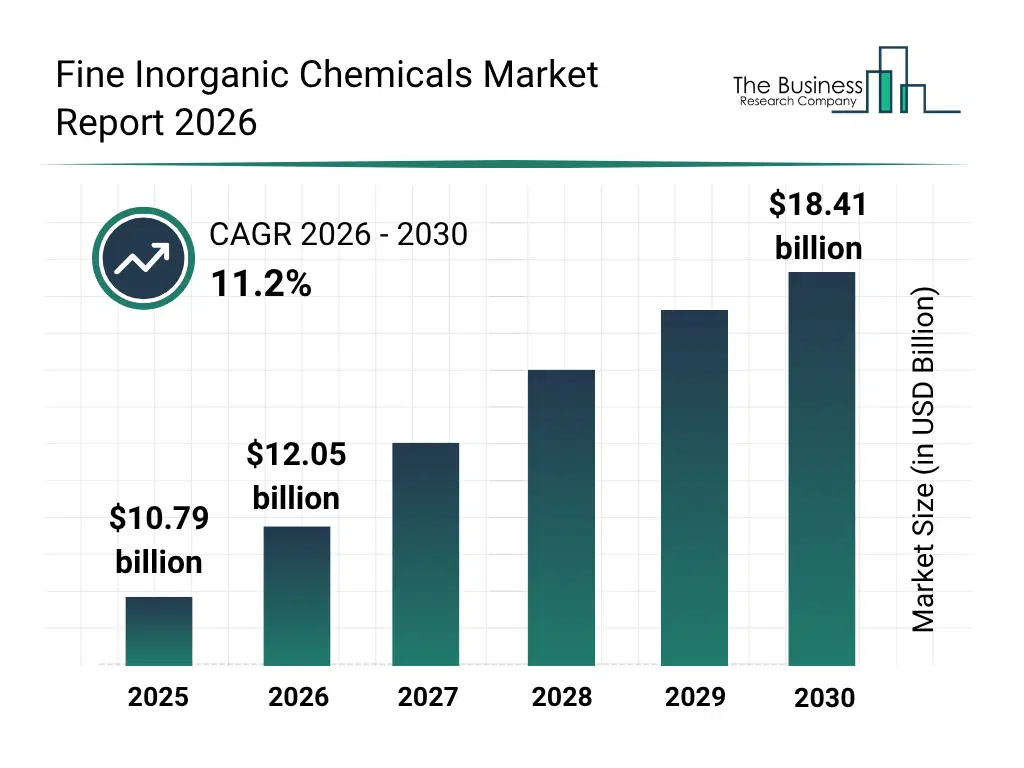
What Is The Fine Inorganic Chemicals Market Size and Share 2026?
The fine inorganic chemicals market size has grown rapidly in recent years. It will grow from $10.79 billion in 2025 to $12.05 billion in 2026 at a compound annual growth rate (CAGR) of 11.6%. The growth in the historic period can be attributed to increasing demand for specialty chemical products, rising requirement for high-purity materials, growing use of inorganic chemicals in specialized applications, increasing demand for consistent chemical performance, expanding production of application-specific chemical compounds.What Is The Fine Inorganic Chemicals Market Growth Forecast?
The fine inorganic chemicals market size is expected to see rapid growth in the next few years. It will grow to $18.41 billion in 2030 at a compound annual growth rate (CAGR) of 11.2%. The growth in the forecast period can be attributed to increasing demand for advanced functional inorganic materials, rising need for ultra-high-purity chemical compounds, growing demand from electronics and semiconductor applications, increasing requirement for specialized chemical formulations, expanding use of fine inorganic chemicals across high-performance industries. Major trends in the forecast period include increasing demand for high-purity inorganic chemicals, rising need for application-specific chemical formulations, growing demand for consistent chemical purity and quality, increasing adoption of specialized inorganic compounds, expanding use of precision inorganic chemicals in technical applications.
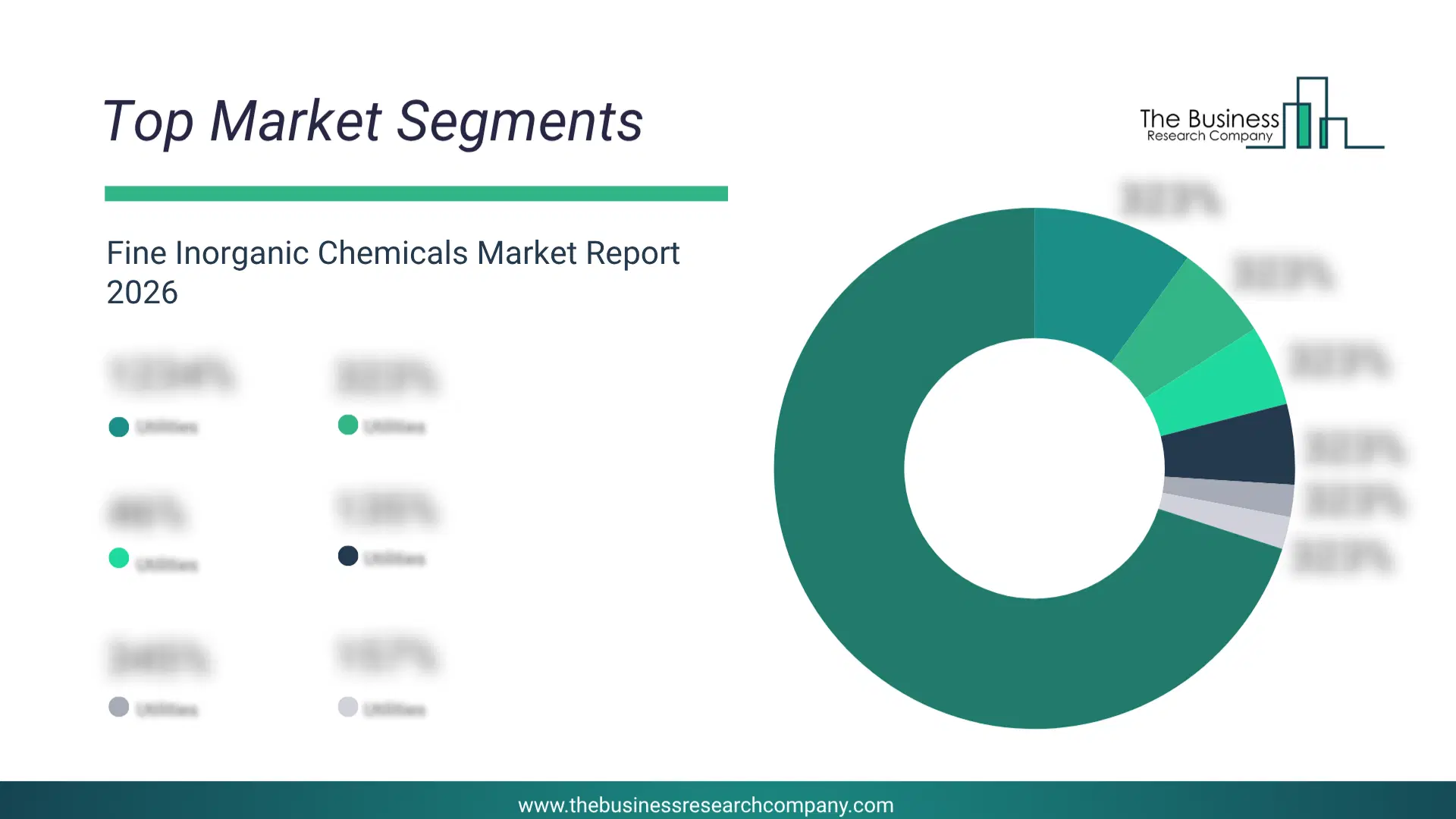
Global Fine Inorganic Chemicals Market Segmentation
1) By Type: High Purity Salts, Oxides, Catalysts, Specialty Compounds, Functional Materials 2) By Purity Level: Standard Purity, High Purity, Ultra High Purity, Electronic Grade Purity 3) By Form: Solid, Liquid 4) By Distribution Channel: Direct Sales, Distributors And Wholesalers, Online Sales Channels 5) By End Use Industry: Chemical Industry, Pharmaceutical Industry, Electronics Industry, Automotive Industry, Energy Industry, Agriculture Industry, Research Institutions, Aerospace And Defense Industry Subsegments: 1) By High Purity Salts: Metal Nitrates, Metal Sulfates, Metal Chlorides, Metal Carbonates 2) By Oxides: Metal Oxides, Rare Earth Oxides, Mixed Metal Oxides, Electronic Grade Oxides 3) By Catalysts: Precious Metal Catalysts, Base Metal Catalysts, Heterogeneous Catalysts, Homogeneous Catalysts 4) By Specialty Compounds: Inorganic Acids, Inorganic Bases, Organometallic Compounds, High Purity Reagents 5) By Functional Materials: Electronic Materials, Ceramic Materials, Battery Materials, Optical MaterialsWhat Is The Driver Of The Fine Inorganic Chemicals Market?
The growing pharmaceutical manufacturing is expected to propel the growth of the fine inorganic chemicals market going forward. A pharmaceutical is a medicinal drug or substance that is developed, manufactured, and used to prevent, diagnose, treat, or cure diseases and medical conditions. Pharmaceutical manufacturing is rising due to the growing prevalence of chronic diseases, which increases the demand for medicines, advanced therapies, and continuous drug production to support long-term disease management. Fine inorganic chemicals enable pharmaceutical manufacturing by providing high-purity raw materials, catalysts, reagents, and specialized compounds essential for drug synthesis, formulation, and quality control processes. For instance, in April 2025, according to Eurostat, a Luxembourg-based government agency, in 2024, EU exports of medicinal and pharmaceutical products increased by 13.5% compared with 2023, reaching $316.38 billion (€313.4 billion). Therefore, the growing pharmaceutical manufacturing is driving the growth of the fine inorganic chemicals industry.Key Players In The Global Fine Inorganic Chemicals Market
Major companies operating in the fine inorganic chemicals market are BASF SE, Linde plc, L'Air Liquide SA, Honeywell International Inc, Mitsubishi Chemical Group Corporation, Evonik Industries AG, Merck KGaA, Solvay SA, Albemarle Corporation, Arkema SA, Umicore SA, Johnson Matthey Plc, Avantor Inc, LANXESS AG, Tata Chemicals Limited, Tosoh Corporation, ADEKA Corporation, Topsoe A/S, Lynas Rare Earths Ltd, Neo Performance Materials Inc, Materion Corporation, Nippon Chemical Industrial Co Ltd, American Elements Corporation, Shepherd Chemical Company, GFS Chemicals Inc, Stanford Advanced Materials, Sisco Research Laboratories Pvt Ltd, Hummel Croton Inc, Central Drug House Ltd, Loba Chemie Pvt Ltd, Nanoshel LLC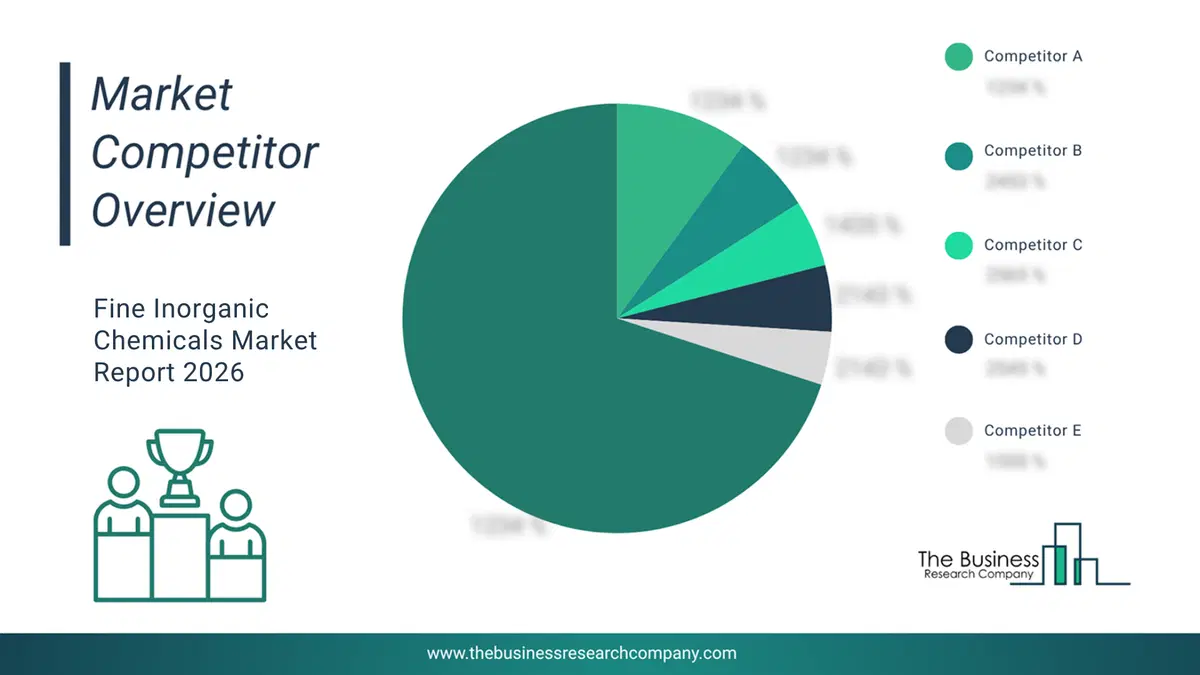
This chart is for illustrative purposes; the full report includes a detailed competitor analysis and comprehensive overview of the top 10 companies in the market.
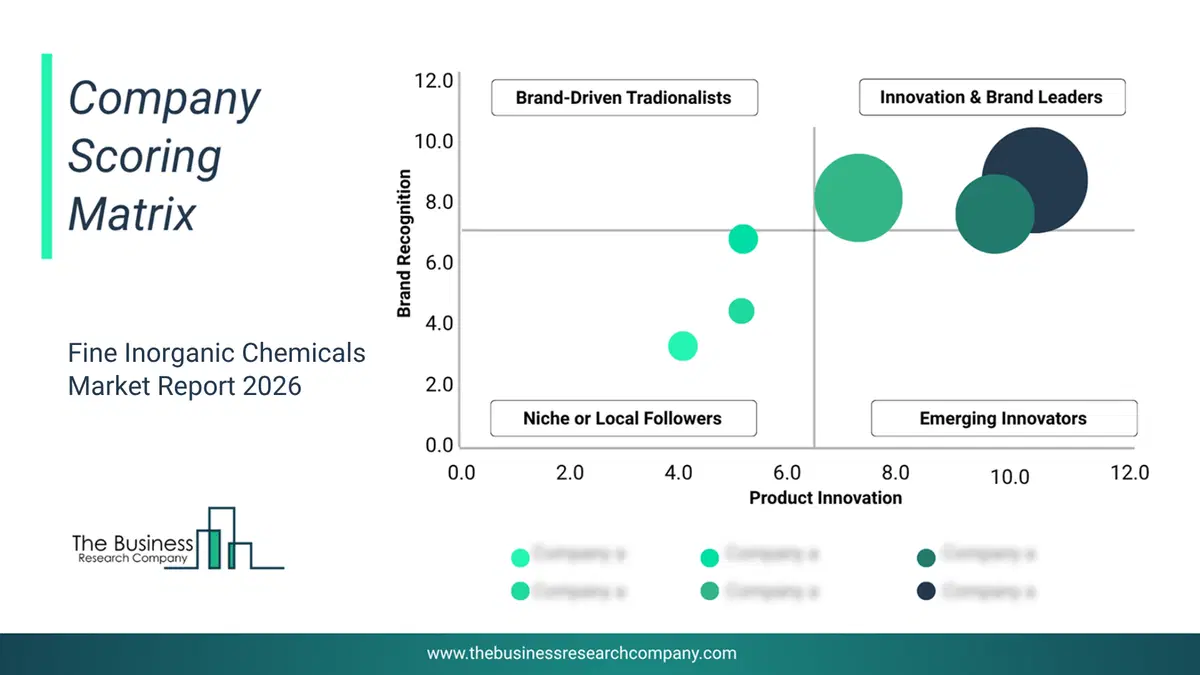
This chart maps companies by product innovation and brand strength, with bubble size indicating relative revenue, helping identify market leaders, challengers, and niche players. This is an illustrative chart; the full report provides a complete and accurate competitive analysis.
Global Fine Inorganic Chemicals Market Trends and Insights
Major companies operating in the fine inorganic chemicals market are focusing on developing innovative products, such as high-purity alumina materials, to enhance semiconductor performance, improve thermal management, and support advanced electronic applications. High-purity alumina materials are specialty inorganic compounds with extremely low impurity levels and controlled particle characteristics, designed to provide superior electrical insulation, thermal conductivity, and reliability compared to conventional alumina materials. For instance, in May 2026, Sumitomo Chemical Co Ltd., a Japan-based chemical company, launched the ELA series of low alpha radiation, high-purity fine spherical alumina products. The ELA series is designed to reduce alpha radiation that can cause malfunctions in highly integrated semiconductors while providing excellent heat dissipation properties. The products feature precisely controlled particle sizes within several micrometers or less and customizable surface properties to meet specific application requirements. Additionally, the materials are targeted for advanced semiconductor applications, including AI-related devices, where high reliability, thermal performance, and material consistency are essential.What Are Latest Mergers And Acquisitions In The Fine Inorganic Chemicals Market?
In November 2024, Vishnu Chemicals Limited, an India-based manufacturer of specialty and inorganic chemicals, acquired Jayansree Pharma Private Limited for $0.006 billion. Through this acquisition, Vishnu Chemicals Limited aims to expand its manufacturing footprint and strengthen its inorganic chemicals portfolio by commissioning the production of strontium carbonate, a key fine inorganic chemical used in electronics, ceramics, ferrite magnets, and specialty industrial applications. Jayansree Pharma Private Limited is an India-based company that manufactures fine inorganic chemicals and specialty inorganic chemicals.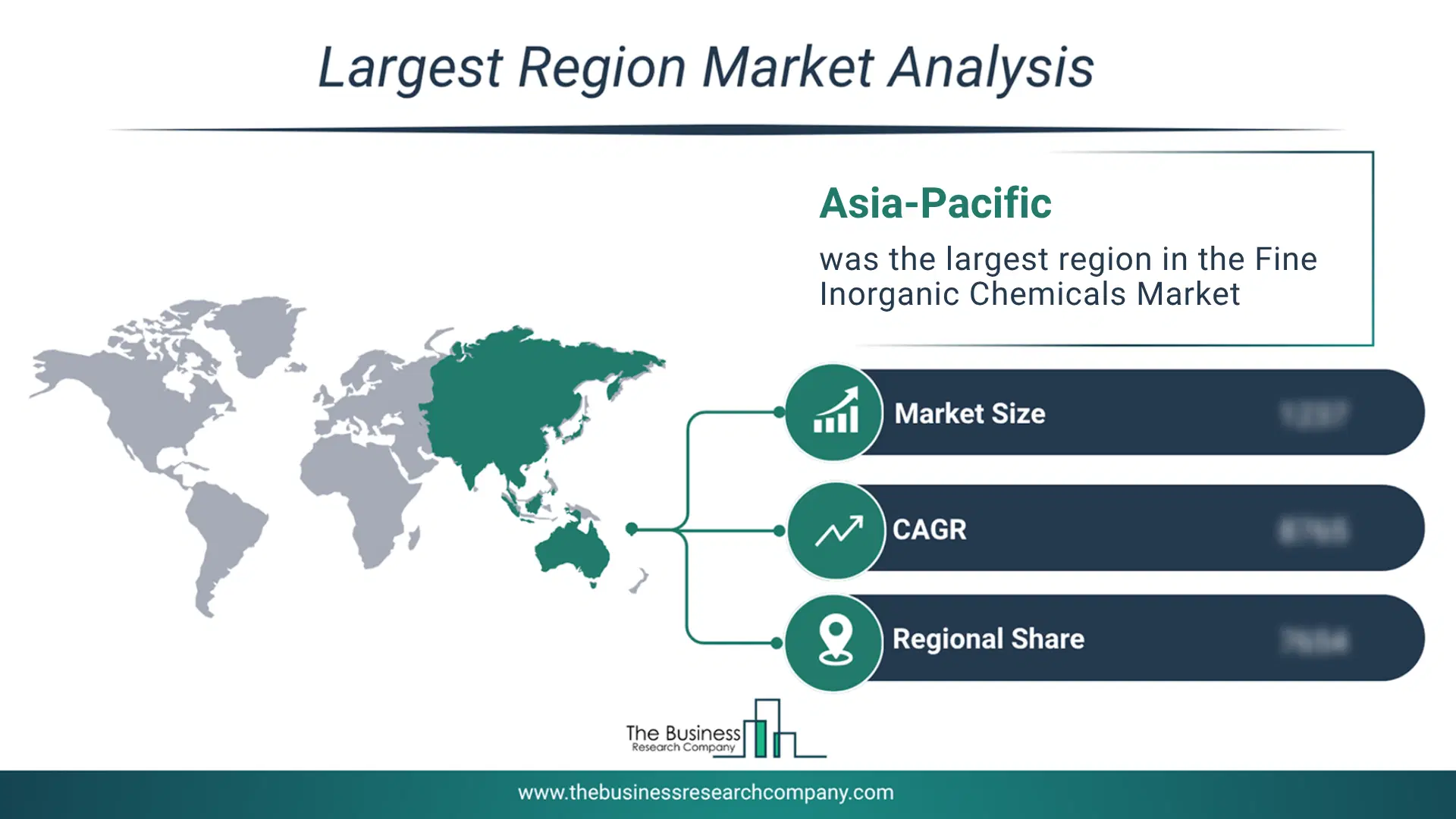
Regional Insights
Asia-Pacific was the largest region in the fine inorganic chemicals market in 2025. Asia-Pacific is expected to be the fastest-growing region in the forecast period. The regions covered in this market report are Asia-Pacific, South East Asia, Western Europe, Eastern Europe, North America, South America, Middle East, Africa. The countries covered in this market report are Australia, Brazil, China, France, Germany, India, Indonesia, Japan, Taiwan, Russia, South Korea, UK, USA, Canada, Italy, Spain.What Defines the Fine Inorganic Chemicals Market?
The fine inorganic chemicals market consists of sales of high-purity inorganic compounds, specialty inorganic intermediates, and custom-formulated inorganic chemicals. Values in this market are ‘factory gate’ values, that is, the value of goods sold by the manufacturers or creators of the goods, whether to other entities (including downstream manufacturers, wholesalers, distributors, and retailers) or directly to end customers. The value of goods in this market includes related services sold by the creators of the goods.How is Market Value Defined and Measured?
The market value is defined as the revenues that enterprises gain from the sale of goods and/or services within the specified market and geography through sales, grants, or donations in terms of the currency (in USD unless otherwise specified). The revenues for a specified geography are consumption values that are revenues generated by organizations in the specified geography within the market, irrespective of where they are produced. It does not include revenues from resales along the supply chain, either further along the supply chain or as part of other products.
This chart presents market attractiveness based on a quantitative evaluation of growth, competition, strategic alignment, and risk, offering a clear view of opportunity areas for decision-making. This chart is for illustrative purposes; the full report contains the complete analysis.

This chart highlights the Total Addressable Market (TAM) by estimating the maximum revenue opportunity using an assumption-driven approach, supporting strategic planning and opportunity sizing across markets. The chart is illustrative; the full report provides a more comprehensive analysis.
What Key Data and Analysis Are Included in the Fine Inorganic Chemicals Market Report 2026?
The fine inorganic chemicals market research report is one of a series of new reports from The Business Research Company that provides market statistics, including industry global market size, regional shares, competitors with the market share, detailed market segments, market trends and opportunities, and any further data you may need to thrive in the fine inorganic chemicals industry. The market research report delivers a complete perspective of everything you need, with an in-depth analysis of the current and future state of the industry.Fine Inorganic Chemicals Market Report Forecast Analysis
| Report Attribute | Details |
|---|---|
| Market Size Value In 2026 | $12.05 billion |
| Revenue Forecast In 2030 | $18.41 billion |
| Growth Rate | CAGR of 11.2% from 2026 to 2030 |
| Base Year For Estimation | 2025 |
| Actual Estimates/Historical Data | 2020-2025 |
| Forecast Period | 2026 - 2030 |
| Market Representation | Revenue in USD Billion and CAGR from 2026 to 2030 |
| Segments Covered | Type, Purity Level, Form, Distribution Channel, End Use Industry |
| Regional Scope | Asia-Pacific, Western Europe, Eastern Europe, North America, South America, Middle East, Africa |
| Country Scope | The countries covered in the report are Australia, Brazil, China, France, Germany, India, Indonesia, Japan, Taiwan, Russia, South Korea, UK, USA, Canada, Italy, Spain. |
| Key Companies Profiled | BASF SE, Linde plc, L'Air Liquide SA, Honeywell International Inc, Mitsubishi Chemical Group Corporation, Evonik Industries AG, Merck KGaA, Solvay SA, Albemarle Corporation, Arkema SA, Umicore SA, Johnson Matthey Plc, Avantor Inc, LANXESS AG, Tata Chemicals Limited, Tosoh Corporation, ADEKA Corporation, Topsoe A/S, Lynas Rare Earths Ltd, Neo Performance Materials Inc, Materion Corporation, Nippon Chemical Industrial Co Ltd, American Elements Corporation, Shepherd Chemical Company, GFS Chemicals Inc, Stanford Advanced Materials, Sisco Research Laboratories Pvt Ltd, Hummel Croton Inc, Central Drug House Ltd, Loba Chemie Pvt Ltd, Nanoshel LLC |
| Customization Scope | Request for Customization |
| Pricing And Purchase Options | Explore Purchase Options |