
Fire-Resistant Lubricants Market Report 2026
Global Outlook – By Type (High Water Content Fluid, Type A, High Water Content Fluid, Type B, Synthetic Anhydrous Fluid, Type U, High-Flashpoint Diester (HFDR)), By Additive Technology (Tricresyl Phosphate (TCP), Polyphenyl Ethers), By Application (Hydraulic Systems, Gearboxes, Chains And Cables, Compressors, Die Casting Machines), By Distribution Channel (Specialty Stores, Other Distribution Channels), By End User Industry (Aerospace, Marine, Manufacturing And Heavy Industry, Mining, Oil And Gas, Power Generation) – Market Size, Trends, Strategies, and Forecast to 2030
Fire-Resistant Lubricants Market Overview
• Fire-Resistant Lubricants market size has reached to $2.81 billion in 2025 • Expected to grow to $3.65 billion in 2030 at a compound annual growth rate (CAGR) of 5.3% • Growth Driver: Expansion Of Industrial Activities Fueling The Growth Of The Market Due To Increasing Infrastructure Investments And Manufacturing Output • Market Trend: Innovative Lubricant Technologies Reduce Fire Risks In High-Temperature Operations • North America was the largest region in 2025 and Asia-Pacific is the fastest growing region.What Is Covered Under Fire-Resistant Lubricants Market?
Fire-resistant lubricants are specially formulated oils and greases designed to resist ignition and combustion under high-temperature or high-pressure conditions. They are primarily used in environments where there is a risk of fire, such as steel mills, mining, and aviation. These lubricants help maintain equipment performance while enhancing safety by reducing the potential for fire-related accidents. The main types of fire-resistant lubricants are high water content fluid, type A, high water content fluid, type B, synthetic anhydrous fluid, type U, high-flashpoint chlorinated, and high-flashpoint diester. High water content fluid, type A, refers to a fire-resistant hydraulic fluid that contains more than 95% water and is typically used in applications where fire hazards are high and environmental compatibility is required. Common additive technologies used for these lubricants include chlorinated paraffins, tricresyl phosphate (TCP), polyphenyl ethers, and ammonium polyphosphate. These are used in various applications, including hydraulic systems, gearboxes, chains and cables, compressors, centrifuges, and die casting machines and are distributed through online stores, specialty stores, and other channels, serving various end users, including aerospace, automotive, marine, manufacturing and heavy industry, mining, oil and gas, and power generation.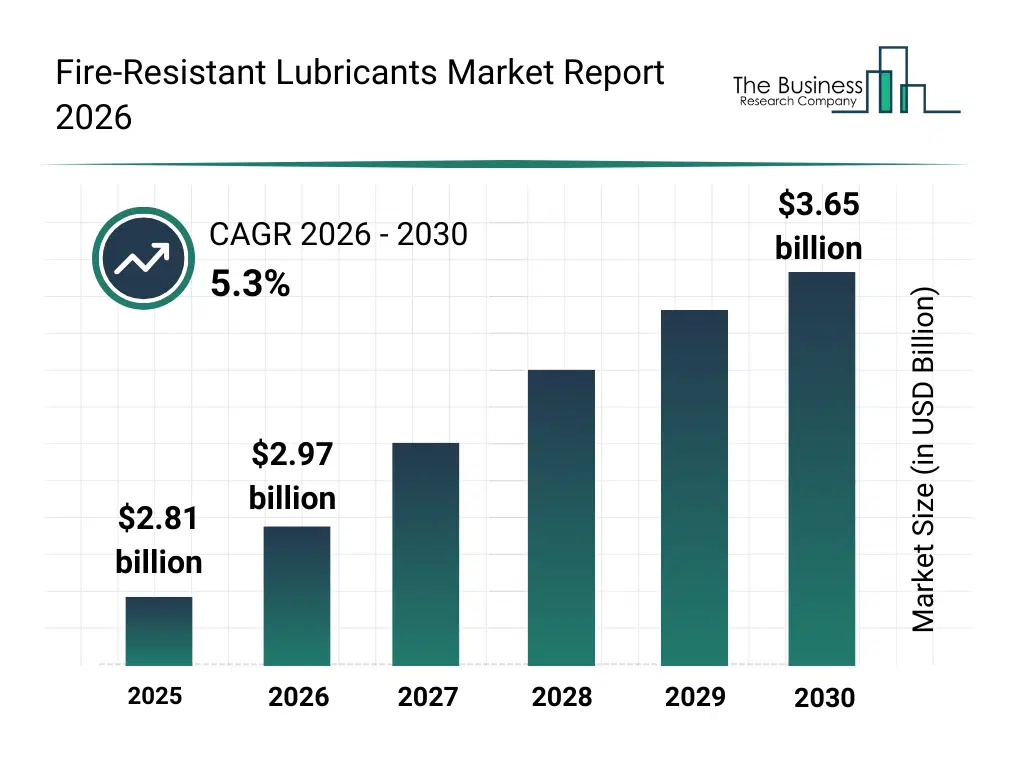
What Is The Fire-Resistant Lubricants Market Size and Share 2026?
The fire-resistant lubricants market size has grown strongly in recent years. It will grow from $2.81 billion in 2025 to $2.97 billion in 2026 at a compound annual growth rate (CAGR) of 5.6%. The growth in the historic period can be attributed to industrial safety regulations, expansion of heavy industries, demand for hydraulic lubricants, mining sector growth, use in steel mills.What Is The Fire-Resistant Lubricants Market Growth Forecast?
The fire-resistant lubricants market size is expected to see strong growth in the next few years. It will grow to $3.65 billion in 2030 at a compound annual growth rate (CAGR) of 5.3%. The growth in the forecast period can be attributed to stricter fire safety norms, growth in automated manufacturing, expansion of aerospace operations, demand for high performance lubricants, investment in industrial safety systems. Major trends in the forecast period include rising demand from high risk industrial environments, growing use in steel and mining operations, expansion of high temperature hydraulic systems, increasing focus on workplace fire safety, adoption in aerospace and defense equipment.
Global Fire-Resistant Lubricants Market Segmentation
1) By Type: High Water Content Fluid, Type A, High Water Content Fluid, Type B, Synthetic Anhydrous Fluid, Type U, High-Flashpoint Diester (HFDR) 2) By Additive Technology: Tricresyl Phosphate (TCP), Polyphenyl Ethers 3) By Application: Hydraulic Systems, Gearboxes, Chains And Cables, Compressors, Die Casting Machines 4) By Distribution Channel: Specialty Stores, Other Distribution Channels 5) By End User Industry: Aerospace, Marine, Manufacturing And Heavy Industry, Mining, Oil And Gas, Power Generation Subsegments: 1) By High Water Content Fluid: Steel Mill Equipment, Die Casting Machinery, Continuous Casting Lines, Foundry Applications 2) By High Water Content Fluid, Type B: Underground Mining Equipment, Hydraulic Systems In Confined Spaces, Presses And Forging Machines 3) By Synthetic Anhydrous Fluid, Type U: High-Temperature Hydraulic Systems, Offshore Drilling Rigs, Military And Defense Applications, Nuclear Power Plants 4) By High-Flashpoint Diester (HFDR): Aerospace Ground Support Equipment, Metal Processing Equipment, High-Speed Hydraulic Systems, Turbine Control SystemsWhat Is The Driver Of The Fire-Resistant Lubricants Market?
The expansion of industrial activities is expected to propel the growth of the fire-resistant lubricants market going forward. Industrial activities refer to the processes involved in the production, manufacturing, and processing of goods within facilities to convert raw materials into finished goods. The expanding industrial activities are due to increasing infrastructure investments by governments and private sectors, as they enable the development and modernization of manufacturing facilities to support economic growth. Fire-resistant lubricants enhance industrial activities by improving equipment safety and reliability in high-temperature environments. They reduce fire hazards while ensuring consistent performance under pressure, supporting both operational efficiency and workplace safety. For instance, in September 2024, according to the Office for National Statistics, a UK-based government department, the total value of UK manufacturers' product sales reached approximately $574.6 billion (£456.1 billion) in 2023, marking an increase of around $21.7 billion (£17.2 billion), or 3.9%, from $553.2 billion (£438.9 billion) in 2022. Therefore, the expansion of industrial activities is driving the growth of the fire-resistant lubricants industry.Key Players In The Global Fire-Resistant Lubricants Market
Major companies operating in the fire-resistant lubricants market are China Petroleum & Chemical Corporation, Exxon Mobil Corporation, Shell plc, TotalEnergies SE, BP p.l.c., Chevron Corporation, Indian Oil Corporation Limited, BASF SE, Idemitsu Kosan Co., Ltd., LUKOIL Lubricants Company, Solvay S.A., Eastman Chemical Company, LANXESS AG, FUCHS SE, Klüber Lubrication München SE & Co. KG, Gulf Oil International Limited, MORESCO Corporation, Condat S.A., Bel-Ray Company, LLC, Verkol S.A., PETROFER Chemie H. R. Fischer GmbH + Co. KG
This chart is for illustrative purposes; the full report includes a detailed competitor analysis and comprehensive overview of the top 10 companies in the market.
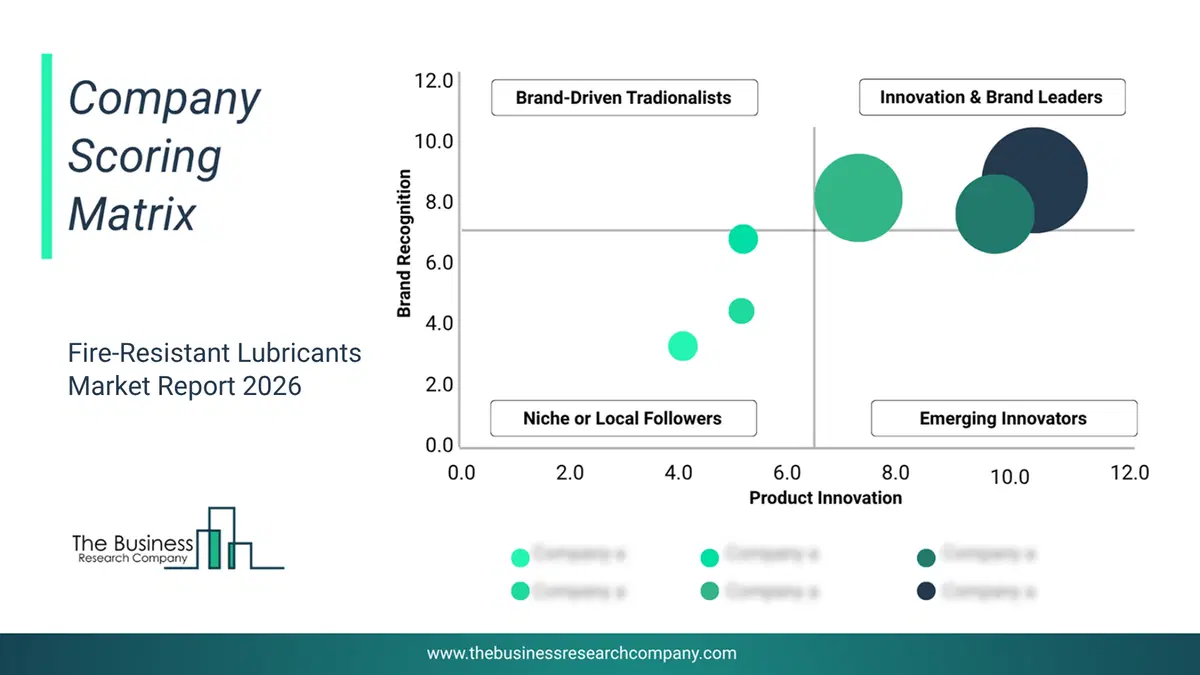
This chart maps companies by product innovation and brand strength, with bubble size indicating relative revenue, helping identify market leaders, challengers, and niche players. This is an illustrative chart; the full report provides a complete and accurate competitive analysis.
Global Fire-Resistant Lubricants Market Trends and Insights
Major companies operating in the fire-resistant lubricants market are focusing on enhancing industrial safety, such as high ignition resistance and self-extinguishing behavior, to minimize fire hazards in high-temperature and fire-prone industrial environments while maintaining reliable lubrication performance and protecting equipment longevity. High ignition resistance and self-extinguishing behavior help the fire-resistant lubricants by reducing the risk of fires in high-temperature industrial settings, ensuring safer operations, protecting equipment, and enabling wider adoption in industries with strict safety standards. For instance, in October 2024, Q8Oils, a Belgium-based industrial lubricant company, launched Q8 Estin S, an ester-based, fire-resistant hydraulic fluid (HFD-U) tailored for demanding applications such as steel mills, rolling mills, and continuous casting plants. The product features high ignition resistance and self-extinguishing behavior to minimize fire hazards, superior oxidation and thermal stability for long fluid life, and strong anti-wear protection to enhance equipment longevity in heavy-duty, high-temperature operations.What Are Latest Mergers And Acquisitions In The Fire-Resistant Lubricants Market?
In March 2024, Kodiak LLC, a US-based chemical company, acquired Aztech Lubricants LLC for an undisclosed amount. With this acquisition, Kodiak LLC aims to expand its geographical footprint and manufacturing capabilities, enhance its product portfolio with powdered chemicals, and optimize delivery timelines as part of its broader growth strategy. Aztech Lubricants LLC is a US-based specialty chemical manufacturer that produces fire-resistant hydraulic lubricants.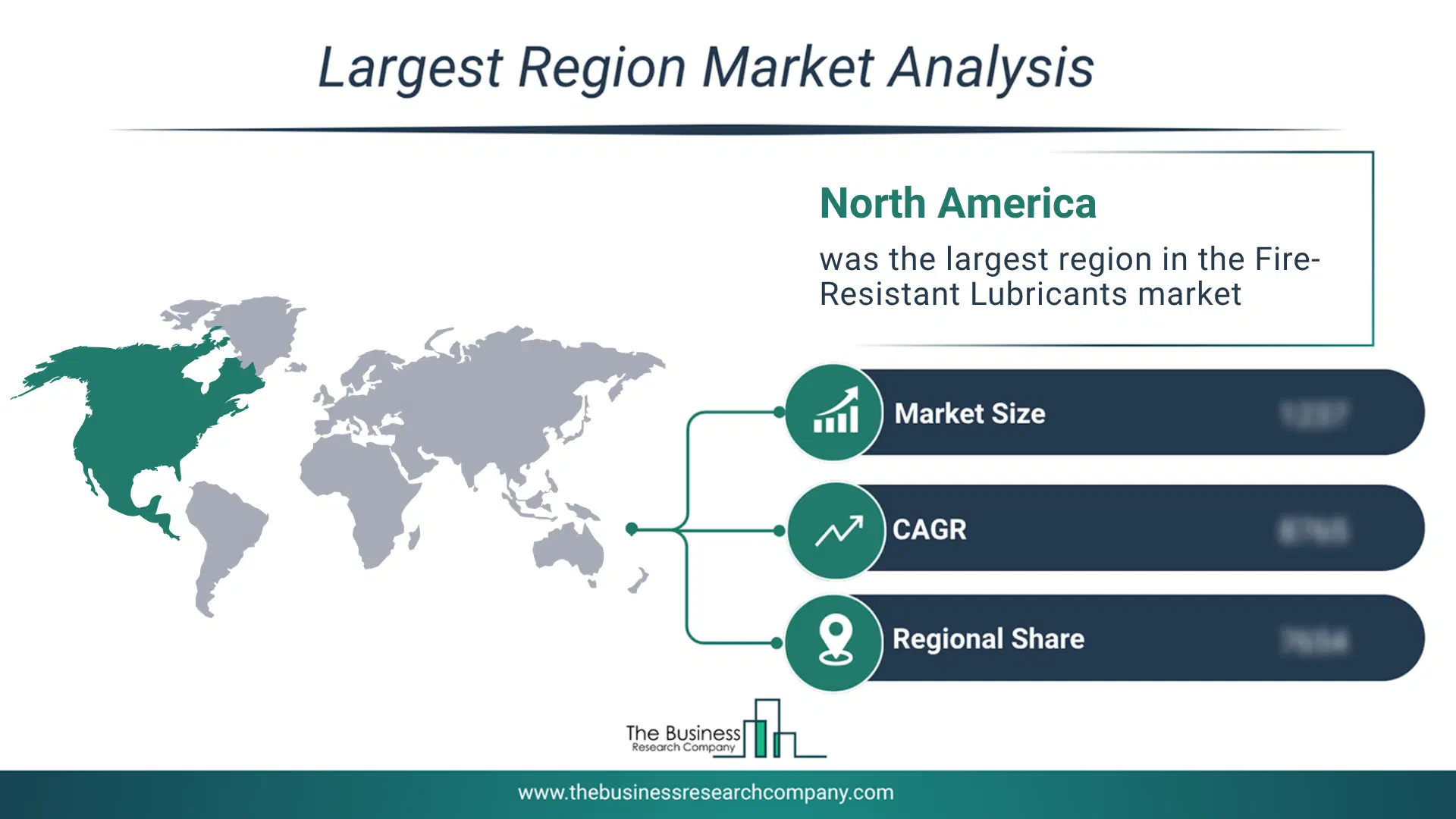
Regional Insights
North America was the largest region in the fire-resistant lubricants market in 2025. Asia-Pacific is expected to be the fastest-growing region in the forecast period. The regions covered in this market report are Asia-Pacific, South East Asia, Western Europe, Eastern Europe, North America, South America, Middle East, Africa The countries covered in this market report are Australia, Brazil, China, France, Germany, India, Indonesia, Japan, Taiwan, Russia, South Korea, UK, USA, Canada, Italy, SpainWhat Defines the Fire-Resistant Lubricants Market?
The fire-resistant lubricants market consists of sales of phosphate ester-based fluid, water-glycol fluids, polyol ester-based fluid, polyol ester-based fluids, and silicone-based lubricants. Values in this market are ‘factory gate’ values, that is, the value of goods sold by the manufacturers or creators of the goods, whether to other entities (including downstream manufacturers, wholesalers, distributors, and retailers) or directly to end customers. The value of goods in this market includes related services sold by the creators of the goods.How is Market Value Defined and Measured?
The market value is defined as the revenues that enterprises gain from the sale of goods and/or services within the specified market and geography through sales, grants, or donations in terms of the currency (in USD unless otherwise specified). The revenues for a specified geography are consumption values that are revenues generated by organizations in the specified geography within the market, irrespective of where they are produced. It does not include revenues from resales along the supply chain, either further along the supply chain or as part of other products.
This chart presents market attractiveness based on a quantitative evaluation of growth, competition, strategic alignment, and risk, offering a clear view of opportunity areas for decision-making. This chart is for illustrative purposes; the full report contains the complete analysis.

This chart highlights the Total Addressable Market (TAM) by estimating the maximum revenue opportunity using an assumption-driven approach, supporting strategic planning and opportunity sizing across markets. The chart is illustrative; the full report provides a more comprehensive analysis.
What Key Data and Analysis Are Included in the Fire-Resistant Lubricants Market Report 2026?
The fire-resistant lubricants market research report is one of a series of new reports from The Business Research Company that provides market statistics, including industry global market size, regional shares, competitors with the market share, detailed market segments, market trends and opportunities, and any further data you may need to thrive in the fire-resistant lubricants industry. The market research report delivers a complete perspective of everything you need, with an in-depth analysis of the current and future state of the industry.Fire Resistant Lubricants Market Report Forecast Analysis
| Report Attribute | Details |
|---|---|
| Market Size Value In 2026 | $2.97 billion |
| Revenue Forecast In 2030 | $3.65 billion |
| Growth Rate | CAGR of 5.6% from 2026 to 2030 |
| Base Year For Estimation | 2025 |
| Actual Estimates/Historical Data | 2020-2025 |
| Forecast Period | 2026 - 2030 |
| Market Representation | Revenue in USD Billion and CAGR from 2026 to 2030 |
| Segments Covered | Type, Additive Technology, Application, Distribution Channel, End User Industry |
| Regional Scope | Asia-Pacific, Western Europe, Eastern Europe, North America, South America, Middle East, Africa |
| Country Scope | The countries covered in this market report are Australia, Brazil, China, France, Germany, India, Indonesia, Japan, Taiwan, Russia, South Korea, UK, USA, Canada, Italy, Spain |
| Key Companies Profiled | China Petroleum & Chemical Corporation, Exxon Mobil Corporation, Shell plc, TotalEnergies SE, BP p.l.c., Chevron Corporation, Indian Oil Corporation Limited, BASF SE, Idemitsu Kosan Co., Ltd., LUKOIL Lubricants Company, Solvay S.A., Eastman Chemical Company, LANXESS AG, FUCHS SE, Klüber Lubrication München SE & Co. KG, Gulf Oil International Limited, MORESCO Corporation, Condat S.A., Bel-Ray Company, LLC, Verkol S.A., PETROFER Chemie H. R. Fischer GmbH + Co. KG |
| Customization Scope | Request for Customization |
| Pricing And Purchase Options | Explore Purchase Options |