
First and Last Mile Delivery Market Report 2026
Global Outlook – By Type (Dry Goods; Postal; Liquid Goods), By Vehicle Type (Light Duty Vehicle; Medium Duty Vehicle; Heavy Duty Vehicle), By End Use (Chemical; Pharmaceutical And Healthcare; Fast-Moving Consumer Goods; Hi Tech Product; Food And Beverage; Other End Uses) – Market Size, Trends, Strategies, and Forecast to 2030
First and Last Mile Delivery Market Overview
• First and Last Mile Delivery market size has reached to $238.99 billion in 2025 • Expected to grow to $383.27 billion in 2030 at a compound annual growth rate (CAGR) of 9.8% • Growth Driver: Surging E-Commerce Propels The First-And Last-Mile Delivery Market • Market Trend: Major Firms Adopt Zero-Emissions Delivery To Enhance Sustainable Transportation Solutions • Asia-Pacific was the largest region in 2025.Market Gains By 2030 – Top Opportunities By Segment
Market Gain identifies the most promising market opportunities by highlighting the segments or products expected to generate the highest incremental revenue growth over the next five years.
What Is Covered Under First and Last Mile Delivery Market?
First-and last-mile delivery refers to the transportation of completed goods from the factory to a distribution center and an end customer. It is the supply chain that signifies the beginning and end of the fulfillment process. They are used for the transportation of goods. The main types of first and last-mile delivery are dry goods, postal and liquid goods. Dry goods refer to grocery items that do not contain liquid. The various vehicle types involved are light-duty vehicles, medium-duty vehicles and heavy-duty vehicles which are used for chemical, pharmaceutical and healthcare, fast-moving consumer goods, hi-tech products, food and beverage and others.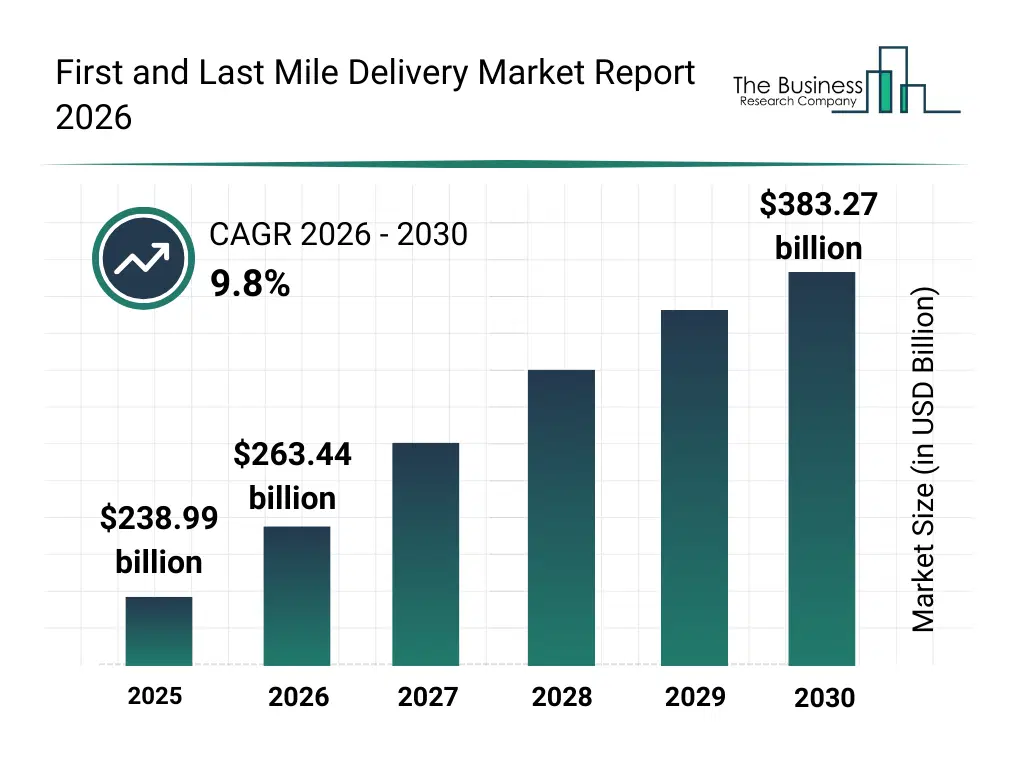
What Is The First and Last Mile Delivery Market Size and Share 2026?
The first and last mile delivery market size has grown rapidly in recent years. It will grow from $238.99 billion in 2025 to $263.44 billion in 2026 at a compound annual growth rate (CAGR) of 10.2%. The growth in the historic period can be attributed to expansion of e-commerce platforms, growth in urbanization, increasing consumer demand for fast delivery, development of local distribution hubs, availability of last-mile delivery fleets.What Is The First and Last Mile Delivery Market Growth Forecast?
The first and last mile delivery market size is expected to see strong growth in the next few years. It will grow to $383.27 billion in 2030 at a compound annual growth rate (CAGR) of 9.8%. The growth in the forecast period can be attributed to increasing investments in autonomous delivery solutions, rising adoption of sustainable delivery models, expansion of smart city logistics infrastructure, growing integration of real-time tracking systems, increasing focus on delivery efficiency optimization. Major trends in the forecast period include increasing adoption of ai-driven route optimization, rising use of electric delivery vehicles, growing demand for same-day and rapid delivery, expansion of micro-fulfillment centers, enhanced focus on delivery cost optimization.
Global First and Last Mile Delivery Market Segmentation
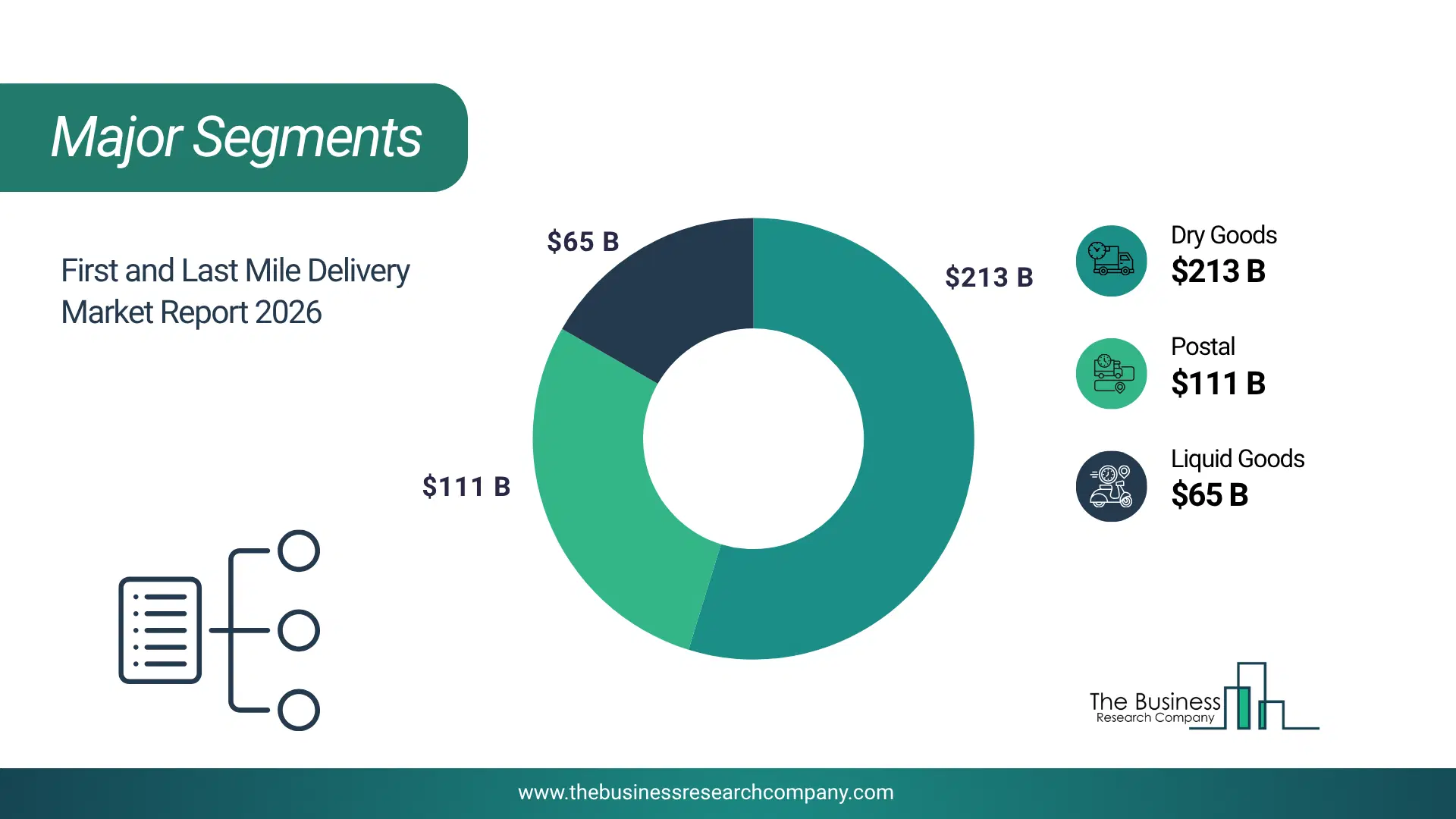
1) By Type: Dry Goods, Postal, Liquid Goods 2) By Vehicle Type: Light Duty Vehicle, Medium Duty Vehicle, Heavy Duty Vehicle 3) By End Use: Chemical, Pharmaceutical And Healthcare, Fast-Moving Consumer Goods, Hi Tech Product, Food And Beverage, Other End Uses Subsegments: 1) By Dry Goods: Consumer Electronics, Apparel And Footwear, Home Goods And Furniture 2) By Postal: Letters And Documents, Small Packages, Bulk Mailing Services 3) By Liquid Goods: Beverages, Chemicals, Food Products The top segments in the first and last mile delivery market will be: • Dry Goods will reach $212.68 Billion by 2030. • Postal will reach $110.53 Billion by 2030. • Liquid Goods will reach $64.77 Billion by 2030.What Is The Driver Of The First and Last Mile Delivery Market?
Rising e-commerce is expected to propel the first-and last-mile delivery markets going forward. E-commerce refers to the buying and selling of goods and services, over an electronic network, most commonly the internet. The first-and last-mile delivery service is a conduit between the supplier and the end customer, where it helps both party during a transaction. The rise in e-commerce will drive the first-and last-mile delivery market growth. For instance, in November 2023, according to reports published by the United States Census Bureau, a US-based government agency, in the third quarter of 2023, U.S. retail e-commerce sales amounted to $284.1 billion, representing a 7.6% increase from the same period in 2022 and accounting for 15.6% of total sales. Therefore, the rising e-commerce is driving the first and last-mile delivery market.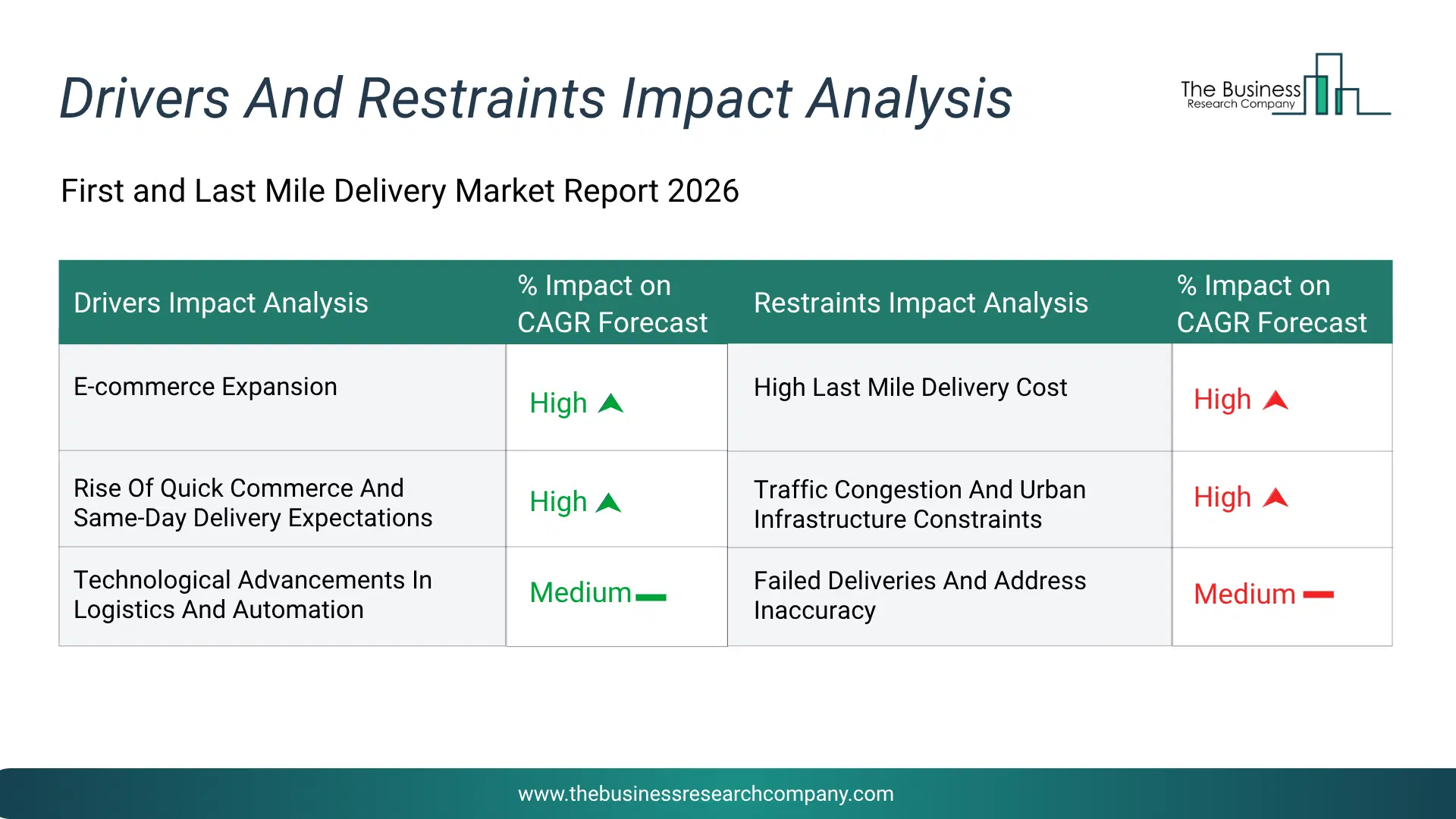
Infographic Chart Showing Key Market Drivers Analysis And Restraints For First And Last Mile Delivery Market
The chart presents an impact analysis of key drivers and restraints, quantifying their relative influence on the market's growth rate and helping assess the balance between growth enablers and limiting factors. This chart offers a high-level perspective; the full report contains more detailed insights.
How Will The Drivers Impact Growth In The Global First and Last Mile Delivery Market?
• E-commerce Expansion (High) – During the forecast period, the continued expansion of e-commerce is expected to become a major growth driver for the first and last mile delivery market by 2030. Increasing online shopping penetration across both developed and emerging economies is generating substantial parcel volumes that require efficient delivery networks. Retailers are expanding direct-to-consumer sales channels and enhancing fulfillment capabilities to meet evolving purchasing behaviors. The growing availability of digital payment systems and mobile commerce platforms is further supporting online retail activity. As e-commerce ecosystems continue to mature globally, demand for reliable first and last mile delivery services is expected to strengthen significantly. • Rise Of Quick Commerce And Same-Day Delivery Expectations (High) – During the forecast period, the rise of quick commerce and same-day delivery expectations is expected to emerge as a key factor driving the expansion of the first and last mile delivery market by 2030. Consumers increasingly prefer rapid order fulfillment for groceries, consumer goods, and essential products, encouraging logistics providers to optimize delivery operations. Businesses are establishing localized distribution centers and dark stores to reduce delivery times and improve service responsiveness. Competitive pressure among retailers is also accelerating investments in faster delivery models and expanded service coverage. • Technological Advancements In Logistics And Automation (Medium) – During the forecast period, the technological advancements in logistics and automation are expected to act as a significant growth catalyst for the first and last mile delivery market by 2030. Delivery operators are increasingly deploying artificial intelligence, route optimization software, automated sorting systems, and real-time tracking technologies to improve operational efficiency. These innovations help reduce transportation costs, enhance delivery accuracy, and improve fleet utilization rates. Automation also enables logistics companies to manage growing shipment volumes while maintaining service quality standards.How Will The Restraints Impact Growth In The Global First and Last Mile Delivery Market?
• High Last Mile Delivery Cost (High) – During the forecast period, the high last mile delivery cost is a major restraint in the first-and-last-mile delivery market because short-distance, fragmented deliveries require high operational spending. Companies incur significant expenses on fuel, labor, packaging, and fleet maintenance to ensure timely deliveries. Since goods are delivered in smaller quantities directly to end customers, the cost per shipment remains relatively high. This reduces overall profit margins for logistics providers, especially in highly competitive e-commerce environments. As highlighted by industry studies, these cost pressures make scaling efficient delivery models difficult. • Traffic Congestion And Urban Infrastructure Constraints (High) – During the forecast period, the traffic congestion and urban infrastructure constraints significantly restrain the growth of the first-and-last-mile delivery market by causing delays and inefficiencies in delivery operations. In densely populated urban areas, frequent traffic jams increase travel time and fuel consumption for delivery fleets. Poor road planning, limited parking spaces, and restricted delivery zones further complicate smooth logistics operations. These issues disrupt last-mile scheduling and reduce the reliability of timely deliveries. According to market reports, such infrastructure challenges remain a persistent barrier to efficient urban logistics. • Failed Deliveries And Address Inaccuracy (Medium) – During the forecast period, the failed deliveries and address inaccuracy act as an important restraint in the first-and-last-mile delivery market due to repeated delivery attempts and operational inefficiencies. Incorrect, incomplete, or outdated customer addresses often result in failed first attempts, requiring additional time and resources for redelivery. This increases transportation costs and reduces workforce productivity for logistics providers. High order volumes in e-commerce further amplify this challenge, especially in rapidly growing urban regions. Industry research indicates that such inefficiencies negatively impact both operational cost and customer satisfaction levels.Key Players In The Global First and Last Mile Delivery Market
Major companies operating in the first and last mile delivery market are FedEx Corporation, DHL Global Forwarding, Cargo Carriers Limited, United Parcel Services Inc., Concargo Private Limited, TNT Holdings B.V., Transtech Logistics Pvt Ltd., DB Schenker, Swift Transportation Company, Kerry Logistics Network Limited, KART, XPO Logistics, DSV A/S, J.B. Hunt Transport Inc., Agility, CEVA Logistics, STO Express, Dachser Group SE & Co. KG, The Toll Group, C.H. Robinson, China Post Group Corporation, Kuehne + Nagel International AG, GEODIS, Nippon Express Co. Ltd.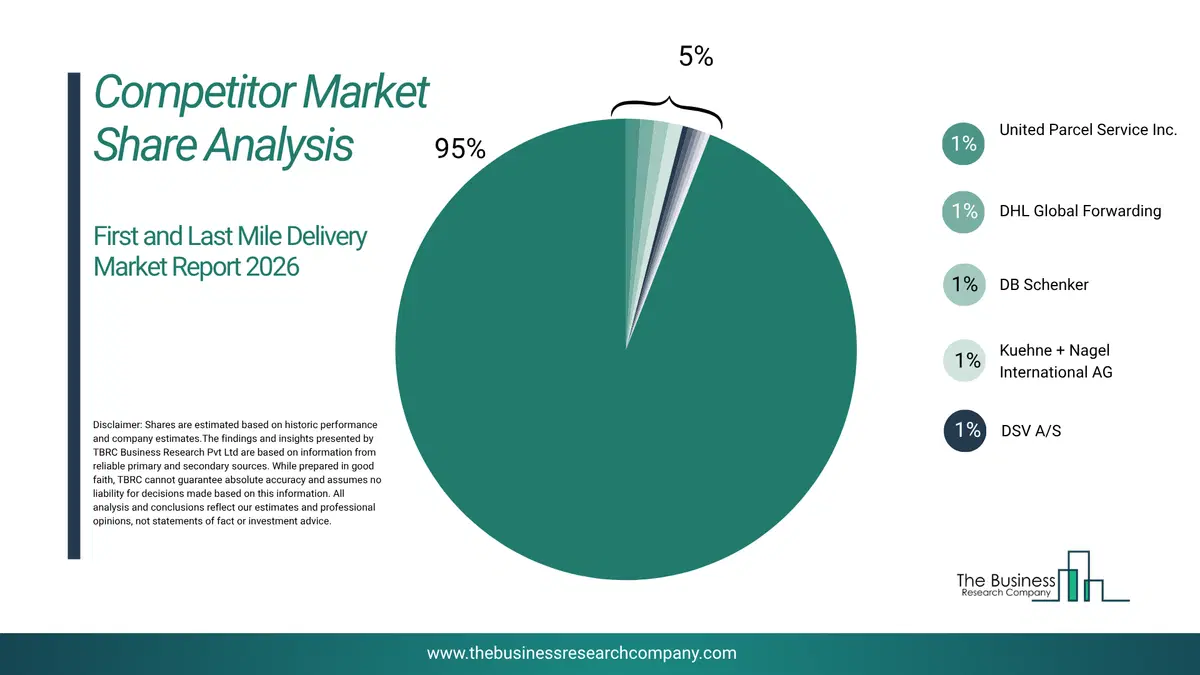
This chart is for illustrative purposes; the full report includes a detailed competitor analysis and comprehensive overview of the top 10 companies in the market.
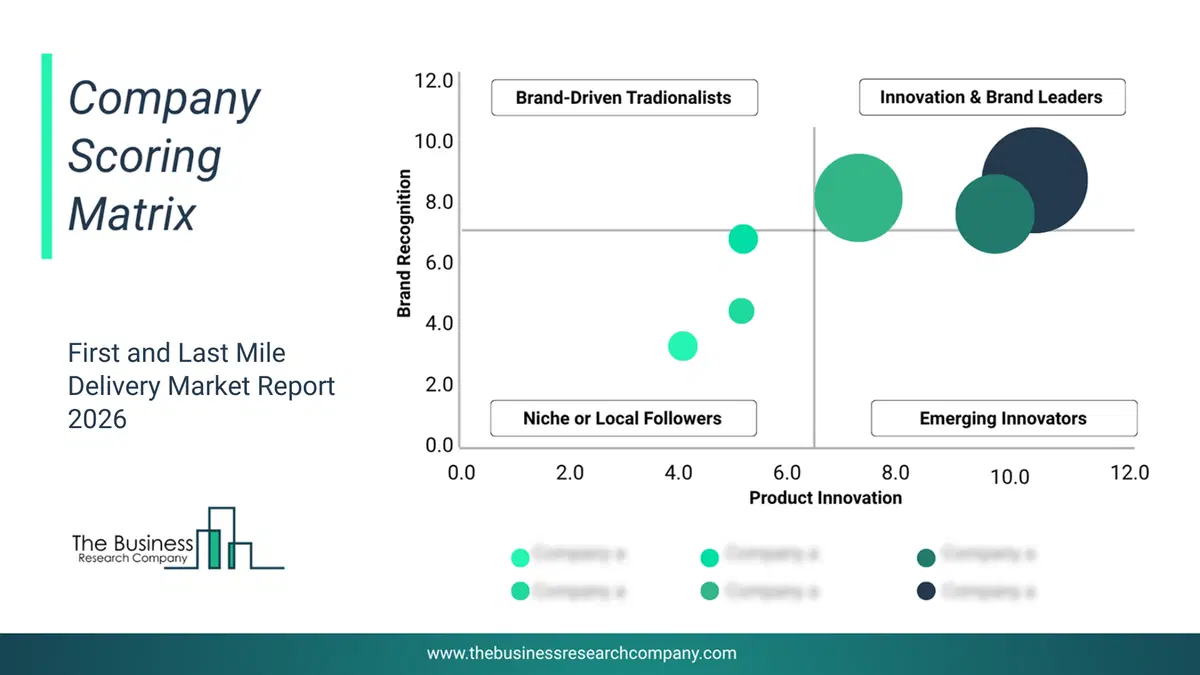
This chart maps companies by product innovation and brand strength, with bubble size indicating relative revenue, helping identify market leaders, challengers, and niche players. This is an illustrative chart; the full report provides a complete and accurate competitive analysis.
Global First and Last Mile Delivery Market Trends and Insights
Major companies operating in the first-and last-mile delivery market are focusing on innovative solutions, such as zero-emissions delivery, with the aim of reducing traffic, providing access to safe and convenient goods and services, and testing novel zero-emissions delivery solutions. Zero-emissions delivery refers to initiatives and programs that aim to revolutionize sustainable transportation by incentivizing or mandating the use of zero-emission transportation options for goods delivery. For instance, in November 2023, Amazon.com Inc., a US-based online retail platform, launched the Last Mile Fleet Programme in India, featuring a fully electric vehicle (EV) fleet, marking a global first for the company. This program will support over 300 Delivery Service Partners (DSPs) in making customer deliveries with zero tailpipe emissions. This initiative allows DSPs to procure safe, high-quality zero-emission vehicles through a fleet management company, expanding from its successful operations in North America and Europe.What Are Latest Mergers And Acquisitions In The First and Last Mile Delivery Market?
In September 2025, ADL Final Mile, a US-based final mile delivery and logistics provider, acquired DMC Logistics LLC for an undisclosed amount. Through this acquisition, ADL Final Mile aims to enhance its Southwest U.S. delivery capabilities by integrating DMC Logistics’ customized final mile services and expanding its distribution network across New Mexico, Arizona, Colorado, Nevada, Texas, and Utah. DMC Logistics LLC is a US-based logistics company that provides customized final mile delivery services to regional and national customers across several western and mountain-state markets.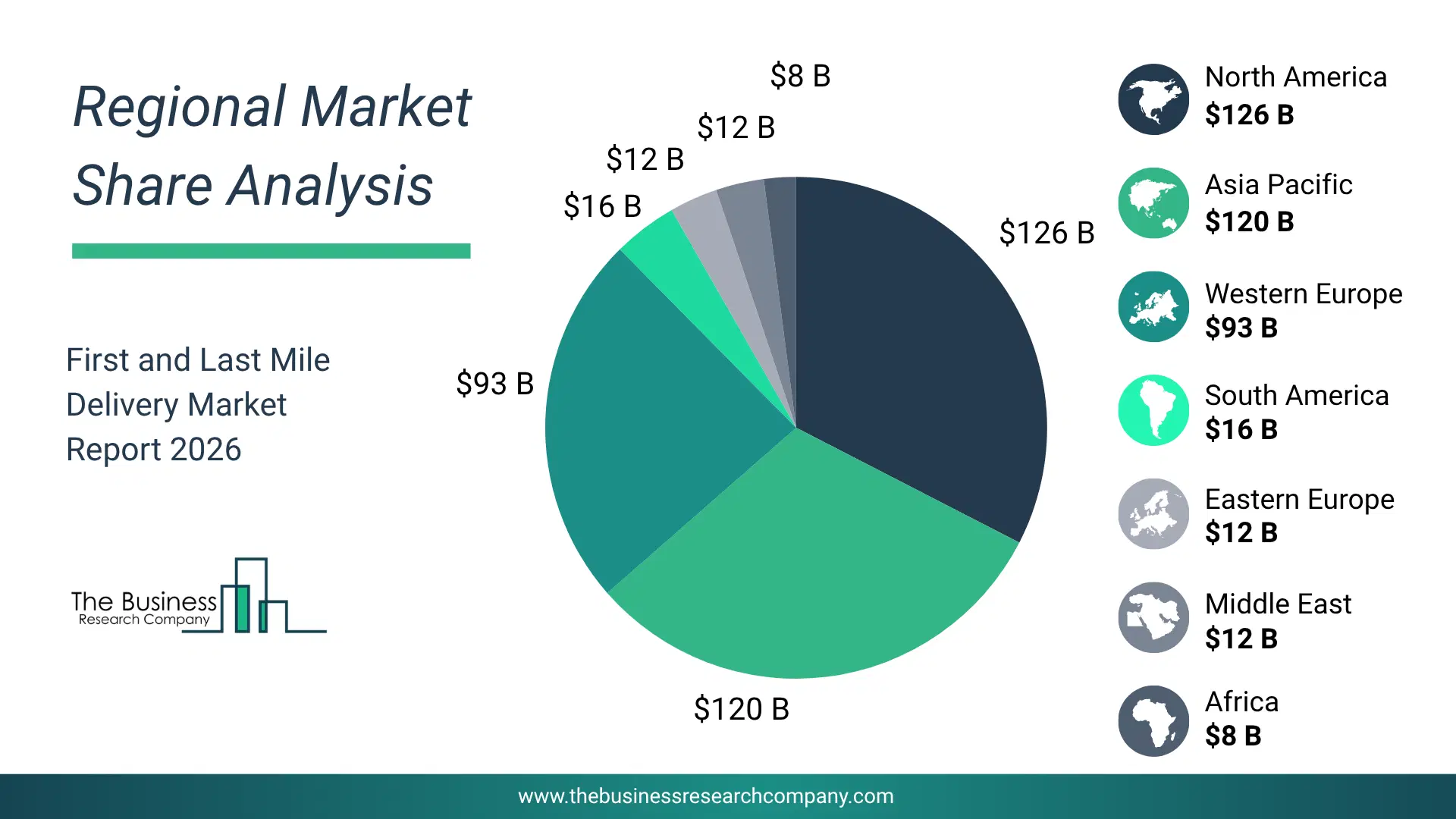
Regional Outlook
Asia-Pacific was the largest region in the first and last mile delivery market in 2025. The regions covered in this market report are Asia-Pacific, South East Asia, Western Europe, Eastern Europe, North America, South America, Middle East, Africa. The countries covered in this market report are Australia; Brazil; China; France; Germany; India; Indonesia; Japan; Taiwan; Russia; South Korea; UK; USA; Canada; Italy; Spain.What Defines the First and Last Mile Delivery Market?
The first and last-mile delivery market includes revenues earned by providing dark stores delivery services and curbside pickup delivery services. The market value includes the value of related goods sold by the service provider or included within the service offering. Only goods and services traded between entities or sold to end consumers are included.How is Market Value Defined and Measured?
The market value is defined as the revenues that enterprises gain from the sale of goods and/or services within the specified market and geography through sales, grants, or donations in terms of the currency (in USD unless otherwise specified). The revenues for a specified geography are consumption values that are revenues generated by organizations in the specified geography within the market, irrespective of where they are produced. It does not include revenues from resales along the supply chain, either further along the supply chain or as part of other products.
This chart presents market attractiveness based on a quantitative evaluation of growth, competition, strategic alignment, and risk, offering a clear view of opportunity areas for decision-making. This chart is for illustrative purposes; the full report contains the complete analysis.

This chart highlights the Total Addressable Market (TAM) by estimating the maximum revenue opportunity using an assumption-driven approach, supporting strategic planning and opportunity sizing across markets. The chart is illustrative; the full report provides a more comprehensive analysis.
What Key Data and Analysis Are Included in the First and Last Mile Delivery Market Report 2026?
The first and last mile delivery market research report is one of a series of new reports from The Business Research Company that provides market statistics, including Market Report 2026?global market size, regional shares, competitors with the market share, detailed market segments, market trends and opportunities, and any further data you may need to thrive in the first and last mile delivery Market Report 2026? The market research report delivers a complete perspective of everything you need, with an in-depth analysis of the current and future state of the Market Report 2026?First and Last Mile Delivery Market Report Forecast Analysis
| Report Attribute | Details |
|---|---|
| Market Size Value In 2026 | $263.44 billion |
| Revenue Forecast In 2030 | $383.27 billion |
| Growth Rate | CAGR of 10.2% from 2026 to 2030 |
| Base Year For Estimation | 2025 |
| Actual Estimates/Historical Data | 2020-2025 |
| Forecast Period | 2026 - 2030 |
| Market Representation | Revenue in USD Billion and CAGR from 2026 to 2030 |
| Segments Covered | Type, Vehicle Type, End Use |
| Regional Scope | Asia-Pacific, Western Europe, Eastern Europe, North America, South America, Middle East, Africa |
| Country Scope | The countries covered in the report are Australia, Brazil, China, France, Germany, India, Indonesia, Japan, Taiwan, Russia, South Korea, UK, USA, Canada, Italy, Spain. |
| Key Companies Profiled | FedEx Corporation, DHL Global Forwarding, Cargo Carriers Limited, United Parcel Services Inc., Concargo Private Limited, TNT Holdings B.V., Transtech Logistics Pvt Ltd., DB Schenker, Swift Transportation Company, Kerry Logistics Network Limited, KART, XPO Logistics, DSV A/S, J.B. Hunt Transport Inc., Agility, CEVA Logistics, STO Express, Dachser Group SE & Co. KG, The Toll Group, C.H. Robinson, China Post Group Corporation, Kuehne + Nagel International AG, GEODIS, Nippon Express Co. Ltd. |
| Customization Scope | Request for Customization |
| Pricing And Purchase Options | Explore Purchase Options |