
Fitness and Recreational Sports Centers Market Report 2026
Global Outlook – By Service Type (Gym And Fitness Centers, Sports Clubs, Swimming Pools, Yoga Centers, Other Service Types), By Age Group (Children, Adults, Seniors), By Revenue Channel (Membership Fees, Personal Training, Merchandise Sales, Other Revenue Channels), By Program Focus (Strength Training, Cardiovascular Fitness, Group Sports, Mind-Body Fitness), By End User (Individuals, Corporate, Educational Institutions, Other End Users) – Market Size, Trends, Strategies, and Forecast to 2035
Fitness and Recreational Sports Centers Market Overview
• Fitness and Recreational Sports Centers market size has reached to $99.3 billion in 2025 • Expected to grow to $141.55 billion in 2030 at a compound annual growth rate (CAGR) of 7.4% • Growth Driver: Growing Awareness of Preventive Healthcare Benefits Is Fueling the Growth of the Fitness and Recreational Sports Centers Market due to Rising Chronic Disease Burden and Increasing Demand for Cost-Effective Health Management Solutions • Market Trend: Expanding Wellness-Oriented Holistic Fitness Programs Is a Key Industry Trend Driven by Integration of Physical Activity, Chronic Disease Management, and Health Education Services • North America was the largest region in 2025 and Asia-Pacific is the fastest growing region.What Is Covered Under Fitness and Recreational Sports Centers Market?
Fitness and Recreational Sports Centers are facilities that provide spaces, equipment, and programs designed to support physical exercise, sports activities, and overall wellness. They offer structured and unstructured activities such as strength training, group classes, and recreational sports to improve health, fitness levels, and leisure engagement. These centers focus on enhancing physical well-being, promoting active lifestyles, and creating community-oriented environments for individuals of all ages. The main service types of fitness and recreational sports centers include gym and fitness centers, sports clubs, swimming pools, yoga centers, and other service types. Gym and fitness centers refer to facilities equipped with exercise machines and training spaces designed to improve physical fitness and overall wellness. These centers are categorized by age group including children, adults, and seniors and generate revenue through membership fees, personal training, merchandise sales, and other revenue channels. The various program focus involved are strength training, cardiovascular fitness, group sports, and mind-body fitness, and they are used by several end users such as individuals, corporate, educational institutions, and others.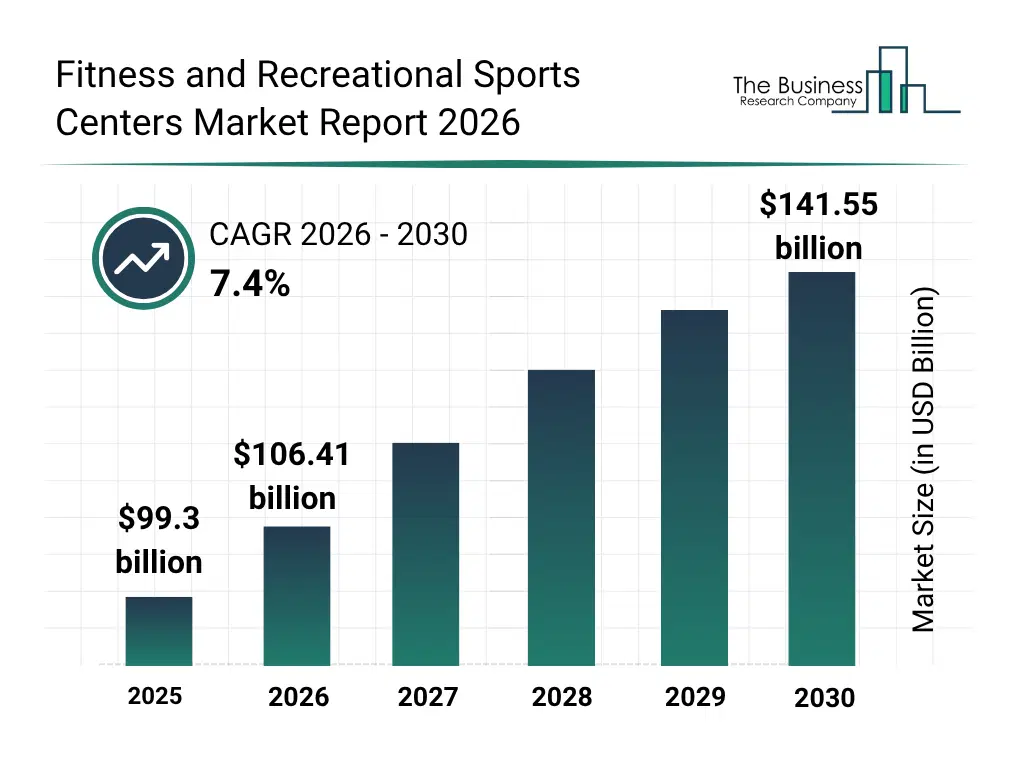
What Is The Fitness and Recreational Sports Centers Market Size and Share 2026?
The fitness and recreational sports centers market size has grown strongly in recent years. It will grow from $99.3 billion in 2025 to $106.41 billion in 2026 at a compound annual growth rate (CAGR) of 7.2%. The growth in the historic period can be attributed to increasing health consciousness among urban populations, rising prevalence of lifestyle related diseases, expansion of organized gym and fitness center networks, growing popularity of group exercise programs, increasing disposable income supporting fitness memberships.What Is The Fitness and Recreational Sports Centers Market Growth Forecast?
The fitness and recreational sports centers market size is expected to see strong growth in the next few years. It will grow to $141.55 billion in 2030 at a compound annual growth rate (CAGR) of 7.4%. The growth in the forecast period can be attributed to rising adoption of digital fitness platforms and hybrid training models, increasing demand for personalized wellness and training programs, growth of corporate wellness initiatives, expansion of smart fitness equipment integration, rising focus on preventive healthcare and active aging populations. Major trends in the forecast period include integration of AI-powered fitness tracking and personalized workout recommendations in fitness centers, expansion of iot-enabled smart gym equipment for real time performance monitoring, rising adoption of virtual and hybrid fitness classes through digital platforms, increasing use of wearable integrated fitness ecosystems for member engagement, growth of sustainable and energy efficient fitness facility infrastructure design.
Global Fitness and Recreational Sports Centers Market Segmentation
1) By Service Type: Gym And Fitness Centers, Sports Clubs, Swimming Pools, Yoga Centers, Other Service Types 2) By Age Group: Children, Adults, Seniors 3) By Revenue Channel: Membership Fees, Personal Training, Merchandise Sales, Other Revenue Channels 4) By Program Focus: Strength Training, Cardiovascular Fitness, Group Sports, Mind-Body Fitness 5) By End User: Individuals, Corporate, Educational Institutions, Other End Users Subsegments: 1) By Gym And Fitness Centers: Full Service Fitness Centers, Budget Fitness Gyms, 24 Hour Access Fitness Centers, Women Only Fitness Centers, Corporate Fitness Centers 2) By Sports Clubs: Indoor Sports Clubs, Outdoor Sports Clubs, Multi Sport Clubs, Racquet Sports Clubs, Professional Training Sports Clubs 3) By Swimming Pools: Indoor Swimming Pools, Outdoor Swimming Pools, Olympic Size Swimming Pools, Recreational Swimming Pools, Therapeutic Swimming Pools 4) By Yoga Centers: Traditional Yoga Centers, Hot Yoga Studios, Meditation And Yoga Centers, Therapeutic Yoga Centers, Corporate Yoga Centers 5) By Other Service Types: Wellness And Spa Services, Rehabilitation And Physiotherapy Services, Childcare And Activity Centers, Nutritional Counseling Services, Virtual Fitness ServicesWhat Is The Driver Of The Fitness and Recreational Sports Centers Market?
The growing awareness of preventive healthcare benefits is expected to propel the growth of the Fitness and Recreational Sports Centers market going forward. Preventive healthcare benefits refer to proactive health management practices such as regular physical activity, early risk reduction, and lifestyle modifications that help prevent chronic diseases and improve long-term health outcomes. The growing awareness of preventive healthcare benefits is increasing due to the rising financial burden of chronic disease management, which encourages individuals and institutions to prioritize cost-effective health maintenance solutions. Fitness and Recreational Sports Centers market supports preventive healthcare benefits by offering structured fitness programs, wellness services, and accessible exercise facilities that enable individuals to adopt preventive health behaviors and reduce long-term medical risks. For instance, in February 2024, according to the Centers for Disease Control and Prevention, a US-based public health agency, chronic diseases and mental health conditions account for approximately 90% of the $4.1 trillion annual healthcare expenditure, reflecting a significant increase in long-term healthcare spending and reinforcing the need for preventive health solutions through regular fitness engagement. Therefore, the growing awareness of preventive healthcare benefits is driving the growth of the Fitness and Recreational Sports Centers industry.Key Players In The Global Fitness and Recreational Sports Centers Market
Major companies operating in the fitness and recreational sports centers market are F45 Training Holdings Inc., Life Time Group Holdings Inc., EōS Fitness LLC, Basic-Fit N.V., Anytime Fitness, Planet Fitness Inc., Genesis Health Clubs LLC, Midtown Athletic Clubs LLC, SATS ASA, Bay Club Company, VASA Fitness LLC, Xponential Fitness Inc., The Gym Group plc, Retro Fitness LLC, UFC Gym LLC, Movati Athletic Inc., Blink Fitness LLC, Fitness Connection Holdings LLC, Club Fitness Inc., Active Wellness LLC, Jetts Fitness Group Pty Ltd, Villa Sport Athletic Club and Spa LLC, Chuze Fitness LLC, Fitness World A/S, Plus Fitness 24/7 Pty Ltd, CrossFit LLC, Stone Creek Club & Spa LLCGlobal Fitness and Recreational Sports Centers Market Trends and Insights
Major companies operating in the Fitness and Recreational Sports Centers market are focusing on expanding wellness-oriented holistic fitness programs, such as integrated wellness hubs that combine physical activity, chronic disease management support, and health education services to improve long-term health outcomes and increase member engagement. Holistic fitness programs refer to comprehensive wellness approaches that integrate physical exercise, mental health practices, nutritional guidance, and recovery techniques to support overall well-being and long-term lifestyle improvement. For instance, in February 2026, YMCA of Delaware, a US-based nonprofit organization, launched the YMCA Wellness Exchange, a community health hub developed in partnership with the American Diabetes Association. The program includes features such as access to obesity and chronic disease education, referral systems for medical care, and integrated support services that connect users with broader healthcare resources, strengthening the role of fitness centers in preventive healthcare delivery.What Are Latest Mergers And Acquisitions In The Fitness and Recreational Sports Centers Market?
In March 2025, LifeFit Group, a Germany-based services company, acquired FIT/One Group for an undisclosed amount. With this acquisition, LifeFit Group aims to expand its geographic footprint across Germany and Austria while strengthening its portfolio of fitness clubs and enhancing its customer base in the European market. FIT/One Group is a Germany-based services company that specializes in providing large-scale fitness centers offering gym access, group fitness classes, and wellness-focused training environments.Regional Outlook/Insights
North America was the largest region in the fitness and recreational sports centers market in 2025. Asia-Pacific is expected to be the fastest-growing region in the forecast period. The regions covered in this market report are Asia-Pacific, South East Asia, Western Europe, Eastern Europe, North America, South America, Middle East, Africa. The countries covered in this market report are Australia, Brazil, China, France, Germany, India, Indonesia, Japan, Taiwan, Russia, South Korea, UK, USA, Canada, Italy, Spain.What Defines the Fitness and Recreational Sports Centers Market?
The fitness and recreational sports centers market includes revenues earned by entities through gym and exercise equipment access, personal training services, group fitness classes, sports facility usage, wellness and rehabilitation programs, and membership-based recreational services. The market value includes the value of related goods sold by the service provider or included within the service offering. Only goods and services traded between entities or sold to end consumers are included.How is Market Value Defined and Measured?
The market value is defined as the revenues that enterprises gain from the sale of goods and/or services within the specified market and geography through sales, grants, or donations in terms of the currency (in USD unless otherwise specified). The revenues for a specified geography are consumption values that are revenues generated by organizations in the specified geography within the market, irrespective of where they are produced. It does not include revenues from resales along the supply chain, either further along the supply chain or as part of other products.What Key Data and Analysis Are Included in the Fitness and Recreational Sports Centers Market Report 2026?
The fitness and recreational sports centers market research report is one of a series of new reports from The Business Research Company that provides market statistics, including industry global market size, regional shares, competitors with the market share, detailed market segments, market trends and opportunities, and any further data you may need to thrive in the fitness and recreational sports centers industry. The market research report delivers a complete perspective of everything you need, with an in-depth analysis of the current and future state of the industry.Fitness and Recreational Sports Centers Market Report Forecast Analysis
| Report Attribute | Details |
|---|---|
| Market Size Value In 2026 | $106.41 billion |
| Revenue Forecast In 2035 | $141.55 billion |
| Growth Rate | CAGR of 7.4% from 2026 to 2035 |
| Base Year For Estimation | 2025 |
| Actual Estimates/Historical Data | 2020-2025 |
| Forecast Period | 2026 - 2030 - 2035 |
| Market Representation | Revenue in USD Billion and CAGR from 2026 to 2035 |
| Segments Covered | Service Type, Age Group, Revenue Channel, Program Focus, End User |
| Regional Scope | Asia-Pacific, Western Europe, Eastern Europe, North America, South America, Middle East, Africa |
| Country Scope | The countries covered in the report are Australia, Brazil, China, France, Germany, India, Indonesia, Japan, Taiwan, Russia, South Korea, UK, USA, Canada, Italy, Spain. |
| Key Companies Profiled | F45 Training Holdings Inc., Life Time Group Holdings Inc., EōS Fitness LLC, Basic-Fit N.V., Anytime Fitness, Planet Fitness Inc., Genesis Health Clubs LLC, Midtown Athletic Clubs LLC, SATS ASA, Bay Club Company, VASA Fitness LLC, Xponential Fitness Inc., The Gym Group plc, Retro Fitness LLC, UFC Gym LLC, Movati Athletic Inc., Blink Fitness LLC, Fitness Connection Holdings LLC, Club Fitness Inc., Active Wellness LLC, Jetts Fitness Group Pty Ltd, Villa Sport Athletic Club and Spa LLC, Chuze Fitness LLC, Fitness World A/S, Plus Fitness 24/7 Pty Ltd, CrossFit LLC, Stone Creek Club & Spa LLC |
| Customization Scope | Request for Customization |
| Pricing And Purchase Options | Explore Purchase Options |