
Flame Retardant Chemicals Market Report 2026
Global Outlook – By Product Type (Non Halogenated, Halogenated), By Substrate (Plastic, Wood, Fiber, Metal, Other Substrates), By Distribution Channel (Direct Sales, Distributors And Wholesalers, Online Channels), By Application (Polyolefins, Epoxy Resins, Polyvinyl Chloride, Polyurethane, Polystyrene, Other Applications), By End User (Construction, Transportation, Electrical And Electronics, Other End Users) – Market Size, Trends, Strategies, and Forecast to 2030
Flame Retardant Chemicals Market Overview
• Flame Retardant Chemicals market size has reached to $8.6 billion in 2025 • Expected to grow to $12.11 billion in 2030 at a compound annual growth rate (CAGR) of 7.0% • Growth Driver: Expansion Of The Construction Industry Driving The Market Growth Due To Increasing Demand For Durable Construction Materials • Market Trend: Innovative Reactive Phosphorus Technologies Strengthening Fire Protection And Sustainability • Asia-Pacific was the largest region and fastest growing region.What Is Covered Under Flame Retardant Chemicals Market?
Flame retardant chemicals refer to specialized chemical substances added to materials to reduce flammability, slow the spread of fire, and improve fire safety performance. These chemicals function by interfering with combustion reactions, reducing heat release, creating protective barriers, or limiting the formation of combustible gases. They are designed to enhance the fire resistance and safety characteristics of materials while supporting compliance with fire safety standards and performance requirements. The main product types of flame retardant chemicals include non halogenated and halogenated. Non halogenated refer to fire-resistant chemical compounds that do not contain halogen elements and are used to reduce the flammability and spread of fire in various materials. These chemicals are used with plastic, wood, fiber, metal, and other substrates and are distributed through direct sales, distributors and wholesalers, and online channels. The key applications of polyolefins, epoxy resins, polyvinyl chloride, polyurethane, polystyrene, and others, while the end-users include construction, transportation, electrical and electronics, and others.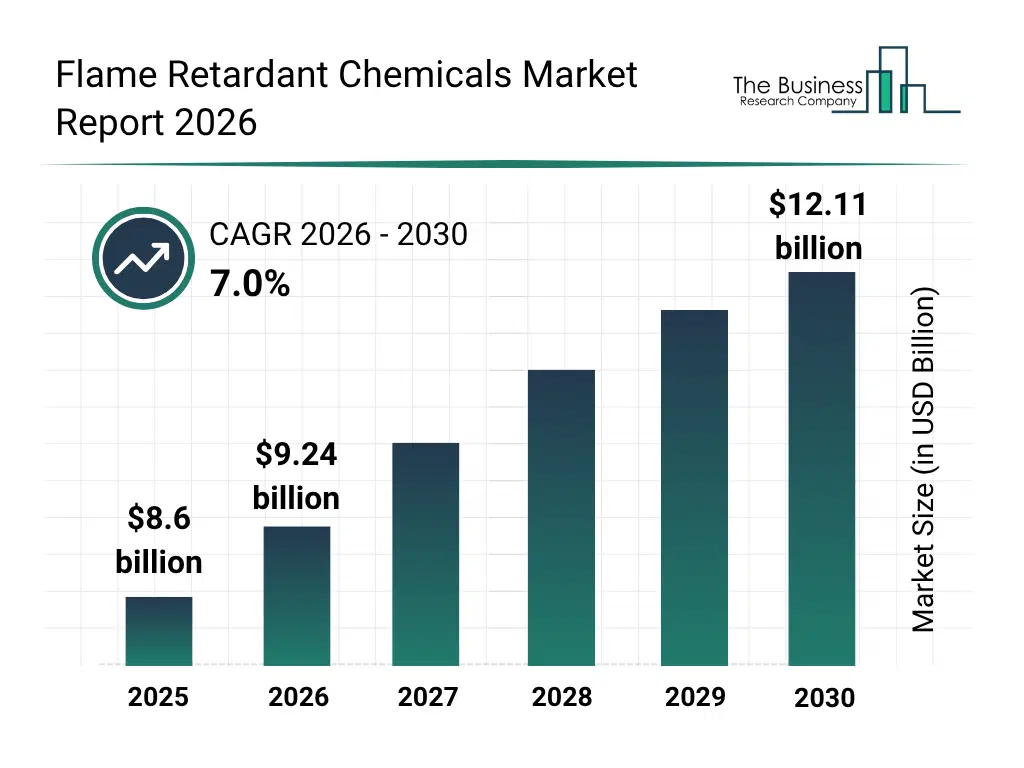
What Is The Flame Retardant Chemicals Market Size and Share 2026?
The flame retardant chemicals market size has grown strongly in recent years. It will grow from $8.6 billion in 2025 to $9.24 billion in 2026 at a compound annual growth rate (CAGR) of 7.4%. The growth in the historic period can be attributed to increasing adoption of fire safety standards, rising demand for fire-resistant materials, growing use of flame retardants in electrical and electronic components, increasing demand for fire protection in construction materials, expanding use of flame retardant chemicals in transportation applications.What Is The Flame Retardant Chemicals Market Growth Forecast?
The flame retardant chemicals market size is expected to see strong growth in the next few years. It will grow to $12.11 billion in 2030 at a compound annual growth rate (CAGR) of 7.0%. The growth in the forecast period can be attributed to increasing demand for low-smoke flame retardant formulations, rising need for high-performance fire protection in electric vehicles, growing demand for thermally stable flame retardant chemicals, increasing adoption of flame retardants in advanced electronic components, expanding demand for application-specific fire safety solutions. Major trends in the forecast period include increasing demand for low-smoke flame retardant formulations, rising adoption of halogen-free fire protection chemicals, growing need for higher thermal stability in flame retardant chemicals, increasing demand for application-specific flame retardant formulations, expanding use of flame retardant chemicals to meet stricter fire safety standards.
Global Flame Retardant Chemicals Market Segmentation
1) By Product Type: Non Halogenated, Halogenated 2) By Substrate: Plastic, Wood, Fiber, Metal, Other Substrates 3) By Distribution Channel: Direct Sales, Distributors And Wholesalers, Online Channels 4) By Application: Polyolefins, Epoxy Resins, Polyvinyl Chloride, Polyurethane, Polystyrene, Other Applications 5) By End User: Construction, Transportation, Electrical And Electronics, Other End Users Subsegments: 1) By Non Halogenated: Aluminum Hydroxide, Magnesium Hydroxide, Phosphorus Based Flame Retardants, Nitrogen Based Flame Retardants, Mineral Based Flame Retardants 2) By Halogenated: Brominated Flame Retardants, Chlorinated Flame Retardants, Polybrominated Diphenyl Ethers, Hexabromocyclododecane, Chlorinated ParaffinsWhat Is The Driver Of The Flame Retardant Chemicals Market?
The expansion of the construction industry is expected to propel the growth of the flame retardant chemicals market going forward. The construction industry encompasses the planning, development, and building of residential, commercial, industrial, and infrastructure projects using a wide range of construction materials and technologies. The construction industry is expanding due to rapid urbanization, as increasing migration to cities creates greater demand for residential housing, commercial buildings, transportation networks, and public infrastructure to accommodate growing urban populations. Construction industry growth supports flame retardant chemicals demand by driving the adoption of fire-resistant materials in insulation, cables, coatings, electrical components, and polymer-based building products to improve safety and comply with fire protection standards. For instance, in March 2025, according to the Bureau of Labor Statistics, a US-based government agency, the construction industry is expected to expand by 4.7% between 2023 and 2033, outpacing the 4.0% growth projected across all industries during the same period. Therefore, the expansion of the construction industry is driving the growth of the flame retardant chemicals industry.Key Players In The Global Flame Retardant Chemicals Market
Major companies operating in the flame retardant chemicals market are BASF SE, Dow Inc, ICL Group Ltd, Albemarle Corporation, LANXESS AG, Eastman Chemical Company, Arkema SA, Clariant AG, DIC Corporation, Huntsman Corporation, Zhejiang Wansheng Co Ltd, Jiangsu Yoke Technology Co Ltd, Italmatch Chemicals SpA, JM Huber Corporation, Budenheim KG, Nabaltec AG, Thor Group Limited, Eti Maden Isletmeleri Genel Mudurlugu, Daihachi Chemical Industry Co Ltd, Greenchemicals Srl, Nippon Carbide Industries Co Inc, NYACOL Nano Technologies Inc, MPI Chemie BV, Hangzhou Lingrui Chemical Co Ltd, Muby Chemicals Pvt Ltd
This chart is for illustrative purposes; the full report includes a detailed competitor analysis and comprehensive overview of the top 10 companies in the market.
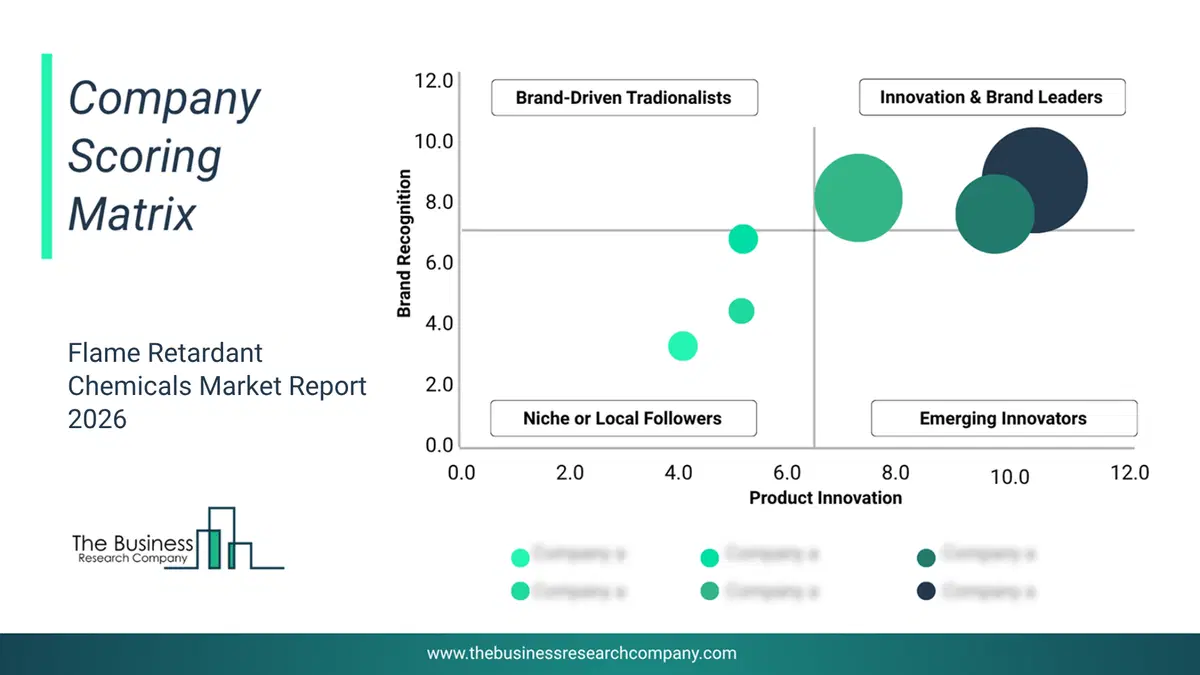
This chart maps companies by product innovation and brand strength, with bubble size indicating relative revenue, helping identify market leaders, challengers, and niche players. This is an illustrative chart; the full report provides a complete and accurate competitive analysis.
Global Flame Retardant Chemicals Market Trends and Insights
Major companies operating in the flame retardant chemicals market are focusing on developing innovative products such as, reactive phosphorus-based flame retardants to enhance fire safety, sustainability, regulatory compliance, and long-term material performance. Reactive phosphorus-based flame retardants are advanced fire protection additives that chemically bond with polymer structures rather than remaining physically dispersed within materials, providing durable flame resistance, reducing migration risks, and offering improved environmental performance compared with traditional additive flame retardants. For instance, in December 2024, ICL Group Ltd., an Israel-based specialty minerals company, launched VeriQuel R100, an innovative reactive phosphorus flame retardant designed for rigid polyurethane insulation products used in applications such as sheathing, in-wall insulation, and polyisocyanurate (PIR) roofing systems. The patented technology chemically integrates with the polymer matrix to create built-in flame retardancy, ensuring long-lasting performance, improved stability, and reduced potential for product migration. VeriQuel R100 is compatible with existing manufacturing processes, allowing manufacturers to enhance product sustainability and meet stricter fire safety and environmental regulations without additional formulation costs.What Are Latest Mergers And Acquisitions In The Flame Retardant Chemicals Market?
In May 2025, J.M. Huber Corporation, a US-based specialty engineered materials manufacturing company, acquired The R.J. Marshall Company’s Alumina Trihydrate (ATH), antimony-free flame retardant, and molybdate-based smoke suppressant assets for an undisclosed amount. With this acquisition, J.M. Huber Corporation aimed to strengthen its Huber Advanced Materials business by expanding its halogen-free flame retardant and smoke suppressant portfolio, integrating high-performance ATH and molybdate-based product lines, enhancing its specialty materials offerings, and reinforcing its leadership in the North American flame retardant and smoke suppressant market. The R.J. Marshall Company is a US-based specialty chemical company that specailizes in providing alumina trihydrate flame retardants, antimony-free fire retardant additives, and molybdate-based smoke suppressant products.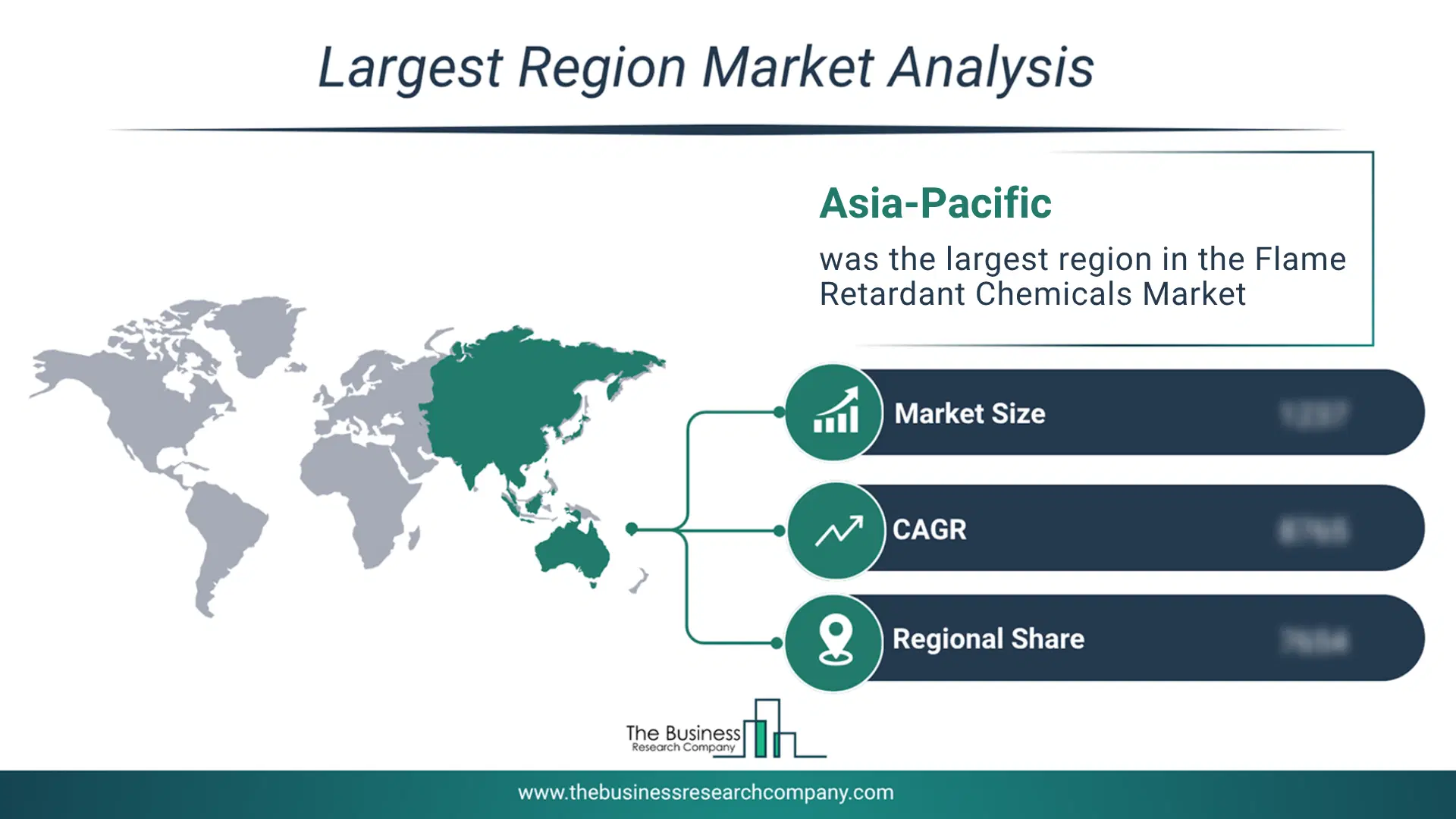
Regional Insights
Asia-Pacific was the largest region in the flame retardant chemicals market in 2025. Asia-Pacific is expected to be the fastest-growing region in the forecast period. The regions covered in this market report are Asia-Pacific, South East Asia, Western Europe, Eastern Europe, North America, South America, Middle East, Africa. The countries covered in this market report are Australia, Brazil, China, France, Germany, India, Indonesia, Japan, Taiwan, Russia, South Korea, UK, USA, Canada, Italy, Spain.What Defines the Flame Retardant Chemicals Market?
The flame retardant chemicals market consists of sales of phosphorus-based flame retardants, nitrogen-based flame retardants, inorganic flame retardants, mineral flame retardants, and other specialty flame retardant chemical formulations. Values in this market are ‘factory gate’ values, that is, the value of goods sold by the manufacturers or creators of the goods, whether to other entities (including downstream manufacturers, wholesalers, distributors, and retailers) or directly to end customers. The value of goods in this market includes related services sold by the creators of the goods.How is Market Value Defined and Measured?
The market value is defined as the revenues that enterprises gain from the sale of goods and/or services within the specified market and geography through sales, grants, or donations in terms of the currency (in USD unless otherwise specified). The revenues for a specified geography are consumption values that are revenues generated by organizations in the specified geography within the market, irrespective of where they are produced. It does not include revenues from resales along the supply chain, either further along the supply chain or as part of other products.
This chart presents market attractiveness based on a quantitative evaluation of growth, competition, strategic alignment, and risk, offering a clear view of opportunity areas for decision-making. This chart is for illustrative purposes; the full report contains the complete analysis.

This chart highlights the Total Addressable Market (TAM) by estimating the maximum revenue opportunity using an assumption-driven approach, supporting strategic planning and opportunity sizing across markets. The chart is illustrative; the full report provides a more comprehensive analysis.
What Key Data and Analysis Are Included in the Flame Retardant Chemicals Market Report 2026?
The flame retardant chemicals market research report is one of a series of new reports from The Business Research Company that provides market statistics, including industry global market size, regional shares, competitors with the market share, detailed market segments, market trends and opportunities, and any further data you may need to thrive in the flame retardant chemicals industry. The market research report delivers a complete perspective of everything you need, with an in-depth analysis of the current and future state of the industry.Flame Retardant Chemicals Market Report Forecast Analysis
| Report Attribute | Details |
|---|---|
| Market Size Value In 2026 | $9.24 billion |
| Revenue Forecast In 2030 | $12.11 billion |
| Growth Rate | CAGR of 7.0% from 2026 to 2030 |
| Base Year For Estimation | 2025 |
| Actual Estimates/Historical Data | 2020-2025 |
| Forecast Period | 2026 - 2030 |
| Market Representation | Revenue in USD Billion and CAGR from 2026 to 2030 |
| Segments Covered | Product Type, Substrate, Distribution Channel, Application, End User |
| Regional Scope | Asia-Pacific, Western Europe, Eastern Europe, North America, South America, Middle East, Africa |
| Country Scope | The countries covered in the report are Australia, Brazil, China, France, Germany, India, Indonesia, Japan, Taiwan, Russia, South Korea, UK, USA, Canada, Italy, Spain. |
| Key Companies Profiled | BASF SE, Dow Inc, ICL Group Ltd, Albemarle Corporation, LANXESS AG, Eastman Chemical Company, Arkema SA, Clariant AG, DIC Corporation, Huntsman Corporation, Zhejiang Wansheng Co Ltd, Jiangsu Yoke Technology Co Ltd, Italmatch Chemicals SpA, JM Huber Corporation, Budenheim KG, Nabaltec AG, Thor Group Limited, Eti Maden Isletmeleri Genel Mudurlugu, Daihachi Chemical Industry Co Ltd, Greenchemicals Srl, Nippon Carbide Industries Co Inc, NYACOL Nano Technologies Inc, MPI Chemie BV, Hangzhou Lingrui Chemical Co Ltd, Muby Chemicals Pvt Ltd |
| Customization Scope | Request for Customization |
| Pricing And Purchase Options | Explore Purchase Options |