
Flame Retardant Plastics Market Report 2026
Global Outlook – By Type (Polyvinyl Chloride, Polyester, Polycarbonate, Polystyrene, Polypropylene, Other Types), By Flame Retardant Type (Organic Flame Retardants, Inorganic Flame Retardants, Halogenated Flame Retardants, Non Halogenated Flame Retardants), By Processing Form (Compounds And Pellets, Sheets, Resin Liquids), By Application (Electrical And Electronics, Transportation, Building And Construction, Consumer Goods, Industrial Machinery) – Market Size, Trends, Strategies, and Forecast to 2030
Flame Retardant Plastics Market Overview
• Flame Retardant Plastics market size has reached to $10.93 billion in 2025 • Expected to grow to $15.31 billion in 2030 at a compound annual growth rate (CAGR) of 6.9% • Growth Driver: Growing Electrical And Electronics Demand Fueling The Growth Of The Market Due To Rising Adoption Of Smart Devices, Data Centers, And Advanced Communication Networks • Market Trend: Innovations In PTFE Free And Non Halogen Flame Retardant Additives Enhance Fire Safety And Environmental Compliance In Polycarbonate Applications • North America was the largest region in 2025 and Asia-Pacific is the fastest growing region.What Is Covered Under Flame Retardant Plastics Market?
The flame retardant plastics are polymer-based materials formulated with additives or chemical modifications that reduce their flammability and slow the spread of fire when exposed to heat or ignition sources. These materials are designed to enhance fire safety by delaying combustion, reducing smoke generation, and improving resistance to burning. The flame-retardant plastics are widely used in applications where compliance with fire safety standards and improved material performance under high-temperature conditions are essential. The main types of flame retardant plastics include polyvinyl chloride, polyester, polycarbonate, polystyrene, polypropylene, and other types. Polyvinyl chloride refers to a versatile thermoplastic material formulated with flame retardant additives to reduce flammability and improve fire resistance in safety-critical applications. These plastics are produced using organic flame retardants, inorganic flame retardants, halogenated flame retardants, and non halogenated flame retardants. They are supplied in processing forms including compounds and pellets, sheets, and resin liquids and are utilized in applications including electrical and electronics, transportation, building and construction, consumer goods, and industrial machinery.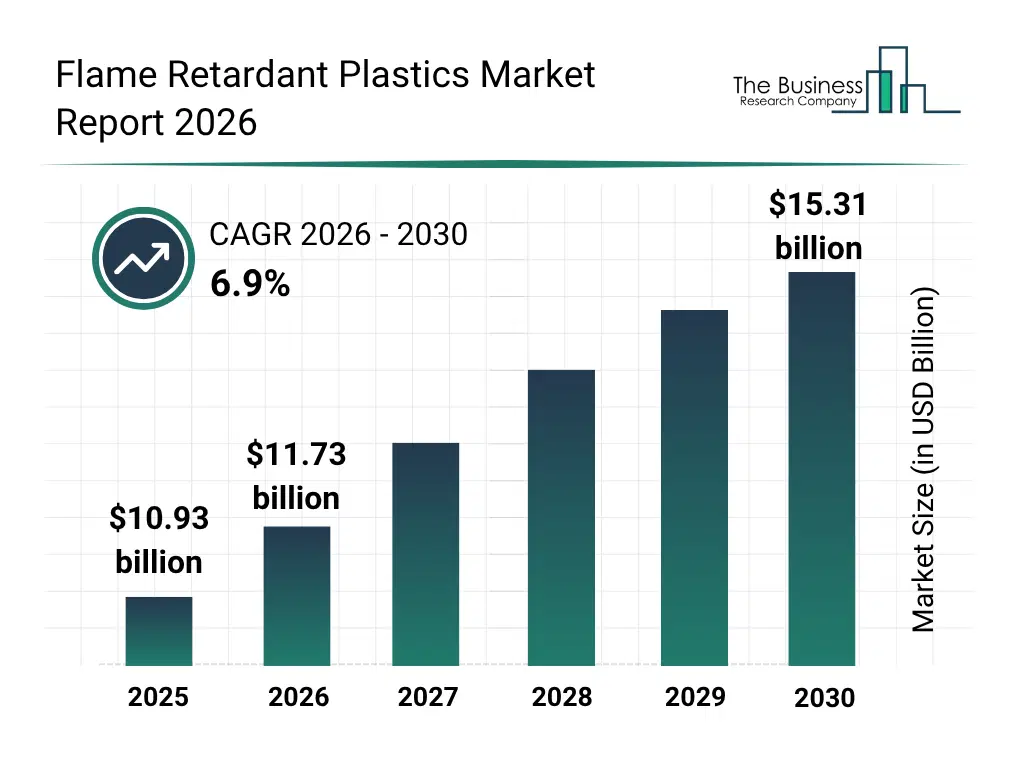
What Is The Flame Retardant Plastics Market Size and Share 2026?
The flame retardant plastics market size has grown strongly in recent years. It will grow from $10.93 billion in 2025 to $11.73 billion in 2026 at a compound annual growth rate (CAGR) of 7.3%. The growth in the historic period can be attributed to growing implementation of fire safety regulations, increasing demand from electrical and electronics manufacturing, rising use of engineering plastics in transportation applications, expanding construction and infrastructure development, increasing adoption of flame retardant materials in consumer goods.What Is The Flame Retardant Plastics Market Growth Forecast?
The flame retardant plastics market size is expected to see strong growth in the next few years. It will grow to $15.31 billion in 2030 at a compound annual growth rate (CAGR) of 6.9%. The growth in the forecast period can be attributed to growing demand for lightweight fire resistant materials, increasing adoption of sustainable non halogenated flame retardants, rising investment in advanced engineering plastic compounds, expanding electric vehicle production requiring flame retardant plastics, increasing development of high performance polymer formulations. Major trends in the forecast period include increasing demand for high performance flame retardant engineering plastics, growing adoption of non halogenated flame retardant plastic formulations, rising use of flame retardant plastics in electrical and electronic components, expanding application of fire resistant plastics in building and construction materials, increasing development of low smoke and high heat resistant plastic compounds.
Global Flame Retardant Plastics Market Segmentation
2) By Flame Retardant Type: Organic Flame Retardants, Inorganic Flame Retardants, Halogenated Flame Retardants, Non Halogenated Flame Retardants 3) By Processing Form: Compounds And Pellets, Sheets, Resin Liquids 4) By Application: Electrical And Electronics, Transportation, Building And Construction, Consumer Goods, Industrial Machinery Subsegments: 1) By Polyvinyl Chloride: Rigid Polyvinyl Chloride, Flexible Polyvinyl Chloride, Chlorinated Polyvinyl Chloride, Polyvinyl Chloride Compounds, Plasticized Polyvinyl Chloride 2) By Polyester: Polyethylene Terephthalate, Polybutylene Terephthalate, Unsaturated Polyester Resins, Thermoplastic Polyester Blends, Flame Retardant Polyester Compounds 3) By Polycarbonate: Standard Polycarbonate, Flame Retardant Polycarbonate Compounds, Glass Filled Polycarbonate, Polycarbonate Blends 4) By Polystyrene: General Purpose Polystyrene, High Impact Polystyrene, Expanded Polystyrene, Extruded Polystyrene 5) By Polypropylene: Homopolymer Polypropylene, Copolymer Polypropylene, Glass Reinforced Polypropylene, Mineral Filled Polypropylene 6) By Other Types: Polyamide, Acrylonitrile Butadiene Styrene, Polyphenylene Ether, Polyphenylene Sulfide, Polyetherimide, Thermoplastic Polyurethane, Polyoxymethylene, Engineering Plastic BlendsWhat Is The Driver Of The Flame Retardant Plastics Market?
The growing demand for electrical and electronics is expected to propel the growth of the flame-retardant plastics market going forward. Electrical and electronics encompass technologies and devices that generate, control, transmit, and utilize electrical energy and electronic signals for communication, automation, and power applications. Electrical and electronics are increasing due to the rising demand for consumer electronics, which is driving higher production and consumption of electrical and electronic components worldwide. Flame retardant plastics support electrical and electronics applications by improving fire resistance and ensuring the safety and reliability of electronic components. For instance, in February 2025, according to the Semiconductor Industry Association (SIA), a US-based semiconductor industry association, global semiconductor sales reached $627.6 billion in 2024, representing a 19.1% increase from $526.8 billion in 2023. Therefore, the growing demand for electrical and electronics is driving the growth of the flame-retardant plastics market.Key Players In The Global Flame Retardant Plastics Market
Major companies operating in the flame retardant plastics market are BASF SE, Dow Inc., SABIC, Covestro AG, Mitsui Chemicals Inc., DuPont de Nemours Inc., Arkema S.A., Albemarle Corporation, ICL Group Ltd., LANXESS AG, Syensqo S.A., Clariant AG, Avient Corporation, ADEKA Corporation, Italmatch Chemicals S.p.A., Celanese Corporation, RTP Company, Nabaltec AG, Huber Engineered Materials Inc., Thor Group Limited, Kaneka Corporation, Tosoh Corporation, DIC Corporation
This chart is for illustrative purposes; the full report includes a detailed competitor analysis and comprehensive overview of the top 10 companies in the market.
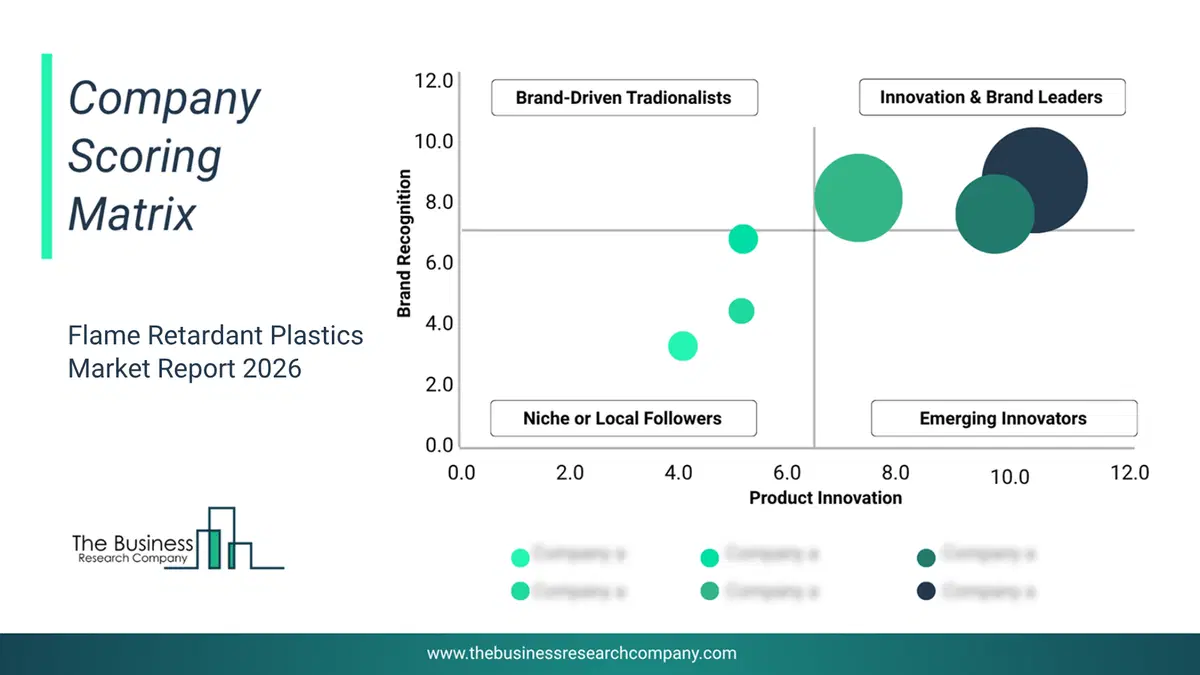
This chart maps companies by product innovation and brand strength, with bubble size indicating relative revenue, helping identify market leaders, challengers, and niche players. This is an illustrative chart; the full report provides a complete and accurate competitive analysis.
Global Flame Retardant Plastics Market Trends and Insights
Major companies operating in the flame retardant plastics market are focusing on developing advanced flame-retardant solutions, such as PTFE-free and non-halogen additives, to improve fire resistance, support regulatory compliance, and reduce environmental impact. PTFE-free and non-halogen flame retardant additives are specialized formulations designed to enhance the flame resistance of plastics without using polytetrafluoroethylene (PTFE) or halogen-based chemicals, helping manufacturers address evolving sustainability and safety requirements. For instance, in October 2023, Avient Corporation, a US-based materials solutions company, introduced its new Cesa Flame Retardant Additives for polycarbonate at Fakuma 2023. The additives are formulated without PTFE and are halogen-free according to IEC 61249-2-21 standards, making them suitable for electrical and electronic applications. It is compatible with both virgin and recycled polycarbonate grades. The solution helps achieve GWFI temperatures up to 960°C and provides manufacturers with greater flexibility through concentrate-based formulations that can be combined with colors and other performance additives.What Are Latest Mergers And Acquisitions In The Flame Retardant Plastics Market?
In January 2025, Nofia Solutions BV, a Belgium-based manufacturer of sustainable flame-retardant polymers and additives, acquired FRX Polymers, Inc. for an undisclosed amount. With this acquisition, Nofia Solutions BV aimed to strengthen its position in sustainable flame-retardant technologies, expand its portfolio of environmentally compliant fire-safety materials, and accelerate the commercialization of advanced halogen-free flame-retardant solutions across multiple industries. FRX Polymers, Inc. is a US-based manufacturer of flame retardant polymers and flame retardant additives.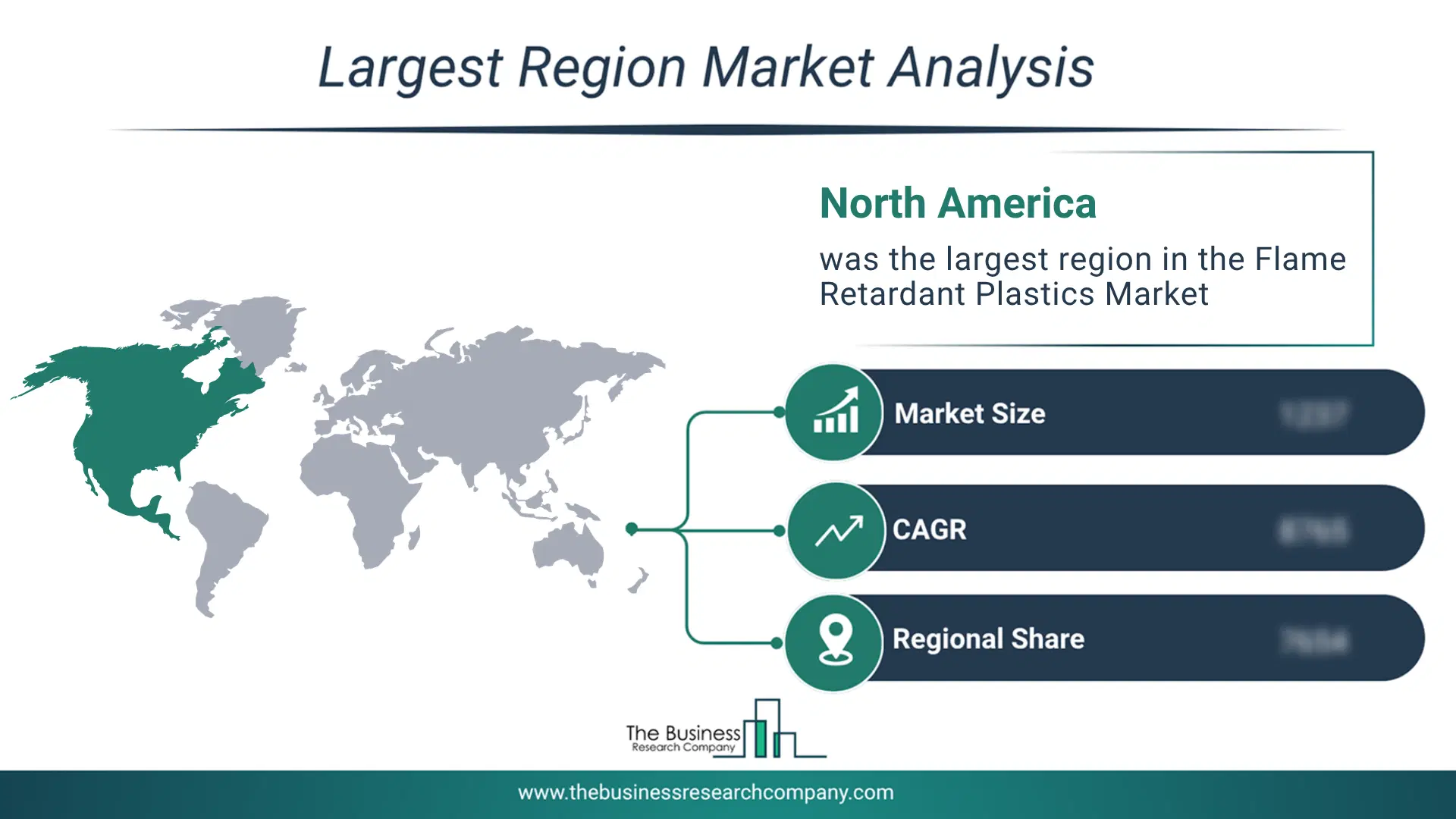
Regional Outlook/Insights
North America was the largest region in the flame retardant plastics market in 2025. Asia-Pacific is expected to be the fastest-growing region in the forecast period. The regions covered in this market report are Asia-Pacific, South East Asia, Western Europe, Eastern Europe, North America, South America, Middle East, Africa. The countries covered in this market report are Australia, Brazil, China, France, Germany, India, Indonesia, Japan, Taiwan, Russia, South Korea, UK, USA, Canada, Italy, Spain.What Defines the Flame Retardant Plastics Market?
The flame retardant plastics market consists of sales of flame retardant cables, electrical connectors, circuit breakers, automotive interior components, and electrical enclosures. Values in this market are ‘factory gate’ values, that is, the value of goods sold by the manufacturers or creators of the goods, whether to other entities (including downstream manufacturers, wholesalers, distributors, and retailers) or directly to end customers. The value of goods in this market includes related services sold by the creators of the goods.How is Market Value Defined and Measured?
The market value is defined as the revenues that enterprises gain from the sale of goods and/or services within the specified market and geography through sales, grants, or donations in terms of the currency (in USD unless otherwise specified). The revenues for a specified geography are consumption values that are revenues generated by organizations in the specified geography within the market, irrespective of where they are produced. It does not include revenues from resales along the supply chain, either further along the supply chain or as part of other products.
This chart presents market attractiveness based on a quantitative evaluation of growth, competition, strategic alignment, and risk, offering a clear view of opportunity areas for decision-making. This chart is for illustrative purposes; the full report contains the complete analysis.

This chart highlights the Total Addressable Market (TAM) by estimating the maximum revenue opportunity using an assumption-driven approach, supporting strategic planning and opportunity sizing across markets. The chart is illustrative; the full report provides a more comprehensive analysis.
What Key Data and Analysis Are Included in the Flame Retardant Plastics Market Report 2026?
The flame retardant plastics market research report is one of a series of new reports from The Business Research Company that provides flame retardant plastics market statistics, including flame retardant plastics industry global market size, regional shares, competitors with a flame retardant plastics market share, detailed flame retardant plastics market segments, market trends and opportunities, and any further data you may need to thrive in the flame retardant plastics industry. This flame retardant plastics market research report delivers a complete perspective of everything you need, with an in-depth analysis of the current and future scenario of the industry.Flame Retardant Plastics Market Report Forecast Analysis
| Report Attribute | Details |
|---|---|
| Market Size Value In 2026 | $11.73 billion |
| Revenue Forecast In 2030 | $15.31 billion |
| Growth Rate | CAGR of 6.9% from 2026 to 2030 |
| Base Year For Estimation | 2025 |
| Actual Estimates/Historical Data | 2020-2025 |
| Forecast Period | 2026 - 2030 |
| Market Representation | Revenue in USD Billion and CAGR from 2026 to 2030 |
| Segments Covered | Type, Flame Retardant Type, Processing Form, Application |
| Regional Scope | Asia-Pacific, Western Europe, Eastern Europe, North America, South America, Middle East, Africa |
| Country Scope | The countries covered in the report are Australia, Brazil, China, France, Germany, India, Indonesia, Japan, Taiwan, Russia, South Korea, UK, USA, Canada, Italy, Spain. |
| Key Companies Profiled | BASF SE, Dow Inc., SABIC, Covestro AG, Mitsui Chemicals Inc., DuPont de Nemours Inc., Arkema S.A., Albemarle Corporation, ICL Group Ltd., LANXESS AG, Syensqo S.A., Clariant AG, Avient Corporation, ADEKA Corporation, Italmatch Chemicals S.p.A., Celanese Corporation, RTP Company, Nabaltec AG, Huber Engineered Materials Inc., Thor Group Limited, Kaneka Corporation, Tosoh Corporation, DIC Corporation |
| Customization Scope | Request for Customization |
| Pricing And Purchase Options | Explore Purchase Options |