
Flexible Electronics Market Report 2026
Global Outlook – By Component ( Flexible Display, Flexible Battery, Flexible Sensors, Flexible Memory, Flexible Photovoltaics), By Circuit Structure ( Single-Sided, Double-Sided, Other Circuit Structures), By Application ( Displays, Thin-Film Photovoltaics, Printed Sensors, Batteries, Organic Light Emitting Diodes (OLED) Lighting, Other Applications), By Vertical ( Consumer Electronics, Energy And Power, Healthcare, Automotive, Military And Defense, Aerospace, Other Verticals) – Market Size, Trends, Strategies, and Forecast to 2030
Flexible Electronics Market Overview
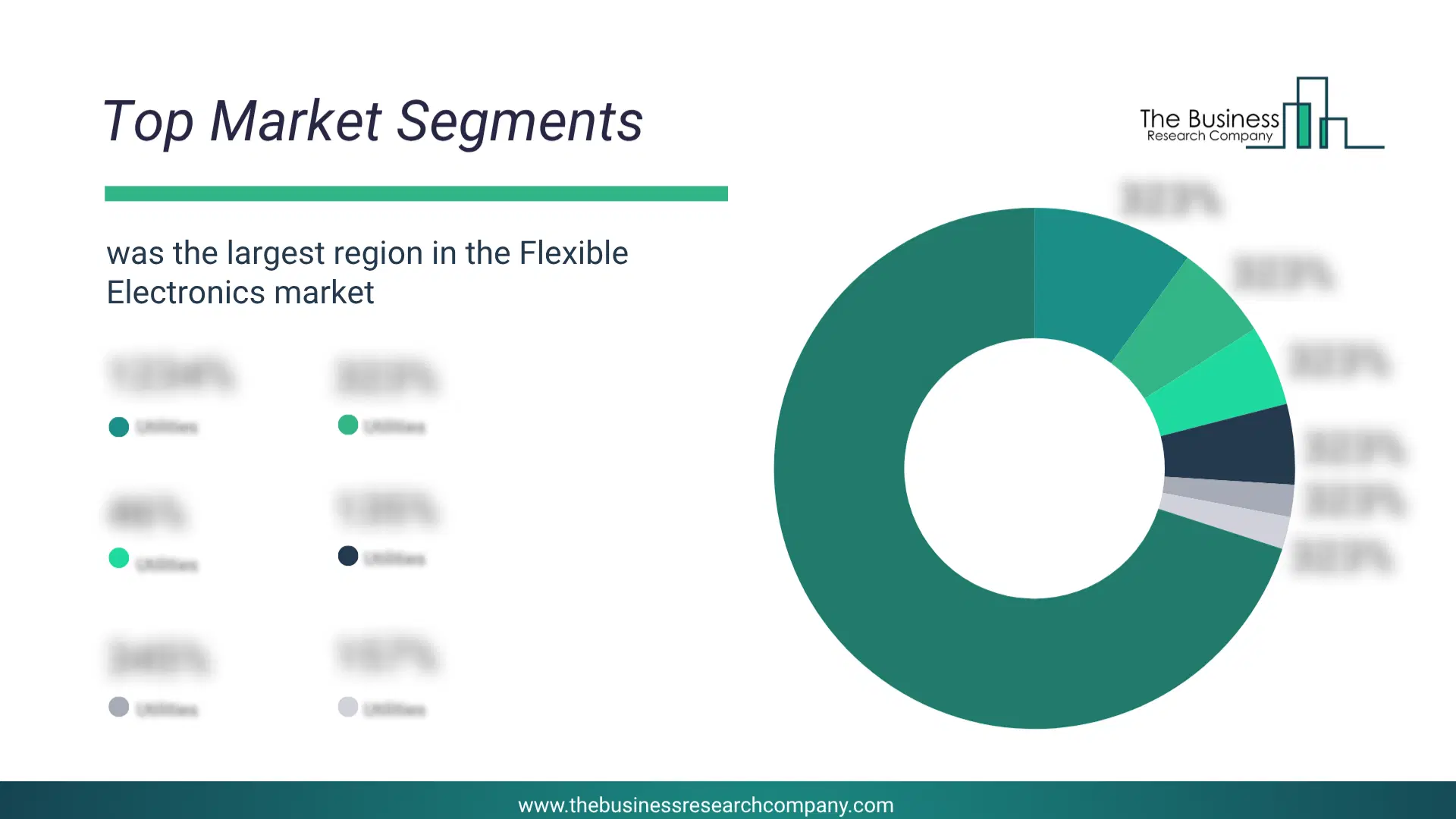
• Flexible Electronics market size has reached to $40.84 billion in 2025 • Expected to grow to $76.18 billion in 2030 at a compound annual growth rate (CAGR) of 13.2% • Growth Driver: Rising Consumer Electronics Demand Fuels Flexible Electronics Growth • Market Trend: Royole Rokit Empowering Product Design With Flexible Electronics • Asia-Pacific was the largest region in 2025 and Europe is the fastest growing region.What Is Covered Under Flexible Electronics Market?
Flexible electronics refers to flex circuits, a method of assembling electronic circuits that involves mounting electronics on flexible plastic substrates like transparent conductive polyester film, polyimide, or polyether ether ketone (PEEK). Silver circuits can be screen printed on polyester to create flex circuits. The main types of flexible electronics are flexible display, flexible battery, flexible sensors, flexible memory, and flexible photovoltaics. Flexible display screens are flexible displays that are made of Organic Light Emitting Diodes (OLED) displays The different circuit structures include single-sided, double-sided and others and are applicable in displays, thin-film photovoltaics, printed sensors, batteries, Organic Light Emitting Diodes (OLED) lighting, other applications and are used in consumer electronics, energy, and power, healthcare, automotive, military and defense, aerospace, other verticals.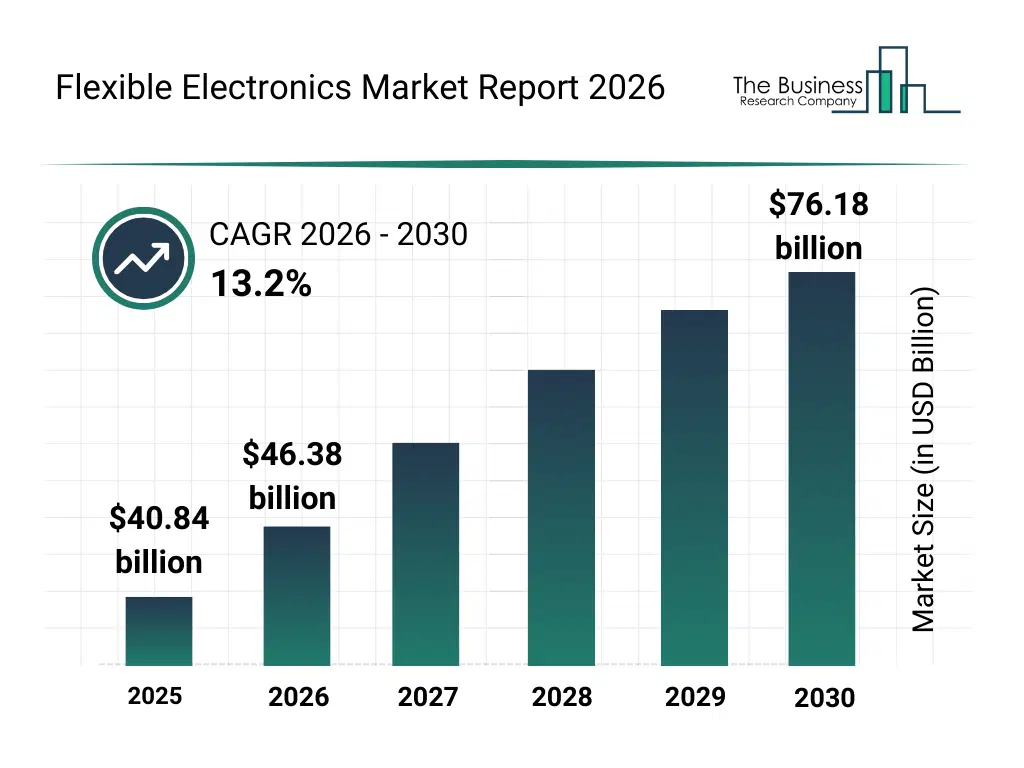
What Is The Flexible Electronics Market Size 2026 And Growth Rate?
The flexible electronics market size has grown rapidly in recent years. It will grow from $40.84 billion in 2025 to $46.38 billion in 2026 at a compound annual growth rate (CAGR) of 13.6%. The growth in the historic period can be attributed to rise in adoption of flexible displays, growth in printed sensors and thin-film photovoltaics, increase in flexible batteries usage, expansion in consumer electronics and healthcare applications, integration in automotive and aerospace industries.What Is The Flexible Electronics Market Growth Forecast?
The flexible electronics market size is expected to see rapid growth in the next few years. It will grow to $76.18 billion in 2030 at a compound annual growth rate (CAGR) of 13.2%. The growth in the forecast period can be attributed to increase in AI and IoT-enabled flexible electronics, rising deployment of smart manufacturing for flex circuits, growth in sustainable materials usage, expansion in advanced flexible sensors and batteries, increasing adoption of flexible electronics in industrial and military applications. Major trends in the forecast period include integration of AI-based flexible electronics design, deployment of IoT-enabled flexible devices, implementation of smart manufacturing for flex circuits, adoption of sustainable materials in flexible electronics, expansion of AI-powered quality control in flex circuits.
Global Flexible Electronics Market Segmentation
1) By Component: Flexible Display, Flexible Battery, Flexible Sensors, Flexible Memory, Flexible Photovoltaics 2) By Circuit Structure: Single-Sided, Double-Sided, Other Circuit Structures 3) By Application: Displays, Thin-Film Photovoltaics, Printed Sensors, Batteries, Organic Light Emitting Diodes (OLED) Lighting, Other Applications 4) By Vertical: Consumer Electronics, Energy And Power, Healthcare, Automotive, Military And Defense, Aerospace, Other Verticals Subsegments: 1) By Flexible Display: OLED Displays, LCD Displays, EPD Displays 2) By Flexible Battery: Lithium-Ion Flexible Batteries, Solid-State Flexible Batteries 3) By Flexible Sensors: Pressure Sensors, Temperature Sensors, Touch Sensors 4) By Flexible Memory: Flexible SRAM, Flexible Flash Memory 5) By Flexible Photovoltaics: Organic Photovoltaics (OPV), Thin-Film PhotovoltaicsWhat Is The Driver Of The Flexible Electronics Market?
Rising demand for consumer electronic devices is driving the growth of the flexible electronics market. Consumer electronics (CE) refers to any electronic equipment intended for end-users or consumers to purchase and use regularly for non-commercial or professional purposes. Consumer electronics use flexible electronics in most electronic devices; as a result, rising demand for consumer electronics increases the demand for the flexible electronics market. For instance, in February 2024, according to the Japan Electronics and Information Technology Industries Association, a Japan-based trade organization, consumer electronic equipment production reached $201.91 million (¥31,685 million), up from $149.27 million (¥23,425 million) in January 2023. Therefore, the rising demand for consumer electronics drives the flexible electronics industry.Key Players In The Global Flexible Electronics Market
Major companies operating in the flexible electronics market are OLEDWorks LLC, AU Optronics Corp., Cymbet Corporation, E Ink Holdings Inc., Enfucell Oy, FlexEnable Ltd., Flexpoint Sensor Systems Inc., Imprint Energy Inc., LG Electronics Inc., Palo Alto Research Center Incorporated, Royole Corporation, Samsung Electronics Co. Ltd., Solar Frontier K.K., LG Corporation, Enfucell Flexible Electronics Co. Ltd., E Ink Holdings, Bebop Sensors Inc., Sensing Tex SL, Coatema Coating Machinery GmbH, Agfa-Gevaert NV, GSI Technologies, Ynvisible Interactive Inc., Isorg SA, PragmatIC Semiconductor, Thales Digital Factory, StoreDot Ltd.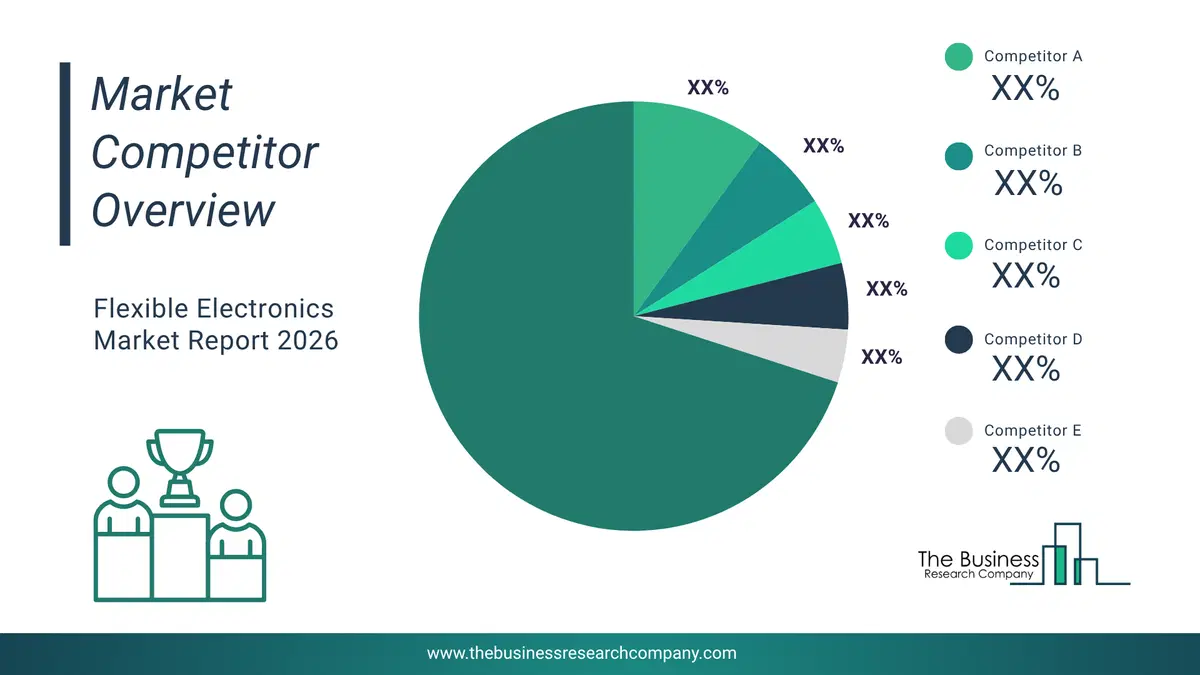
This chart is for illustrative purposes; the full report includes a detailed competitor analysis and comprehensive overview of the top 10 companies in the market.
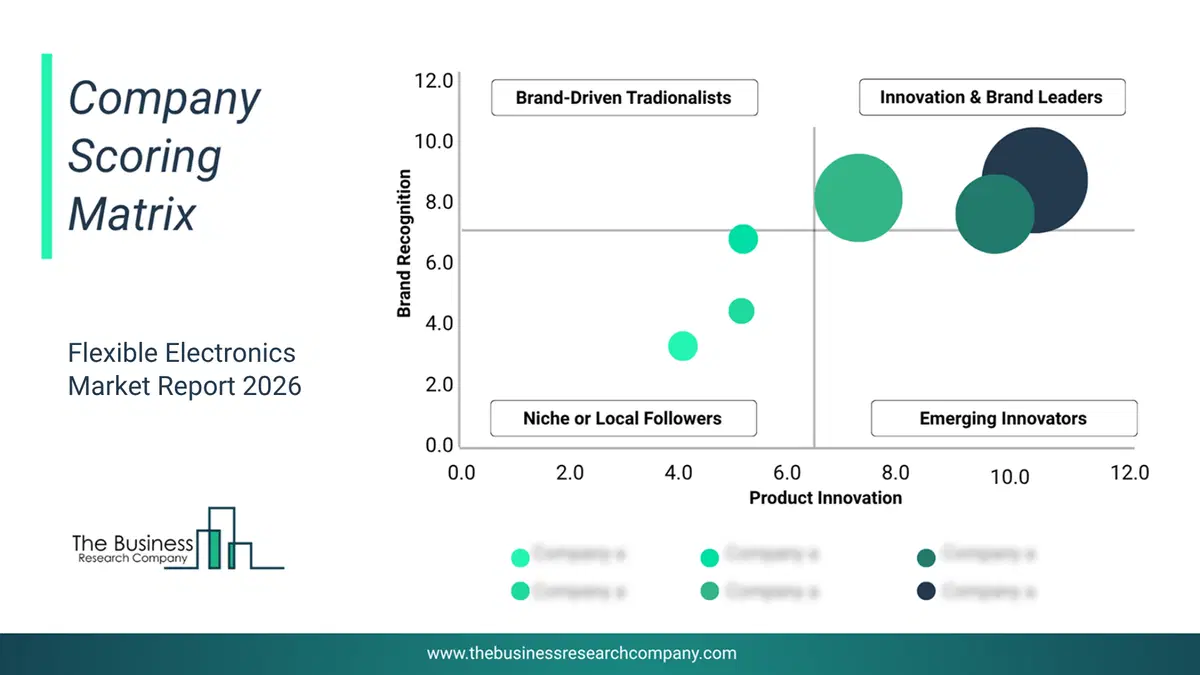
This chart maps companies by product innovation and brand strength, with bubble size indicating relative revenue, helping identify market leaders, challengers, and niche players. This is an illustrative chart; the full report provides a complete and accurate competitive analysis.
Global Flexible Electronics Market Trends and Insights
Major companies operating in the flexible electronics market are focusing on innovating products with technology, such as the flexible hybrid electronics, to provide reliable services to customers. Flexible hybrid electronics (FHE) refers to a class of electronic devices that combine flexible substrates, such as plastic, paper, or fabric, with traditional and printed electronic components. For instance, in November 2023, Würth Elektronik, a Germany-based company that specializes in the design, manufacturing, and supply of electronic and electromechanical components, launched the research project HyPerStripes. HyPerStripes is to advance flexible hybrid electronics, focusing on applications such as medical instruments, health monitoring, and secure electronics. One of its key innovations is the development of roll-to-roll processing, allowing for the production of endless flexible electronics on stretchable substrates. This project aims to transfer European research and development knowledge into industrial production via a sustainable technology platform.What Are Latest Mergers And Acquisitions In The Flexible Electronics Market?
In March 2023, MBK Partners, a South Korea–based private equity firm, agreed to acquire NexFlex for ₩530 billion (approximately $403 million). The acquisition of NexFlex by MBK Partners aims to strengthen its portfolio in advanced materials and electronics and support NexFlex’s expansion in the global flexible copper-clad laminate (FCCL) market. NexFlex is a South Korea–based manufacturer of flexible copper-clad laminates used in flexible printed circuit boards for smartphones, displays, and other electronic devices.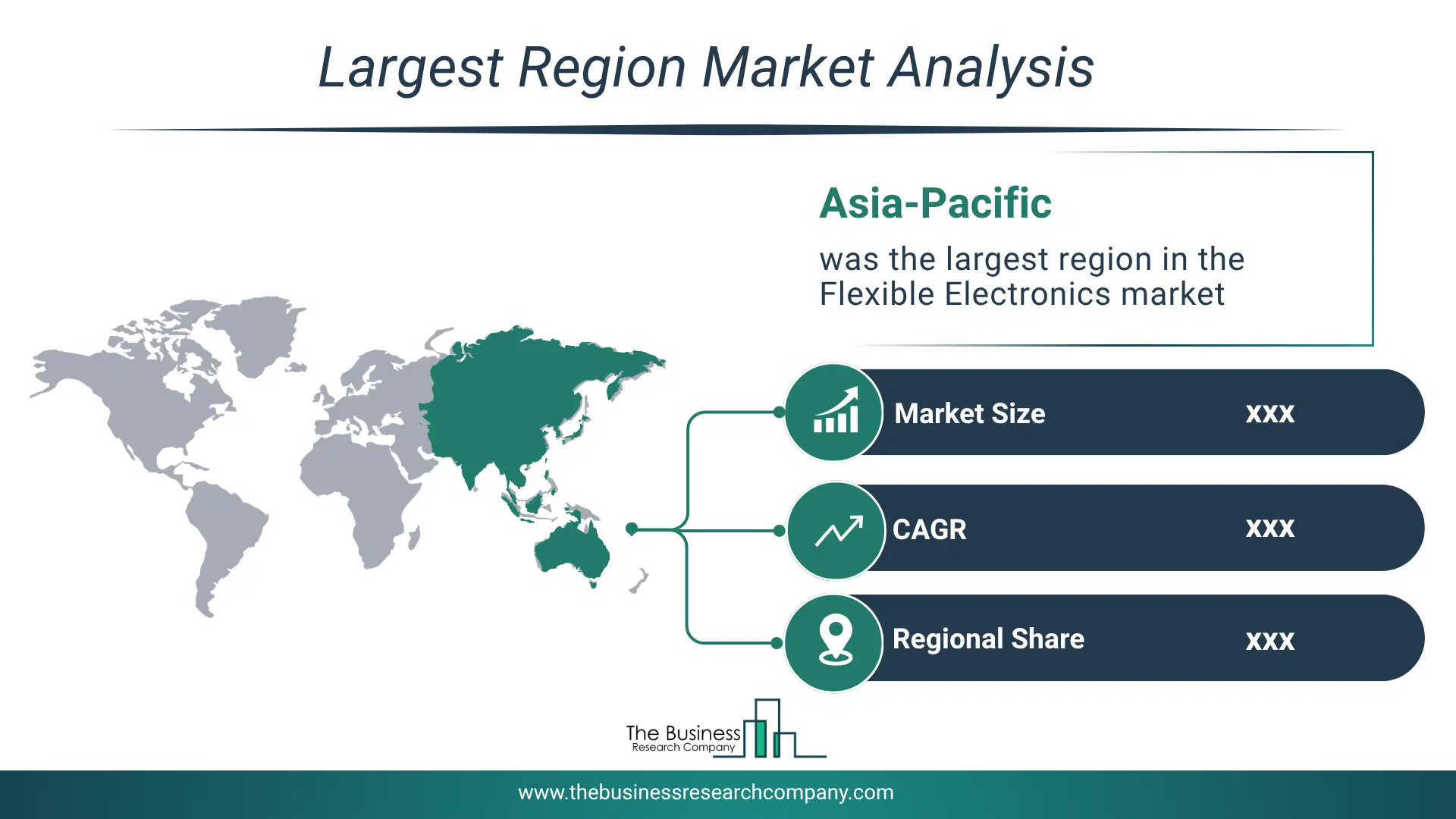
Regional Outlook
Asia-Pacific was the largest region in the flexible electronics market in 2025. Europe is expected to be the fastest-growing region in the forecast period. The regions covered in this market report are Asia-Pacific, South East Asia, Western Europe, Eastern Europe, North America, South America, Middle East, Africa. The countries covered in this market report are Australia, Brazil, China, France, Germany, India, Indonesia, Japan, Taiwan, Russia, South Korea, UK, USA, Canada, Italy, Spain.What Defines the Flexible Electronics Market?
The flexible electronics market consists of sales of liquid crystal display (LCD), electrophoretic display (EPD), organic light emitting diode (OLED) display, thin-film batteries, printed batteries, layered lithium polymer batteries, micro-batteries, advanced lithium-ion batteries, thin flexible supercapacitors, stretchable batteries, flexible pressure sensors, flexible gas sensors, flexible humidity sensors, flexible temperature sensors, flexible strain sensors, flexible magneto-impedance sensors, and flexible thermal flow sensors. Values in this market are ‘factory gate’ values, that is the value of goods sold by the manufacturers or creators of the goods, whether to other entities (including downstream manufacturers, wholesalers, distributors, and retailers) or directly to end customers. The value of goods in this market includes related services sold by the creators of the goods.How is Market Value Defined and Measured?
The market value is defined as the revenues that enterprises gain from the sale of goods and/or services within the specified market and geography through sales, grants, or donations in terms of the currency (in USD unless otherwise specified). The revenues for a specified geography are consumption values that are revenues generated by organizations in the specified geography within the market, irrespective of where they are produced. It does not include revenues from resales along the supply chain, either further along the supply chain or as part of other products.
This chart presents market attractiveness based on a quantitative evaluation of growth, competition, strategic alignment, and risk, offering a clear view of opportunity areas for decision-making. This chart is for illustrative purposes; the full report contains the complete analysis.

This chart highlights the Total Addressable Market (TAM) by estimating the maximum revenue opportunity using an assumption-driven approach, supporting strategic planning and opportunity sizing across markets. The chart is illustrative; the full report provides a more comprehensive analysis.
What Key Data and Analysis Are Included in the Flexible Electronics Market Report 2026?
The flexible electronics market research report is one of a series of new reports from The Business Research Company that provides market statistics, including industry global market size, regional shares, competitors with the market share, detailed market segments, market trends and opportunities, and any further data you may need to thrive in the flexible electronics industry. The market research report delivers a complete perspective of everything you need, with an in-depth analysis of the current and future state of the industry.Flexible Electronics Market Report Forecast Analysis
| Report Attribute | Details |
|---|---|
| Market Size Value In 2026 | $46.38 billion |
| Revenue Forecast In 2030 | $76.18 billion |
| Growth Rate | CAGR of 13.2% from 2026 to 2030 |
| Base Year For Estimation | 2025 |
| Actual Estimates/Historical Data | 2020-2025 |
| Forecast Period | 2026 - 2030 |
| Market Representation | Revenue in USD Billion and CAGR from 2026 to 2030 |
| Segments Covered | Component, Circuit Structure, Application, Vertical |
| Regional Scope | Asia-Pacific, Western Europe, Eastern Europe, North America, South America, Middle East, Africa |
| Country Scope | The countries covered in the report are Australia, Brazil, China, France, Germany, India, Indonesia, Japan, Taiwan, Russia, South Korea, UK, USA, Canada, Italy, Spain. |
| Key Companies Profiled | OLEDWorks LLC, AU Optronics Corp., Cymbet Corporation, E Ink Holdings Inc., Enfucell Oy, FlexEnable Ltd., Flexpoint Sensor Systems Inc., Imprint Energy Inc., LG Electronics Inc., Palo Alto Research Center Incorporated, Royole Corporation, Samsung Electronics Co. Ltd., Solar Frontier K.K., LG Corporation, Enfucell Flexible Electronics Co. Ltd., E Ink Holdings, Bebop Sensors Inc., Sensing Tex SL, Coatema Coating Machinery GmbH, Agfa-Gevaert NV, GSI Technologies, Ynvisible Interactive Inc., Isorg SA, PragmatIC Semiconductor, Thales Digital Factory, StoreDot Ltd. |
| Customization Scope | Request for Customization |
| Pricing And Purchase Options | Explore Purchase Options |