
Flight Safety Camera Systems Market Report 2026
Global Outlook – By Type (Cockpit Cameras, Cabin Cameras, External Cameras), By Technology (Analog, Digital), By Platform (Fixed Wing Aircraft, Rotary Wing Aircraft, Unmanned Aerial Vehicles), By Application (Commercial Aviation, Military Aviation, General Aviation, Other Applications), By End User (Original Equipment Manufacturers, Aftermarket) – Market Size, Trends, Strategies, and Forecast to 2035
Flight Safety Camera Systems Market Overview
• Flight Safety Camera Systems market size has reached to $1.94 billion in 2025 • Expected to grow to $3.07 billion in 2030 at a compound annual growth rate (CAGR) of 9.5% • Growth Driver: Increasing Commercial Aircraft Deliveries Driving The Growth Of The Market Due To Rising Air Passenger Traffic • Market Trend: Next-Generation Aircraft Situational Awareness Innovations • North America was the largest region in 2025 and Asia-Pacific is the fastest growing region.What Is Covered Under Flight Safety Camera Systems Market?
Flight safety camera systems are specialized onboard camera solutions installed in aircraft to monitor flight operations, external surroundings, and other areas relevant to aircraft safety and operational awareness. Depending on their configuration, they provide real-time or recorded video to support situational awareness, accident and incident investigation, security, and maintenance diagnostics. The main types of flight safety camera systems include cockpit cameras, cabin cameras, and external cameras. Cockpit cameras refer to camera systems installed within the flight deck to capture visual information that can support situational awareness, safety monitoring, and incident analysis. These systems use analog and digital technologies and are installed on fixed wing aircraft, rotary wing aircraft, and unmanned aerial vehicles. The various applications involved are commercial aviation, military aviation, general aviation, and others and they are utilized by end users including original equipment manufacturers and aftermarket providers.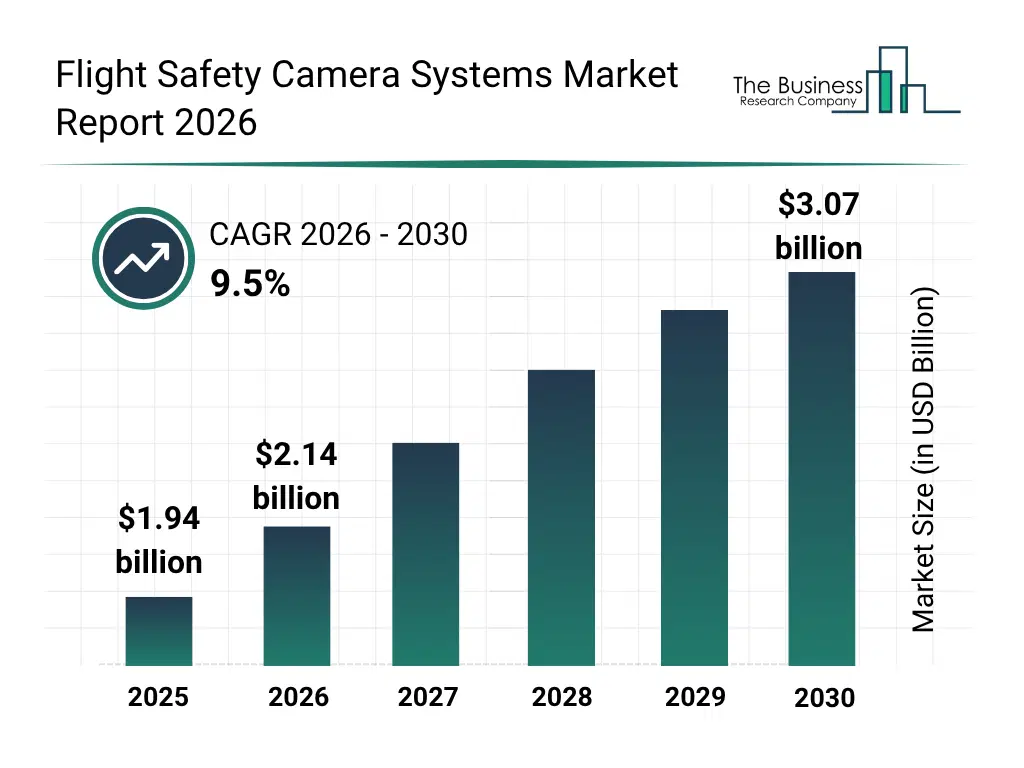
What Is The Flight Safety Camera Systems Market Size and Share 2026?
The flight safety camera systems market size has grown strongly in recent years. It will grow from $1.94 billion in 2025 to $2.14 billion in 2026 at a compound annual growth rate (CAGR) of 9.9%. The growth in the historic period can be attributed to increasing adoption of onboard video surveillance for aircraft safety, rising regulatory emphasis on aircraft monitoring and incident investigation, growing demand for recorded flight footage to support accident analysis, increasing use of cabin surveillance to improve passenger and crew security, rising deployment of external cameras for aircraft visibility during ground operations.What Is The Flight Safety Camera Systems Market Growth Forecast?
The flight safety camera systems market size is expected to see strong growth in the next few years. It will grow to $3.07 billion in 2030 at a compound annual growth rate (CAGR) of 9.5%. The growth in the forecast period can be attributed to expanding demand for advanced aircraft vision capabilities across commercial and military fleets, increasing adoption of infrared and low-light monitoring for enhanced operational visibility, growing installation of camera systems on UAV platforms, rising need for continuous visual monitoring across critical aircraft zones, increasing demand for integrated camera solutions in newly manufactured aircraft. Major trends in the forecast period include increasing adoption of high-resolution cameras for enhanced aircraft situational awareness, rising deployment of infrared and low-light cameras for improved visibility in challenging conditions, growing integration of onboard camera systems across cockpit, cabin, and external aircraft areas, increasing demand for continuous video recording to support accident investigation and safety assessments, expanding use of aircraft camera systems for maintenance diagnostics and operational monitoring.Tariff Impact On Flight Safety Camera Systems Market
Tariffs are impacting the flight safety camera systems market by increasing the cost of imported aircraft cameras, image sensors, optical components, video processing units, and electronic components required for onboard surveillance systems. This is raising equipment and installation costs and may slow camera system upgrades across commercial aviation, military aviation, and general aviation, particularly in regions dependent on imported aerospace electronics such as Asia-Pacific and Latin America. Hardware-intensive segments such as cockpit cameras, cabin cameras, and external cameras are most affected due to global component and aerospace supply chain dependencies. However, tariffs are also encouraging regional camera manufacturing, domestic sourcing of electronic components, supplier diversification, and increased investment in local aerospace surveillance ecosystems, creating greater long-term supply chain resilience.
Global Flight Safety Camera Systems Market Segmentation
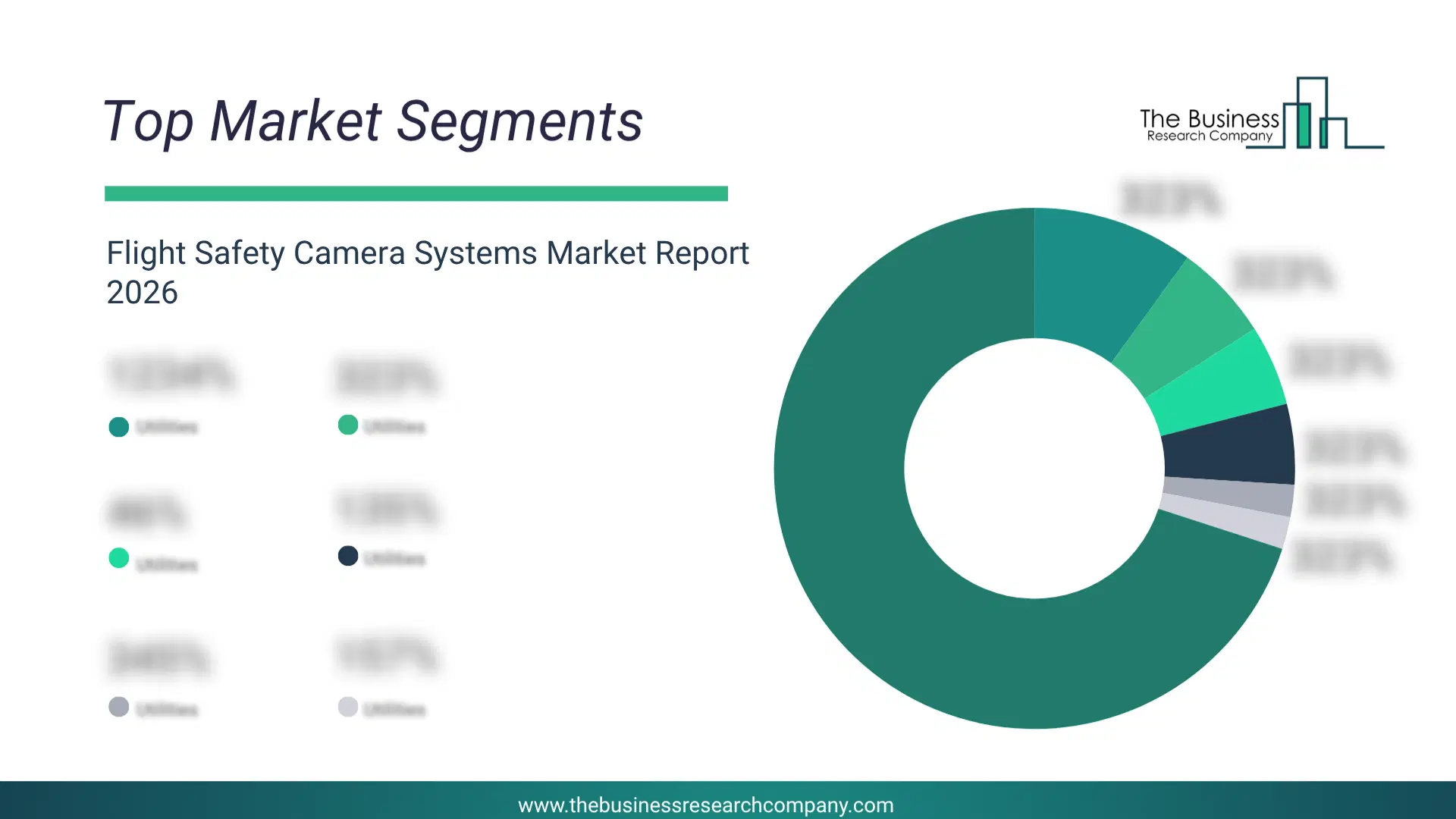
2) By Technology: Analog, Digital 3) By Platform: Fixed Wing Aircraft, Rotary Wing Aircraft, Unmanned Aerial Vehicles 4) By Application: Commercial Aviation, Military Aviation, General Aviation, Other Applications 5) By End User: Original Equipment Manufacturers, Aftermarket Subsegments: 1) By Cockpit Cameras: Pilot Monitoring Cameras, Instrument Panel Monitoring Cameras, Forward Vision Cameras, Low Light Vision Cameras, Infrared Vision Cameras 2) By Cabin Cameras: Passenger Monitoring Cameras, Crew Activity Monitoring Cameras, Cabin Surveillance Cameras, Emergency Exit Monitoring Cameras, Cargo Cabin Monitoring Cameras 3) By External Cameras: Nose Mounted Cameras, Tail Mounted Cameras, Wing Mounted Cameras, Landing Gear Cameras, Belly Mounted CamerasWhat Is The Driver Of The Flight Safety Camera Systems Market?
The increasing commercial aircraft deliveries are expected to propel the growth of the flight safety camera systems market going forward. Commercial aircraft deliveries refer to the transfer of newly manufactured passenger and cargo aircraft from aircraft manufacturers to airline operators after production, certification, and acceptance. Commercial aircraft deliveries are increasing due to rising air passenger traffic, which is driving airlines to purchase more aircraft to accommodate the growing number of passengers. Increasing commercial aircraft deliveries drives the adoption of flight safety camera systems by creating demand for advanced onboard camera installations in new aircraft to enhance flight monitoring and safety operations. For instance, in June 2025, according to the International Air Transport Association (IATA), a Canada-based airline industry association, 1,851 aircraft were expected to be delivered globally in 2026, up from 1,692 aircraft forecast for 2025, representing an expected increase of approximately 9.4%. Therefore, the increasing commercial aircraft deliveries are driving the growth of the flight safety camera systems industry.Key Players In The Global Flight Safety Camera Systems Market
Major companies operating in the flight safety camera systems market are RTX Corporation, Honeywell International Inc., Safran S.A., BAE Systems plc, Thales Group, L3Harris Technologies Inc., Leonardo S.p.A., Panasonic Holdings Corporation, Elbit Systems Ltd., Garmin Ltd., Teledyne Technologies Incorporated, Curtiss-Wright Corporation, HENSOLDT AG, AeroVironment Inc., Groupe Latecoere, KID-Systeme GmbH, AD Aerospace Ltd., Cabin Avionics Ltd., Kappa Optronics GmbH, Opgal Optronic Industries Ltd., JAI A/S, Sierra-Olympia Technologies Inc., Imperx Inc., IO Industries Inc., Raptor Photonics Ltd., Rugged Video Ltd., Aerial View Systems Inc., IRCameras LLC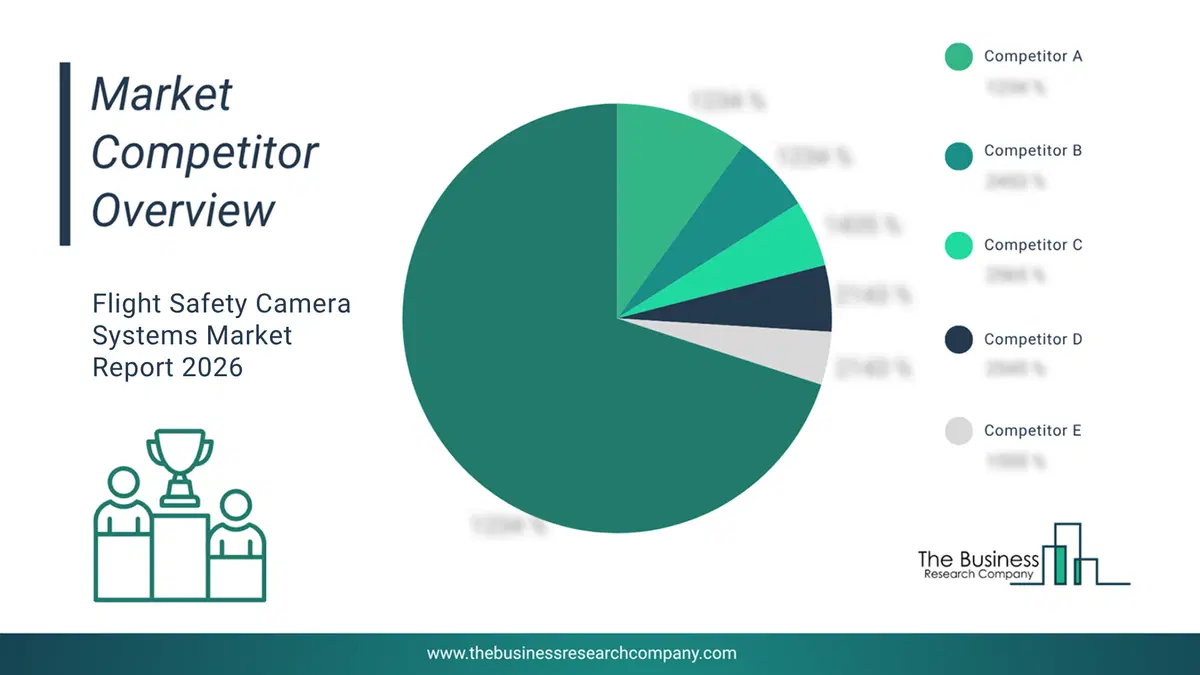
This chart is for illustrative purposes; the full report includes a detailed competitor analysis and comprehensive overview of the top 10 companies in the market.
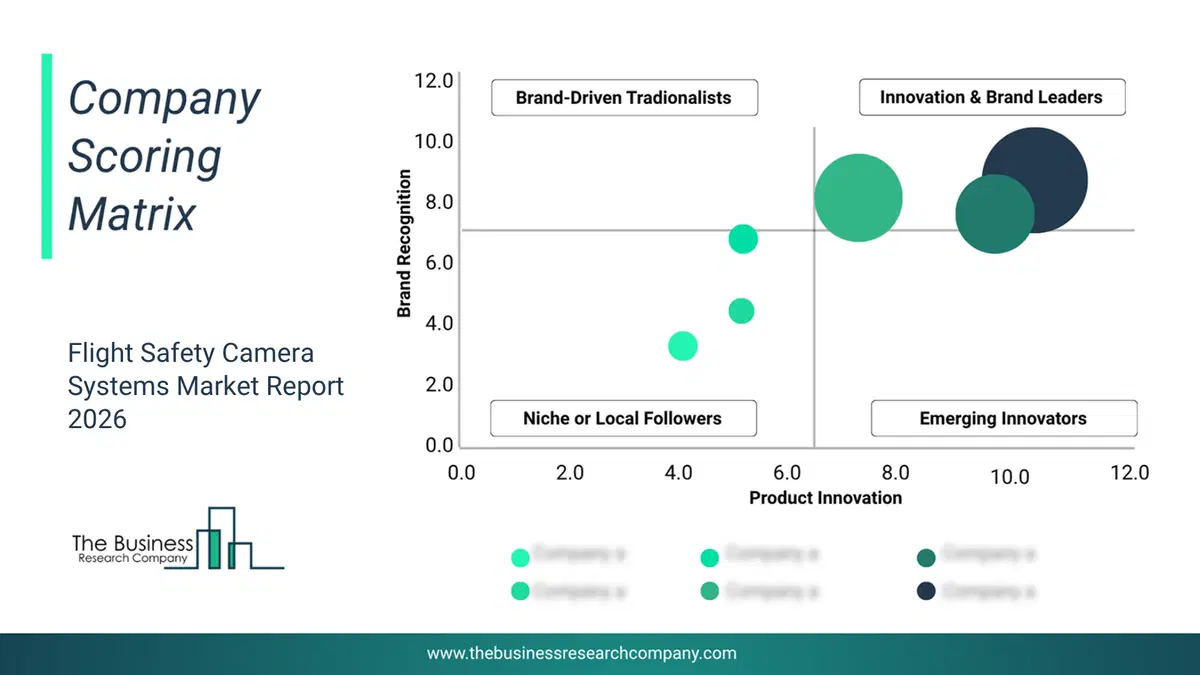
This chart maps companies by product innovation and brand strength, with bubble size indicating relative revenue, helping identify market leaders, challengers, and niche players. This is an illustrative chart; the full report provides a complete and accurate competitive analysis.
Global Flight Safety Camera Systems Market Trends and Insights
Major companies operating in the flight safety camera systems market are focusing on developing innovative solutions, such as 360-degree aircraft situational awareness camera systems, to enhance pilot situational awareness, operational safety, and mission efficiency during critical flight operations. A 360-degree aircraft situational awareness camera system integrates multiple high-definition cameras with real-time image stitching software to generate a seamless bird's-eye view of the aircraft and its surroundings, providing broader visibility than traditional single-view cockpit, belly-mounted, or door-mounted camera systems that offer limited fields of view. For instance, in March 2026, Turbolyft Aerospace Corporation, a Canada-based aviation technology company, launched AWARE, a next-generation helicopter situational awareness platform, at Verticon 2026. The system is the first 360-degree overhead aircraft awareness solution developed for the Airbus AS350/H125 helicopter, using six strategically positioned onboard cameras to capture synchronized imagery around the aircraft. Through advanced HD image processing and real-time image stitching, AWARE generates a seamless top-down view that eliminates blind spots while improving approach safety, landing-zone visibility, and obstacle detection. The platform enhances operational accuracy during confined-area landings, offshore operations, rooftop approaches, emergency medical services, search and rescue missions, utility operations, and law enforcement activities, while reducing pilot workload. In addition, it is designed to support future capabilities, including AI-powered object recognition, people detection, thermal monitoring, and longline visibility, further enhancing flight safety and mission effectiveness.What Are Latest Mergers And Acquisitions In The Flight Safety Camera Systems Market?
In October 2025, Acron Aviation Inc., a US-based aerospace and defense company, acquired Trakka Systems for an undisclosed amount. With this acquisition, Acron Aviation aims to expand its aviation footprint, strengthen its line-fit capabilities for original equipment manufacturer (OEM) platforms, and enhance its mission-critical aircraft systems portfolio by integrating advanced vision technologies into its solutions offering. Trakka Systems is an Australia-based manufacturer of flight safety and airborne vision camera systems for aerospace and mission-critical applications.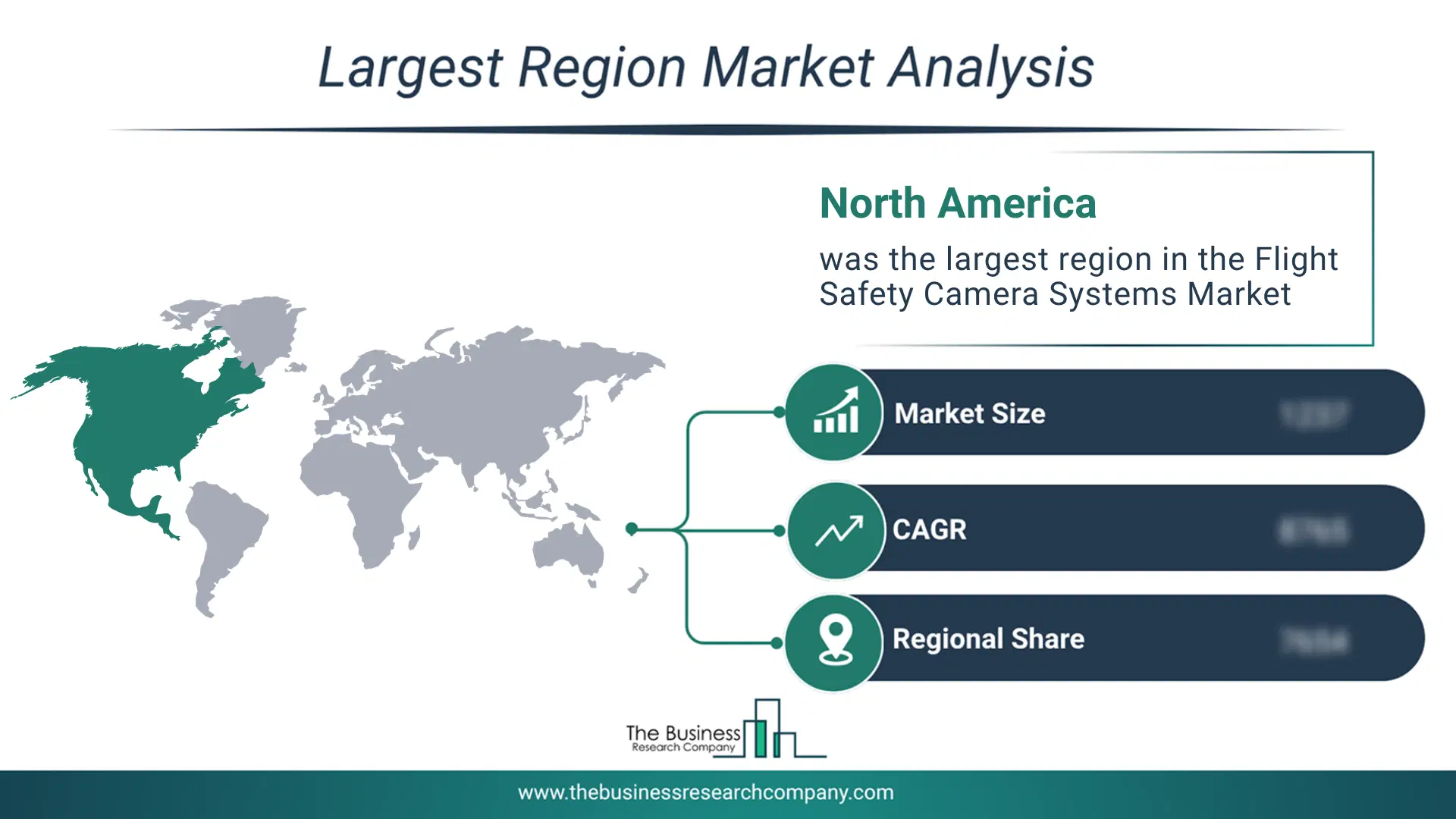
Regional Outlook/Insights
North America was the largest region in the flight safety camera systems market in 2025. Asia-Pacific is expected to be the fastest-growing region in the forecast period. The regions covered in this market report are Asia-Pacific, South East Asia, Western Europe, Eastern Europe, North America, South America, Middle East, Africa. The countries covered in this market report are Australia, Brazil, China, France, Germany, India, Indonesia, Japan, Taiwan, Russia, South Korea, UK, USA, Canada, Italy, Spain.What Defines the Flight Safety Camera Systems Market?
The flight safety camera systems market consists of sales of cargo compartment cameras, tail-mounted cameras, landing gear monitoring cameras, and multi-camera video management systems. Values in this market are ‘factory gate’ values, that is the value of goods sold by the manufacturers or creators of the goods, whether to other entities (including downstream manufacturers, wholesalers, distributors and retailers) or directly to end customers. The value of goods in this market includes related services sold by the creators of the goods.How is Market Value Defined and Measured?
The market value is defined as the revenues that enterprises gain from the sale of goods and/or services within the specified market and geography through sales, grants, or donations in terms of the currency (in USD unless otherwise specified). The revenues for a specified geography are consumption values that are revenues generated by organizations in the specified geography within the market, irrespective of where they are produced. It does not include revenues from resales along the supply chain, either further along the supply chain or as part of other products.
This chart presents market attractiveness based on a quantitative evaluation of growth, competition, strategic alignment, and risk, offering a clear view of opportunity areas for decision-making. This chart is for illustrative purposes; the full report contains the complete analysis.

This chart highlights the Total Addressable Market (TAM) by estimating the maximum revenue opportunity using an assumption-driven approach, supporting strategic planning and opportunity sizing across markets. The chart is illustrative; the full report provides a more comprehensive analysis.
What Key Data and Analysis Are Included in the Flight Safety Camera Systems Market Report 2026?
The flight safety camera systems market research report is one of a series of new reports from The Business Research Company that provides market statistics, including industry global market size, regional shares, competitors with the market share, detailed market segments, market trends and opportunities, and any further data you may need to thrive in the flight safety camera systems industry. The market research report delivers a complete perspective of everything you need, with an in-depth analysis of the current and future state of the industry.Flight Safety Camera Systems Market Report Forecast Analysis
| Report Attribute | Details |
|---|---|
| Market Size Value In 2026 | $2.14 billion |
| Revenue Forecast In 2030 | $3.07 billion |
| Growth Rate | CAGR of 9.5% from 2026 to 2035 |
| Base Year For Estimation | 2025 |
| Actual Estimates/Historical Data | 2020-2025 |
| Forecast Period | 2026 - 2030 |
| Market Representation | Revenue in USD Billion and CAGR from 2026 to 2030 |
| Segments Covered | Type, Technology, Platform, Application, End User |
| Regional Scope | Asia-Pacific, Western Europe, Eastern Europe, North America, South America, Middle East, Africa |
| Country Scope | The countries covered in the report are Australia, Brazil, China, France, Germany, India, Indonesia, Japan, Taiwan, Russia, South Korea, UK, USA, Canada, Italy, Spain. |
| Customization Scope | Request for Customization |
| Pricing And Purchase Options | Explore Purchase Options |