

Floating Offshore Wind Market Report 2026
Global Outlook – By Component (Turbines, Floating Structures, Subsea Cables, Other Components), By Location (Shallow Water, Deep Water, Transitional Water), By Application (Commercial Power Generation, Research And Development, Other Applications) – Market Size, Trends, Strategies, and Forecast to 2030
Floating Offshore Wind Market Overview
• Floating Offshore Wind market size has reached to $2.12 billion in 2025 • Expected to grow to $13.05 billion in 2030 at a compound annual growth rate (CAGR) of 43.3% • Growth Driver: Rising Demand For Renewable Energy Fueling The Growth Of The Market Due To Expanding Clean Energy Initiatives • Market Trend: Revolutionizing Offshore Wind With Semi-Submersible Designs • Europe was the largest region in 2025 and is the fastest growing region.What Is Covered Under Floating Offshore Wind Market?
Floating offshore wind refers to wind turbines that are mounted on floating platforms, allowing them to be deployed in deeper waters where traditional fixed-bottom turbines are not feasible. The purpose of this technology is to harness wind energy in areas with higher wind speeds, expanding the potential for offshore wind power generation beyond shallow coastal regions. The main components of floating offshore wind systems include turbines, floating structures, subsea cables, and other elements. A turbine is a rotary mechanical device that extracts energy from fluid flow and converts it into useful work. These systems are used in various locations, including shallow water, deep water, and transitional water, and serve applications such as commercial power generation, research and development, and other uses.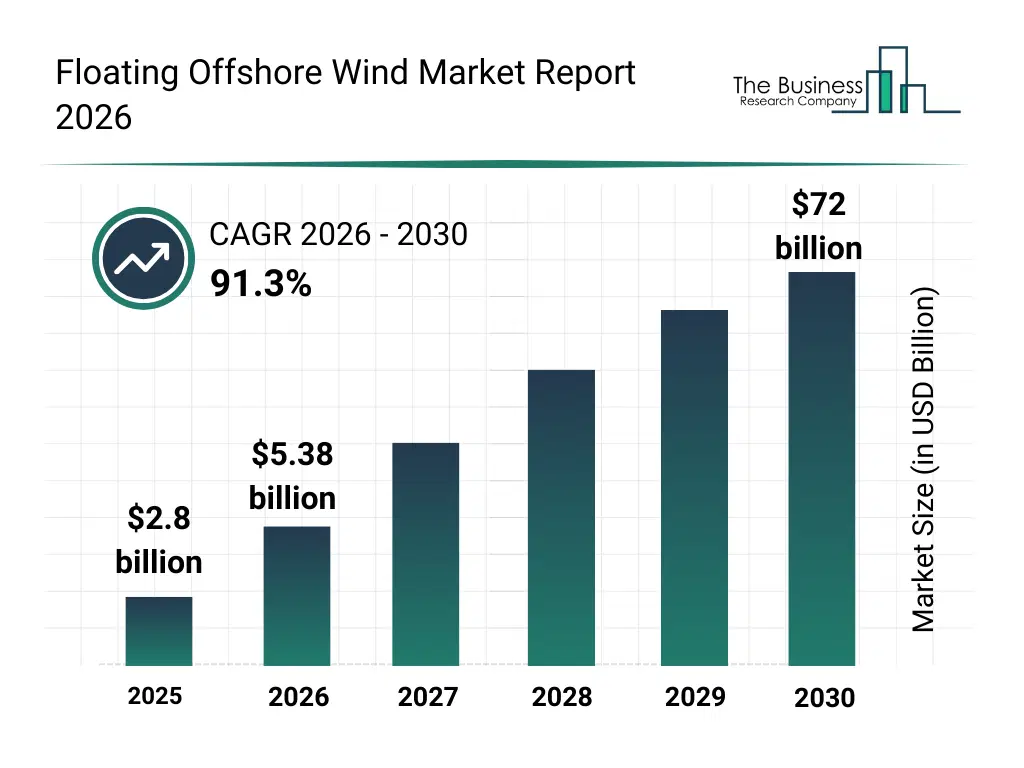
What Is The Floating Offshore Wind Market Size and Share 2026?
The floating offshore wind market size has grown exponentially in recent years. It will grow from $2.12 billion in 2025 to $3.09 billion in 2026 at a compound annual growth rate (CAGR) of 45.6%. The growth in the historic period can be attributed to rising offshore wind energy investments, limitations of shallow water fixed-bottom turbines, government incentives for renewable energy, technological advancements in wind turbine design, growing global electricity demand.What Is The Floating Offshore Wind Market Growth Forecast?
The floating offshore wind market size is expected to see exponential growth in the next few years. It will grow to $13.05 billion in 2030 at a compound annual growth rate (CAGR) of 43.3%. The growth in the forecast period can be attributed to expansion of deep-water wind farm projects, increasing focus on carbon neutrality, advancements in floating platform technology, integration with smart grids and energy storage, supportive government policies and subsidies. Major trends in the forecast period include development of high-capacity floating wind turbines, adoption of semi-submersible and spar-buoy platforms, integration of advanced mooring and ballast systems, deployment of subsea power and fiber optic cables, expansion of floating offshore wind farms for commercial power generation.
Global Floating Offshore Wind Market Segmentation
2) By Location: Shallow Water, Deep Water, Transitional Water 3) By Application: Commercial Power Generation, Research And Development, Other Applications Subsegments: 1) By Turbines: Horizontal Axis Wind Turbines (HAWT), Vertical Axis Wind Turbines (VAWT), Direct-Drive Wind Turbines, Gearbox-based Wind Turbines, High Capacity Wind Turbines 2) By Floating Structures: Spar-Buoy, Semi-Submersible Platform, Tension Leg Platform (TLP), Floating Concrete Structures 3) By Subsea Cables: Power Cables, Fiber Optic Cables, Umbilical Cables 4) By Other Components: Mooring Systems, Anchoring Systems, Ballast Systems, Dynamic Positioning SystemsWhat Is The Driver Of The Floating Offshore Wind Market?
Increasing demand for renewable energy is expected to propel the growth of the floating offshore wind market going forward. Renewable energy refers to energy that is generated from natural resources that are replenished over time, such as sunlight, wind, rain, tides, waves, geothermal heat, and more. The increasing demand for renewable energy is due to reduced carbon emissions by replacing fossil fuels like coal, oil, and natural gas, which are the primary sources of greenhouse gases (GHGs) such as carbon dioxide (CO₂). Floating offshore wind helps renewable energy by harnessing wind power in deeper ocean waters, where traditional fixed turbines can't be deployed, significantly expanding the potential for clean energy generation in areas with strong and consistent winds. For instance, in February 2024, according to a report published by the Energy Information Administration, a US-based government agency, in 2024, solar capacity is expected to grow by 30% (31 GW), while U.S. wind capacity is projected to rise by 5% annually, adding 6 GW in 2023 and 7 GW in 2024. Therefore, the increased renewable energy demand is driving the floating offshore wind industry.Key Players In The Global Floating Offshore Wind Market
Major companies operating in the floating offshore wind market are Equinor ASA, Hitachi Ltd., Iberdrola S.A., Mitsubishi Heavy Industries, ABB Limited, Ørsted A/S, Prysmian S.p.A., Shanghai Electric Group Company Limited, Siemens Gamesa Renewable Energy S.A., Goldwind Science & Technology Co Ltd., Guangdong Mingyang Smart Energy Group Co Ltd., General Electric Renewable Energy, Aker Solutions ASA, Vattenfall AB, Envision Energy Limited, Principle Power Inc., Naval Energies SAS, Doosan Heavy Industries & Construction Company Limited, BW Ideol AS, Global Energy Group Limited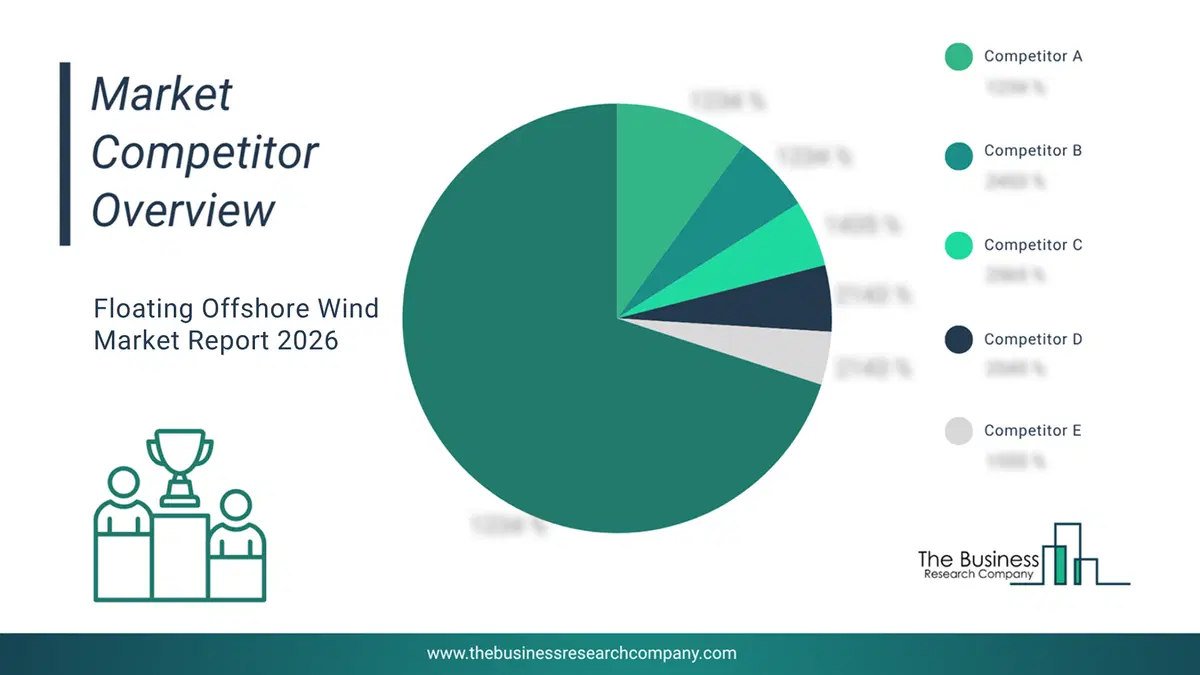
This chart is for illustrative purposes; the full report includes a detailed competitor analysis and comprehensive overview of the top 10 companies in the market.
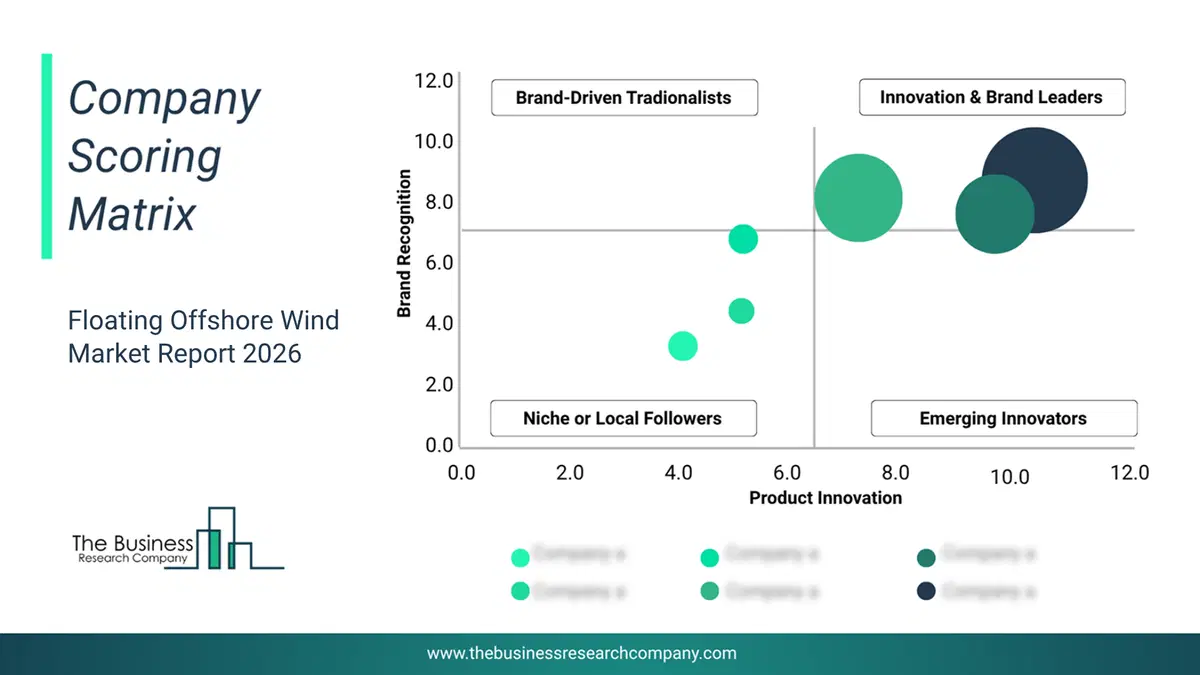
This chart maps companies by product innovation and brand strength, with bubble size indicating relative revenue, helping identify market leaders, challengers, and niche players. This is an illustrative chart; the full report provides a complete and accurate competitive analysis.
Global Floating Offshore Wind Market Trends and Insights
Major companies operating in the floating offshore wind market are focusing on technological advancements, such as floating offshore wind technology, to enhance efficiency, scalability, and cost-effectiveness. Floating offshore wind technology refers to a method of generating electricity from wind energy using turbines mounted on floating structures that are anchored to the seabed. For instance, in Mar 2025, Saipem S.p.A., an Italy-based oilfield services company, launched Star1, a semi-submersible floating wind foundation to support next-generation offshore turbines exceeding 20 MW. The technology features a steel semi-submersible design with three arms for enhanced stability, optimized mooring loads, and support for turbines exceeding 20 MW, ready for FEED and deployment in Sicily’s 7 Seas Med (800 GWh/year) and Sardinia’s Ichnusa Wind Power (1.6 TWh/year) projects.What Are Latest Mergers And Acquisitions In The Floating Offshore Wind Market?
In July 2024, Archer Limited, a Norway-based oilfield services company, acquired Moreld Ocean Wind (MOW) for an undisclosed amount. Through this acquisition, Archer aims to strengthen its energy services portfolio and support its energy customers' ambitions in the energy transition by entering and capitalizing on the growing floating offshore wind market. Moreld Ocean Wind (MOW), a Norway-based floating offshore wind solutions.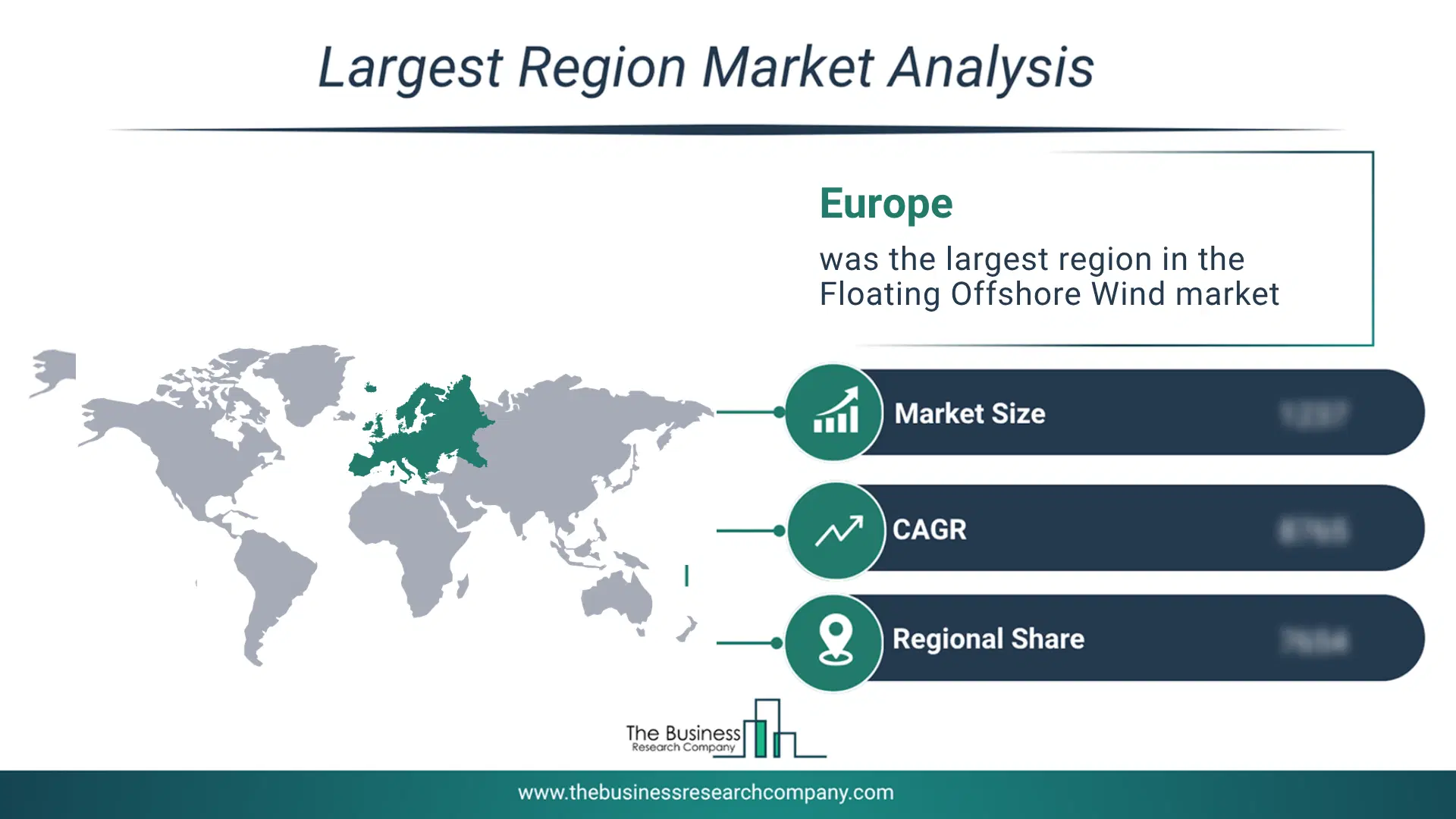
Regional Outlook
Europe was the largest region in the floating offshore wind market in 2025. The regions covered in this market report are Asia-Pacific, South East Asia, Western Europe, Eastern Europe, North America, South America, Middle East, Africa. The countries covered in this market report are Australia, Brazil, China, France, Germany, India, Indonesia, Japan, Taiwan, Russia, South Korea, UK, USA, Canada, Italy, Spain.What Defines the Floating Offshore Wind Market?
The floating offshore wind market consists of revenues earned by entities by providing services such as design and engineering services, manufacturing, fabrication, installation, and maintenance. The market value includes the value of related goods sold by the service provider or included within the service offering. The floating offshore wind market also includes sales of floating foundations, mooring systems, substations, installation vessels and equipment, and maintenance and inspection tools. Values in this market are ‘factory gate’ values, that is, the value of goods sold by the manufacturers or creators of the goods, whether to other entities (including downstream manufacturers, wholesalers, distributors, and retailers) or directly to end customers. The value of goods in this market includes related services sold by the creators of the goods.How is Market Value Defined and Measured?
The market value is defined as the revenues that enterprises gain from the sale of goods and/or services within the specified market and geography through sales, grants, or donations in terms of the currency (in USD unless otherwise specified). The revenues for a specified geography are consumption values that are revenues generated by organizations in the specified geography within the market, irrespective of where they are produced. It does not include revenues from resales along the supply chain, either further along the supply chain or as part of other products.
This chart presents market attractiveness based on a quantitative evaluation of growth, competition, strategic alignment, and risk, offering a clear view of opportunity areas for decision-making. This chart is for illustrative purposes; the full report contains the complete analysis.

This chart highlights the Total Addressable Market (TAM) by estimating the maximum revenue opportunity using an assumption-driven approach, supporting strategic planning and opportunity sizing across markets. The chart is illustrative; the full report provides a more comprehensive analysis.
What Key Data and Analysis Are Included in the Floating Offshore Wind Market Report 2026?
The floating offshore wind market research report is one of a series of new reports from The Business Research Company that provides market statistics, including industry global market size, regional shares, competitors with the market share, detailed market segments, market trends and opportunities, and any further data you may need to thrive in the floating offshore wind industry. The market research report delivers a complete perspective of everything you need, with an in-depth analysis of the current and future state of the industry.Floating Offshore Wind Market Report Forecast Analysis
| Report Attribute | Details |
|---|---|
| Market Size Value In 2026 | $3.09 billion |
| Revenue Forecast In 2030 | $13.05 billion |
| Growth Rate | CAGR of 43.3% from 2026 to 2030 |
| Base Year For Estimation | 2025 |
| Actual Estimates/Historical Data | 2020-2025 |
| Forecast Period | 2026 - 2030 |
| Market Representation | Revenue in USD Billion and CAGR from 2026 to 2030 |
| Segments Covered | Component, Location, Application |
| Regional Scope | Asia-Pacific, Western Europe, Eastern Europe, North America, South America, Middle East, Africa |
| Country Scope | The countries covered in the report are Australia, Brazil, China, France, Germany, India, Indonesia, Japan, Taiwan, Russia, South Korea, UK, USA, Canada, Italy, Spain. |
| Key Companies Profiled | Equinor ASA, Hitachi Ltd., Iberdrola S.A., Mitsubishi Heavy Industries, ABB Limited, Ørsted A/S, Prysmian S.p.A., Shanghai Electric Group Company Limited, Siemens Gamesa Renewable Energy S.A., Goldwind Science & Technology Co Ltd., Guangdong Mingyang Smart Energy Group Co Ltd., General Electric Renewable Energy, Aker Solutions ASA, Vattenfall AB, Envision Energy Limited, Principle Power Inc., Naval Energies SAS, Doosan Heavy Industries & Construction Company Limited, BW Ideol AS, Global Energy Group Limited |
| Customization Scope | Request for Customization |
| Pricing And Purchase Options | Explore Purchase Options |