
Floating Offshore Wind Power Market 2026
By Component (Mooring Systems, Platforms, Subsea Cables, Turbines), By Technology (Floating Wind Turbine, Hydrodynamic Floating Structure, Other Technologies), By Water Depth (Shallow Water, Transitional Water, Deep Water), By Turbine Capacity (Up To 3 MW, 3 MW – 5 MW, Above 5 MW), By Application (Hydrogen Production, Off-Grid Power Generation, Utility-Scale Power Generation), And By Region, Opportunities And Strategies – Global Forecast To 2035
Floating Offshore Wind Power Market Definition
Floating offshore wind power refers to the deployment of wind turbines mounted on floating structures in marine environments where traditional fixed-bottom foundations are not feasible due to deep water depths or unsuitable seabed conditions. These systems enable wind energy generation in deeper waters, typically more than 50–60 meters deep, unlocking access to stronger and more consistent wind resources farther from shore. Floating offshore wind power is primarily used by utility companies, energy developers, independent power producers and grid operators seeking renewable electricity generation. It is also employed in specific industrial applications, such as powering offshore hydrogen production or delivering electricity to remote or off-grid facilities like oil platforms or island communities.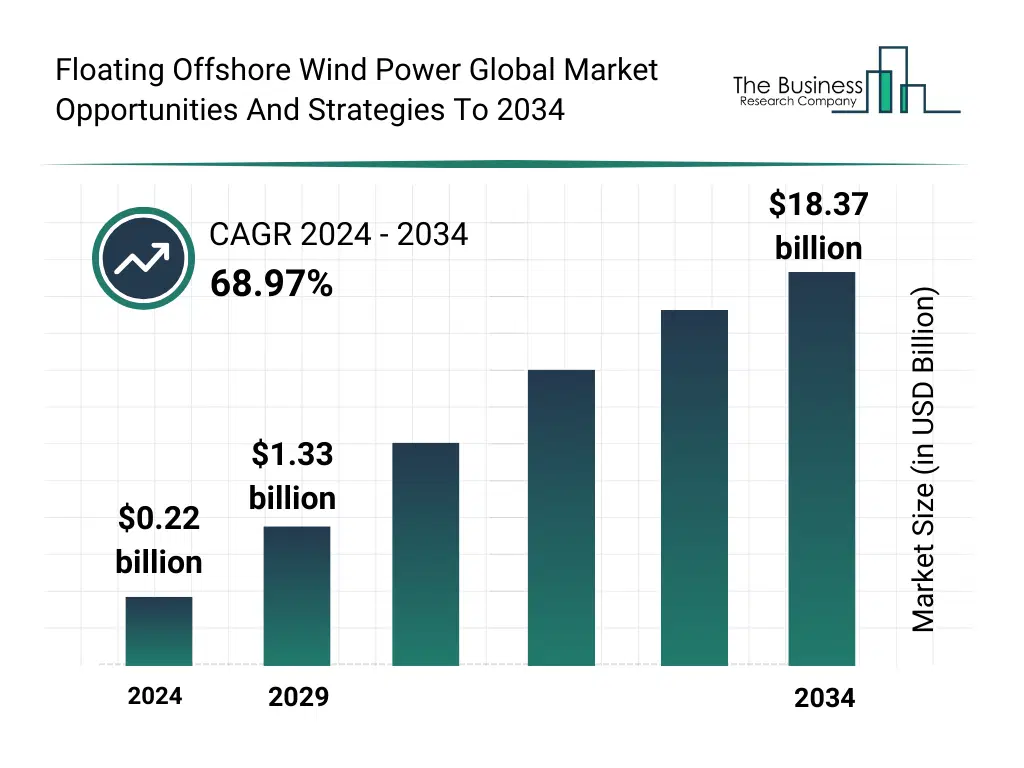
Floating Offshore Wind Power Market Size
The global floating offshore wind power market reached a value of nearly $219.18 million in 2024, having grown at a compound annual growth rate (CAGR) of 37.88% since 2019. The market is expected to grow from $219.18 million in 2024 to $1,333.37 million in 2029 at a rate of 43.49%. The market is then expected to grow at a CAGR of 68.97% from 2029 and reach $18,367.06 million in 2034. Growth in the historic period resulted from high electricity demand, rising government funding for decarbonization, rising demand for corporate renewable PPAs and increased private and institutional investment in floating wind projects. Factors that negatively affected growth in the historic period were the high initial capital and installation costs and complex grid integration challenges. Going forward, high integration of renewable energy sources, expansion of offshore wind projects, expanding industrial and port infrastructure for floating wind and rising connection to offshore transmission hubs and grids will drive growth. Factors that could hinder the growth of the floating offshore wind power market in the future include supply chain and component cost volatility, environmental and regulatory approval barriers and impact of trade war and tariff.Floating Offshore Wind Power Market Drivers
The key drivers of the floating offshore wind power market include: High Integration Of Renewable Energy Sources High integration of renewable energy sources is expected to be a key driver of the growth of the floating offshore wind power market in the forecast period. As nations accelerate their transition toward low-carbon energy systems, floating wind provides a reliable and scalable solution to meet rising renewable energy quotas, especially in regions where shallow-water sites are limited. By complementing solar, onshore wind and other renewable sources, floating offshore wind contributes to a more resilient and diversified energy mix. This high integration encourages investment in offshore wind infrastructure, supports grid flexibility and enhances overall system stability, positioning floating wind as a critical contributor to future energy portfolios while meeting ambitious climate and decarbonization targets. As a result, the market is expected to witness sustained growth driven by synergistic deployment alongside other renewable sources.Floating Offshore Wind Power Market Restraints
The key restraints on the floating offshore wind power market include: Supply Chain And Component Cost Volatility Supply chain and component cost volatility is restricting the growth of the floating offshore wind power market during the forecast period. The floating offshore wind market faces constraints due to volatility in supply chains and the cost of critical components. Turbines, mooring systems, cables and specialized materials often depend on a limited number of manufacturers and suppliers, making the market susceptible to delays, price fluctuations and procurement risks. Additionally, global events such as trade restrictions, material shortages, or geopolitical tensions can further disrupt the supply chain, increasing project costs and delivery timelines. This volatility creates uncertainty for developers and investors, which can slow down project development and affect market confidence.Floating Offshore Wind Power Market Trends
Major trends shaping the floating offshore wind power market include: Innovation In Dynamic Cable Designs For Deepwater Durability Major companies in the floating offshore wind power market are focusing on the development of advanced dynamic subsea cable systems designed specifically for floating turbines operating in deep-water and high-stress environments. These innovations aim to deliver enhanced mechanical resilience, higher voltage ratings and lifetime performance under constant motion and harsh marine conditions. For instance, in March 2025, Prysmian Group, an Italy-based cable systems company, launched a 245 kV (kilovolt) HVAC (high voltage alternating current) dynamic cable system tailored for floating offshore wind farms, engineered to resist mooring and wave-induced motions and to support deep-water export-cable requirements. It supports deep-water export cable requirements while delivering superior mechanical performance, high resistance and enhanced reliability for floating offshore wind projects. Adoption Of High-Capacity Turbines To Boost Energy Output In Deep Waters Key players operating in the floating offshore wind power market are increasingly deploying and certifying ultra-large rotor and high-capacity wind turbines to maximize energy capture and reduce the number of units needed per site. These turbines are designed for deep-water floating platforms and aim to drive down the levelized cost of energy (LCOE) by improving economies of scale and harnessing stronger offshore wind resources. For example, in June 2025, Ocergy, a France-based floating wind foundation company, in collaboration with EnBW Energie Baden Württemberg AG, Kyuden Mirai Energy Co., Ltd. and TEPCO Renewable Power Co., Ltd., launched the “RECORD15” joint industry project to install a >15 MW (megawatt) wind turbine on its modular OCG (offshore composite gravity)-Wind floating platform by 2028. EnBW Energie Baden-Württemberg AG is a Germany-based major publicly traded energy company. Kyuden Mirai Energy Co., Ltd. is a Japan-based company specializing in the development, construction and operation of renewable power projects. TEPCO Renewable Power Co., Ltd. is a Japan-based company focused on renewable energy power generation.Opportunities And Recommendations In The Floating Offshore Wind Power Market
Opportunities – The top opportunities in the floating offshore wind power market segmented by component will arise in the turbines segment, which will gain $440.60 million of global annual sales by 2029. The top opportunities in the floating offshore wind power market segmented by technology will arise in the hydrodynamic floating structure segment, which will gain $690.76 million of global annual sales by 2029. The top opportunities in the floating offshore wind power market segmented by water depth will arise in the transitional water segment, which will gain $531.88 million of global annual sales by 2029. The top opportunities in the floating offshore wind power market segmented by turbine capacity will arise in the above 5 MW segment, which will gain $902.41 million of global annual sales by 2029. The top opportunities in the floating offshore wind power market segmented by application will arise in the utility-scale power generation segment, which will gain $958.98 million of global annual sales by 2029. The floating offshore wind power market size will gain the most in China at $734.00 million. Recommendations- To take advantage of the opportunities, The Business Research Company recommends the floating offshore wind power companies to focus on dynamic subsea cable system advancement, focus on ultra-large turbine deployment and platform integration, focus on lightweight semi-submersible platform design, focus on hybrid offshore renewable system integration, focus on platforms to unlock scalable deep-water deployment, focus on hydrodynamic floating structures to enable deep-water scaling, focus on deep water deployment to maximize long-term capacity growth, focus on above 5 MW capacity to capture large-scale offshore growth, expand in emerging markets, focus on smart mooring system collaboration, focus on flexible value-based pricing to improve project viability and investor confidence, focus on performance-driven promotion to increase stakeholder confidence and accelerate adoption, focus on digital outreach and collaborative education to expand market readiness and focus on hydrogen production to capture high-growth offshore value creation.
Floating Offshore Wind Power Market Segmentation
The floating offshore wind power market is segmented by component, by technology, by water depth, by turbine capacity and by application.By Component –
The floating offshore wind power market is segmented by component into:
- a) Mooring Systems
- b) Platforms
- c) Subsea Cables
- d) Turbines
By Technology –
The floating offshore wind power market is segmented by technology into:
- a) Floating Wind Turbine
- b) Hydrodynamic Floating Structure
- c) Other Technologies
By Water Depth –
The floating offshore wind power market is segmented by water depth into:
- a) Shallow Water
- b) Transitional Water
- c) Deep Water
By Turbine Capacity –
The floating offshore wind power market is segmented by turbine capacity into:
- a) Up To 3 MW
- b) 3 MW – 5 MW
- c) Above 5 MW
By Application –
The floating offshore wind power market is segmented by application into:
- a) Hydrogen Production
- b) Off-Grid Power Generation
- c) Utility-Scale Power Generation
By Geography - The floating offshore wind power market is segmented by geography into:
- • China
- • India
- • Japan
- • Australia
- • Indonesia
- • South Korea
- • USA
- • Canada
- • Brazil
- • France
- • Germany
- • UK
- • Italy
- • Spain
- • Russia
-
o Asia Pacific
o Africa