
Floating Wind Power Market Report 2026
Global Outlook – By Foundation Type (Spar-Buoy Foundation, Tension-Leg Platform (TLP) Foundation, Semi-Submersible Foundation, Other Foundations), By Turbine Capacity (Up To 3 MW, 3 MW - 5 MW, Above 5 MW), By Water Depth (Shallow Water, Transitional Water, Deep Water) – Market Size, Trends, Strategies, and Forecast to 2030
Floating Wind Power Market Overview
• Floating Wind Power market size has reached to $6.6 billion in 2025 • Expected to grow to $28.67 billion in 2030 at a compound annual growth rate (CAGR) of 34.1% • Growth Driver: Intersection of Renewable Energy Demand and Floating Wind Power Growth • Market Trend: Innovations in Floating Wind Turbine Platforms • Europe was the largest region in 2025.What Is Covered Under Floating Wind Power Market?
Floating wind power refers to the generation of electricity using wind turbines that are installed on floating platforms anchored to the seabed in deep waters, typically where conventional fixed-bottom turbines are not feasible. These floating platforms are designed to remain stable despite the motion of the waves, allowing the turbines to capture wind energy from areas with stronger and more consistent winds. Floating wind power has the potential to expand offshore wind energy capacity significantly by accessing deeper ocean areas where wind resources are abundant. The main types of foundation in the floating wind power market are spar-buoy foundation, tension-leg platform (TLP) foundation, and semi-submersible foundation. A spar-buoy foundation consists of a long, cylindrical structure (the spar) that extends deep into the water, providing stability through ballast and buoyancy. The various turbine capacities include up to 3 mw, 3 mw - 5 mw, and above 5 mw. Additionally, these turbines are deployed in various water depths, including shallow water, transitional water, and deep water.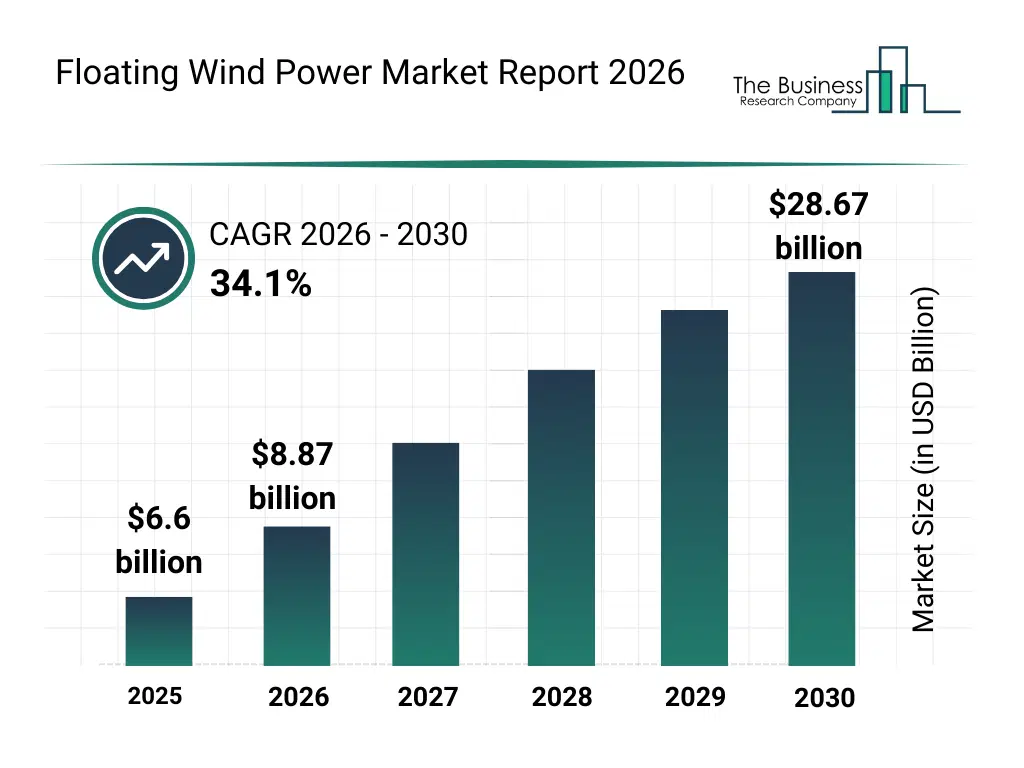
What Is The Floating Wind Power Market Size and Share 2026?
The floating wind power market size has grown exponentially in recent years. It will grow from $6.6 billion in 2025 to $8.87 billion in 2026 at a compound annual growth rate (CAGR) of 34.4%. The growth in the historic period can be attributed to limitations of fixed-bottom offshore wind sites, early offshore wind pilot projects, advancements in offshore engineering, increasing demand for renewable offshore power, government support for offshore wind.What Is The Floating Wind Power Market Growth Forecast?
The floating wind power market size is expected to see exponential growth in the next few years. It will grow to $28.67 billion in 2030 at a compound annual growth rate (CAGR) of 34.1%. The growth in the forecast period can be attributed to increasing investments in deepwater offshore wind farms, rising demand for large-scale clean energy generation, technological advancements in floating foundations, expansion of offshore transmission infrastructure, growing commercialization of floating wind technology. Major trends in the forecast period include advancement of floating turbine platform designs, increasing deployment in deepwater locations, growing use of large-capacity offshore turbines, expansion of mooring and anchoring technologies, enhanced focus on offshore grid integration.
Global Floating Wind Power Market Segmentation
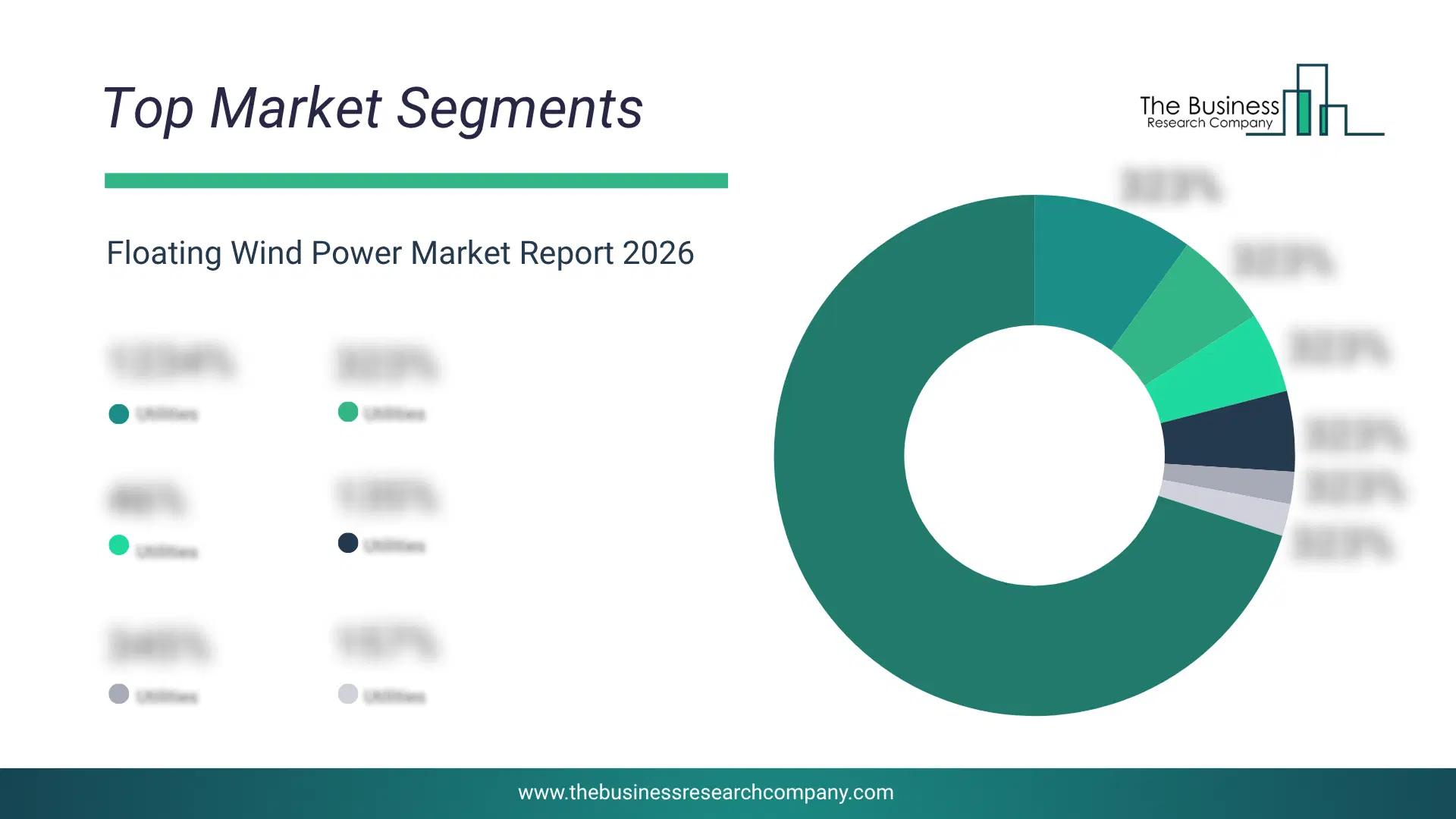
1) By Foundation Type: Spar-Buoy Foundation, Tension-Leg Platform (TLP) Foundation, Semi-Submersible Foundation, Other Foundations 2) By Turbine Capacity: Up To 3 MW, 3 MW - 5 MW, Above 5 MW 3) By Water Depth: Shallow Water, Transitional Water, Deep Water Subsegments: 1) By Spar-Buoy Foundation: Deep Water Spar Buoy Systems, Concrete Spar Buoy Foundations, Floating Turbines With Spar Buoy Anchoring, Hybrid Spar-Buoy Solutions, Lightweight Spar Buoy Designs 2) By Tension-Leg Platform (TLP) Foundation: Concrete TLP Foundations, Floating TLP For Deepwater Applications, Anchor-Based TLP Systems, Hybrid TLP Solutions With Concrete And Steel, TLP With Mooring Systems For Wind Turbines 3) By Semi-Submersible Foundation: Concrete Semi-Submersible Platforms, Steel Semi-Submersible Designs, Subsea Buoyancy-Based Semi-Submersible Platforms, Flexible Semi-Submersible Designs, Hybrid Semi-Submersible Platforms For Shallow And Deep Waters 4) By Other Foundations: Concrete Gravity-Based Foundations, Hybrid Floating Foundations, Submerged Buoy And Pontoon Systems, Mooring And Anchoring Solutions For Floating Wind, Innovative Foundation Designs For Harsh Marine EnvironmentsWhat Is The Driver Of The Floating Wind Power Market?
The increasing demand for renewable energy is expected to propel the growth of the floating wind power market going forward. Renewable energy is derived from natural sources replenished on a human timescale, such as sunlight, wind, rain, tides, waves, and geothermal heat. Renewable energy is attributed to naturally replenished sources, such as solar, wind, hydro, geothermal, and biomass, which provide sustainable and environmentally friendly alternatives to fossil fuels. Floating wind power enhances renewable energy by enabling electricity generation in deep offshore waters, where stronger winds lead to higher energy output, expanding the potential for clean, sustainable energy worldwide. For instance, in 2023, according to the International Energy Agency (IEA), a France-based international affairs organization, global annual renewable capacity additions surged by nearly 50% to approximately 510 gigawatts (GW), marking the fastest growth rate in the past two decades. By 2028, global renewable capacity is forecast to reach 7,300 GW. Therefore, the increasing demand for renewable energy is driving the growth of floating wind power industry.Key Players In The Global Floating Wind Power Market
Major companies operating in the floating wind power market are TotalEnergies SE, Mitsubishi Corporation, Engie SA, Hitachi Ltd., General Electric Company, Siemens Energy AG, Hyundai Engineering & Construction Co.Ltd., Shanghai Electric Wind Power Equipment Co., Vestas Wind Systems A/S, Goldwind Science & Technology Co. Ltd., Nordex SE, DEME Group, Taiyuan Heavy Industry Co. Ltd., Suzlon Energy Limited, Envision Group, Sinovel Wind Group Co. Ltd., EEW Group, Ming Yang Wind Power Group Limited, Doosan Group, BW Ideol AS, Flowocean AB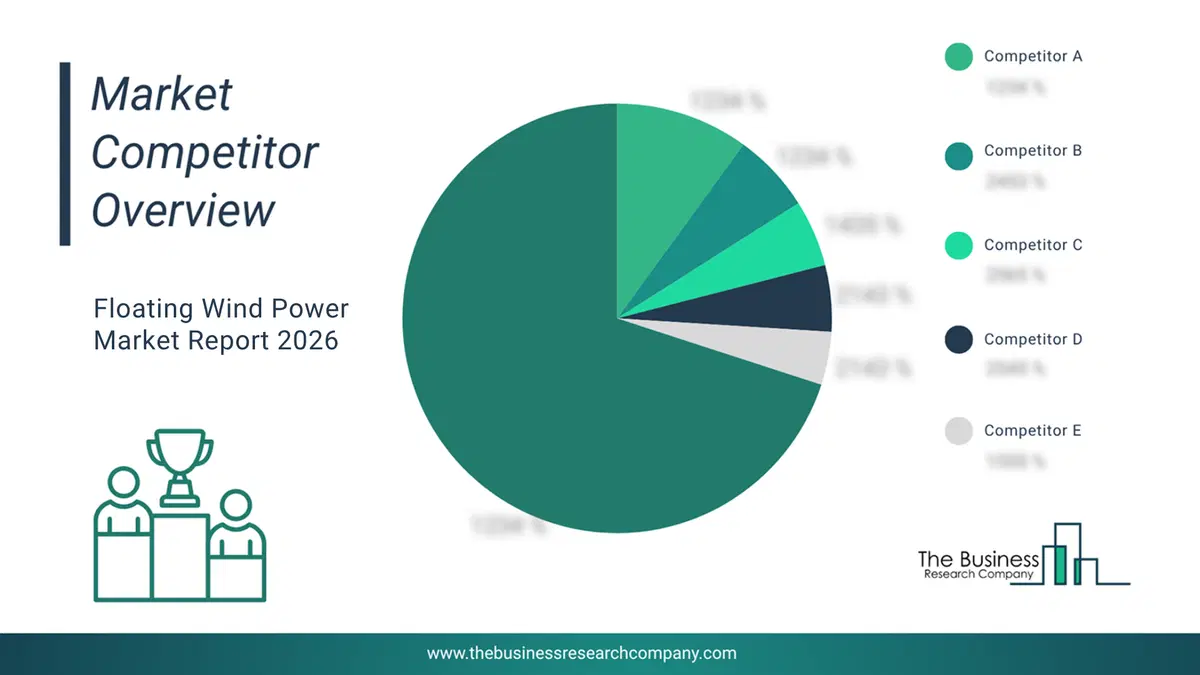
This chart is for illustrative purposes; the full report includes a detailed competitor analysis and comprehensive overview of the top 10 companies in the market.
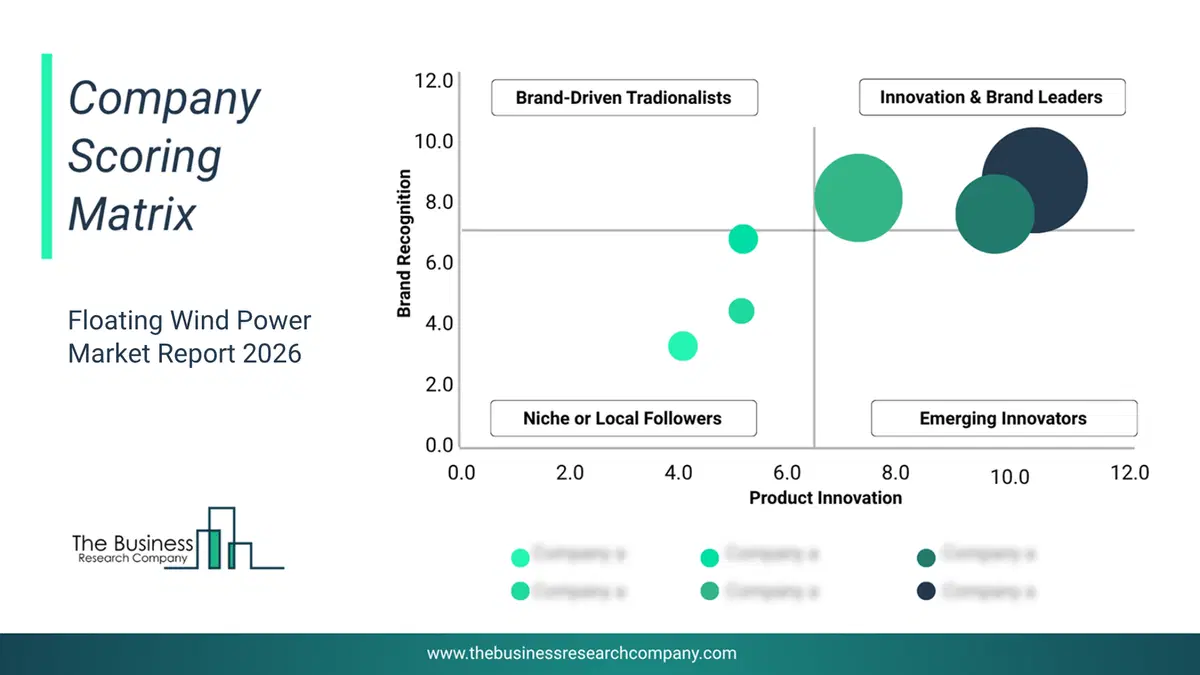
This chart maps companies by product innovation and brand strength, with bubble size indicating relative revenue, helping identify market leaders, challengers, and niche players. This is an illustrative chart; the full report provides a complete and accurate competitive analysis.
Global Floating Wind Power Market Trends and Insights
Major companies operating in the floating wind power market are developing floating wind turbine platforms to harness offshore wind energy in deeper waters, where traditional fixed-bottom turbines are not feasible, thereby expanding renewable energy capacity and driving innovation in clean energy solutions. A floating wind turbine platform features two rotors mounted on a single floating structure, designed to increase energy capture and improve stability in offshore environments. For instance, in July 2024, Ming Yang Smart Energy Group Limited, a China-based renewable energy company, introduced the Ocean X, the biggest twin-rotor floating wind turbine platform, featuring two MySE8.3-180 hybrid drive wind turbines, each boasting a capacity of 8.3 MW. This platform boasts a high capacity of 16.6 MW and a reduced levelized cost of energy (LCOE) through improved aerodynamic performance and lower material usage. Additionally, it includes advanced anti-typhoon technology, making it suitable for harsh maritime conditions. These developments are expected to enhance the efficiency and deployment of offshore wind projects, providing significant energy output and cost-effectiveness benefits.What Are Latest Mergers And Acquisitions In The Floating Wind Power Market?
In June 2025, Aurora Energy Services Ltd., a UK-based energy services company, acquired Encomara for an undisclosed amount. Through this acquisition, Aurora aims to strengthen its floating wind power capabilities by integrating Encomara’s proprietary SQUID quick-connect mooring and electrical connection system, which reduces installation time, cost, and risk for floating offshore wind turbines. Encomara Ltd. is a UK-based engineering company that specializes in floating wind deployment systems and subsea engineering solutions designed to support the development, installation, and operation of floating offshore wind projects.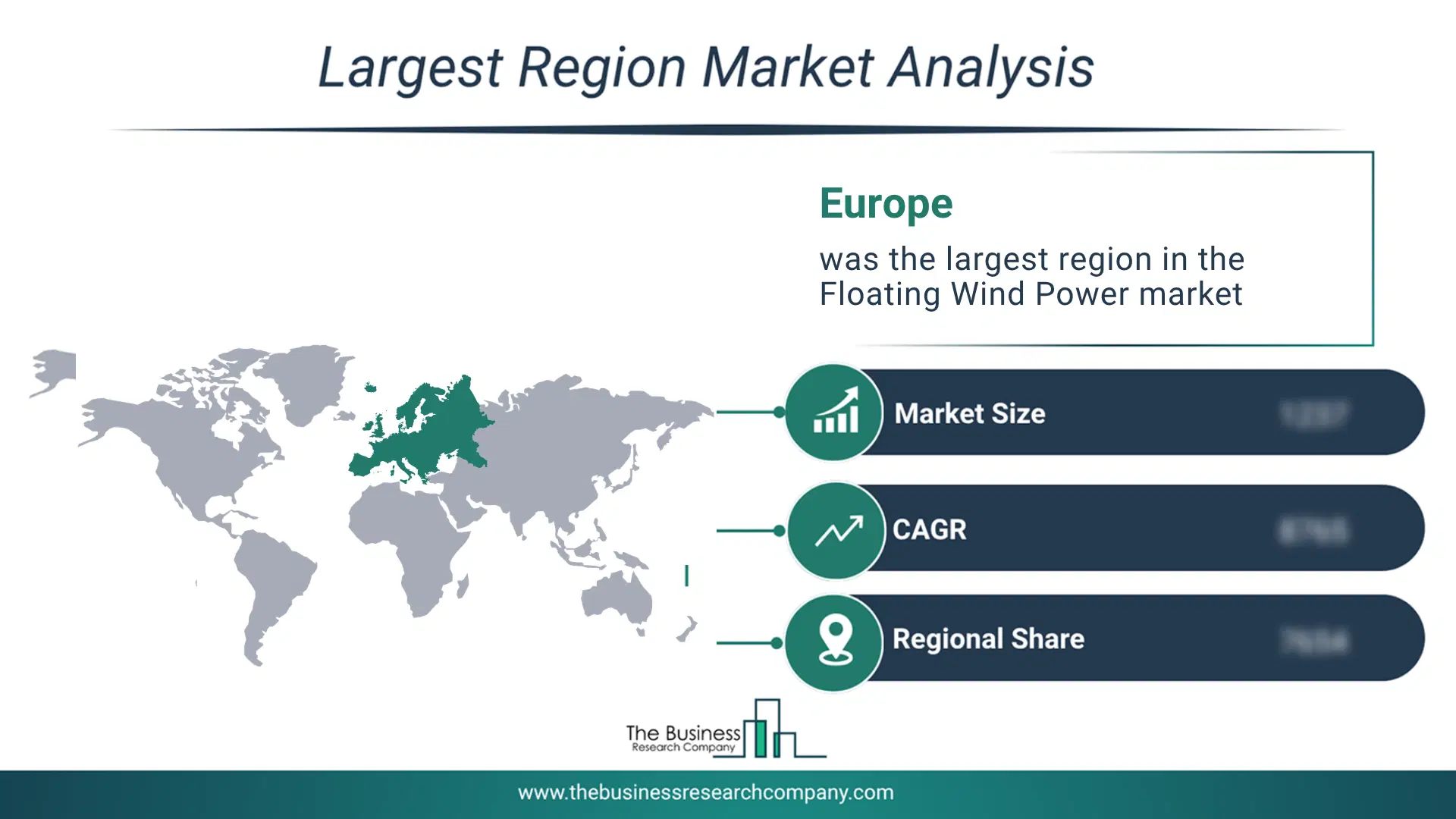
Regional Outlook
Europe was the largest region in the floating wind power market in 2025. The regions covered in this market report are Asia-Pacific, South East Asia, Western Europe, Eastern Europe, North America, South America, Middle East, Africa. The countries covered in this market report are Australia, Brazil, China, France, Germany, India, Indonesia, Japan, Taiwan, Russia, South Korea, UK, USA, Canada, Italy, SpainWhat Defines the Floating Wind Power Market?
The floating wind power market consists of revenues earned by entities by providing services such as feasibility studies and site assessment, design and engineering, and permitting and regulatory compliance. The market value includes the value of related goods sold by the service provider or included within the service offering. The floating wind power market also includes sales of spar-buoy or semi-submersible structures, offshore wind turbines, mooring and anchoring systems, underwater cabling, and floating substations. Values in this market are ‘factory gate’ values, that is the value of goods sold by the manufacturers or creators of the goods, whether to other entities (including downstream manufacturers, wholesalers, distributors and retailers) or directly to end customers. The value of goods in this market includes related services sold by the creators of the goods.How is Market Value Defined and Measured?
The market value is defined as the revenues that enterprises gain from the sale of goods and/or services within the specified market and geography through sales, grants, or donations in terms of the currency (in USD unless otherwise specified). The revenues for a specified geography are consumption values that are revenues generated by organizations in the specified geography within the market, irrespective of where they are produced. It does not include revenues from resales along the supply chain, either further along the supply chain or as part of other products.
This chart presents market attractiveness based on a quantitative evaluation of growth, competition, strategic alignment, and risk, offering a clear view of opportunity areas for decision-making. This chart is for illustrative purposes; the full report contains the complete analysis.

This chart highlights the Total Addressable Market (TAM) by estimating the maximum revenue opportunity using an assumption-driven approach, supporting strategic planning and opportunity sizing across markets. The chart is illustrative; the full report provides a more comprehensive analysis.
What Key Data and Analysis Are Included in the Floating Wind Power Market Report 2026?
The floating wind power market research report is one of a series of new reports from The Business Research Company that provides market statistics, including Market Report 2026?global market size, regional shares, competitors with the market share, detailed market segments, market trends and opportunities, and any further data you may need to thrive in the floating wind power Market Report 2026? The market research report delivers a complete perspective of everything you need, with an in-depth analysis of the current and future state of the Market Report 2026?Floating Wind Power Market Report Forecast Analysis
| Report Attribute | Details |
|---|---|
| Market Size Value In 2026 | $8.87 billion |
| Revenue Forecast In 2030 | $28.67 billion |
| Growth Rate | CAGR of 34.4% from 2026 to 2030 |
| Base Year For Estimation | 2025 |
| Actual Estimates/Historical Data | 2020-2025 |
| Forecast Period | 2026 - 2030 - 2030 |
| Market Representation | Revenue in USD Billion and CAGR from 2026 to 2030 |
| Segments Covered | Foundation Type, Turbine Capacity, Water Depth |
| Regional Scope | Asia-Pacific, Western Europe, Eastern Europe, North America, South America, Middle East, Africa |
| Country Scope | The countries covered in the report are Australia, Brazil, China, France, Germany, India, Indonesia, Japan, Taiwan, Russia, South Korea, UK, USA, Canada, Italy, Spain. |
| Key Companies Profiled | TotalEnergies SE, Mitsubishi Corporation, Engie SA, Hitachi Ltd., General Electric Company, Siemens Energy AG, Hyundai Engineering & Construction Co.Ltd., Shanghai Electric Wind Power Equipment Co., Vestas Wind Systems A/S, Goldwind Science & Technology Co. Ltd., Nordex SE, DEME Group, Taiyuan Heavy Industry Co. Ltd., Suzlon Energy Limited, Envision Group, Sinovel Wind Group Co. Ltd., EEW Group, Ming Yang Wind Power Group Limited, Doosan Group, BW Ideol AS, Flowocean AB |
| Customization Scope | Request for Customization |
| Pricing And Purchase Options | Explore Purchase Options |