
Flow-Mediated Dilation Test Market Report 2026
Global Outlook – By Analysis Method (Automated Flow Mediated Dilation Analysis, Semi Automated Flow Mediated Dilation Analysis, Manual Flow Mediated Dilation Analysis), By Application (Cardiovascular Risk Assessment, Metabolic Disorder Evaluation, Research And Clinical Trials), By End User (Hospitals, Diagnostic Centers, Cardiology Clinics, Research Institutes And Academic Centers, Ambulatory Surgical Centers) – Market Size, Trends, Strategies, and Forecast to 2030
Flow-Mediated Dilation Test Market Report 2026 Market Overview
• Flow-Mediated Dilation Test Market Report 2026 market size has reached to $0.07 billion in 2025 • Expected to grow to $0.1 billion in 2030 at a compound annual growth rate (CAGR) of 6.5% • Growth Driver: Rising Prevalence Of Cardiovascular Diseases Driving Market Growth Due To Increasing Need For Early Endothelial Function Assessment • North America was the largest region in 2025 and Asia-Pacific is the fastest growing region.What Is Covered Under Flow-Mediated Dilation Test Market?
A flow-mediated dilation test refers to a non-invasive diagnostic ultrasound procedure used to evaluate vascular endothelial function by measuring the percentage increase in brachial artery diameter following a brief period of ischemia induced by a blood pressure cuff. This test assesses the endothelium's ability to release nitric oxide in response to shear stress, serving as a critical early indicator of cardiovascular disease and atherosclerosis. The main analysis methods of flow-mediated dilation test include automated flow mediated dilation analysis, semi automated flow mediated dilation analysis, and manual flow mediated dilation analysis. Automated flow mediated dilation analysis refers to computer-assisted measurement systems that automatically evaluate changes in arterial diameter following temporary blood flow occlusion to assess endothelial function and vascular health. These methods are applied in cardiovascular risk assessment, metabolic disorder evaluation, and research and clinical trials, serving end users including hospitals, diagnostic centers, cardiology clinics, research institutes and academic centers, and ambulatory surgical centers.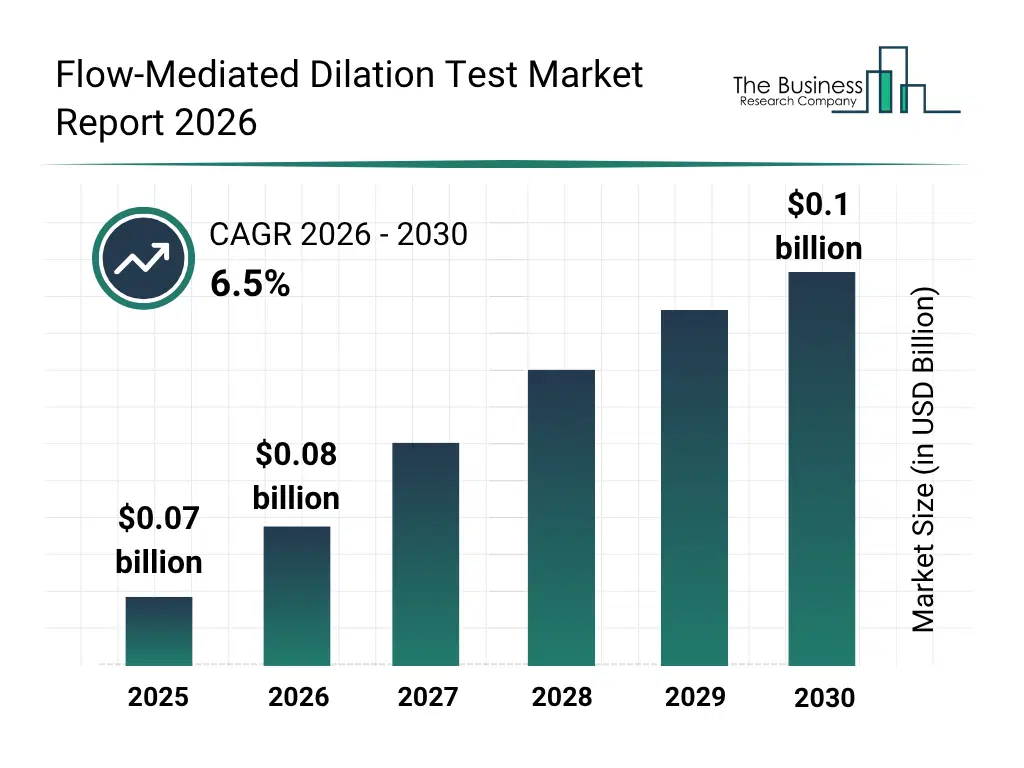
What Is The Flow-Mediated Dilation Test Market Size and Share 2026?
The flow-mediated dilation test market size has grown strongly in recent years. It will grow from $0.07 billion in 2025 to $0.08 billion in 2026 at a compound annual growth rate (CAGR) of 6.2%. The growth in the historic period can be attributed to increasing prevalence of cardiovascular diseases and atherosclerosis, rising awareness about early cardiovascular risk assessment, growing demand for non-invasive diagnostic procedures, increasing adoption of vascular health monitoring in clinical research, rising utilization of ultrasound-based endothelial function evaluation.What Is The Flow-Mediated Dilation Test Market Growth Forecast?
The flow-mediated dilation test market size is expected to see strong growth in the next few years. It will grow to $0.1 billion in 2030 at a compound annual growth rate (CAGR) of 6.5%. The growth in the forecast period can be attributed to increasing adoption of AI-based vessel measurement solutions, growing demand for personalized cardiovascular risk prediction, rising integration of advanced imaging software with diagnostic systems, increasing expansion of preventive healthcare screening programs, growing clinical adoption of automated endothelial assessment technologies. Major trends in the forecast period include increasing adoption of automated flow-mediated dilation analysis for faster endothelial function assessment, growing integration of advanced ultrasound imaging technologies for improved vascular measurement accuracy, rising demand for non-invasive cardiovascular disease risk evaluation methods, increasing use of endothelial function testing for early detection of vascular abnormalities, growing adoption of standardized clinical protocols for flow-mediated dilation testing.
Global Flow-Mediated Dilation Test Market Segmentation
1) By Analysis Method: Automated Flow Mediated Dilation Analysis, Semi Automated Flow Mediated Dilation Analysis, Manual Flow Mediated Dilation Analysis 2) By Application: Cardiovascular Risk Assessment, Metabolic Disorder Evaluation, Research And Clinical Trials 3) By End User: Hospitals, Diagnostic Centers, Cardiology Clinics, Research Institutes And Academic Centers, Ambulatory Surgical Centers Subsegments: 1) By Automated Flow Mediated Dilation Analysis: Real Time Automated Edge Detection, Artificial Intelligence Based Vessel Wall Tracking, Fully Automated Diameter Measurement, Automated Endothelial Function Assessment 2) By Semi Automated Flow Mediated Dilation Analysis: Operator Assisted Edge Detection, Manual Region Of Interest Selection With Automated Measurement, Software Guided Image Analysis, Hybrid Diameter Measurement 3) By Manual Flow Mediated Dilation Analysis: Caliper Based Diameter Measurement, Frame By Frame Ultrasound Analysis, Offline Manual Image Analysis, Visual Vessel Diameter AssessmentWhat Are The Drivers Of The Flow-Mediated Dilation Test Market?
The rising prevalence of cardiovascular diseases is expected to propel the growth of the flow-mediated dilation test market going forward. Cardiovascular diseases refer to a group of disorders affecting the heart and blood vessels such as coronary artery disease, stroke, heart failure, and peripheral arterial disease. The prevalence of cardiovascular diseases is increasing due to the growing incidence of lifestyle-related risk factors such as obesity, diabetes, hypertension, physical inactivity, and unhealthy dietary habits. The flow-mediated dilation test market supports cardiovascular diseases by enabling the early assessment of endothelial dysfunction, helping healthcare providers identify cardiovascular risk before structural vascular damage develops and allowing timely preventive interventions. For instance in October 2024, according to the Centers for Disease Control and Prevention (CDC), a US-based public health agency, in 2023, cardiovascular disease caused 919,032 deaths, accounting for approximately one in every three deaths. Therefore, the rising prevalence of cardiovascular diseases is driving the growth of the flow-mediated dilation test industry. The growing incidence of diabetes and obesity is expected to propel the growth of the flow-mediated dilation test market going forward. Diabetes and obesity refer to chronic metabolic health conditions in which diabetes causes persistently elevated blood glucose levels, while obesity involves excessive body fat accumulation that increases the risk of cardiovascular disease, hypertension, and other long-term health complications. The incidence of diabetes and obesity is increasing as sedentary lifestyles have reduced physical activity and increased metabolic disease risk. The flow-mediated dilation test supports the management of diabetes and obesity by enabling early assessment of endothelial dysfunction, identifying cardiovascular risk before clinical disease develops, and helping clinicians monitor vascular health during treatment. For instance, in February 2026, according to the National Diabetes Audit (NDA) 2024–25 published by the Government of the United Kingdom, a UK-based government department, 43.0% of people with type 1 diabetes in England received all eight recommended care processes during the financial year ending March 2025. Therefore, the growing incidence of diabetes and obesity is driving the growth of the flow-mediated dilation test industry. The increasing incidence of comorbidities is expected to propel the growth of the flow-mediated dilation test market going forward. Comorbidities refer to the presence of two or more chronic medical conditions, such as diabetes, hypertension, obesity, and chronic kidney disease, occurring simultaneously in the same individual. The incidence of comorbidities is increasing due to aging populations, sedentary lifestyles, and the growing prevalence of chronic diseases. Flow-mediated dilation tests support the management of patients with multiple comorbidities by enabling early evaluation of endothelial dysfunction, identifying elevated cardiovascular risk, and helping clinicians monitor vascular health before the onset of major cardiovascular events. For instance, in August 2025, according to the International Journal of Population Data Science (IJPDS), a UK-based scientific journal, the mean number of comorbidities was higher among individuals in the most deprived population than in the least deprived population (1.84 vs. 1.49; p < 0.001). Additionally, 28.6% of people with multiple sclerosis (pwMS) in the most deprived areas had more than three comorbidities, compared with 20.6% of those in the least deprived areas. Therefore, the increasing incidence of comorbidities is driving the growth of the flow-mediated dilation test industry.Key Players In The Global Flow-Mediated Dilation Test Market
Major companies operating in the flow-mediated dilation test market report are Canon Medical Systems, Siemens Healthineers AG, GE HealthCare, Koninklijke Philips N.V., Mindray Medical, D.E. Hokanson Inc, Quipu Srl, Vascular Diagnostics, UNEX Corporation.
This chart is for illustrative purposes; the full report includes a detailed competitor analysis and comprehensive overview of the top 10 companies in the market.
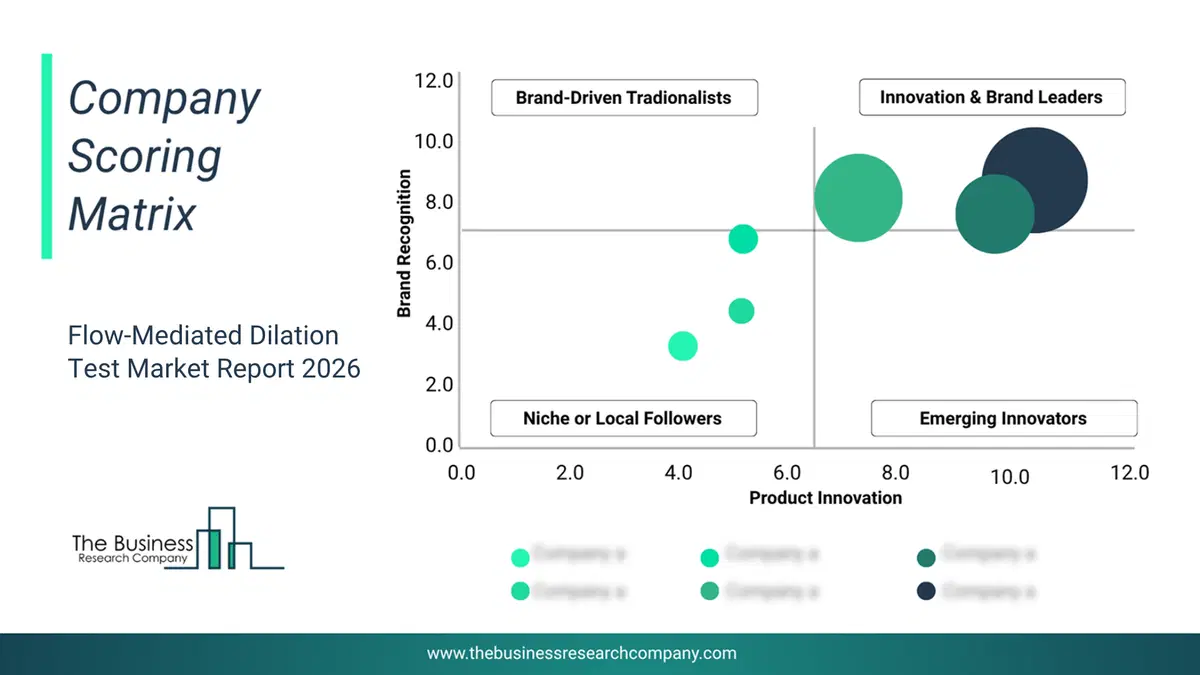
This chart maps companies by product innovation and brand strength, with bubble size indicating relative revenue, helping identify market leaders, challengers, and niche players. This is an illustrative chart; the full report provides a complete and accurate competitive analysis.
Regional Outlook
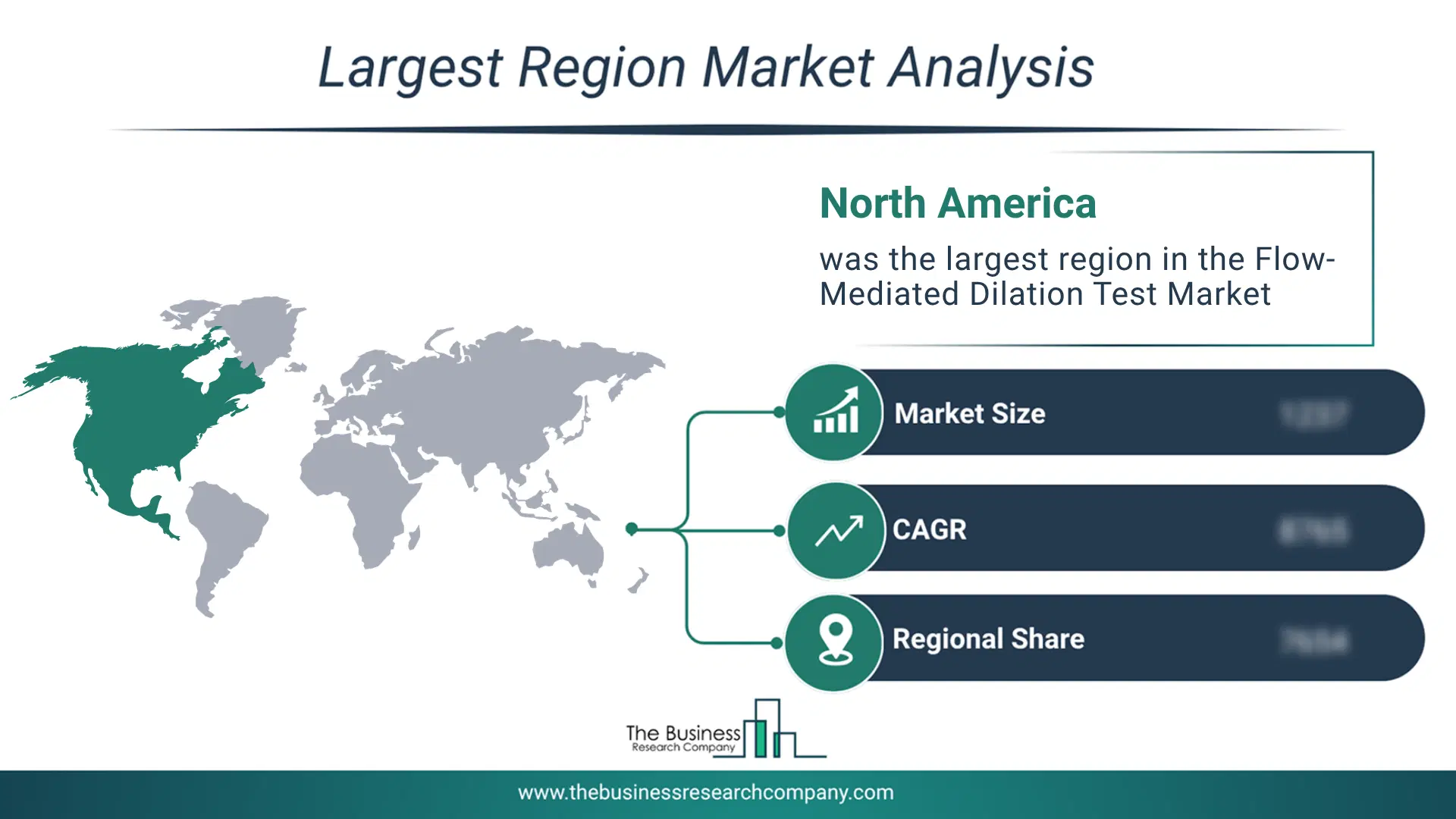
North America was the largest region in the flow-mediated dilation test market in 2025. Asia-Pacific is expected to be the fastest-growing region in the forecast period. The regions covered in this market report are Asia-Pacific, South East Asia, Western Europe, Eastern Europe, North America, South America, Middle East, Africa. The countries covered in this market report are Australia, Brazil, China, France, Germany, India, Indonesia, Japan, Taiwan, Russia, South Korea, UK, USA, Canada, Italy, Spain.What Defines the Flow-Mediated Dilation Test Market?
The flow-mediated dilation test market consists of revenues earned by entities by providing services such as flow-mediated dilation (FMD) testing services, endothelial function assessment services, vascular ultrasound imaging services, cardiovascular risk assessment services, diagnostic reporting and interpretation services. The market value includes the value of related goods sold by the service provider or included within the service offering. Only goods and services traded between entities or sold to end consumers are included.How is Market Value Defined and Measured?
The market value is defined as the revenues that enterprises gain from the sale of goods and/or services within the specified market and geography through sales, grants, or donations in terms of the currency (in USD unless otherwise specified). The revenues for a specified geography are consumption values that are revenues generated by organizations in the specified geography within the market, irrespective of where they are produced. It does not include revenues from resales along the supply chain, either further along the supply chain or as part of other products.
This chart presents market attractiveness based on a quantitative evaluation of growth, competition, strategic alignment, and risk, offering a clear view of opportunity areas for decision-making. This chart is for illustrative purposes; the full report contains the complete analysis.

This chart highlights the Total Addressable Market (TAM) by estimating the maximum revenue opportunity using an assumption-driven approach, supporting strategic planning and opportunity sizing across markets. The chart is illustrative; the full report provides a more comprehensive analysis.
What Key Data and Analysis Are Included in the Flow-Mediated Dilation Test Market Report 2026?
The flow-mediated dilation test market research report is one of a series of new reports from The Business Research Company that provides market statistics, including industry global market size, regional shares, competitors with the market share, detailed market segments, market trends and opportunities, and any further data you may need to thrive in the flow-mediated dilation test industry. The market research report delivers a complete perspective of everything you need, with an in-depth analysis of the current and future state of the industry.Flow-Mediated Dilation Test Market Report Forecast Analysis
| Report Attribute | Details |
|---|---|
| Market Size Value In 2026 | $0.08 billion |
| Revenue Forecast In 2030 | $0.1 billion |
| Growth Rate | CAGR of 6.5% from 2026 to 2030 |
| Base Year For Estimation | 2025 |
| Actual Estimates/Historical Data | 2020-2025 |
| Forecast Period | 2026 - 2030 |
| Market Representation | Revenue in USD Billion and CAGR from 2026 to 2030 |
| Segments Covered | Analysis Method, Application, End User |
| Regional Scope | Asia-Pacific, Western Europe, Eastern Europe, North America, South America, Middle East, Africa |
| Country Scope | The countries covered in the report are Australia, Brazil, China, France, Germany, India, Indonesia, Japan, Taiwan, Russia, South Korea, UK, USA, Canada, Italy, Spain. |
| Key Companies Profiled | Canon Medical Systems, Siemens Healthineers AG, GE HealthCare, Koninklijke Philips N.V., Mindray Medical, D.E. Hokanson Inc, Quipu Srl, Vascular Diagnostics, UNEX Corporation. |
| Customization Scope | Request for Customization |
| Pricing And Purchase Options | Explore Purchase Options |