
Flue Gas Desulfurization System Market Report 2026
Global Outlook – By Type (Wet FGD Systems, Spray Dry FGD System), By Installation (Greenfield, Brownfield), By End-Use (Power Generation, Chemical, Iron And Steel, Metal Processing And Mining, Cement Manufacturing, Paper And Pulp, Other End Uses) – Market Size, Trends, Strategies, and Forecast to 2030
Flue Gas Desulfurization System Market Overview
• Flue Gas Desulfurization System market size has reached to $21.46 billion in 2025 • Expected to grow to $28.55 billion in 2030 at a compound annual growth rate (CAGR) of 5.9% • Growth Driver: Surge In Coal-Fired Power Plants Drives Demand For Flue Gas Desulfurization Systems • Asia-Pacific was the largest region in 2025.What Is Covered Under Flue Gas Desulfurization System Market?
Flue gas desulfurization system refers to a device that removes sulfur dioxide (SO2) from the fuel gas emission produced from industrial combustion. It is mainly used for reducing SO2 emissions from industries. The main types of flue gas desulfurization systems are wet FGD systems, spray dry FGD systems, and dry and semi-dry FGD systems. Wet FGD systems are used for scrubbing with alkaline sorbent to remove sulfur dioxide. Wet FGD systems are used to remove SO2 from flue gases. These are installed in greenfield and brownfield for use in power generation, chemical, iron and steel, metal processing and mining, cement manufacturing, paper and pulp and others.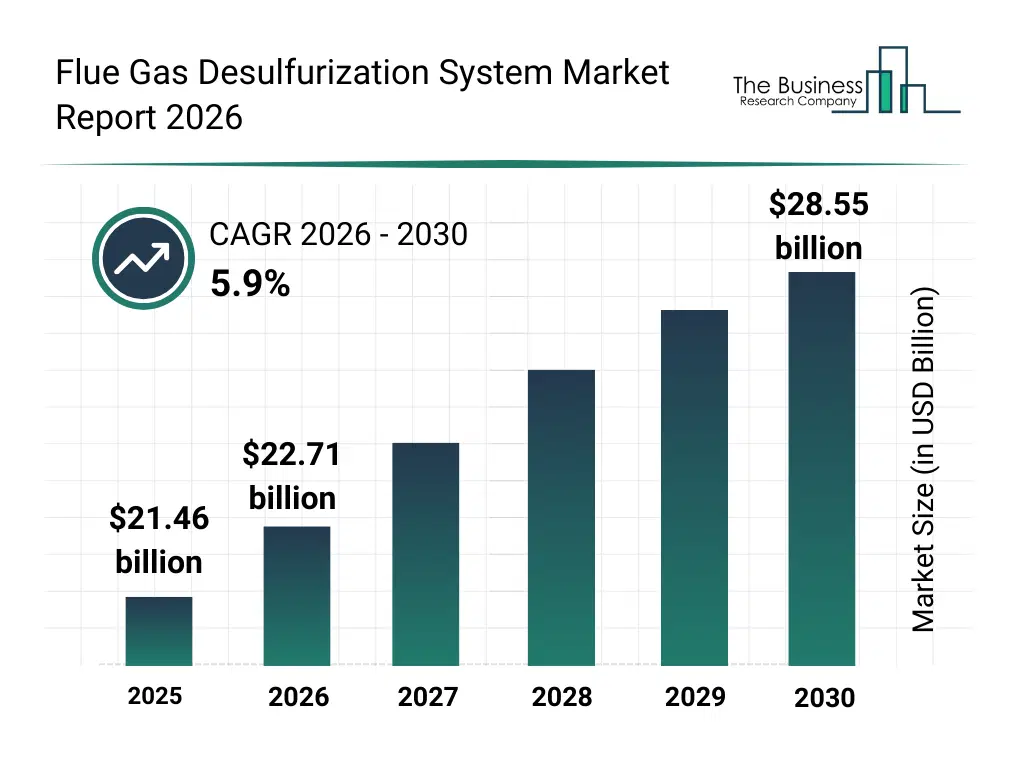
What Is The Flue Gas Desulfurization System Market Size and Share 2026?
The flue gas desulfurization system market size has grown strongly in recent years. It will grow from $21.46 billion in 2025 to $22.71 billion in 2026 at a compound annual growth rate (CAGR) of 5.9%. The growth in the historic period can be attributed to expansion of coal-based power generation, tightening air pollution regulations, growth in heavy industrial activity, increasing awareness of emission control technologies, availability of large-scale fgd solutions.What Is The Flue Gas Desulfurization System Market Growth Forecast?
The flue gas desulfurization system market size is expected to see strong growth in the next few years. It will grow to $28.55 billion in 2030 at a compound annual growth rate (CAGR) of 5.9%. The growth in the forecast period can be attributed to increasing investments in clean energy transition, rising demand for low-emission industrial operations, expansion of brownfield plant upgrades, growing adoption of digital monitoring systems, increasing global environmental compliance standards. Major trends in the forecast period include increasing deployment of wet and semi-dry fgd systems, rising demand for high-efficiency so2 removal, growing retrofitting of existing industrial plants, expansion of automated emission control systems, enhanced focus on regulatory compliance.Tariff Impact On Flue Gas Desulfurization System Market
Tariffs are affecting the flue gas desulfurization system market by increasing costs of imported absorbers, pumps, fans, control systems, and corrosion-resistant materials used in large-scale installations. Power generation and heavy industrial facilities in Asia-Pacific, Europe, and North America are most impacted due to dependence on imported specialized components and engineering systems. These tariffs are increasing project capital costs and extending installation timelines. However, they are also encouraging domestic manufacturing of FGD components, regional engineering partnerships, and innovation in cost-efficient emission control technologies.
Global Flue Gas Desulfurization System Market Segmentation
1) By Type: Wet FGD Systems, Spray Dry FGD System 2) By Installation: Greenfield, Brownfield 3) By End-Use: Power Generation, Chemical, Iron And Steel, Metal Processing And Mining, Cement Manufacturing, Paper And Pulp, Other End Uses Subsegments: 1) By Wet FGD Systems: Limestone Wet FGD, Seawater FGD 2) By Spray Dry FGD Systems: Spray Dry Absorber (SDA) Systems, Semi-Dry FGD SystemsWhat Are The Drivers Of The Flue Gas Desulfurization System Market?
The increasing number of coal-fired power plants is expected to propel the growth of the flue gas desulfurization system market going forward. Coal-fired power plants refer to power stations that generate electricity by burning coal. The rise in the number of coal-fired power plants is fueled by growing global energy demand and reliance on coal as a primary energy source. Flue gas desulfurization systems help reduce sulfur dioxide and other harmful emissions from coal-fired power plants, ensuring compliance with environmental regulations and improving air quality. For instance, in 2024, according to the International Energy Agency (IEA), a France-based intergovernmental energy agency, coal production reached a record 9.15 billion tonnes in 2024 and is expected to rise slightly to 9.2 billion tonnes in 2025. Therefore, the increasing number of coal-fired power plants is driving the growth of the flue gas desulfurization system industry. Increase in air pollution is expected to propel the growth of the flue gas desulfurization system market going forward. Air pollution refers to the presence of harmful substances or pollutants in the Earth's atmosphere, which can have detrimental effects on the environment, human health, and the well-being of other living organisms. Flue gas desulfurization (FGD) systems play a crucial role in mitigating air pollution by reducing the emission of sulfur dioxide (SO2) from industrial sources, particularly coal-fired power plants. These systems employ various technologies to capture and remove sulfur dioxide from the flue gases before they are released into the atmosphere. By doing so, FGD systems contribute to the prevention of acid rain formation, alleviate respiratory issues associated with SO2 exposure, and address stringent environmental regulations aimed at reducing harmful emissions. For instance, in April 2023, according to a report published by the American Lung Association, a US-based public health organization, over 120 million people in the United States, more than one in three, are subjected to unhealthy air pollution levels. Therefore, an increase in air pollution is driving the flue gas desulfurization system industry.Key Players In The Global Flue Gas Desulfurization System Market
Major companies operating in the flue gas desulfurization system market are Mitsubishi Heavy Industries Ltd., General Electric Company, Doosan Lentjes GmbH, Babcock & Wilcox Enterprises Inc., Siemens AG, FLSmidth & Co. A/S, Hamon Corporation, Marsulex Environmental Technologies Corporation, Thermax Limited, Ducon Technologies Inc., Clyde Bergemann Power Group, Andritz AG, Valmet Corporation, Chiyoda Corporation, China Energy Engineering Group Co. Ltd., Tri-Mer Corporation, Veolia Water Technologies, Wärtsilä Corp., Wheelabrator Technologies Inc., Yokogawa Electric Corporation, Zhejiang Feida Environmental Science & Technology, Zhejiang DunAn Artificial Environment, Zhejiang Shuanghuan Environmental Protection, Dürr AG, GEA Group AG
This chart is for illustrative purposes; the full report includes a detailed competitor analysis and comprehensive overview of the top 10 companies in the market.
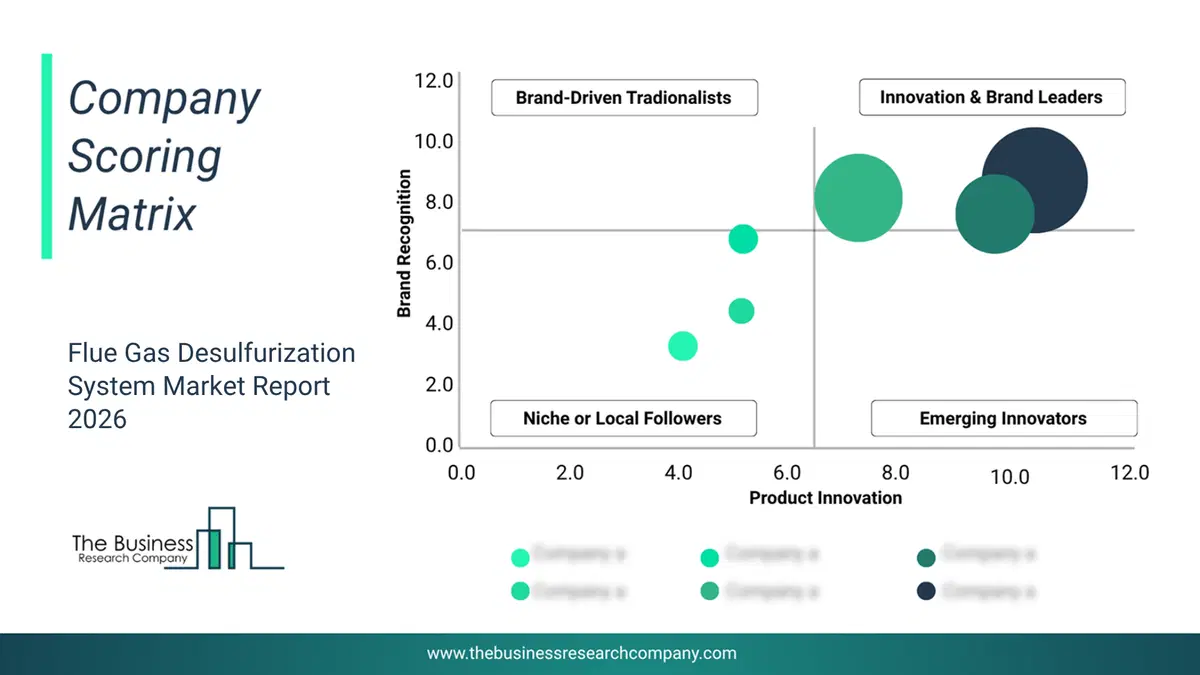
This chart maps companies by product innovation and brand strength, with bubble size indicating relative revenue, helping identify market leaders, challengers, and niche players. This is an illustrative chart; the full report provides a complete and accurate competitive analysis.
What Are Latest Mergers And Acquisitions In The Flue Gas Desulfurization System Market?
In February 2025, ANDRITZ AG, an Austria-based technology company, acquired LDX Group, for an undisclosed amount. With this acquisition, ANDRITZ AG aims to strengthen its environmental solutions portfolio by integrating LDX Group’s advanced water and wastewater treatment technologies, enhancing global service offerings and sustainability solutions for industrial and municipal clients. LDX Group is a US-based company specializing in environmental engineering solutions, including water and wastewater treatment technologies.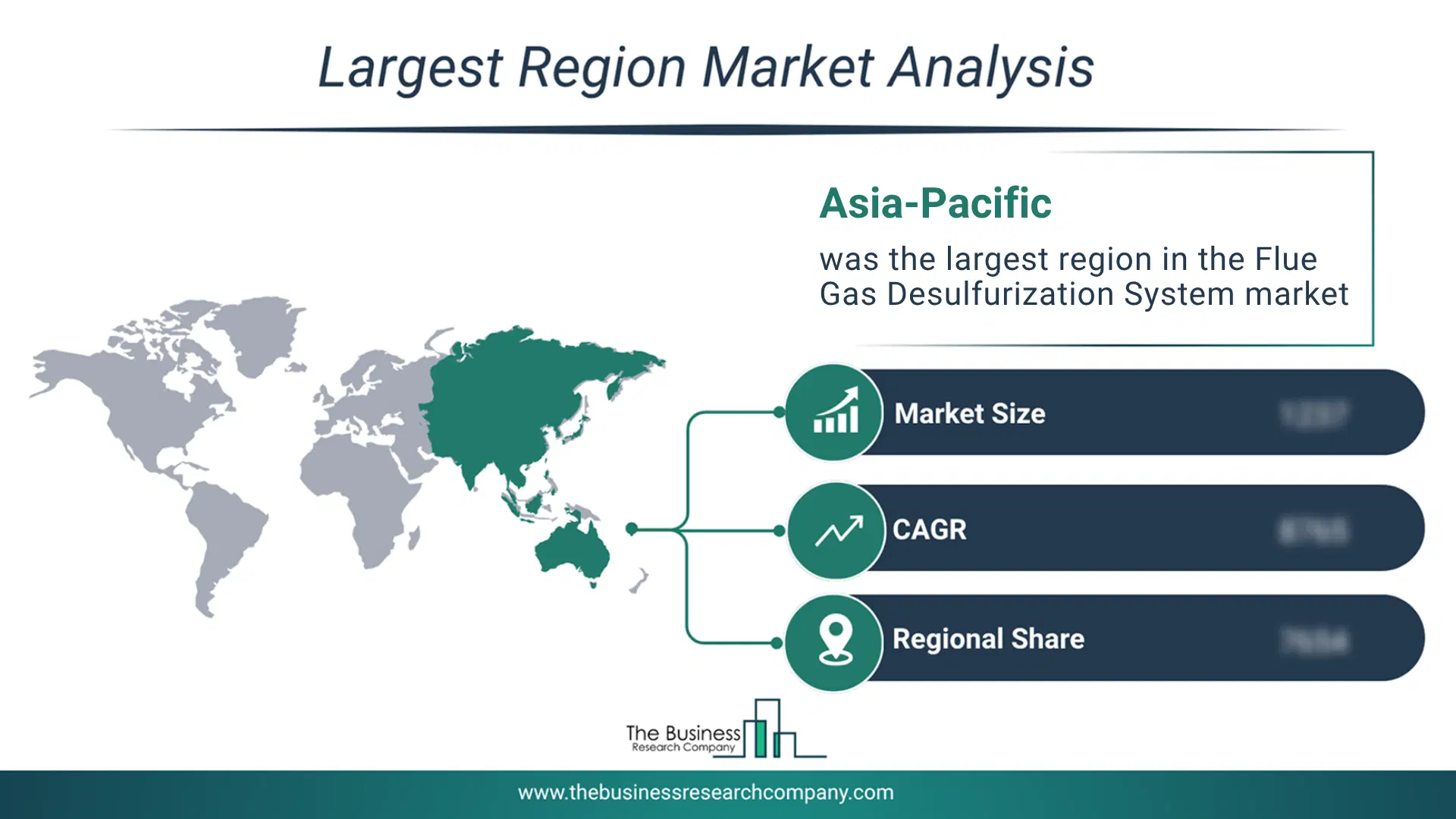
Regional Outlook
Asia-Pacific was the largest region in the flue gas desulfurization system market share in 2025. The regions covered in this market report are Asia-Pacific, South East Asia, Western Europe, Eastern Europe, North America, South America, Middle East, Africa The countries covered in this market report are Australia, Brazil, China, France, Germany, India, Indonesia, Japan, Taiwan, Russia, South Korea, UK, USA, Canada, Italy, Spain.What Defines the Flue Gas Desulfurization System Market?
The flue gas desulfurization system market consists of sales of flue gas desulfurization systems for once-through processes and regenerable processes. Values in this market are ‘factory gate’ values, that is the value of goods sold by the manufacturers or creators of the goods, whether to other entities (including downstream manufacturers, wholesalers, distributors and retailers) or directly to end customers. The value of goods in this market includes related services sold by the creators of the goods.How is Market Value Defined and Measured?
The market value is defined as the revenues that enterprises gain from the sale of goods and/or services within the specified market and geography through sales, grants, or donations in terms of the currency (in USD unless otherwise specified). The revenues for a specified geography are consumption values that are revenues generated by organizations in the specified geography within the market, irrespective of where they are produced. It does not include revenues from resales along the supply chain, either further along the supply chain or as part of other products.
This chart presents market attractiveness based on a quantitative evaluation of growth, competition, strategic alignment, and risk, offering a clear view of opportunity areas for decision-making. This chart is for illustrative purposes; the full report contains the complete analysis.

This chart highlights the Total Addressable Market (TAM) by estimating the maximum revenue opportunity using an assumption-driven approach, supporting strategic planning and opportunity sizing across markets. The chart is illustrative; the full report provides a more comprehensive analysis.
What Key Data and Analysis Are Included in the Flue Gas Desulfurization System Market Report 2026?
The flue gas desulfurization system market research report is one of a series of new reports from The Business Research Company that provides market statistics, including industry global market size, regional shares, competitors with the market share, detailed market segments, market trends and opportunities, and any further data you may need to thrive in the flue gas desulfurization system industry. The market research report delivers a complete perspective of everything you need, with an in-depth analysis of the current and future state of the industry.Flue Gas Desulfurization System Market Report Forecast Analysis
| Report Attribute | Details |
|---|---|
| Market Size Value In 2026 | $22.71 billion |
| Revenue Forecast In 2030 | $28.55 billion |
| Growth Rate | CAGR of 5.9% from 2026 to 2030 |
| Base Year For Estimation | 2025 |
| Actual Estimates/Historical Data | 2020-2025 |
| Forecast Period | 2026 - 2030 |
| Market Representation | Revenue in USD Billion and CAGR from 2026 to 2030 |
| Segments Covered | Type, Installation, End-Use |
| Regional Scope | Asia-Pacific, Western Europe, Eastern Europe, North America, South America, Middle East, Africa |
| Key Companies Profiled | Mitsubishi Heavy Industries Ltd., General Electric Company, Doosan Lentjes GmbH, Babcock & Wilcox Enterprises Inc., Siemens AG, FLSmidth & Co. A/S, Hamon Corporation, Marsulex Environmental Technologies Corporation, Thermax Limited, Ducon Technologies Inc., Clyde Bergemann Power Group, Andritz AG, Valmet Corporation, Chiyoda Corporation, China Energy Engineering Group Co. Ltd., Tri-Mer Corporation, Veolia Water Technologies, Wärtsilä Corp., Wheelabrator Technologies Inc., Yokogawa Electric Corporation, Zhejiang Feida Environmental Science & Technology, Zhejiang DunAn Artificial Environment, Zhejiang Shuanghuan Environmental Protection, Dürr AG, GEA Group AG |
| Customization Scope | Request for Customization |
| Pricing And Purchase Options | Explore Purchase Options |