
Fluid Catalytic Cracking (FCC) Wet Gas Scrubbers Market Report 2026
Global Outlook – By Type (Venturi Scrubbers, Packed Bed Scrubbers, Spray Tower Scrubbers, Other Types), By Pollutant Focus (Particulate Matter Removal, Sulfur Oxides Removal, Multi Pollutant Control Systems), By Installation Type (New Plant Installations, Retrofits And Upgrades), By Application (Petroleum Refineries, Petrochemical Plants, Chemical Processing, Other Applications), By End-User (Oil And Gas, Chemical, Power Generation, Other End Users) – Market Size, Trends, Strategies, and Forecast to 2035
Fluid Catalytic Cracking (FCC) Wet Gas Scrubbers Market Overview
• Fluid Catalytic Cracking (FCC) Wet Gas Scrubbers market size has reached to $1.36 billion in 2025 • Expected to grow to $2.01 billion in 2030 at a compound annual growth rate (CAGR) of 8.2% • Growth Driver: Expansion Of Refining Capacities Driving The Market Growth Due To Rising Global Demand For Petroleum Products • Market Trend: Innovative Emissions Control Technology Gains Major Refinery Contract • Asia-Pacific was the largest region in 2025 and Middle East is the fastest growing region.What Is Covered Under Fluid Catalytic Cracking (FCC) Wet Gas Scrubbers Market?
A fluid catalytic cracking (FCC) wet gas scrubber is an air pollution control system used in refinery FCC units to clean flue gas produced during catalyst regeneration. It works by bringing the hot exhaust gas into contact with a scrubbing liquid, typically water or an alkaline solution, which absorbs and removes contaminants such as fine catalyst particles, sulfur oxides, and other acidic gases. This process reduces harmful emissions, helping refineries comply with environmental regulations while minimizing the release of pollutants into the atmosphere. The main types of fluid catalytic cracking (FCC) wet gas scrubbers include venturi scrubbers, packed bed scrubbers, spray tower scrubbers, and other types. Venturi scrubbers refer to high-efficiency air pollution control systems designed to remove fine particulate matter and gaseous pollutants from FCC unit exhaust streams using high-velocity gas-liquid contact. These systems focus on pollutant control such as particulate matter removal, sulfur oxides removal, and multi pollutant control systems and are available in installation types including new plant installations and retrofits and upgrades. They find application in petroleum refineries, petrochemical plants, chemical processing, and others, serving end users including oil and gas, chemical, power generation, and others.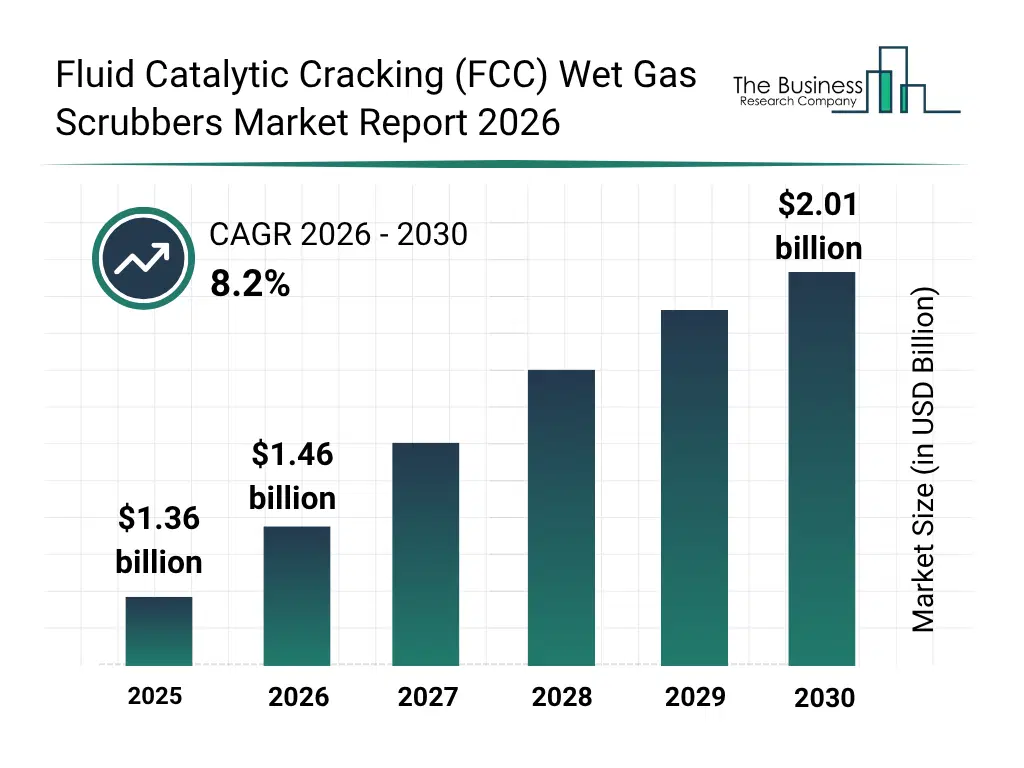
What Is The Fluid Catalytic Cracking (FCC) Wet Gas Scrubbers Market Size and Share 2026?
The fluid catalytic cracking (FCC) wet gas scrubbers market size has grown strongly in recent years. It will grow from $1.36 billion in 2025 to $1.46 billion in 2026 at a compound annual growth rate (CAGR) of 8.0%. The growth in the historic period can be attributed to tightening environmental emission regulations for refineries, increasing industrial pollution control requirements, expansion of oil refining capacity globally, rising awareness of air quality management, growing adoption of sulfur emission reduction technologies.What Is The Fluid Catalytic Cracking (FCC) Wet Gas Scrubbers Market Growth Forecast?
The fluid catalytic cracking (FCC) wet gas scrubbers market size is expected to see strong growth in the next few years. It will grow to $2.01 billion in 2030 at a compound annual growth rate (CAGR) of 8.2%. The growth in the forecast period can be attributed to stricter carbon emission reduction policies, increasing investments in refinery modernization projects, rising adoption of advanced pollution control systems, growth in sustainable refining operations, expansion of multi pollutant regulatory compliance frameworks. Major trends in the forecast period include deployment of advanced wet gas scrubber systems with high efficiency particulate removal, increasing adoption of multi pollutant control scrubber systems in refinery operations, rising integration of energy efficient scrubbing technologies for emission reduction compliance, expansion of retrofit scrubber installations in aging refinery infrastructure, growing use of hybrid scrubbing systems combining chemical and mechanical filtration methods.
Global Fluid Catalytic Cracking (FCC) Wet Gas Scrubbers Market Segmentation
1) By Type: Venturi Scrubbers, Packed Bed Scrubbers, Spray Tower Scrubbers, Other Types 2) By Pollutant Focus: Particulate Matter Removal, Sulfur Oxides Removal, Multi Pollutant Control Systems 3) By Installation Type: New Plant Installations, Retrofits And Upgrades 4) By Application: Petroleum Refineries, Petrochemical Plants, Chemical Processing, Other Applications 5) By End-User: Oil And Gas, Chemical, Power Generation, Other End Users Subsegments: 1) By Venturi Scrubbers: High Energy Venturi Scrubbers, Low Energy Venturi Scrubbers, Adjustable Throat Venturi Scrubbers, Fixed Throat Venturi Scrubbers 2) By Packed Bed Scrubbers: Structured Packing Packed Bed Scrubbers, Random Packing Packed Bed Scrubbers, Counter Current Flow Packed Bed Scrubbers, Cross Flow Packed Bed Scrubbers 3) By Spray Tower Scrubbers: Single Stage Spray Tower Scrubbers, Multi Stage Spray Tower Scrubbers, Vertical Spray Tower Scrubbers, Horizontal Spray Tower Scrubbers 4) By Other Types: Cyclonic Scrubbers, Wet Electrostatic Precipitator Systems, Hybrid Scrubber Systems, Multi Stage Combination ScrubbersWhat Are The Drivers Of The Fluid Catalytic Cracking (FCC) Wet Gas Scrubbers Market?
The expansion of refining capacities is expected to drive the growth of the fluid catalytic cracking (FCC) wet gas scrubbers market going forward. Refining capacity is increasing due to rising global demand for petroleum products, prompting refiners to expand existing facilities and add new processing units. As capacity grows, refineries operate FCC units at higher throughput levels, leading to increased emissions of acid gases and particulate matter. FCC wet gas scrubbers play a critical role in controlling these emissions, enabling regulatory compliance and supporting continuous refinery operations. For instance, in June 2024, according to the U.S. Energy Information Administration, a US-based government agency, operable atmospheric crude oil distillation capacity in the United States grew by 2% in 2023, adding 324,000 barrels per day. Therefore, the expansion of refining capacities is driving the growth of the fluid catalytic cracking (FCC) wet gas scrubbers industry. The increasing corporate ESG commitments is expected to propel the growth of the fluid catalytic cracking (FCC) wet gas scrubbers market going forward. Corporate ESG commitments refer to the pledges and actions taken by companies to integrate environmental, social, and governance (ESG) principles into their business strategies and operations. Corporate ESG commitments are rising due to increasing pressure from investors who demand greater transparency, responsible practices, and sustainable business operations. Corporate ESG commitments encourage companies to implement FCC wet gas scrubbers to reduce sulfur, nitrogen, and particulate emissions from refining operations, aligning environmental performance with sustainability goals, meeting stakeholder and investor expectations, ensuring regulatory compliance, and enhancing corporate reputation in the global push toward cleaner and more responsible industrial practices. For instance, in October 2025, according to the Organization for Economic Co‑operation and Development (OECD), a France-based international organization promoting policies to improve economic and social well-being globally, 91% of companies by market capitalization reported sustainability-related information in 2024, up from 86% in 2022, with Europe leading at 98%, followed by Developed Asia-Pacific excluding the United States at 94%, and the United States at 93%. Therefore, the increasing corporate ESG commitments is driving the growth of the fluid catalytic cracking (FCC) wet gas scrubbers industry.Key Players In The Global Fluid Catalytic Cracking (FCC) Wet Gas Scrubbers Market
Major companies operating in the fluid catalytic cracking (fcc) wet gas scrubbers market are Mitsubishi Heavy Industries Ltd., DuPont Clean Technologies, Andritz AG, GEA Group Aktiengesellschaft (AG), Hitachi Zosen Corporation, Thermax Limited, Babcock & Wilcox Enterprises Inc., CECO Environmental Corp., Sly Inc., Tri-Mer Corporation, Ducon Technologies Inc., AirPol Inc., Elessent Clean Technologies Inc., KCH Engineered Systems, ExxonMobil, Ducon Infratechnologies Limited, Kimre Inc.Global Fluid Catalytic Cracking (FCC) Wet Gas Scrubbers Market Trends and Insights
Major companies operating in the fluid catalytic cracking (FCC) wet gas scrubbers market are focusing on developing innovative solutions such as, advanced wet gas scrubbing technology to reduce emissions and enhance refinery efficiency. Advanced wet gas scrubbing technology, which uses high-efficiency spray towers and chemical absorption to remove sulfur oxides and fine particulates from FCC flue gas, helps refineries reduce emissions and comply with environmental regulations. For instance, in December 2025, Babcock & Wilcox, a US-based engineering and manufacturing company, was awarded a $40 million contract to deliver advanced wet gas scrubbing technology at a Canadian petroleum refinery. The contracted system will feature high-capacity absorbers with optimized spray towers, corrosion-resistant materials, and integrated process controls to ensure efficient pollutant removal while minimizing energy consumption. This technology is particularly effective in handling high-sulfur feedstocks, offering refineries compliance with stringent environmental regulations and operational cost savings.Regional Outlook/Insights
Asia-Pacific was the largest region in the fluid catalytic cracking (FCC) wet gas scrubbers market in 2025. Middle East is expected to be the fastest-growing region in the forecast period. The regions covered in this market report are Asia-Pacific, South East Asia, Western Europe, Eastern Europe, North America, South America, Middle East, Africa. The countries covered in this market report are Australia, Brazil, China, France, Germany, India, Indonesia, Japan, Taiwan, Russia, South Korea, UK, USA, Canada, Italy, Spain.What Defines the Fluid Catalytic Cracking (FCC) Wet Gas Scrubbers Market?
The fluid catalytic cracking (FCC) wet gas scrubbers market consists of sales of wet gas scrubber units, absorber vessels, spray nozzles, mist eliminators, pumps, and control systems. Values in this market are ‘factory gate’ values, that is, the value of goods sold by the manufacturers or creators of the goods, whether to other entities including downstream manufacturers, wholesalers, distributors, and retailers or directly to end customers. The value of goods in this market includes related services sold by the creators of the goods.How is Market Value Defined and Measured?
The market value is defined as the revenues that enterprises gain from the sale of goods and/or services within the specified market and geography through sales, grants, or donations in terms of the currency (in USD unless otherwise specified). The revenues for a specified geography are consumption values that are revenues generated by organizations in the specified geography within the market, irrespective of where they are produced. It does not include revenues from resales along the supply chain, either further along the supply chain or as part of other products.What Key Data and Analysis Are Included in the Fluid Catalytic Cracking (FCC) Wet Gas Scrubbers Market Report 2026?
The fluid catalytic cracking (fcc) wet gas scrubbers market research report is one of a series of new reports from The Business Research Company that provides market statistics, including industry global market size, regional shares, competitors with the market share, detailed market segments, market trends and opportunities, and any further data you may need to thrive in the fluid catalytic cracking (fcc) wet gas scrubbers industry. The market research report delivers a complete perspective of everything you need, with an in-depth analysis of the current and future state of the industry.Fluid Catalytic Cracking (FCC) Wet Gas Scrubbers Market Report Forecast Analysis
| Report Attribute | Details |
|---|---|
| Market Size Value In 2026 | $1.46 billion |
| Revenue Forecast In 2035 | $2.01 billion |
| Growth Rate | CAGR of 8.2% from 2026 to 2035 |
| Base Year For Estimation | 2025 |
| Actual Estimates/Historical Data | 2020-2025 |
| Forecast Period | 2026 - 2030 - 2035 |
| Market Representation | Revenue in USD Billion and CAGR from 2026 to 2035 |
| Segments Covered | Type, Pollutant Focus, Installation Type, Application, End-User |
| Regional Scope | Asia-Pacific, Western Europe, Eastern Europe, North America, South America, Middle East, Africa |
| Country Scope | The countries covered in the report are Australia, Brazil, China, France, Germany, India, Indonesia, Japan, Taiwan, Russia, South Korea, UK, USA, Canada, Italy, Spain. |
| Key Companies Profiled | Mitsubishi Heavy Industries Ltd., DuPont Clean Technologies, Andritz AG, GEA Group Aktiengesellschaft (AG), Hitachi Zosen Corporation, Thermax Limited, Babcock & Wilcox Enterprises Inc., CECO Environmental Corp., Sly Inc., Tri-Mer Corporation, Ducon Technologies Inc., AirPol Inc., Elessent Clean Technologies Inc., KCH Engineered Systems, ExxonMobil, Ducon Infratechnologies Limited, Kimre Inc. |
| Customization Scope | Request for Customization |
| Pricing And Purchase Options | Explore Purchase Options |