
Fluid Dispensing Systems Market Report 2026
Global Outlook – By Product (Flux, Lubricant, Solder Paste, Adhesives And Sealants, Conformal Coatings, Other Products), By Machine Type (Manual, Semi-Automatic, Automatic), By End-Use Industry (Electrical And Electronics, Automotive, Aerospace, Medical, Other End Use Industries) – Market Size, Trends, Strategies, and Forecast to 2030
Fluid Dispensing Systems Market Overview
• Fluid Dispensing Systems market size has reached to $38.78 billion in 2025 • Expected to grow to $53.24 billion in 2030 at a compound annual growth rate (CAGR) of 6.7% • Growth Driver: Automation Technology Driving Growth In The Fluid Dispensing Systems Market • Market Trend: Growing Focus On Digitally Connected Dispensing Technologies • North America was the largest region in 2025.What Is Covered Under Fluid Dispensing Systems Market?
Fluid dispensing systems are equipment designed to accurately dispense fluids, such as adhesives, lubricants, sealants, and coatings, in various industrial applications. These systems ensure precise control over dispensing, improving efficiency, reducing waste, and enhancing product quality. The main types of products included in fluid dispensing systems are flux, lubricant, solder paste, adhesives and sealants, conformal coatings, and others. Flux is a substance used in soldering processes to facilitate the flow of solder and remove oxidation from metal surfaces. The various types of machines included are manual, semi-automatic, and automatic, which are used by several end-use industries, including electrical and electronics, automotive, building and construction, aerospace, medical, and others.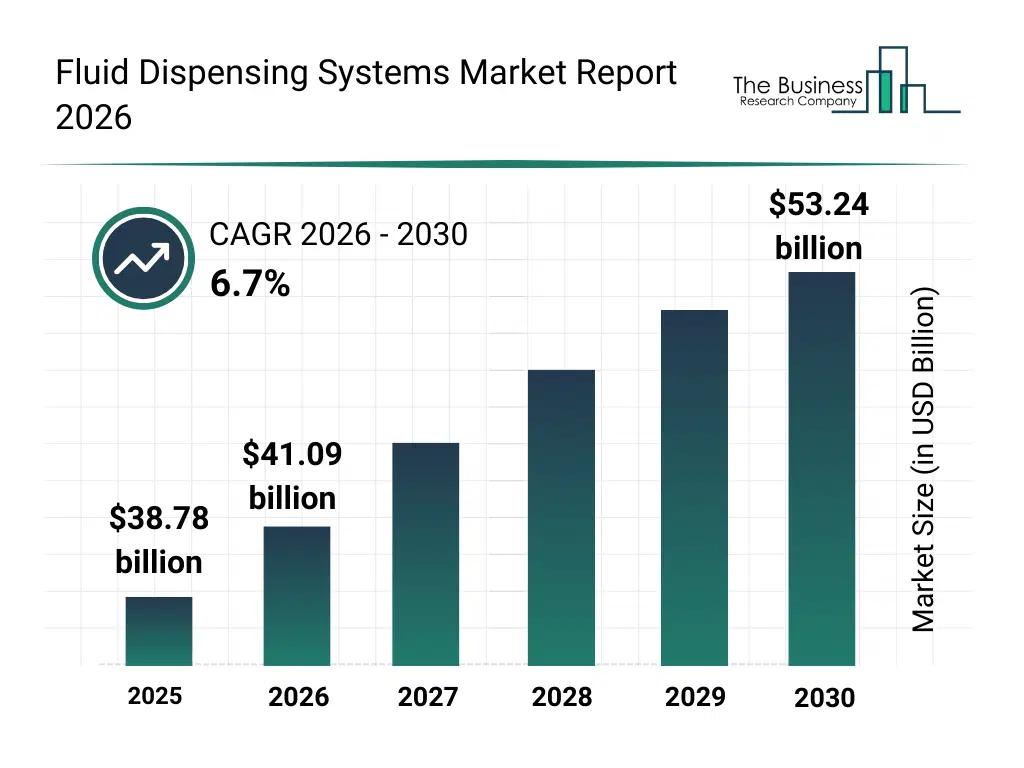
What Is The Fluid Dispensing Systems Market Size and Share 2026?
The fluid dispensing systems market size has grown strongly in recent years. It will grow from $38.78 billion in 2025 to $41.09 billion in 2026 at a compound annual growth rate (CAGR) of 5.9%. The growth in the historic period can be attributed to expansion of electronics manufacturing, growth in automotive assembly operations, increasing use of adhesives and sealants, rising demand for precision coating applications, availability of advanced dispensing technologies.What Is The Fluid Dispensing Systems Market Growth Forecast?
The fluid dispensing systems market size is expected to see strong growth in the next few years. It will grow to $53.24 billion in 2030 at a compound annual growth rate (CAGR) of 6.7%. The growth in the forecast period can be attributed to increasing adoption of fully automated production lines, rising demand for miniaturized electronic components, expansion of medical device manufacturing, growing focus on material efficiency, increasing use of data-driven dispensing control. Major trends in the forecast period include increasing adoption of automated precision dispensing systems, rising demand for high-accuracy fluid control, growing integration of smart sensors and software, expansion of multi-fluid dispensing capabilities, enhanced focus on waste reduction.Tariff Impact On Fluid Dispensing Systems Market
Tariffs are affecting the fluid dispensing systems market by raising costs for imported pumps, valves, controllers, precision nozzles, and electronic control modules. Electrical and electronics manufacturing hubs in Asia-Pacific, along with automotive and aerospace facilities in North America and Europe, are most impacted due to dependence on imported high-precision components. These tariffs are increasing equipment prices and slowing capital investment decisions for automated dispensing lines. At the same time, they are promoting domestic production, local system integration, and innovation in standardized, cost-efficient dispensing platforms.
Global Fluid Dispensing Systems Market Segmentation
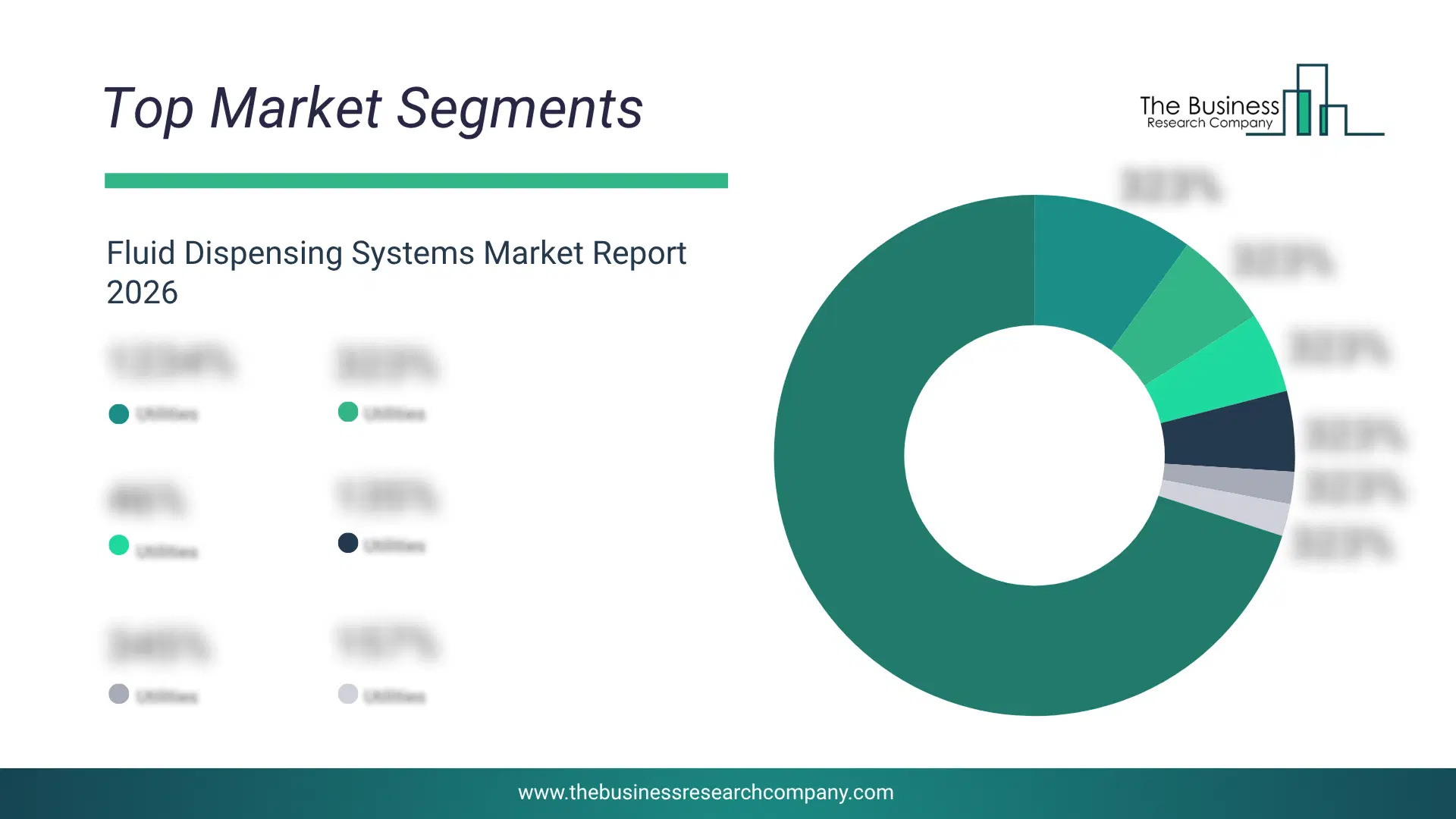
1) By Product: Flux, Lubricant, Solder Paste, Adhesives And Sealants, Conformal Coatings, Other Products 2) By Machine Type: Manual, Semi-Automatic, Automatic 3) By End-Use Industry: Electrical And Electronics, Automotive, Aerospace, Medical, Other End Use Industries Subsegments: 1) By Flux: Rosin-Based Flux, Water-Soluble Flux, No-Clean Flux 2) By Lubricant: Oil-Based Lubricants, Water-Based Lubricants, Grease Lubricants 3) By Solder Paste: Lead-Based Solder Paste, Lead-Free Solder Paste 4) By Adhesives And Sealants: Epoxy Adhesives, Silicone Sealants, Acrylic Adhesives 5) By Conformal Coatings: Acrylic Coatings, Silicone Coatings, Polyurethane Coatings 6) By Other Products: Thermal Interface Materials, Coating MaterialsWhat Is The Driver Of The Fluid Dispensing Systems Market?
The spread of automation technology and machinery in industries is expected to propel the growth of the fluid dispensing systems market going forward. Industrial automation uses advanced technologies, such as robotics, control systems, and computer software, to automate and streamline industrial processes, increasing efficiency, productivity, and safety in manufacturing and other industrial sectors. The rise of automation technology in industries drives the growth of fluid dispensing systems by enabling precise, efficient, and reliable fluid handling processes. Automation ensures consistent dispensing, increased throughput, and improved process control and fosters innovation in fluid dispensing solutions, meeting the demand for seamless integration into automated production lines. For instance, in April 2024, according to the International Federation of Robotics, a Germany-based international organization, In the United States, manufacturing companies have significantly increased their automation efforts, with total industrial robot installations rising 12% to 44,303 units in 2023. Therefore, the spread of automation technology and machinery in industries is driving the growth of the fluid dispensing systems industry.Key Players In The Global Fluid Dispensing Systems Market
Major companies operating in the fluid dispensing systems market are ITW Dynatec GmbH, Nordson Corporation, Dymax Corporation, Valco Melton, Precision Valve & Automation Inc., Fisnar Inc., TechCon Inc., DOPAG India Pvt. Ltd., GPD Global Inc., Musashi Engineering Inc., InterTronic Solutions Inc., San-Ei Tech Co. Ltd., Fishman Corporation, Ellsworth Adhesives, Protec Co. Ltd., Thermo Fisher Scientific Inc., Agilent Technologies Inc., Ecolab Inc., Bel-Art Products, Heathrow Scientific LLC, Argos Technologies Inc., DWK Life Sciences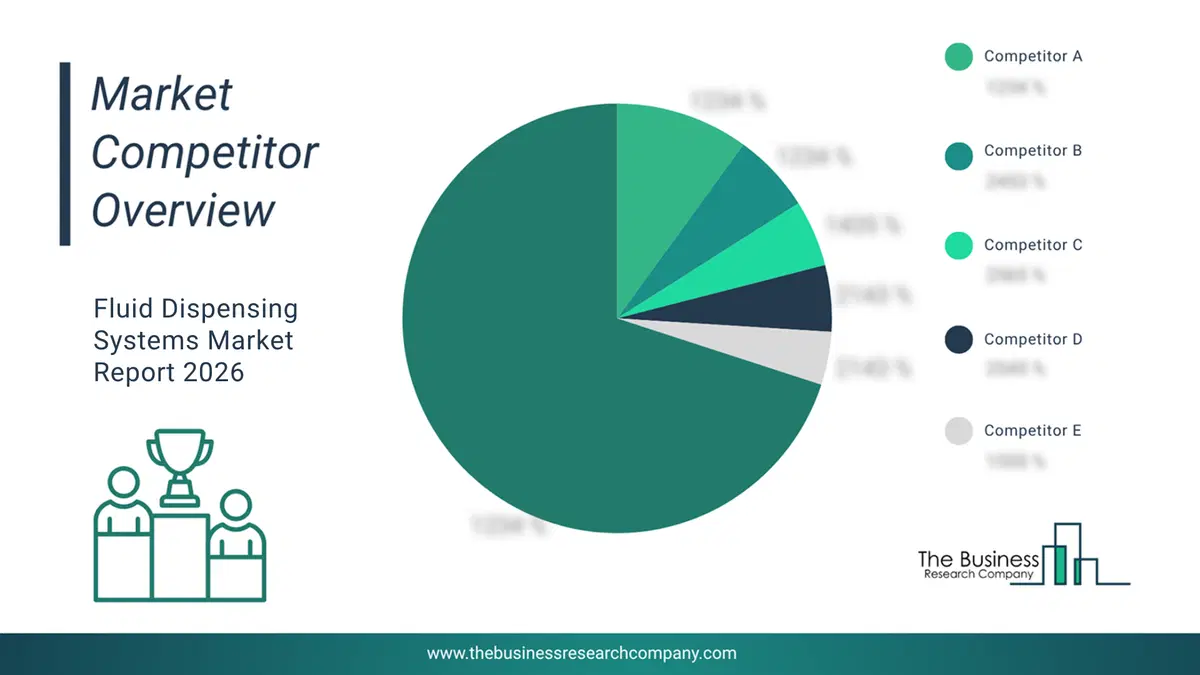
This chart is for illustrative purposes; the full report includes a detailed competitor analysis and comprehensive overview of the top 10 companies in the market.
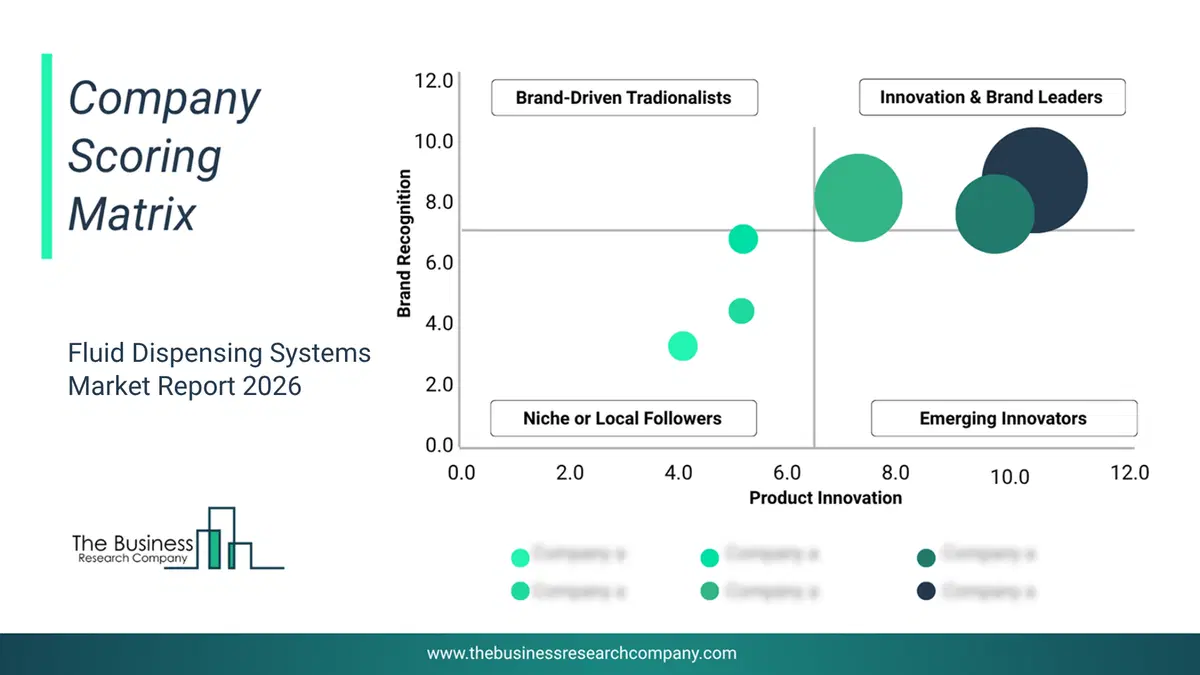
This chart maps companies by product innovation and brand strength, with bubble size indicating relative revenue, helping identify market leaders, challengers, and niche players. This is an illustrative chart; the full report provides a complete and accurate competitive analysis.
Global Fluid Dispensing Systems Market Trends and Insights
Major companies operating in the fluid dispensing system market are focusing on innovation in advanced manufacturing and automation, such as digitally connected fluid-dispensing systems to improve real-time control, monitoring, and integration with modern production lines. Digitally connected fluid-dispensing systems refer to equipment enabled with industrial Ethernet and web-based interfaces that support remote operation, data visibility, and automated process management. For instance, in October 2024, Nordson EFD, a US-based precision fluid-dispensing company, launched its PICO Nexs Jetting System, a compact, Ethernet-connected dispensing platform that enables browser-based setup, multi-valve control, and seamless integration into automated production lines; the system uses piezoelectric jetting to deposit precise sub-microliter droplets of adhesives, coatings, or biomaterials with high repeatability, supports a wide range of fluids, features modular nozzle heads and intuitive software for pattern programming, reduces material waste, increases throughput, and ensures consistent quality in applications spanning microelectronics, medical devices, and lab automation.What Are Latest Mergers And Acquisitions In The Fluid Dispensing Systems Market?
In July 2023, LubriSource, Inc., a US-based automation company, acquired a fluid storage and dispensing product line from The IFH Group for an undisclosed amount. This acquisition is significant as it revives a well-known product line used for decades in various industries that handle oils, lubricants, and industrial fluids. IFH Group is a US-based provider of fluid dispensing systems.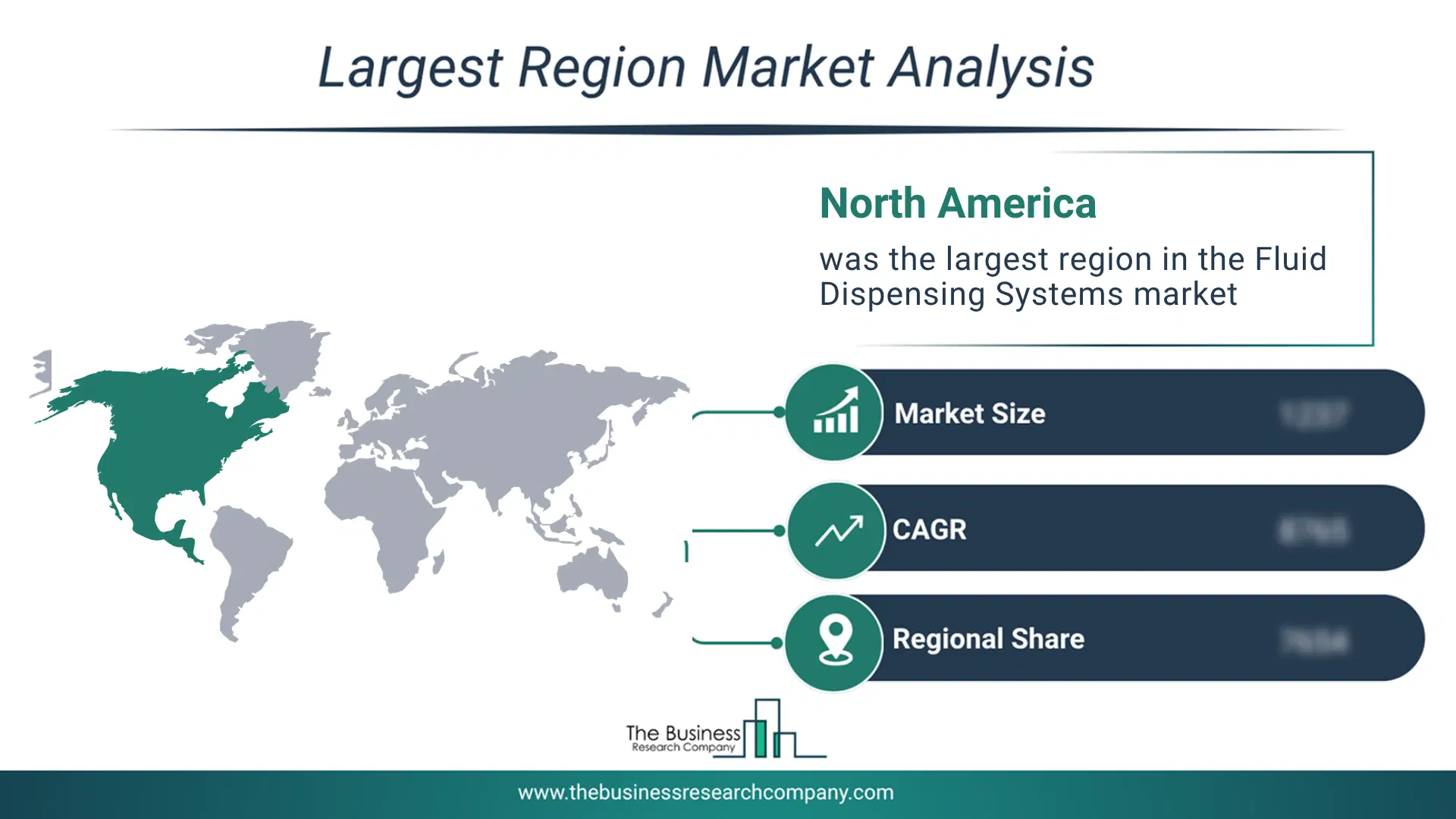
Regional Outlook
North America was the largest region in the fluid dispensing systems market in 2025. The regions covered in this market report are Asia-Pacific, South East Asia, Western Europe, Eastern Europe, North America, South America, Middle East, Africa The countries covered in this market report are Australia, Brazil, China, France, Germany, India, Indonesia, Japan, Taiwan, Russia, South Korea, UK, USA, Canada, Italy, Spain.What Defines the Fluid Dispensing Systems Market?
The fluid dispensing systems market consists of sales of fluid reservoir, control system, dispensing valves, syringe barrels and plungers, and cartridges. Values in this market are ‘factory gate’ values, that is the value of goods sold by the manufacturers or creators of the goods, whether to other entities (including downstream manufacturers, wholesalers, distributors and retailers) or directly to end customers. The value of goods in this market includes related services sold by the creators of the goods.How is Market Value Defined and Measured?
The market value is defined as the revenues that enterprises gain from the sale of goods and/or services within the specified market and geography through sales, grants, or donations in terms of the currency (in USD unless otherwise specified). The revenues for a specified geography are consumption values that are revenues generated by organizations in the specified geography within the market, irrespective of where they are produced. It does not include revenues from resales along the supply chain, either further along the supply chain or as part of other products.
This chart presents market attractiveness based on a quantitative evaluation of growth, competition, strategic alignment, and risk, offering a clear view of opportunity areas for decision-making. This chart is for illustrative purposes; the full report contains the complete analysis.

This chart highlights the Total Addressable Market (TAM) by estimating the maximum revenue opportunity using an assumption-driven approach, supporting strategic planning and opportunity sizing across markets. The chart is illustrative; the full report provides a more comprehensive analysis.
What Key Data and Analysis Are Included in the Fluid Dispensing Systems Market Report 2026?
The fluid dispensing systems market research report is one of a series of new reports from The Business Research Company that provides market statistics, including industry global market size, regional shares, competitors with the market share, detailed market segments, market trends and opportunities, and any further data you may need to thrive in the fluid dispensing systems industry. The market research report delivers a complete perspective of everything you need, with an in-depth analysis of the current and future state of the industry.Fluid Dispensing Systems Market Report Forecast Analysis
| Report Attribute | Details |
|---|---|
| Market Size Value In 2026 | $41.09 billion |
| Revenue Forecast In 2030 | $53.24 billion |
| Growth Rate | CAGR of 6.7% from 2026 to 2030 |
| Base Year For Estimation | 2025 |
| Actual Estimates/Historical Data | 2020-2025 |
| Forecast Period | 2026 - 2030 |
| Market Representation | Revenue in USD Billion and CAGR from 2026 to 2030 |
| Segments Covered | Product, Machine Type, End-Use Industry |
| Regional Scope | Asia-Pacific, Western Europe, Eastern Europe, North America, South America, Middle East, Africa |
| Key Companies Profiled | ITW Dynatec GmbH, Nordson Corporation, Dymax Corporation, Valco Melton, Precision Valve & Automation Inc., Fisnar Inc., TechCon Inc., DOPAG India Pvt. Ltd., GPD Global Inc., Musashi Engineering Inc., InterTronic Solutions Inc., San-Ei Tech Co. Ltd., Fishman Corporation, Ellsworth Adhesives, Protec Co. Ltd., Thermo Fisher Scientific Inc., Agilent Technologies Inc., Ecolab Inc., Bel-Art Products, Heathrow Scientific LLC, Argos Technologies Inc., DWK Life Sciences |
| Customization Scope | Request for Customization |
| Pricing And Purchase Options | Explore Purchase Options |