

Fly-By-Wire Systems Market Report 2026
Global Outlook – By System Type (Analog Fly By Wire, Digital Fly By Wire, Power By Wire), By Component (Flight Control Computers, Sensors, Actuators, Flight Control Software, Data Buses And Communication Systems, Cockpit Control Interfaces, Power Supply Units, Other Components), By Aircraft Type (Commercial Aircraft, Military Aircraft, Business Jets, Helicopters, Unmanned Aerial Vehicles, Advanced Air Mobility Aircraft), By Application (Primary Flight Controls, Secondary Flight Controls, Autonomous And Advanced Flight Systems), By End User (Original Equipment Manufacturers, Airlines, Maintenance, Repair, And Overhaul Providers, Defense Organizations, Aircraft Operators) – Market Size, Trends, Strategies, and Forecast to 2035
Fly-By-Wire Systems Market Overview
• Fly-By-Wire Systems market size has reached to $5.54 billion in 2025 • Expected to grow to $8.23 billion in 2030 at a compound annual growth rate (CAGR) of 8.2% • Growth Driver: Growing Commercial Aircraft Production Driving The Market Growth Due To Increasing Demand For Enhance Aviation Safety And Tracking Technologies • Market Trend: Advanced Fly-By-Wire Systems Enhance VTOL Aircraft Safety and Performance • North America was the largest region in 2025 and Asia-Pacific is the fastest growing region.What Is Covered Under Fly-By-Wire Systems Market?
Fly-by-wire systems refer to electronic flight control technologies that use computerized interfaces and electronic signal transmission to convey pilot commands to aircraft flight-control mechanisms. These systems replace or reduce reliance on direct mechanical control linkages and can incorporate hydraulic or electromechanical actuators. They enhance aircraft control precision, flight stability, operational efficiency, and enable advanced automated flight-control capabilities. The main system types of fly-by-wire systems include analog fly by wire, digital fly by wire, and power by wire. Analog fly by wire refer to flight control systems that use analog electronic signals to transmit pilot commands to aircraft control surfaces and actuators. These systems incorporate flight control computers, sensors, actuators, flight control software, data buses and communication systems, cockpit control interfaces, power supply units, and other components and they are used in commercial aircraft, military aircraft, business jets, helicopters, unmanned aerial vehicles, and advanced air mobility aircraft. The various applications involved are primary flight controls, secondary flight controls, and autonomous and advanced flight systems and they are utilized by end users including original equipment manufacturers, airlines, maintenance, repair, and overhaul providers, defense organizations, and aircraft operators.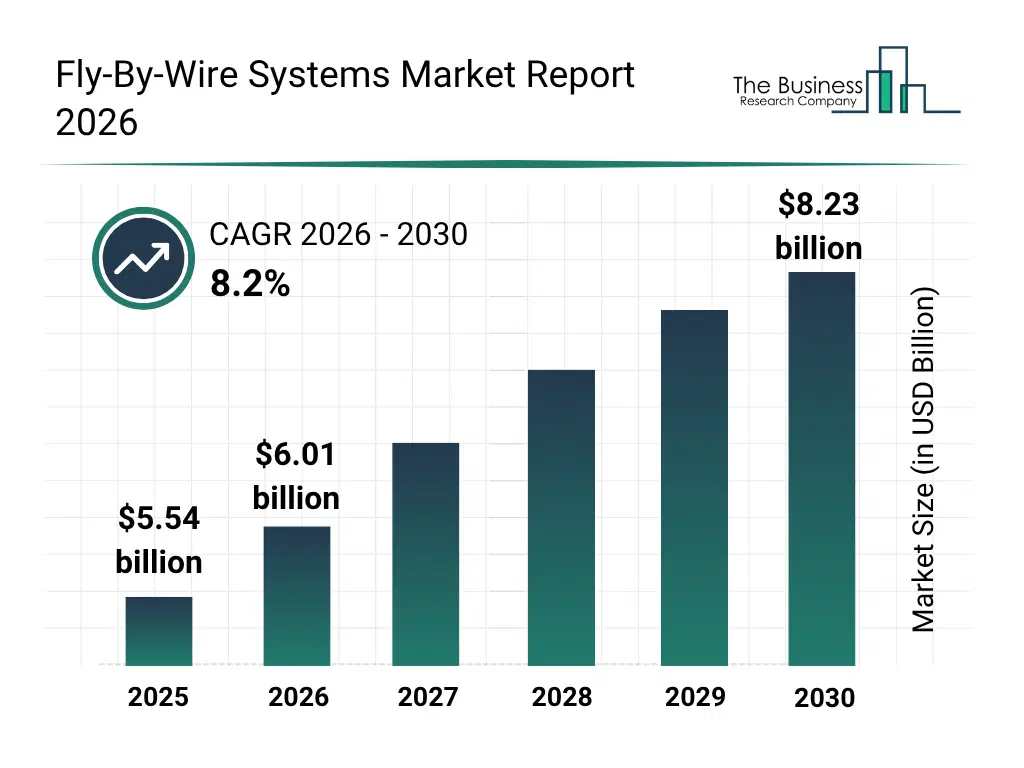
What Is The Fly-By-Wire Systems Market Size and Share 2026?
The fly-by-wire systems market size has grown strongly in recent years. It will grow from $5.54 billion in 2025 to $6.01 billion in 2026 at a compound annual growth rate (CAGR) of 8.6%. The growth in the historic period can be attributed to increasing adoption of electronic flight control systems, rising demand for improved aircraft flight stability, growing production of commercial aircraft, expanding use of computerized flight controls, need for reduced mechanical system complexity.What Is The Fly-By-Wire Systems Market Growth Forecast?
The fly-by-wire systems market size is expected to see strong growth in the next few years. It will grow to $8.23 billion in 2030 at a compound annual growth rate (CAGR) of 8.2%. The growth in the forecast period can be attributed to increasing demand for autonomous flight capabilities, rising adoption of electric power by wire systems, growing deployment of advanced air mobility aircraft, expanding requirements for flight control system redundancy, need for enhanced aircraft operational efficiency. Major trends in the forecast period include fly by wire system redundancy enhancement, digital flight control system integration, electro mechanical actuator adoption, flight control software modernization, lightweight flight control component integration.Tariff Impact On Fly-By-Wire Systems Market
Tariffs are impacting the Fly-By-Wire Systems market by increasing the cost of imported flight control computers, sensors, actuators, electronic components, software hardware, and specialized aerospace manufacturing equipment. This is raising aircraft production and maintenance costs and can delay procurement and system integration, particularly in regions dependent on international aerospace supply chains such as North America, Europe, and Asia-Pacific. Component-intensive segments such as flight control computers, sensors, actuators, data buses, and power supply units are most affected due to their reliance on specialized global suppliers. However, tariffs are also encouraging domestic aerospace component manufacturing, supplier diversification, and regional production of critical flight control technologies, strengthening long-term supply-chain resilience.
Global Fly-By-Wire Systems Market Segmentation
2) By Component: Flight Control Computers, Sensors, Actuators, Flight Control Software, Data Buses And Communication Systems, Cockpit Control Interfaces, Power Supply Units, Other Components 3) By Aircraft Type: Commercial Aircraft, Military Aircraft, Business Jets, Helicopters, Unmanned Aerial Vehicles, Advanced Air Mobility Aircraft 4) By Application: Primary Flight Controls, Secondary Flight Controls, Autonomous And Advanced Flight Systems 5) By End User: Original Equipment Manufacturers, Airlines, Maintenance, Repair, And Overhaul Providers, Defense Organizations, Aircraft Operators Subsegments: 1) By Analog Fly By Wire: Single Channel Analog Fly By Wire Systems, Dual Channel Analog Fly By Wire Systems, Triple Channel Analog Fly By Wire Systems, Aircraft Control Analog Fly By Wire Systems, Backup Analog Fly By Wire Systems 2) By Digital Fly By Wire: Full Digital Fly By Wire Systems, Digital Flight Control Systems, Triple Redundant Digital Fly By Wire Systems, Quadruple Redundant Digital Fly By Wire Systems, Advanced Digital Fly By Wire Systems 3) By Power By Wire: Electro Hydrostatic Power By Wire Systems, Electromechanical Power By Wire Systems, Electro Hydraulic Power By Wire Systems, Distributed Power By Wire Systems, Advanced Electric Power By Wire SystemsWhat Is The Driver Of The Fly-By-Wire Systems Market?
The rising demand for commercial aircraft is expected to propel the growth of the fly-by-wire systems market going forward. Commercial aircraft are passenger or cargo airplanes designed for air transportation services, including domestic and international flights operated by airlines and aviation companies. The demand for commercial aircraft is increasing due to rising air passenger traffic, as the growing number of travelers worldwide is encouraging airlines to expand their fleets, increase flight capacity, and acquire new aircraft to meet higher transportation needs. Growing commercial aircraft production drives demand for fly-by-wire systems by increasing the need for advanced electronic flight control systems that enhance aircraft safety, improve operational efficiency, reduce weight, and support the integration of next-generation aviation technologies. For instance, in June 2025, according to the International Air Transport Association (IATA), a Canada-based airline industry association, 1,692 commercial aircraft were expected to be delivered globally in 2025, up from 1,266 aircraft delivered in 2024, representing an expected increase of approximately 33.6%. Therefore, the rising demand for commercial aircraft is driving the growth of the fly-by-wire systems industry.Key Players In The Global Fly-By-Wire Systems Market
Major companies operating in the fly-by-wire systems market are The Boeing Company, Airbus SE, RTX Corporation, Lockheed Martin Corporation, General Atomics Aeronautical Systems Inc., Honeywell International Inc., Northrop Grumman Corporation, Safran S.A., BAE Systems plc, Thales S.A., Leonardo S.p.A., Parker-Hannifin Corporation, Aviation Industry Corporation of China Ltd., Bombardier Inc., Dassault Aviation S.A., Embraer S.A., Liebherr-International AG, Elbit Systems Ltd., Israel Aerospace Industries Ltd., Saab AB, Moog Inc., Korea Aerospace Industries Ltd., Turkish Aerospace Industries Inc., Nabtesco Corporation, Woodward Inc., Joby Aviation Inc., Volocopter GmbH, Beta Technologies Inc., Eve Holding Inc., AURA AERO SAS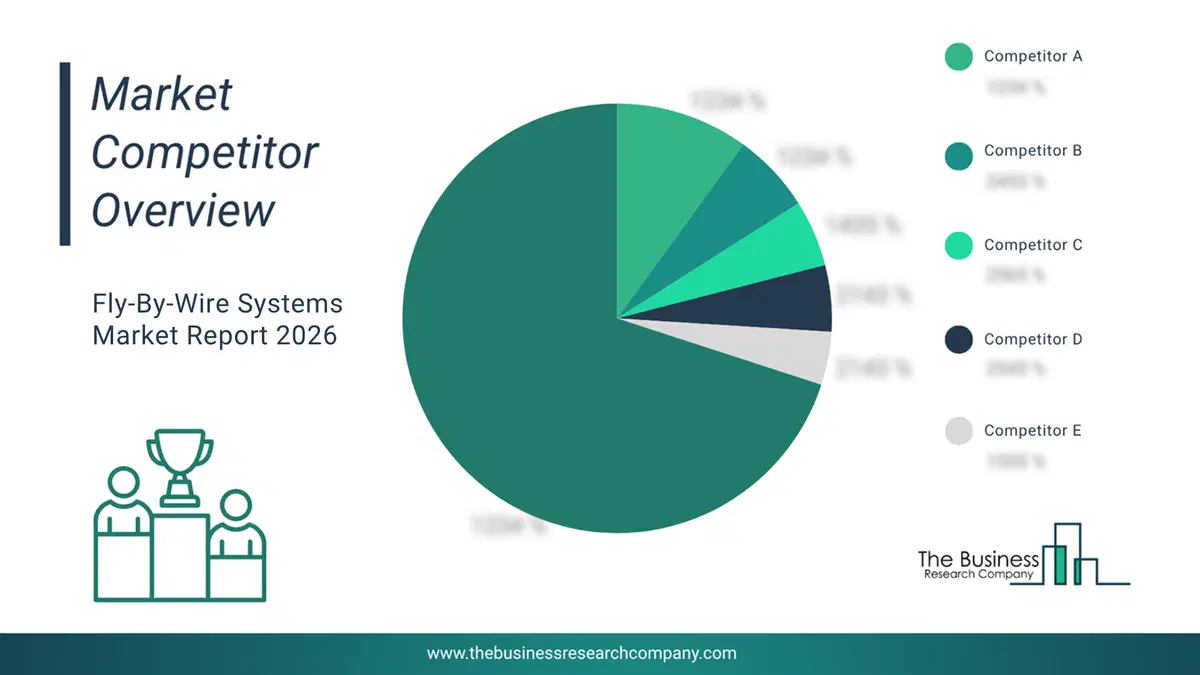
This chart is for illustrative purposes; the full report includes a detailed competitor analysis and comprehensive overview of the top 10 companies in the market.
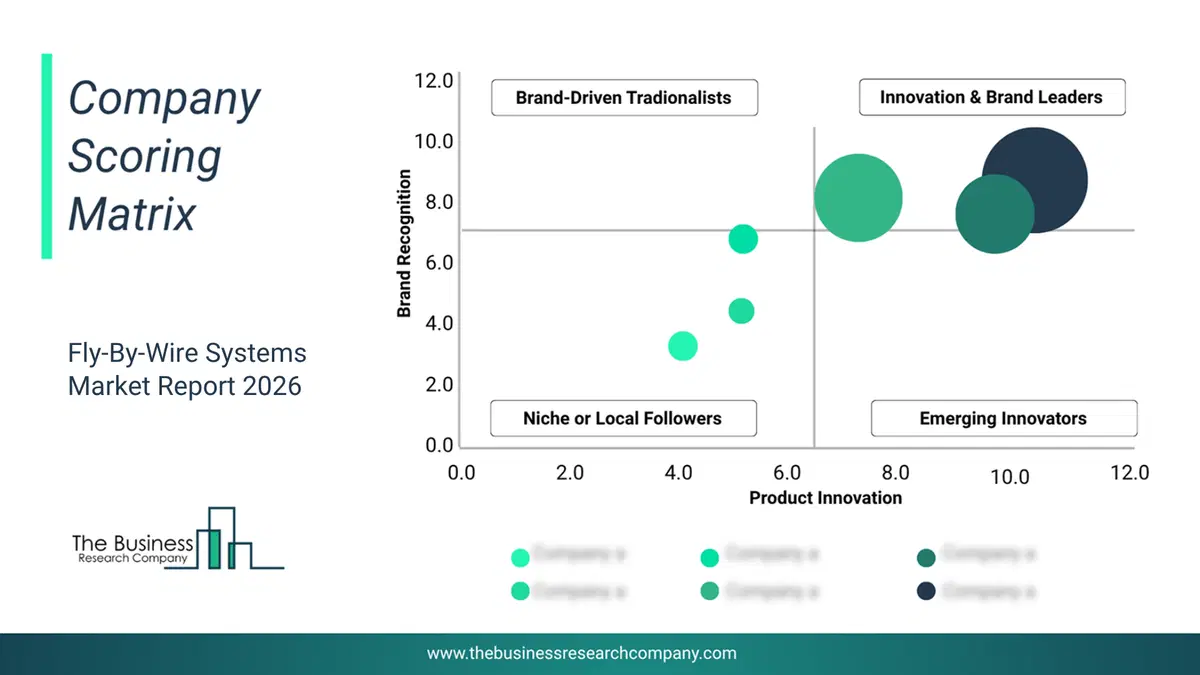
This chart maps companies by product innovation and brand strength, with bubble size indicating relative revenue, helping identify market leaders, challengers, and niche players. This is an illustrative chart; the full report provides a complete and accurate competitive analysis.
Global Fly-By-Wire Systems Market Trends and Insights
Major companies operating in the fly-by-wire systems market are focusing on providing advanced flight-control computers and software for next-generation aircraft to enhance precision, stability, safety, and operational efficiency. Advanced flight-control computers and software refer to electronic computing hardware and specialized software that process pilot commands and sensor data to automatically control an aircraft’s flight functions with high precision, stability, and safety. For instance, in July 2026, Horizon Aircraft, a Canada-based eVTOL aircraft manufacturer, selected BETA Technologies, a US-based aerospace and defense company, to supply advanced flight-control computers for its Cavorite X7 hybrid-electric vertical takeoff and landing (VTOL) aircraft. Through the partnership, Horizon Aircraft will integrate BETA's fly-by-wire (FBW) flight-control hardware and customized software into the Cavorite X7 as it advances aircraft development, testing, and certification activities. BETA's FBW platform is designed specifically for modern VTOL aircraft and incorporates safety-critical software, system redundancy, and a flexible architecture to support reliable aircraft operations. The flight-control computer also supports certification pathways for FAA Part 21.17(b) powered-lift, Part 23, and Part 25 applications, as well as future international regulatory frameworks. In addition, Horizon Aircraft will use the same flight-control computer hardware as BETA's own fleet, enabling shared economies of scale that can reduce component costs and improve manufacturing efficiency.What Are Latest Mergers And Acquisitions In The Fly-By-Wire Systems Market?
In July 2025, Safran S.A., a France-based aerospace, defense, and security company, acquired Collins Aerospace’s actuation and flight control business from RTX Corporation for $1.8 billion. With this acquisition, Safran S.A. aimed to become a global leader in critical flight control and actuation systems by integrating Collins Aerospace’s advanced hydraulic and mechanical actuation technologies, expanding its aerospace systems portfolio across commercial aircraft, military aircraft, and helicopters, strengthening its aftermarket capabilities, and positioning itself for next-generation aircraft programs with increased electrification. Collins Aerospace is a US-based aerospace systems manufacturing company that specializes in providing fly-by-wire (FBW) systems.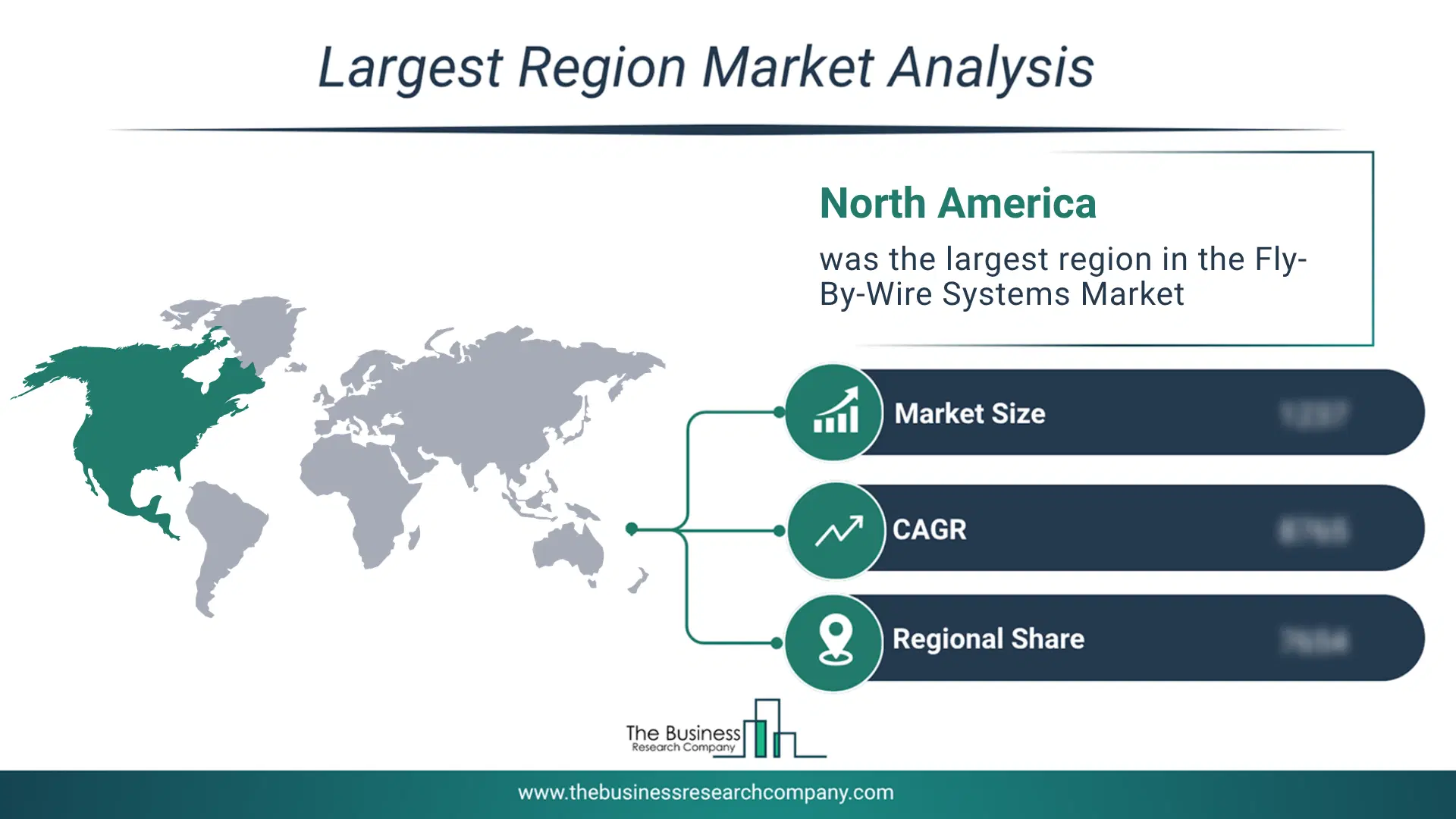
Regional Outlook/Insights
North America was the largest region in the fly-by-wire systems market in 2025. Asia-Pacific is expected to be the fastest-growing region in the forecast period. The regions covered in this market report are Asia-Pacific, South East Asia, Western Europe, Eastern Europe, North America, South America, Middle East, Africa. The countries covered in this market report are Australia, Brazil, China, France, Germany, India, Indonesia, Japan, Taiwan, Russia, South Korea, UK, USA, Canada, Italy, Spain.What Defines the Fly-By-Wire Systems Market?
The fly-by-wire systems market consists of sales of fly-by-wire control systems, electronic flight control assemblies, integrated flight control solutions, and related aircraft control system components. Values in this market are ‘factory gate’ values, that is, the value of goods sold by the manufacturers or creators of the goods, whether to other entities (including downstream manufacturers, wholesalers, distributors, and retailers) or directly to end customers. The value of goods in this market includes related services sold by the creators of the goods.How is Market Value Defined and Measured?
The market value is defined as the revenues that enterprises gain from the sale of goods and/or services within the specified market and geography through sales, grants, or donations in terms of the currency (in USD unless otherwise specified). The revenues for a specified geography are consumption values that are revenues generated by organizations in the specified geography within the market, irrespective of where they are produced. It does not include revenues from resales along the supply chain, either further along the supply chain or as part of other products.
This chart presents market attractiveness based on a quantitative evaluation of growth, competition, strategic alignment, and risk, offering a clear view of opportunity areas for decision-making. This chart is for illustrative purposes; the full report contains the complete analysis.

This chart highlights the Total Addressable Market (TAM) by estimating the maximum revenue opportunity using an assumption-driven approach, supporting strategic planning and opportunity sizing across markets. The chart is illustrative; the full report provides a more comprehensive analysis.
What Key Data and Analysis Are Included in the Fly-By-Wire Systems Market Report 2026?
The fly-by-wire systems market research report is one of a series of new reports from The Business Research Company that provides market statistics, including industry global market size, regional shares, competitors with the market share, detailed market segments, market trends and opportunities, and any further data you may need to thrive in the fly-by-wire systems industry. The market research report delivers a complete perspective of everything you need, with an in-depth analysis of the current and future state of the industry.Fly-By-Wire Systems Market Report Forecast Analysis
| Report Attribute | Details |
|---|---|
| Market Size Value In 2026 | $6.01 billion |
| Revenue Forecast In 2030 | $8.23 billion |
| Growth Rate | CAGR of 8.2% from 2026 to 2035 |
| Base Year For Estimation | 2025 |
| Actual Estimates/Historical Data | 2020-2025 |
| Forecast Period | 2026 - 2030 |
| Market Representation | Revenue in USD Billion and CAGR from 2026 to 2030 |
| Segments Covered | System Type, Component, Aircraft Type, Application, End User |
| Regional Scope | Asia-Pacific, Western Europe, Eastern Europe, North America, South America, Middle East, Africa |
| Country Scope | The countries covered in the report are Australia, Brazil, China, France, Germany, India, Indonesia, Japan, Taiwan, Russia, South Korea, UK, USA, Canada, Italy, Spain. |
| Customization Scope | Request for Customization |
| Pricing And Purchase Options | Explore Purchase Options |