
Folding-Wheel Personal Mobility Robot Market Report 2026
Global Outlook – By Product Type (Automatic Folding-Wheel Personal Mobility Robots, Semi-Automatic Folding-Wheel Personal Mobility Robots, Self-Balancing Folding-Wheel Personal Mobility Robots, Smart Robotic Folding Mobility Robots), By Folding & Control Technology (Remote-Controlled Folding Robots, Sensor-Based Automatic Folding Robots, App-Controlled Folding Mobility Robots, AI-Assisted Self-Balancing Folding Robots), By Wheel Configuration (Two-Wheel Folding Mobility Robots, Three-Wheel Folding Mobility Robots), By Application (Personal Urban Mobility, Assisted Mobility for Elderly Users), By End-User (Individual Users, Elderly and Mobility-Impaired Users) – Market Size, Trends, Strategies, and Forecast to 2030
Folding-Wheel Personal Mobility Robot Market Overview
• Folding-Wheel Personal Mobility Robot market size has reached to $1.67 billion in 2025 • Expected to grow to $3.47 billion in 2030 at a compound annual growth rate (CAGR) of 15.7% • Growth Driver: Growing Prevalence Of Musculoskeletal Disorders Boosts The Market Due To Increasing Demand For Assisted Mobility And Joint Support • Market Trend: Next-Generation Mobility Devices For Enhanced Accessibility • Asia-Pacific was the largest region in 2025.What Is Covered Under Folding-Wheel Personal Mobility Robot Market?
Folding-wheel personal mobility robot refers to a compact, motorized device designed for individual transportation that integrates robotics and electric mobility technology. Its foldable wheel or frame design allows easy portability and storage, making it ideal for personal commuting or assisting users with mobility challenges. The main product types of folding-wheel personal mobility robots are manual folding-wheel robots and automatic folding-wheel robots. Manual folding-wheel robots are human-powered, foldable devices designed for convenient transport and storage. They are distributed through online retail, specialty stores, direct sales, and others. They are used in applications such as personal mobility, healthcare, elderly care, and rehabilitation. Others serving end-users include individuals, hospitals and clinics, rehabilitation centers, and others.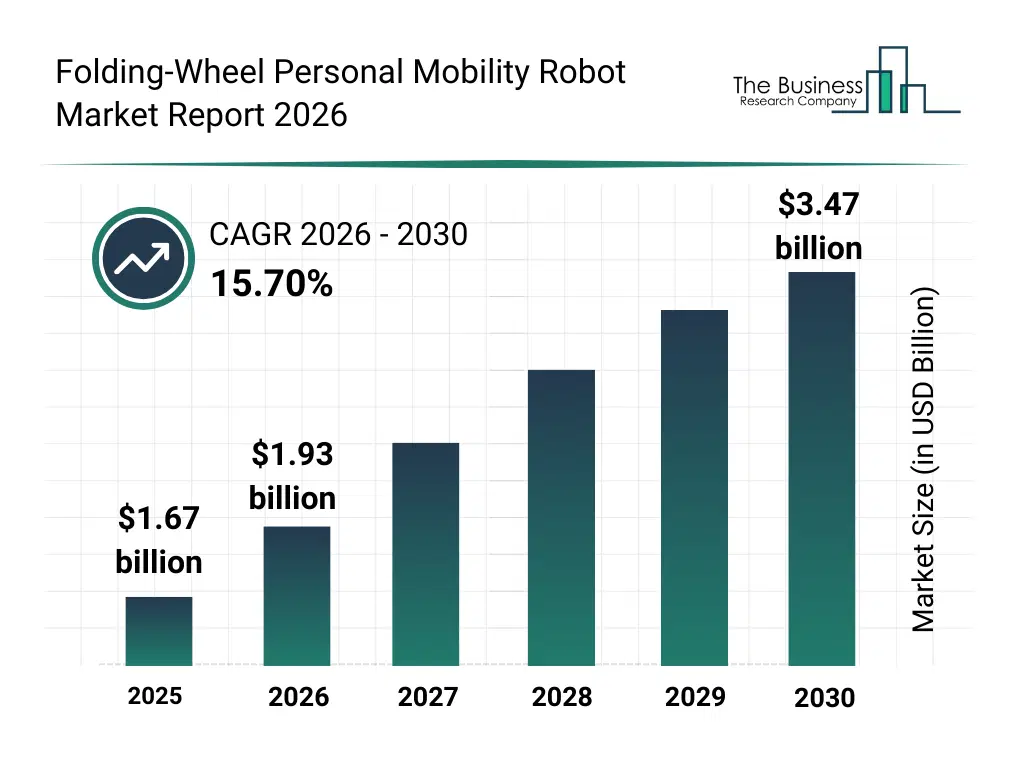
What Is The Folding-Wheel Personal Mobility Robot Market Size and Share 2026?
The folding-wheel personal mobility robot market size has grown rapidly in recent years. It will grow from $1.67 billion in 2025 to $1.93 billion in 2026 at a compound annual growth rate (CAGR) of 16.0%. The growth in the historic period can be attributed to rising urban commuting challenges, early adoption of personal mobility robots, development of foldable wheel mechanisms, growing awareness of mobility aids, integration of electric mobility technology.What Is The Folding-Wheel Personal Mobility Robot Market Growth Forecast?
The folding-wheel personal mobility robot market size is expected to see rapid growth in the next few years. It will grow to $3.47 billion in 2030 at a compound annual growth rate (CAGR) of 15.7%. The growth in the forecast period can be attributed to AI-driven route optimization, expansion of smart city infrastructure, adoption in elderly care and rehabilitation, improvements in battery life and energy density, integration with iot-connected devices. Major trends in the forecast period include compact foldable mobility design, sensor-based navigation, ai-assisted personal commuting, battery optimization and energy efficiency, remote-controlled mobility assistance.
Global Folding-Wheel Personal Mobility Robot Market Segmentation
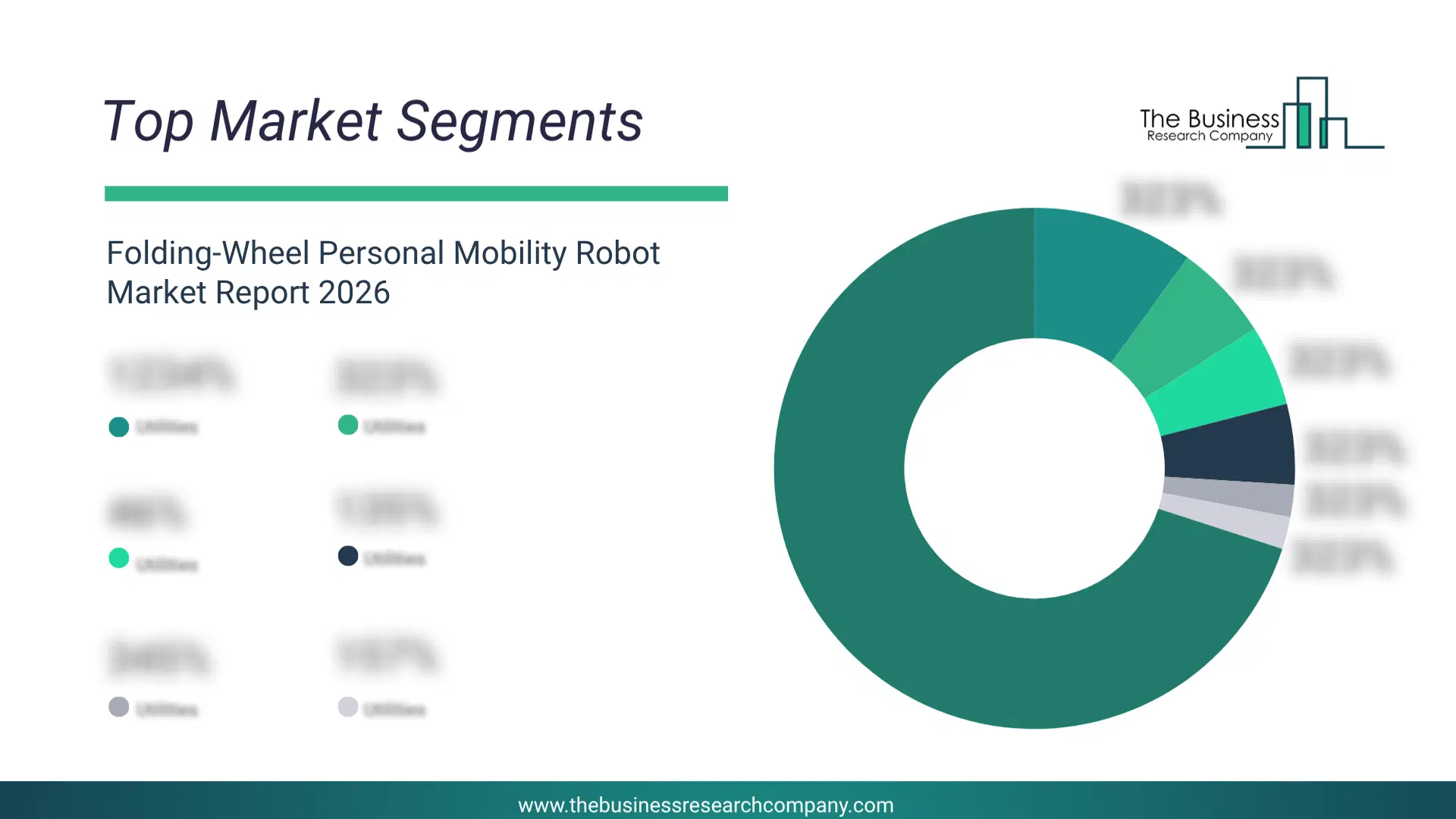
1) By Product Type: Automatic Folding-Wheel Personal Mobility Robots, Semi-Automatic Folding-Wheel Personal Mobility Robots, Self-Balancing Folding-Wheel Personal Mobility Robots, Smart Robotic Folding Mobility Robots 2) By Folding & Control Technology: Remote-Controlled Folding Robots, Sensor-Based Automatic Folding Robots, App-Controlled Folding Mobility Robots, AI-Assisted Self-Balancing Folding Robots 3) By Wheel Configuration: Two-Wheel Folding Mobility Robots, Three-Wheel Folding Mobility Robots, Four-Wheel Folding Mobility Robots 4) By Application: Personal Urban Mobility, Assisted Mobility for Elderly Users, Healthcare Mobility Assistance, Rehabilitation and Recovery Mobility, Travel and Portable Mobility Assistance 5) By End-User: Individual Users, Elderly and Mobility-Impaired Users, Hospitals and Clinics, Rehabilitation Centers, Assisted Living and Care Facilities Subsegments: 1) By Automatic Folding-Wheel Personal Mobility Robots: Automatic Folding-Wheel Personal Mobility Robots, One-Touch Button Folding Mobility Robots, Remote-Controlled Folding Mobility Robots, App-Enabled Automatic Folding Mobility Robots, Fully Autonomous Folding Mechanism Robots 2) By Semi-Automatic Folding-Wheel Personal Mobility Robots: Semi-Automatic Folding-Wheel Personal Mobility Robots, Assisted Folding Mobility Robots (Motor-Assisted Fold), Power-Lock Semi-Automatic Folding Robots, Hybrid Manual-Electric Folding Mobility Robots, Sensor-Triggered Assisted Folding Robots 3) By Self-Balancing Folding-Wheel Personal Mobility Robots: Two-Wheel Gyroscopic Self-Balancing Folding Robots, AI-Stabilized Self-Balancing Folding Mobility Robots, Dynamic Terrain-Adaptive Folding Robots, Lean-Controlled Self-Balancing Folding Robots 4) By Smart Robotic Folding Mobility Robots: AI-Enabled Smart Folding Mobility Robots, IoT-Connected Folding Mobility Robots, Voice-Controlled Folding Personal Mobility Robots, Health-Monitoring Integrated Folding Mobility RobotsWhat Are The Drivers Of The Folding-Wheel Personal Mobility Robot Market?
The rising incidence of musculoskeletal disorders is expected to propel the growth of the folding-wheel personal mobility robot market going forward. Musculoskeletal disorders (MSDs) are health conditions that impair the muscles, bones, joints, or connective tissues, leading to discomfort and limited physical function. The rise in musculoskeletal disorders results from sedentary lifestyles causing weakened muscles and joints and increased strain from inactivity. Folding-wheel personal mobility robots help individuals with musculoskeletal disorders by assisting movement, reducing strain on joints and muscles, and supporting daily mobility, enabling users to walk or move longer distances safely and with less pain. For instance, in January 2024, according to GOV.UK, a UK-based government agency, in 2023, 18.4% of individuals aged 16 and over reported having a long-term musculoskeletal (MSK) condition, reflecting an increase from 17.6% in 2022. Therefore, the rising incidence of musculoskeletal disorders is driving the growth of the folding-wheel personal mobility robot industry. The rising healthcare expenditure is expected to propel the growth of the folding-wheel personal mobility robot market going forward. Healthcare expenditure refers to the total spending on medical services, equipment, and technologies aimed at improving health outcomes. Healthcare expenditure is growing due to the increasing demand for advanced medical technologies, as hospitals and clinics invest more in innovative equipment and digital solutions to improve patient care and outcomes. Increasing healthcare spending enables medical facilities and homecare providers to offer folding-wheel personal mobility robots, enhancing mobility, comfort, and daily living for individuals with limited physical movement. For instance, in June 2025, according to the Centers for Medicare & Medicaid Services, a US-based government agency, in 2023, national health expenditures (NHE) grew by 7.5%, reaching $4.9 trillion, which averages $14,570 per person and represents 17.6% of the Gross Domestic Product (GDP). Spending on Medicare increased by 8.1% to $1,029.8 billion, making up 21% of total NHE. Therefore, the rising healthcare expenditure is driving the growth of the folding-wheel personal mobility robot industry.Key Players In The Global Folding-Wheel Personal Mobility Robot Market
Major companies operating in the folding-wheel personal mobility robot market are WHILL Inc., Airwheel, Cheelcare, Robooter, XSTO Mobility, Mobius Mobility, ComfyGo, Golden Technologies, Pride Mobility Products, ZiiLIF, SUPERPI, ALBA Robot, Care for Mobility, Zuowei Technology, Mobot, Bbr Robot, Zinger Chair, KD Smart Chair, EzLite Cruiser, Trident Mobility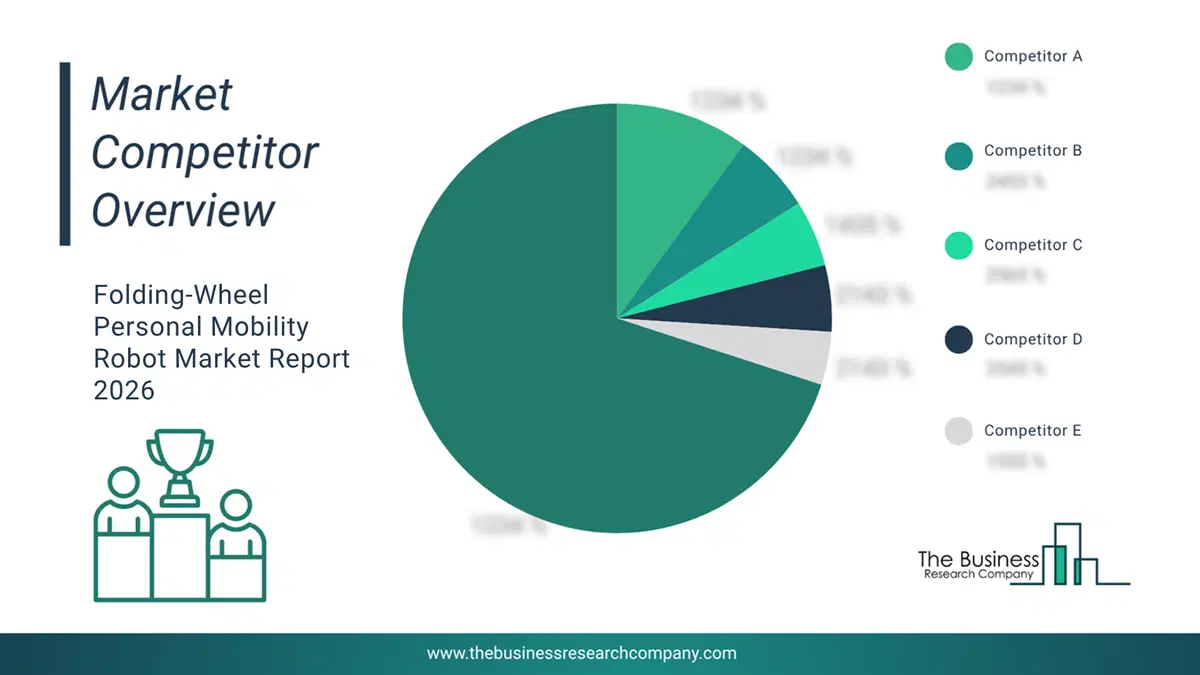
This chart is for illustrative purposes; the full report includes a detailed competitor analysis and comprehensive overview of the top 10 companies in the market.
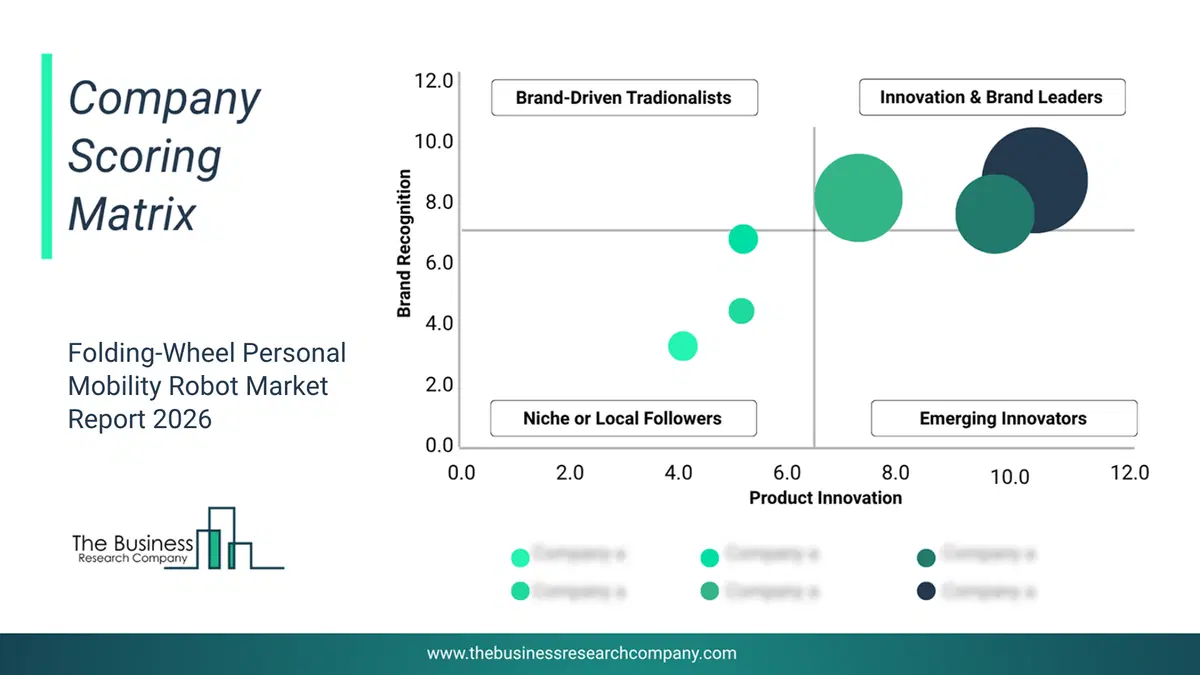
This chart maps companies by product innovation and brand strength, with bubble size indicating relative revenue, helping identify market leaders, challengers, and niche players. This is an illustrative chart; the full report provides a complete and accurate competitive analysis.
Global Folding-Wheel Personal Mobility Robot Market Trends and Insights
Major companies operating in the folding-wheel personal mobility robot market are focusing on developing advanced solutions, such as the omni traction drive systems, to enhance maneuverability, stability, and user convenience across diverse terrains. Omni traction drive system refers to a wheel and motor technology that enables a personal mobility robot to move smoothly in any direction, including sideways and diagonally, while maintaining stability and traction on varied surfaces. For instance, in September 2025, Honda Motor Co. Ltd., a Japan-based manufacturing company, launched a UNI-ONE hands-free personal mobility device in Japan to offer enhanced, self-balancing mobility for users. That allows users to move by simply shifting their body weight while keeping their hands free, enabling natural multitasking. Its adjustable height offers an eye level close to standing people, fostering natural communication and reducing social barriers. UNI-ONE aims to reduce physical strain, expand mobility options for diverse users, and improve productivity by supporting movement in workplaces, large venues, and daily activities.
Regional Outlook
Asia-Pacific was the largest region in the folding-wheel personal mobility robot market in 2025. The regions covered in this market report are Asia-Pacific, South East Asia, Western Europe, Eastern Europe, North America, South America, Middle East, Africa. The countries covered in this market report are Australia, Brazil, China, France, Germany, India, Indonesia, Japan, Taiwan, Russia, South Korea, UK, USA, Canada, Italy, SpainWhat Defines the Folding-Wheel Personal Mobility Robot Market?
The folding-wheel personal mobility robot market consists of sales of electric wheelchair, motorized wheelchair, and powerchair. Values in this market are ‘factory gate’ values, that is the value of goods sold by the manufacturers or creators of the goods, whether to other entities (including downstream manufacturers, wholesalers, distributors and retailers) or directly to end customers. The value of goods in this market includes related services sold by the creators of the goods.How is Market Value Defined and Measured?
The market value is defined as the revenues that enterprises gain from the sale of goods and/or services within the specified market and geography through sales, grants, or donations in terms of the currency (in USD unless otherwise specified). The revenues for a specified geography are consumption values that are revenues generated by organizations in the specified geography within the market, irrespective of where they are produced. It does not include revenues from resales along the supply chain, either further along the supply chain or as part of other products.
This chart presents market attractiveness based on a quantitative evaluation of growth, competition, strategic alignment, and risk, offering a clear view of opportunity areas for decision-making. This chart is for illustrative purposes; the full report contains the complete analysis.

This chart highlights the Total Addressable Market (TAM) by estimating the maximum revenue opportunity using an assumption-driven approach, supporting strategic planning and opportunity sizing across markets. The chart is illustrative; the full report provides a more comprehensive analysis.
What Key Data and Analysis Are Included in the Folding-Wheel Personal Mobility Robot Market Report 2026?
The folding-wheel personal mobility robot market research report is one of a series of new reports from The Business Research Company that provides market statistics, including industry global market size, regional shares, competitors with the market share, detailed market segments, market trends and opportunities, and any further data you may need to thrive in the folding-wheel personal mobility robot industry. The market research report delivers a complete perspective of everything you need, with an in-depth analysis of the current and future state of the industry.Folding-Wheel Personal Mobility Robot Market Report Forecast Analysis
| Report Attribute | Details |
|---|---|
| Market Size Value In 2026 | $1.93 billion |
| Revenue Forecast In 2030 | $3.47 billion |
| Growth Rate | CAGR of 15.7% from 2026 to 2030 |
| Base Year For Estimation | 2025 |
| Actual Estimates/Historical Data | 2020-2025 |
| Forecast Period | 2026 - 2030 |
| Market Representation | Revenue in USD Billion and CAGR from 2026 to 2030 |
| Segments Covered | Product Type, Folding & Control Technology, Wheel Configuration, Application, End-User |
| Regional Scope | Asia-Pacific, Western Europe, Eastern Europe, North America, South America, Middle East, Africa |
| Country Scope | The countries covered in the report are Australia, Brazil, China, France, Germany, India, Indonesia, Japan, Taiwan, Russia, South Korea, UK, USA, Canada, Italy, Spain. |
| Key Companies Profiled | WHILL Inc., Airwheel, Cheelcare, Robooter, XSTO Mobility, Mobius Mobility, ComfyGo, Golden Technologies, Pride Mobility Products, ZiiLIF, SUPERPI, ALBA Robot, Care for Mobility, Zuowei Technology, Mobot, Bbr Robot, Zinger Chair, KD Smart Chair, EzLite Cruiser, Trident Mobility |
| Customization Scope | Request for Customization |
| Pricing And Purchase Options | Explore Purchase Options |