
Food Allergen Testing Market Report 2026
Global Outlook – By Test Type (Allergen Testing, Intolerance Testing), By Technology (Biosensors, Immunoassay Or Enzyme Linked Immunosorbent Assay (ELISA), Polymerase Chain Reaction (PCR), Other Technologies), By Application (Seafood And Meat Products, Dairy Products, Beverages, Bakery And Confectionery, Baby Food And Infant Formula, Other Applications) - Market Size, Trends, Strategies, and Forecast to 2030
Food Allergen Testing Market Overview
• Food Allergen Testing market size has reached to $1.11 billion in 2025 • Expected to grow to $1.71 billion in 2030 at a compound annual growth rate (CAGR) of 8.7% • Growth Driver: Rising Food Allergies Fuel Growth In Food Allergen Testing Market • Market Trend: New Rapid Gluten Test Promises Accurate Detection And Eliminates False Negatives • North America was the largest region in 2025 and Asia-Pacific is the fastest growing region.What Is Covered Under Food Allergen Testing Market?
Food allergen testing is a process used to detect and quantify the presence of specific allergenic proteins in food products. These tests are essential for identifying allergens that may trigger adverse reactions in individuals with food allergies or intolerances. The primary purpose of food allergen testing is to ensure food safety and regulatory compliance by accurately labeling food products to alert consumers about potential allergens. The main test types of food allergen testing are allergen testing and intolerance testing. Allergen testing refers to identifying and quantifying specific allergenic substances in food products to ensure consumer safety. The various technologies involved are biosensors, immunoassay or enzyme-linked immunosorbent assay (ELISA), polymerase chain reaction (PCR), and others. It is used for applications such as biosensors, immunoassay or enzyme-linked immunosorbent assay (ELISA), polymerase chain reaction (PCR), and others.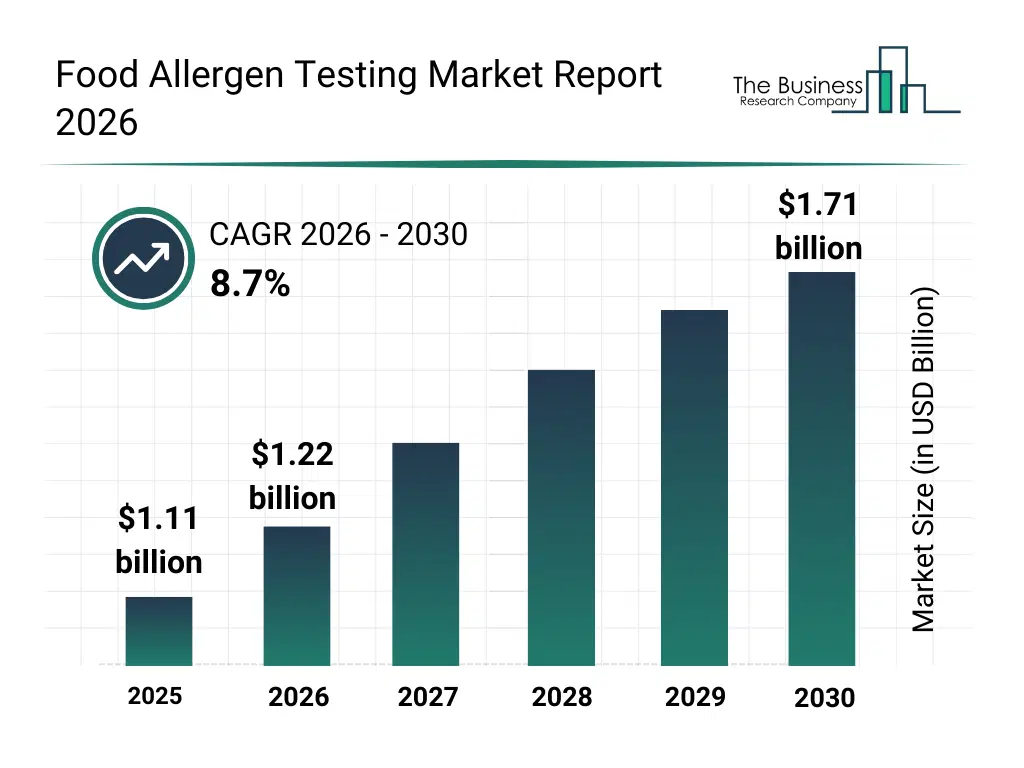
What Is The Food Allergen Testing Market Size and Share 2026?
The food allergen testing market size has grown rapidly in recent years. It will grow from $1.11 billion in 2025 to $1.22 billion in 2026 at a compound annual growth rate (CAGR) of 10.2%. The growth in the historic period can be attributed to increase in food allergy prevalence, implementation of food labeling regulations, growth of packaged food industry, expansion of food testing laboratories, adoption of ELISA testing.What Is The Food Allergen Testing Market Growth Forecast?
The food allergen testing market size is expected to see strong growth in the next few years. It will grow to $1.71 billion in 2030 at a compound annual growth rate (CAGR) of 8.7%. The growth in the forecast period can be attributed to demand for high-sensitivity detection, growth in global food trade, expansion of PCR-based testing, stricter allergen regulations, automation in food testing processes. Major trends in the forecast period include rising demand for food safety testing, increased regulatory compliance requirements, expansion of allergen detection in processed foods, growing use of rapid testing technologies, adoption of advanced molecular diagnostic methods.
Global Food Allergen Testing Market Segmentation
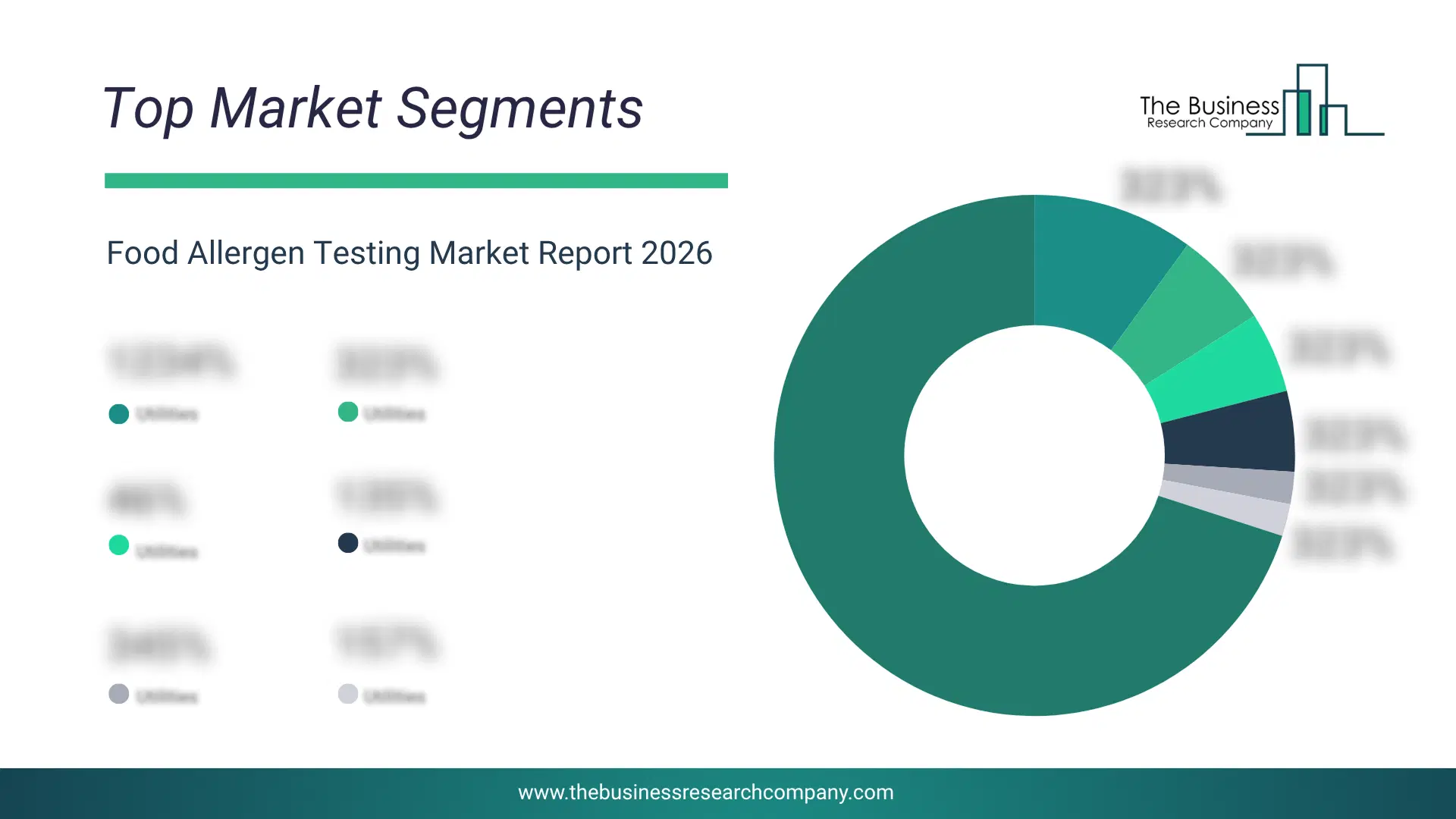
1) By Test Type: Allergen Testing, Intolerance Testing 2) By Technology: Biosensors, Immunoassay Or Enzyme Linked Immunosorbent Assay (ELISA), Polymerase Chain Reaction (PCR), Other Technologies 3) By Application: Seafood And Meat Products, Dairy Products, Beverages, Bakery And Confectionery, Baby Food And Infant Formula, Other Applications Subsegments: 1) By Allergen Testing: Immunoassay-Based Tests, PCR-Based Tests, Mass Spectrometry-Based Tests, Luminex xMAP Technology, Chromatography-Based Tests 2) By Intolerance Testing: Breath Tests, Blood Tests, Elimination Diets And Food Challenge TestingWhat Is The Driver Of The Food Allergen Testing Market?
The increasing incidences of food allergies are expected to propel the food allergen testing market going forward. Food allergies refer to adverse immune responses triggered by specific food proteins, potentially causing a range of symptoms from mild discomfort to severe reactions. The increasing incidences of food allergies are caused due to genetic predispositions, environmental influences, dietary changes, and improved awareness and diagnosis. Food allergen testing identifies and quantifies allergenic substances in food products, preventing allergic reactions in individuals with food allergies. For instance, in March 2024, according to CPD Online College Limited, a UK-based company, In the UK, approximately 2 million people are believed to have a diagnosed food allergy. In the US, around 33 million people are thought to have allergies. Australia has some of the highest allergy rates globally, with food allergies affecting 10% of infants, 4-8% of children, and 2% of adults. Therefore, the increasing incidences of food allergies are driving the growth of the food allergen testing industry.Key Players In The Global Food Allergen Testing Market
Major companies operating in the food allergen testing market are Thermo Fisher Scientific, Ecolab Inc., Eurofins Scientific, SGS SA, Bureau Veritas, Intertek Group plc, Bio-Rad Laboratories Inc., ALS Limited, Neogen Corporation, IEH Laboratories & Consulting Group, AsureQuality Limited, Mérieux NutriSciences, Microbac Laboratories Inc, R-Biopharm AG, TUV SUD America, Symbio Laboratories, Campden BRI, Romer Labs, Q Laboratories Inc., NSL Analytical Services Inc.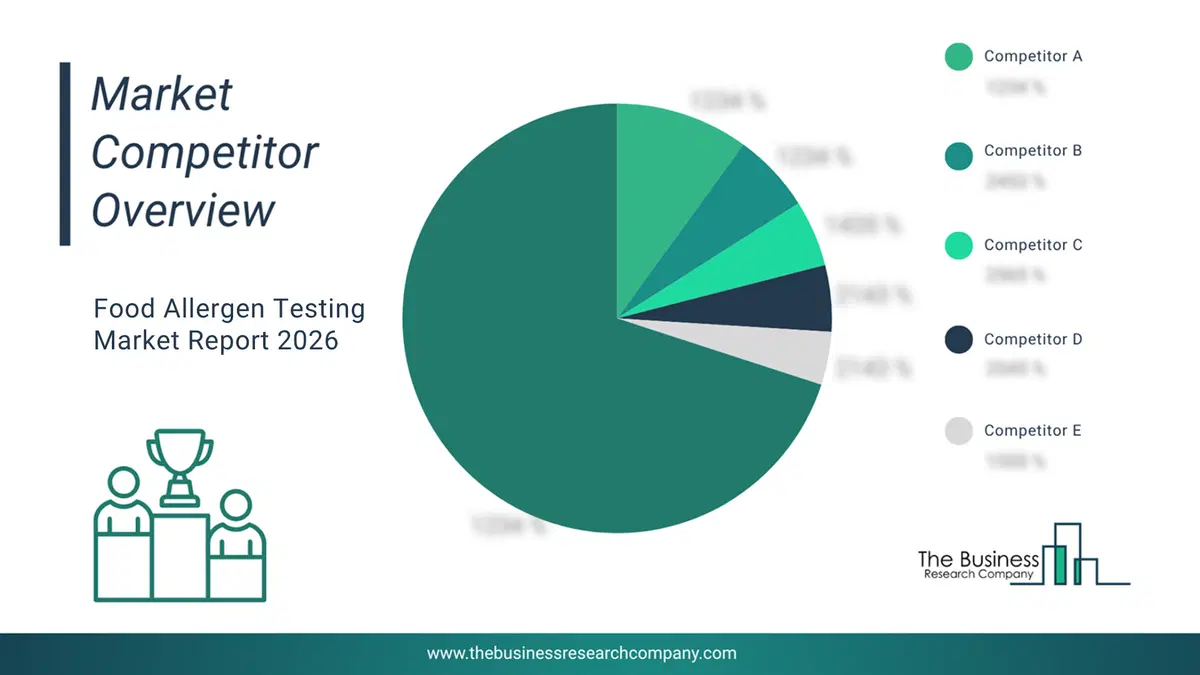
This chart is for illustrative purposes; the full report includes a detailed competitor analysis and comprehensive overview of the top 10 companies in the market.
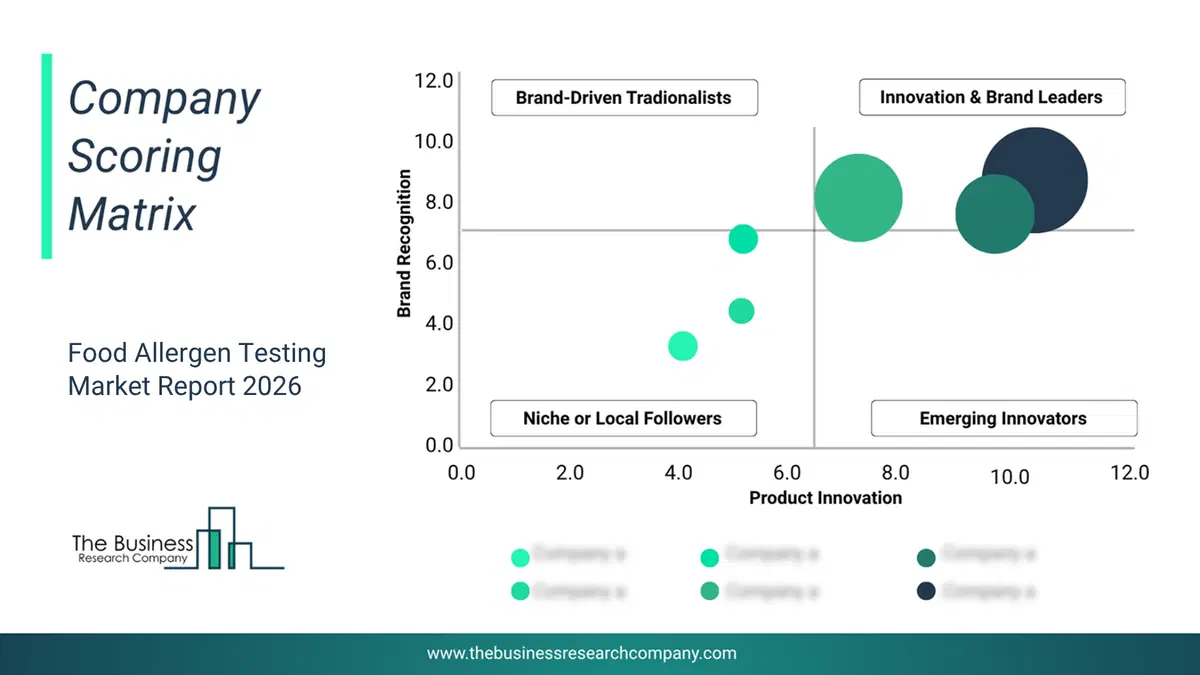
This chart maps companies by product innovation and brand strength, with bubble size indicating relative revenue, helping identify market leaders, challengers, and niche players. This is an illustrative chart; the full report provides a complete and accurate competitive analysis.
Global Food Allergen Testing Market Trends and Insights
Major companies operating in the food allergen testing market are focused on developing rapid tests such as immunochromatographic assays for detection and to gain a competitive edge in the market. Immunochromatographic assay refers to a rapid diagnostic test method used to detect specific allergenic proteins in food products using the principles of chromatography and immunological reactions. For instance, in March 2024, Gold Standard Diagnostics Budapest Kft, a Hungary-based company providing diagnostic solutions, launched the SENSIStrip Gluten PowerLine lateral flow test to ensure the rapid gluten test minimizes the occurrence of false negative results. It uses an immunochromatographic assay. It is a sensitive detection system based on a monoclonal antibody and is particularly capable of detecting gluten residues in food matrices, rinse water, and swabs. This test allows for a quick and sensitive detection of gluten, which is crucial for people with gluten intolerance or celiac disease. It also includes an introduced hook line to exclude false-negative interpretations of highly contaminated samples. The results can be interpreted visually, and a quantitative evaluation is also possible in combination with their RapidScan ST5 lateral flow reader.What Are Latest Mergers And Acquisitions In The Food Allergen Testing Market?
In March 2024, ALS Limited, an Australia-based company providing testing, inspection, certification, and verification, acquired York Analytical Laboratories and Wessling Holding GmbH & Co. KG for $148.03 million. The ALS Limited's acquisitions of York Analytical Laboratories and Wessling Holding GmbH & Co. KG aimed to strengthen its market presence, diversify its service offerings, gain a competitive advantage, and achieve its strategic objectives for growth in the life sciences and analytical testing sectors. York Analytical Laboratories is a US-based environmental laboratory specializing in food intolerance and allergy testing. Wessling Holding GmbH & Co. KG is a Germany-based provider of analytical, consulting, and testing services in various industries, including food, pharmaceuticals, and environmental.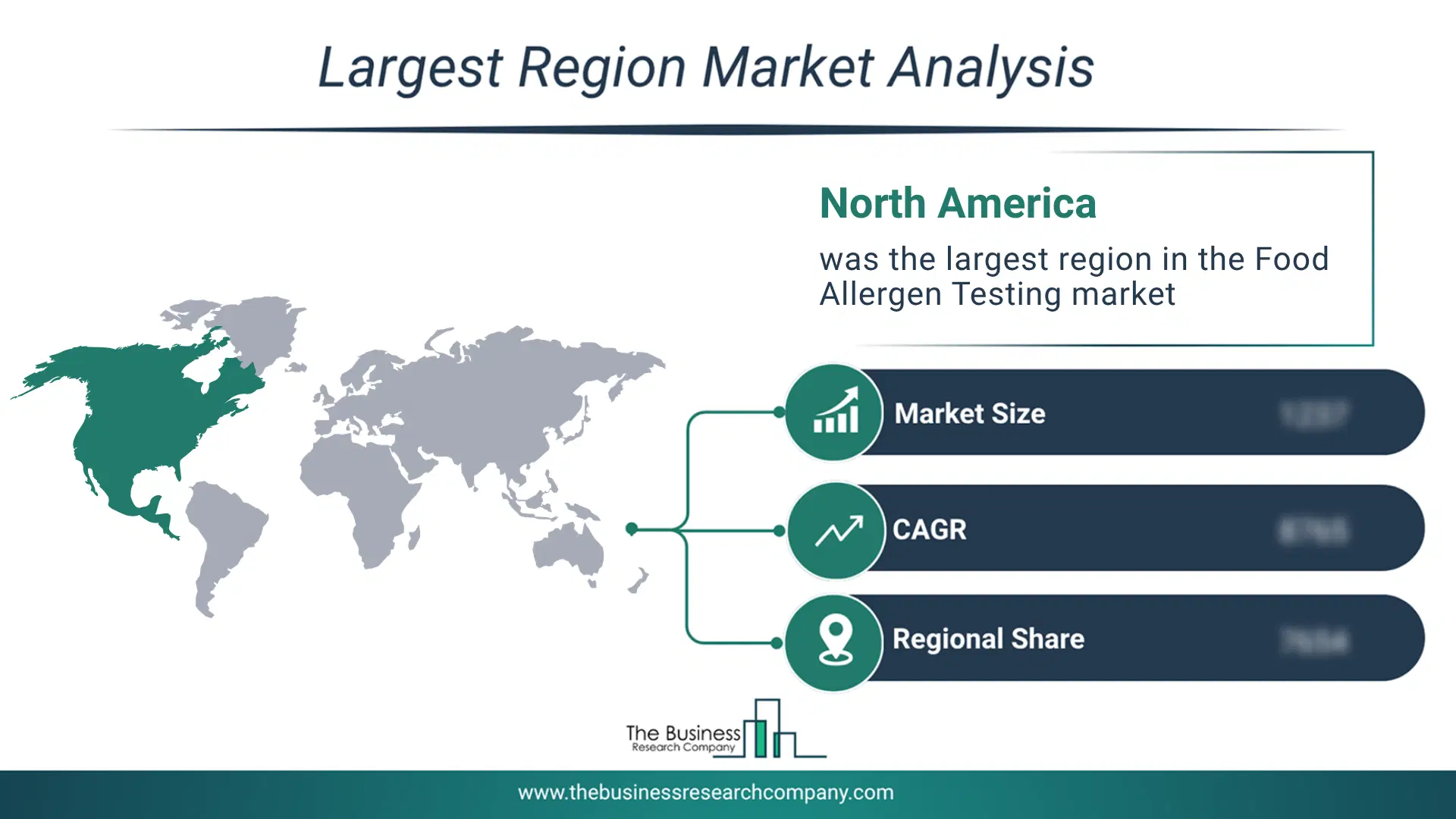
Regional Outlook
North America was the largest region in the food allergen testing market in 2025. Asia-Pacific is expected to be the fastest-growing region in the forecast period. The regions covered in this market report are Asia-Pacific, South East Asia, Western Europe, Eastern Europe, North America, South America, Middle East, Africa. The countries covered in this market report are Australia, Brazil, China, France, Germany, India, Indonesia, Japan, Taiwan, Russia, South Korea, UK, USA, Canada, Italy, Spain.What Defines the Food Allergen Testing Market?
The food allergen testing market includes revenues earned by entities by providing safety assurance, labeling compliance, allergen testing, lateral flow devices (LFDs), mass spectrometry, and ELISA kits. The market value includes the value of related goods sold by the service provider or included within the service offering. Only goods and services traded between entities or sold to end consumers are included.How is Market Value Defined and Measured?
The market value is defined as the revenues that enterprises gain from the sale of goods and/or services within the specified market and geography through sales, grants, or donations in terms of the currency (in USD unless otherwise specified). The revenues for a specified geography are consumption values that are revenues generated by organizations in the specified geography within the market, irrespective of where they are produced. It does not include revenues from resales along the supply chain, either further along the supply chain or as part of other products.
This chart presents market attractiveness based on a quantitative evaluation of growth, competition, strategic alignment, and risk, offering a clear view of opportunity areas for decision-making. This chart is for illustrative purposes; the full report contains the complete analysis.

This chart highlights the Total Addressable Market (TAM) by estimating the maximum revenue opportunity using an assumption-driven approach, supporting strategic planning and opportunity sizing across markets. The chart is illustrative; the full report provides a more comprehensive analysis.
What Key Data and Analysis Are Included in the Food Allergen Testing Market Report 2026?
The food allergen testing market research report is one of a series of new reports from The Business Research Company that provides market statistics, including industry global market size, regional shares, competitors with the market share, detailed market segments, market trends and opportunities, and any further data you may need to thrive in the food allergen testing industry. The market research report delivers a complete perspective of everything you need, with an in-depth analysis of the current and future state of the industry.Food Allergen Testing Market Report Forecast Analysis
| Report Attribute | Details |
|---|---|
| Market Size Value In 2026 | $1.22 billion |
| Revenue Forecast In 2030 | $1.71 billion |
| Growth Rate | CAGR of 8.7% from 2026 to 2030 |
| Base Year For Estimation | 2025 |
| Actual Estimates/Historical Data | 2020-2025 |
| Forecast Period | 2026 - 2030 |
| Market Representation | Revenue in USD Billion and CAGR from 2026 to 2030 |
| Segments Covered | Test Type, Technology, Application |
| Regional Scope | Asia-Pacific, Western Europe, Eastern Europe, North America, South America, Middle East, Africa |
| Country Scope | The countries covered in the report are Australia, Brazil, China, France, Germany, India, Indonesia, Japan, Taiwan, Russia, South Korea, UK, USA, Canada, Italy, Spain |
| Key Companies Profiled | Thermo Fisher Scientific, Ecolab Inc., Eurofins Scientific, SGS SA, Bureau Veritas, Intertek Group plc, Bio-Rad Laboratories Inc., ALS Limited, Neogen Corporation, IEH Laboratories & Consulting Group, AsureQuality Limited, Mérieux NutriSciences, Microbac Laboratories Inc, R-Biopharm AG, TUV SUD America, Symbio Laboratories, Campden BRI, Romer Labs, Q Laboratories Inc., NSL Analytical Services Inc. |
| Customization Scope | Request for Customization |
| Pricing And Purchase Options | Explore Purchase Options |