

Food Emulsifiers Market Report 2026
Global Outlook – By Type (Lecithin, Monoglyceride, Diglyceride, And Derivatives, Sorbitan Ester, Polyglycerol Ester, Other Types ), By Nature (Natural, Synthetic), By Form (Fine Powder, Hydrate ), By Application (Dairy And Frozen Products, Bakery, Meat, Poultry, And Seafood, Beverage, Confectionery, Other Applications) – Market Size, Trends, Strategies, and Forecast to 2030
Food Emulsifiers Market Overview
• Food Emulsifiers market size has reached to $4.13 billion in 2025 • Expected to grow to $6.12 billion in 2030 at a compound annual growth rate (CAGR) of 8.2% • Growth Driver: The Growing Demand From The Food And Beverage Industry Fuels Food Emulsifiers Market Growth • Market Trend: Trend- Increasing Focus On Introducing Clean Label Products To Gain A Competitive Edge • Europe was the largest region in 2025 and Asia-Pacific is the fastest growing region.What Is Covered Under Food Emulsifiers Market?
Food emulsifiers are surface-active agents that act as a boundary between two insoluble fluids, such as water and oil, enabling them to be blended into stable emulsions. Food emulsifiers are added to bread, salad, dressings, sauces, ice creams, puddings, and various other food items to reduce stickiness, control crystallization, and prevent separation. The main types of food emulsifiers are lecithin, monoglyceride, diglyceride, and derivatives, sorbitan ester, polyglycerol ester, and others. Lecithin is used in food applications as a lubricant, aerating agent, and viscosity transformer. The lecithin emulsifier's molecular structure makes it a good emulsifier for the interaction of water and oil. The food emulsifiers are either natural or synthetic and are available in different forms such as fine powder, hydrate. Food emulsifiers are used in various applications such as dairy and frozen products, bakery, meat, poultry and seafood, beverage, confectionery, and others.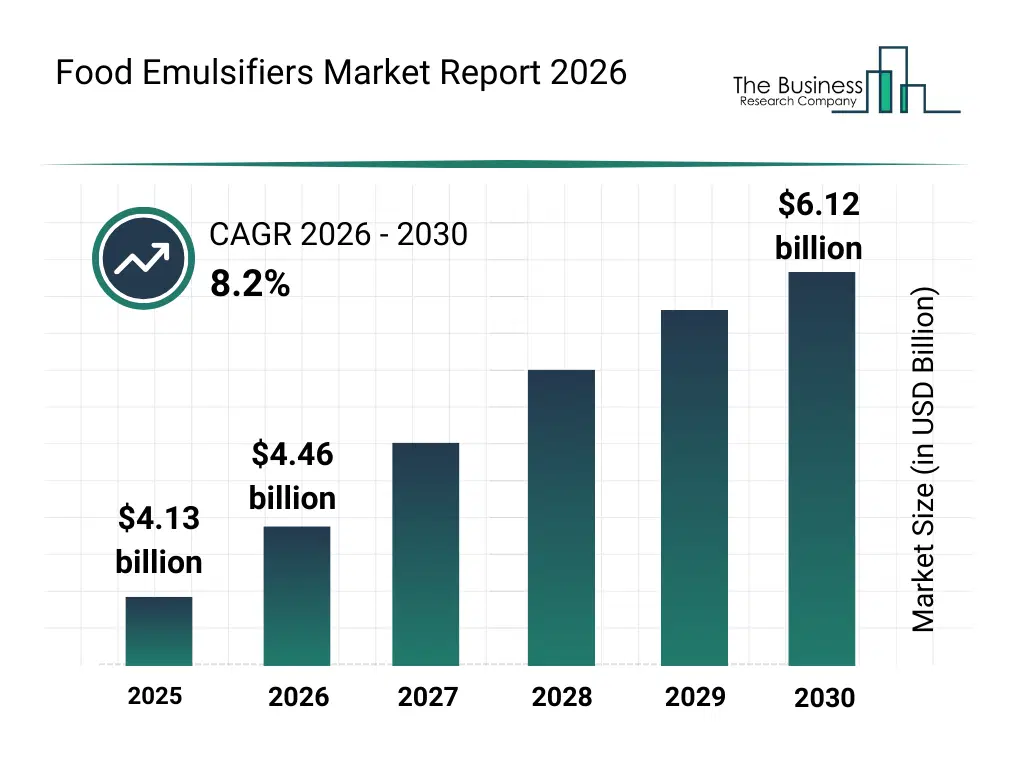
What Is The Food Emulsifiers Market Size and Share 2026?
The food emulsifiers market size has grown strongly in recent years. It will grow from $4.13 billion in 2025 to $4.46 billion in 2026 at a compound annual growth rate (CAGR) of 8.0%. The growth in the historic period can be attributed to expansion of processed food consumption, increasing use of emulsifiers in bakery and dairy, advancements in food formulation science, growth of convenience food products, availability of diverse emulsifier sources.What Is The Food Emulsifiers Market Growth Forecast?
The food emulsifiers market size is expected to see strong growth in the next few years. It will grow to $6.12 billion in 2030 at a compound annual growth rate (CAGR) of 8.2%. The growth in the forecast period can be attributed to increasing demand for plant-based food products, rising regulatory focus on ingredient transparency, expansion of clean-label product launches, growing adoption of functional and fortified foods, increasing innovation in emulsifier technologies. Major trends in the forecast period include rising demand for natural and plant-based emulsifiers, growing use of clean-label ingredients, expansion of functional food applications, enhanced customization of emulsifier blends, increasing focus on texture and stability optimization.
Global Food Emulsifiers Market Segmentation
1) By Type: Lecithin, Monoglyceride, Diglyceride, And Derivatives, Sorbitan Ester, Polyglycerol Ester, Other Types 2) By Nature: Natural, Synthetic 3) By Form: Fine Powder, Hydrate 4) By Application: Dairy And Frozen Products, Bakery, Meat, Poultry, And Seafood, Beverage, Confectionery, Other Applications Subsegments: 1) By Lecithin: Soy Lecithin, Sunflower Lecithin, Egg Lecithin, Other Lecithin Sources (Canola, Corn) 2) By Monoglyceride, Diglyceride, And Derivatives: Monoglycerides, Diglycerides, Glycerol Esters Of Fatty Acids, Mixed Glycerides 3) By Sorbitan Ester: Sorbitan Monostearate (SMS), Sorbitan Monooleate (SMO), Sorbitan Monopalmitate (SMP), Sorbitan Tristearate (STS) 4) By Polyglycerol Ester: Polyglycerol Esters Of Fatty Acids (PGME), Polyglycerol Esters Of Mono-And Diglycerides (PGMD) 5) By Other Types: Propylene Glycol Esters Of Fatty Acids (PGFA), DATEM (Diacetyl Tartaric Acid Esters of Mono-And Diglycerides)What Is The Driver Of The Food Emulsifiers Market?
The increasing demand from the food and beverage industry is expected to boost the growth of the food emulsifiers market going forward. The food and beverage industry encompasses businesses involved in the production, distribution, and sale of edible goods and drinks, ranging from agriculture and manufacturing to restaurants and cafes. Food emulsifiers are crucial in the food and beverage industry for stabilizing and blending ingredients like oil and water, ensuring a consistent texture and longer shelf life in various products. For instance, in March 2025, according to the Australian Bureau of Statistics, an Australian-based national statistical agency platform reported that in 2023-24, an estimated 15.3 million tonnes of food and non-alcoholic beverages were sold across food stores in Australia. This represents a 3.5% increase, or 0.51 million tonnes, over the previous 12-month period (2022-23). Therefore, the increasing demand from the food and beverage industry is driving the growth of the food emulsifiers industry.Key Players In The Global Food Emulsifiers Market
Major companies operating in the food emulsifiers market are DuPont Nutrition and Biosciences, Palsgaard A/S, Riken Vitamin Co Ltd., Cargill Incorporated, Estelle Chemicals Pvt Ltd., Kerry Group Inc., Tate & Lyle Plc, Corbion NV, BASF SE, Puratos Group, Koninklijke DSM NV, Beldem S.A., Lecico GmbH, Lasenor Emul S.L., ABITEC Corporation, Ingredion Incorporated, Stepan Company, Ashland Global Holdings Inc., Croda International Plc, Evonik Industries AG, Wacker Chemie AG, Givaudan SA, Sensient Technologies Corporation, FMC Corporation, Mitsubishi Chemical Corporation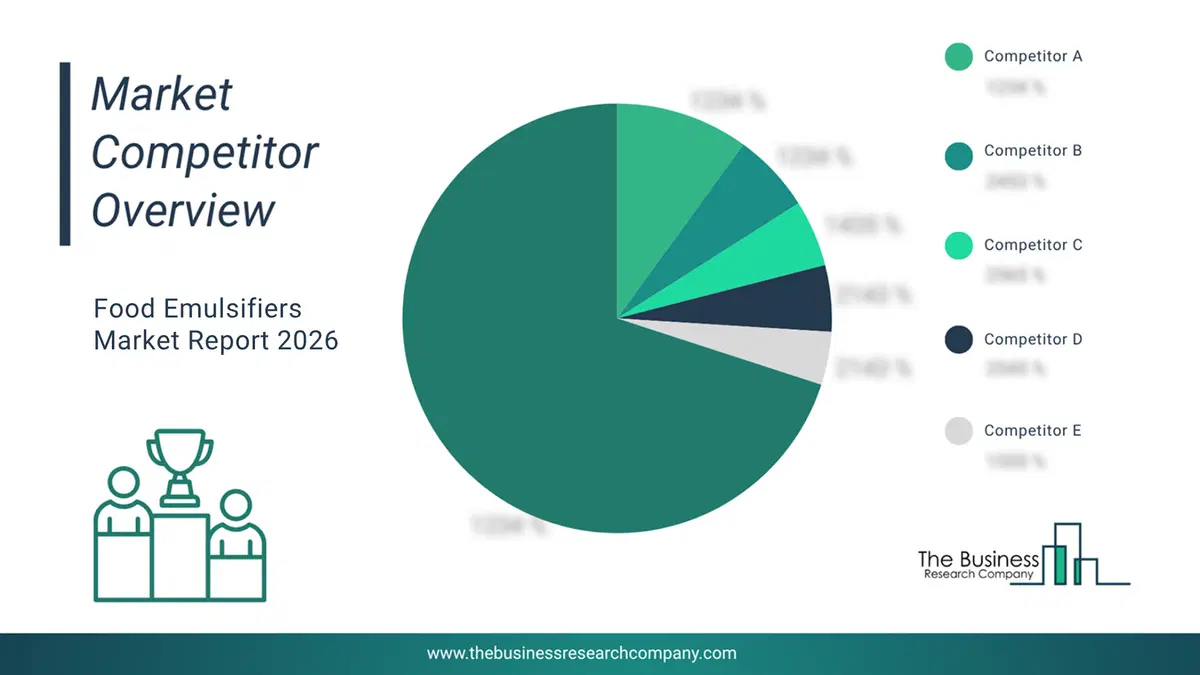
This chart is for illustrative purposes; the full report includes a detailed competitor analysis and comprehensive overview of the top 10 companies in the market.
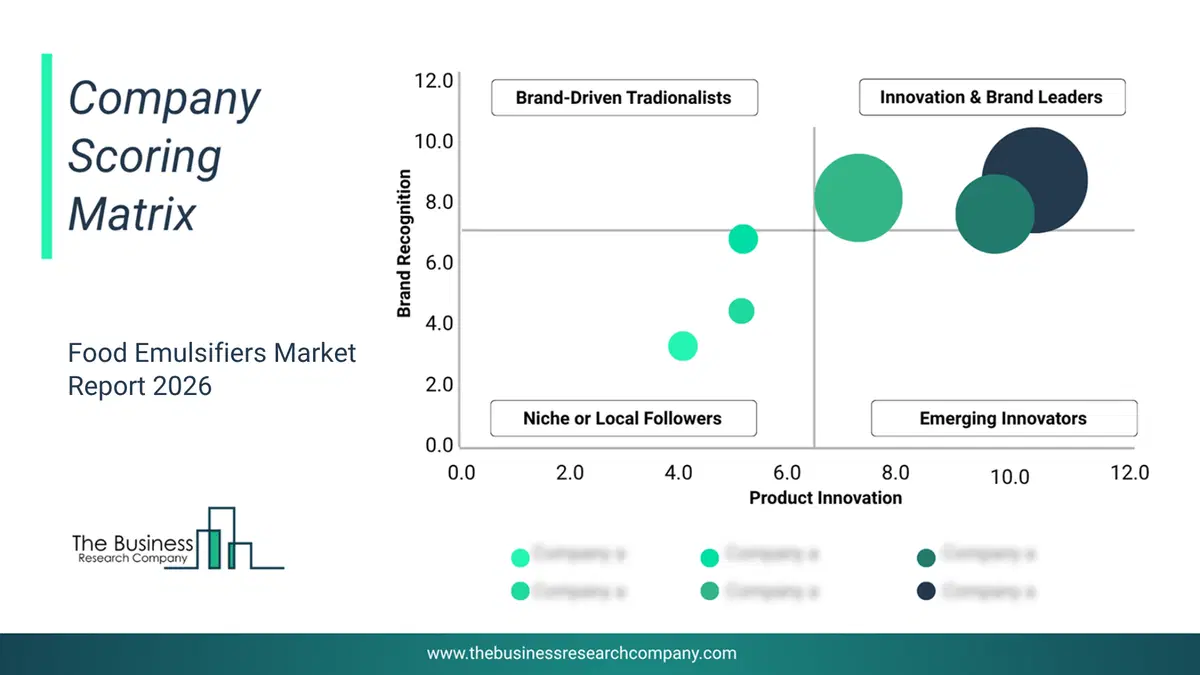
This chart maps companies by product innovation and brand strength, with bubble size indicating relative revenue, helping identify market leaders, challengers, and niche players. This is an illustrative chart; the full report provides a complete and accurate competitive analysis.
Global Food Emulsifiers Market Trends and Insights
Major companies operating in the food emulsifiers market are focused on developing clean-label products to gain a competitive edge in the market. Developing clean-label products with food emulsifiers enhances product stability and texture while meeting consumer demand for transparent ingredient lists. For instance, in August 2023, Vantage Specialty Chemicals Inc., a US-based specialty chemicals company, launched a new emulsifier called Simply Kake, which is specifically formulated to complement the food industry's cleaner label initiatives. It is designed to help bakers create taller, lighter, and more evenly textured cakes and sweets with an optimal crumb structure. The Simply Kake emulsifier provides the baking performance and advantages of conventional hydrated emulsifiers and circumvents the difficulties associated with working with enzymes, which are delicate to process and have a restricted shelf life.What Are Latest Mergers And Acquisitions In The Food Emulsifiers Market?
In March 2024, Kingswood Capital Management LP, a US-based private investment firm, completed the acquisition of Corbion's emulsifier business for $362 million. This transaction marks a significant move in the food ingredients sector, allowing Kingswood to expand its portfolio in the emulsifiers market. Corbion N.V. is a Netherlands-based food company, specializes in manufacturing food emulsifiers.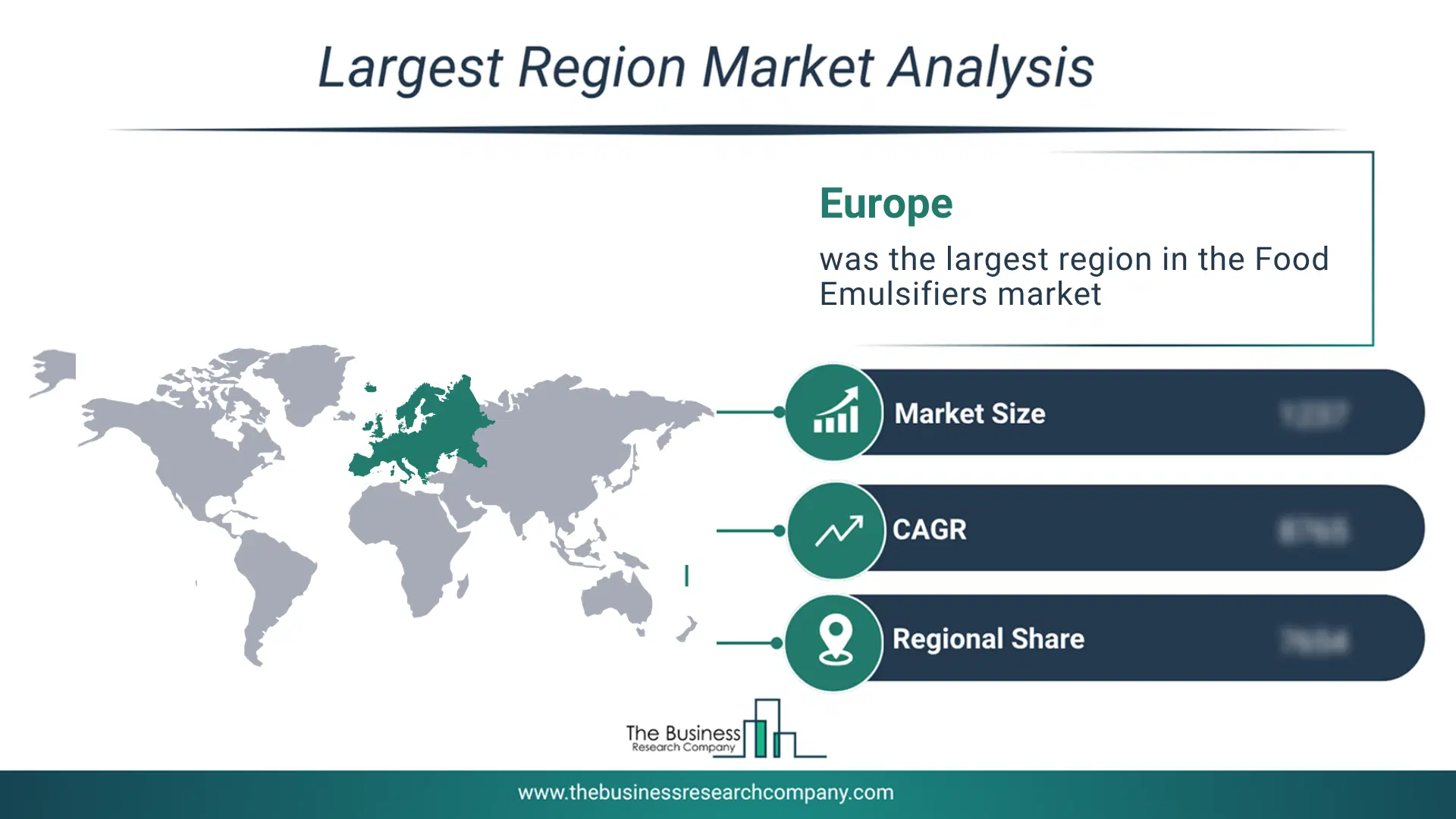
Regional Outlook
Europe was the largest region in the food emulsifiers market in 2025. Asia-Pacific is expected to be the fastest growing region in the forecast period. The regions covered in this market report are Asia-Pacific, South East Asia, Western Europe, Eastern Europe, North America, South America, Middle East and Africa. The countries covered in this market report are Australia, Brazil, China, France, Germany, India, Indonesia, Japan, Taiwan, Russia, South Korea, UK, USA, Italy, Spain, CanadaWhat Defines the Food Emulsifiers Market?
The food emulsifiers market consists of sales of lecithin, monoglyceride, diglyceride, derivatives, and other food emulsifiers. Values in this market are ‘factory gate’ values, that is the value of goods sold by the manufacturers or creators of the goods, whether to other entities (including downstream manufacturers, wholesalers, distributors and retailers) or directly to end customers. The value of goods in this market includes related services sold by the creators of the goods.How is Market Value Defined and Measured?
The market value is defined as the revenues that enterprises gain from the sale of goods and/or services within the specified market and geography through sales, grants, or donations in terms of the currency (in USD unless otherwise specified). The revenues for a specified geography are consumption values that are revenues generated by organizations in the specified geography within the market, irrespective of where they are produced. It does not include revenues from resales along the supply chain, either further along the supply chain or as part of other products.
This chart presents market attractiveness based on a quantitative evaluation of growth, competition, strategic alignment, and risk, offering a clear view of opportunity areas for decision-making. This chart is for illustrative purposes; the full report contains the complete analysis.

This chart highlights the Total Addressable Market (TAM) by estimating the maximum revenue opportunity using an assumption-driven approach, supporting strategic planning and opportunity sizing across markets. The chart is illustrative; the full report provides a more comprehensive analysis.
What Key Data and Analysis Are Included in the Food Emulsifiers Market Report 2026?
The food emulsifiers market research report is one of a series of new reports from The Business Research Company that provides market statistics, including industry global market size, regional shares, competitors with the market share, detailed market segments, market trends and opportunities, and any further data you may need to thrive in the food emulsifiers industry. The market research report delivers a complete perspective of everything you need, with an in-depth analysis of the current and future state of the industry.Food Emulsifiers Market Report Forecast Analysis
| Report Attribute | Details |
|---|---|
| Market Size Value In 2026 | $4.46 billion |
| Revenue Forecast In 2030 | $6.12 billion |
| Growth Rate | CAGR of 8.0% from 2026 to 2030 |
| Base Year For Estimation | 2025 |
| Actual Estimates/Historical Data | 2020-2025 |
| Forecast Period | 2026 - 2030 |
| Market Representation | Revenue in USD Billion and CAGR from 2026 to 2030 |
| Segments Covered | Type, Nature, Form, Application |
| Regional Scope | Asia-Pacific, Western Europe, Eastern Europe, North America, South America, Middle East, Africa |
| Country Scope | The countries covered in the report are Australia, Brazil, China, France, Germany, India, Indonesia, Japan, Taiwan, Russia, South Korea, UK, USA, Canada, Italy, Spain. |
| Key Companies Profiled | DuPont Nutrition and Biosciences, Palsgaard A/S, Riken Vitamin Co Ltd., Cargill Incorporated, Estelle Chemicals Pvt Ltd., Kerry Group Inc., Tate & Lyle Plc, Corbion NV, BASF SE, Puratos Group, Koninklijke DSM NV, Beldem S.A., Lecico GmbH, Lasenor Emul S.L., ABITEC Corporation, Ingredion Incorporated, Stepan Company, Ashland Global Holdings Inc., Croda International Plc, Evonik Industries AG, Wacker Chemie AG, Givaudan SA, Sensient Technologies Corporation, FMC Corporation, Mitsubishi Chemical Corporation |
| Customization Scope | Request for Customization |
| Pricing And Purchase Options | Explore Purchase Options |