
Food Fraud Deoxyribonucleic Acid (DNA) Testing Market Report 2026
Global Outlook – By Technology (Polymerase Chain Reaction (PCR) Based Testing, Next-Generation Sequencing (NGS), DNA Barcoding, Isothermal Amplification Technologies, Other Technologies), By Testing Workflow (In-House Laboratory Testing, Outsourced Testing Services), By Target (Meat And Meat Products, Dairy Products, Cereals And Grains, Processed Foods, Fruits And Vegetables, Other Targets), By Application (Species Identification, Genetically Modified Organism (GMO) Testing, Allergen Detection, Authentication, Other Applications), By End-User (Food Manufacturers, Retailers, Laboratories, Regulatory Bodies, Other End Users) – Market Size, Trends, Strategies, and Forecast to 2030
Food Fraud Deoxyribonucleic Acid (DNA) Testing Market Overview
• Food Fraud Deoxyribonucleic Acid (DNA) Testing market size has reached to $1.45 billion in 2025 • Expected to grow to $2.1 billion in 2030 at a compound annual growth rate (CAGR) of 7.7% • Growth Driver: Rising Food Safety Concerns Driving Growth In The Market Due To Increasing Incidence Of Foodborne Diseases And Complex Global Supply Chains • Market Trend: Innovative Solutions For Rapid Food Ingredient Verification And Adulteration Detection • Asia-Pacific was the largest region and fastest growing region.What Is Covered Under Food Fraud Deoxyribonucleic Acid (DNA) Testing Market?
Food fraud deoxyribonucleic acid (DNA) testing is a scientific method used to identify the species or origin of food products by analyzing their DNA. It helps to detect adulteration, mislabeling, or substitution of ingredients in food, ensuring authenticity, safety, and compliance with regulatory standards. This testing helps protect consumers, maintain brand integrity, and prevent economic losses due to fraudulent practices. The main technologies of food fraud deoxyribonucleic acid (DNA) testing include polymerase chain reaction (PCR) based testing, next-generation sequencing (NGS), DNA barcoding, isothermal amplification technologies, and other technologies. Polymerase chain reaction based testing refers to methods that amplify specific DNA sequences to detect, identify, and verify the authenticity of food ingredients and detect adulteration. The testing workflows include in-house laboratory testing and outsourced testing services with targets that include meat and meat products, dairy products, cereals and grains, processed foods, fruits and vegetables, and other targets. The various applications involved are species identification, genetically modified organism (GMO) testing, allergen detection, authentication, and other applications, and are used by several end users such as food manufacturers, retailers, laboratories, regulatory bodies, and other end users.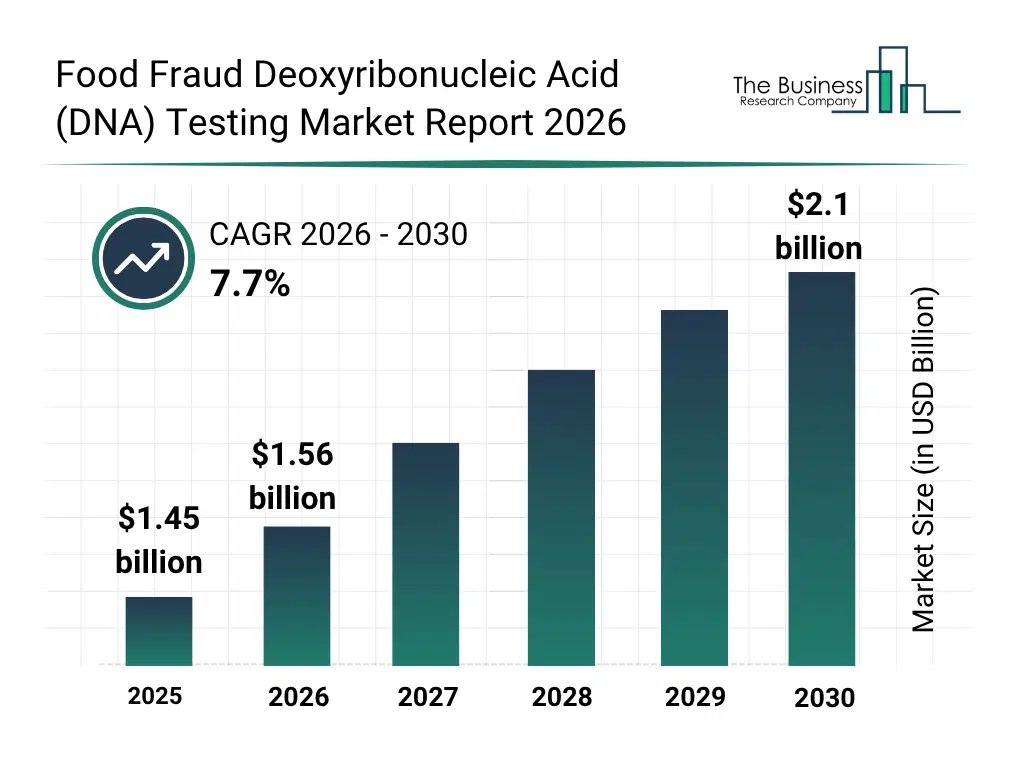
What Is The Food Fraud Deoxyribonucleic Acid (DNA) Testing Market Size and Share 2026?
The food fraud deoxyribonucleic acid (DNA) testing market size has grown strongly in recent years. It will grow from $1.45 billion in 2025 to $1.56 billion in 2026 at a compound annual growth rate (CAGR) of 7.5%. The growth in the historic period can be attributed to rising incidents of food adulteration, increasing regulatory enforcement for food labeling, growth in global food trade, expansion of molecular biology techniques, rising consumer awareness about Food Authenticity.What Is The Food Fraud Deoxyribonucleic Acid (DNA) Testing Market Growth Forecast?
The food fraud deoxyribonucleic acid (DNA) testing market size is expected to see strong growth in the next few years. It will grow to $2.1 billion in 2030 at a compound annual growth rate (CAGR) of 7.7%. The growth in the forecast period can be attributed to growing demand for transparent food supply chains, increasing adoption of NGS technologies, expansion of GMO and allergen testing requirements, rising investment in food safety infrastructure, demand for rapid and portable DNA Testing solutions. Major trends in the forecast period include increasing adoption of PCR-based authentication testing, growing demand for species-level identification in meat products, expansion of outsourced DNA testing services, rising implementation of real-time testing workflows, development of multiplex DNA testing panels.
Global Food Fraud Deoxyribonucleic Acid (DNA) Testing Market Segmentation
1) By Technology: Polymerase Chain Reaction (PCR) Based Testing, Next-Generation Sequencing (NGS), DNA Barcoding, Isothermal Amplification Technologies, Other Technologies 2) By Testing Workflow: In-House Laboratory Testing, Outsourced Testing Services 3) By Target: Meat And Meat Products, Dairy Products, Cereals And Grains, Processed Foods, Fruits And Vegetables, Other Targets 4) By Application: Species Identification, Genetically Modified Organism (GMO) Testing, Allergen Detection, Authentication, Other Applications 5) By End-User: Food Manufacturers, Retailers, Laboratories, Regulatory Bodies, Other End Users Subsegments: 1) By Polymerase Chain Reaction Based Testing: Conventional Polymerase Chain Reaction Testing, Real Time Polymerase Chain Reaction Testing, Multiplex Polymerase Chain Reaction Testing, Digital Polymerase Chain Reaction Testing, Nested Polymerase Chain Reaction Testing 2) By Next Generation Sequencing: Whole Genome Sequencing, Targeted Gene Panel Sequencing, Metagenomic Sequencing, Shotgun Sequencing, Amplicon Sequencing 3) By DNA Barcoding: Mitochondrial Gene Based Identification, Chloroplast Gene Based Identification, Ribosomal Gene Based Identification, Single Locus Barcoding, Multi Locus Barcoding 4) By Isothermal Amplification Technologies: Loop Mediated Isothermal Amplification, Recombinase Polymerase Amplification, Strand Displacement Amplification, Helicase Dependent Amplification, Rolling Circle Amplification 5) By Other Technologies: Microarray Based Testing, Hybridization Based Detection, Gene Expression Profiling, High Resolution Melting Analysis, Biosensor Based Molecular DetectionWhat Is The Driver Of The Food Fraud Deoxyribonucleic Acid (DNA) Testing Market?
The rising concerns over food safety are expected to propel the growth of the food fraud deoxyribonucleic acid (DNA) testing market going forward. Concerns over food safety refer to rising awareness and apprehension about contamination, adulteration, and hygiene issues in food products that can pose risks to consumer health. Increasing concerns over food safety are driven by the globalization of food supply chains, which increases the risk of contamination across multiple stages of production, processing, and distribution, making traceability and quality control more complex. Food fraud DNA testing enhances food safety by accurately verifying species, detecting adulteration, and ensuring ingredient authenticity and traceability to prevent contamination, mislabeling, and allergen risks. For instance, in December 2024, according to the European Food Safety Authority, an Italy-based government agency, in 2023, there were 148,181 cases of campylobacteriosis, corresponding to 45.7 cases per 100,000 people, marking a 4.3% increase in the notification rate compared to 2022. Therefore, the rising concerns over food safety are driving the growth of the food fraud deoxyribonucleic acid (DNA) testing industry.Key Players In The Global Food Fraud Deoxyribonucleic Acid (DNA) Testing Market
Major companies operating in the food fraud deoxyribonucleic acid (dna) testing market are STC Group, SGS Société Générale de Surveillance SA, Bureau Veritas SA, Intertek Group plc, ALS Limited, NSF International, LGC Limited, AsureQuality Limited, Fera Science Limited, Microbac Laboratories Inc., Symbio Laboratories, Envirologix Inc., IdentiGEN Limited, FoodChain ID Group Inc., Clear Labs Inc., Bio‑Check Ltd., Food Forensics Ltd., AES‑INTEC Pvt. Ltd., AttoDNA Limited, QACSFOOD.
This chart is for illustrative purposes; the full report includes a detailed competitor analysis and comprehensive overview of the top 10 companies in the market.
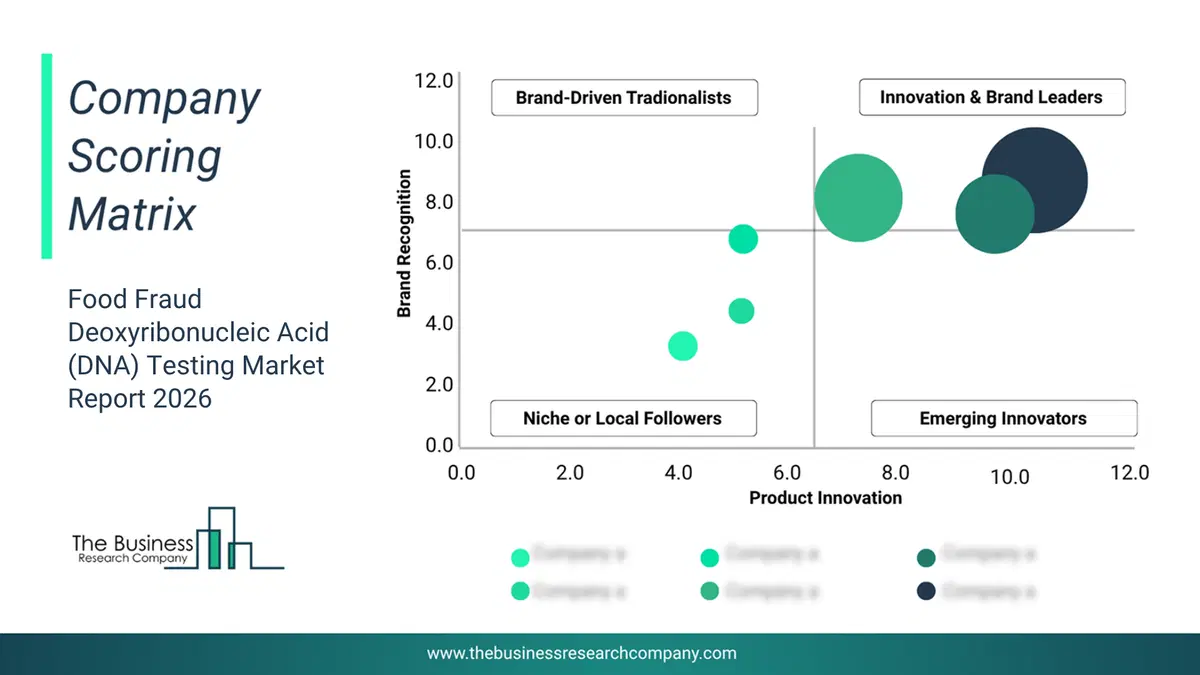
This chart maps companies by product innovation and brand strength, with bubble size indicating relative revenue, helping identify market leaders, challengers, and niche players. This is an illustrative chart; the full report provides a complete and accurate competitive analysis.
Global Food Fraud Deoxyribonucleic Acid (DNA) Testing Market Trends and Insights
Major companies operating in the food fraud deoxyribonucleic acid (DNA) testing market are focusing on developing advanced solutions, such as rapid DNA-based speciation kits, to ensure food integrity, combat food fraud, and enhance supply chain traceability. Rapid DNA-based speciation kits refer to ready-to-use kits that allow quick identification of the species origin of biological samples using DNA analysis. For instance, in April 2023, Bio-Rad Laboratories Inc., a US-based manufacturing company, launched an ID-Check Speciation Solution. It is a real-time PCR testing method featuring ready-to-use kits that target mitochondrial DNA to detect species like bovine, chicken, duck, goat, horse, sheep, swine, and turkey in food, feed, and environmental samples. The kits include a duplex detection system with an internal amplification control to prevent false negatives and offer remarkable sensitivity, achieving detection limits as low as 0.001% (0.01% for chicken and swine) in under two hours, enabling rapid and accurate verification of raw materials and production line cleaning processes for quality assurance personnel.What Are Latest Mergers And Acquisitions In The Food Fraud Deoxyribonucleic Acid (DNA) Testing Market?
In November 2023, Oxford Nanopore Technologies plc, a UK-based technology company, partnered with WeNou to advance real-time genomic sequencing solutions. With this partnership, Oxford Nanopore Technologies and WeNou aim to develop and commercialize the first rapid, portable nanopore sequencing test for untargeted DNA-based food authenticity verification to detect food fraud across multiple species in complex samples. WeNou is a Portugal-based biotechnology company specializing in DNA-based food authenticity and safety testing using next-generation sequencing (NGS).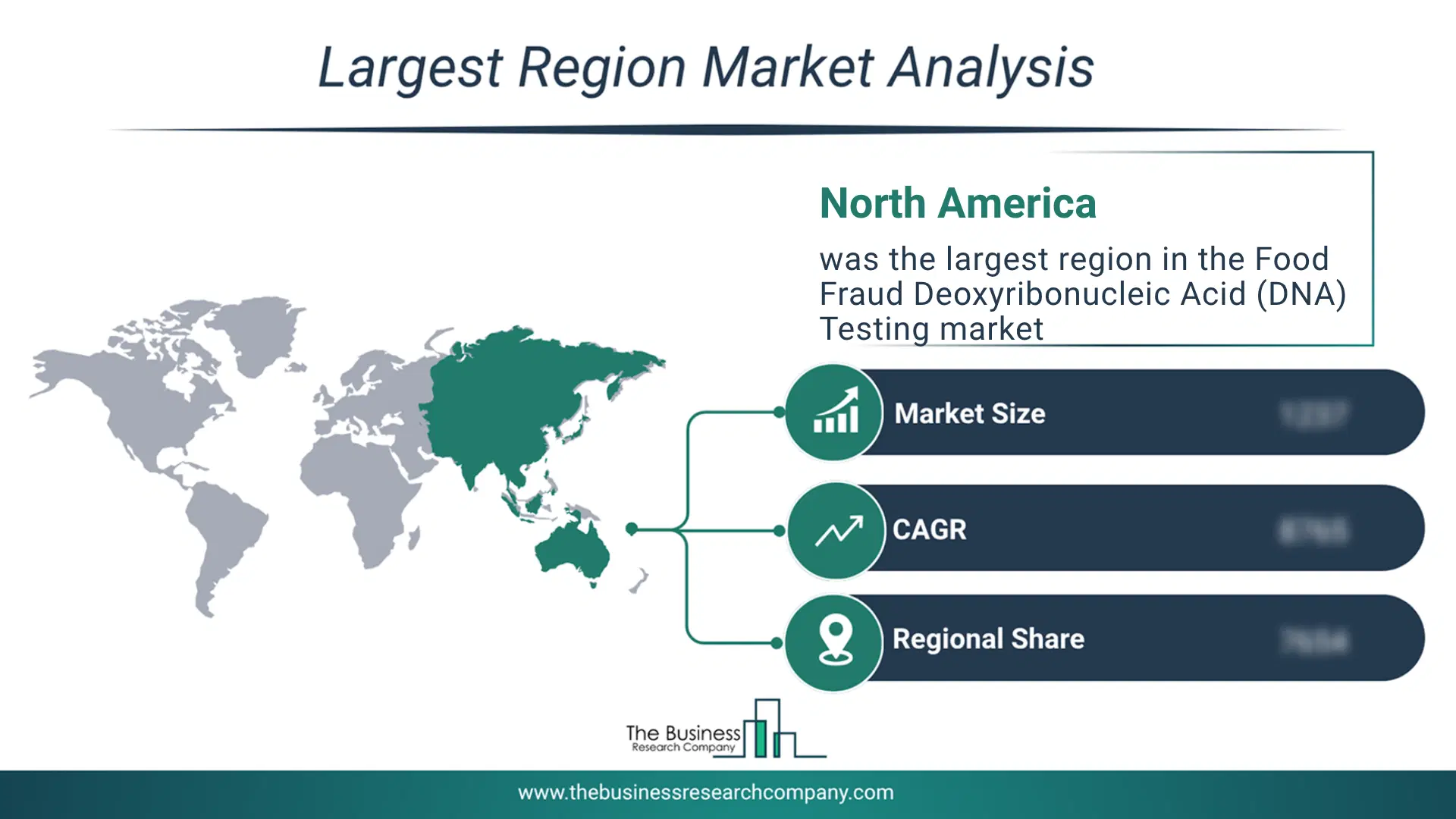
Regional Insights
North America was the largest region in the food fraud deoxyribonucleic acid (DNA) testing market in 2025. Asia-Pacific is expected to be the fastest-growing region in the forecast period. The regions covered in this market report are Asia-Pacific, South East Asia, Western Europe, Eastern Europe, North America, South America, Middle East, Africa. The countries covered in this market report are Australia, Brazil, China, France, Germany, India, Indonesia, Japan, Taiwan, Russia, South Korea, UK, USA, Canada, Italy, Spain.What Defines the Food Fraud Deoxyribonucleic Acid (DNA) Testing Market?
The food fraud deoxyribonucleic acid (DNA) testing market consists of revenues earned by entities by providing services such as species authentication testing, ingredient verification, allergen detection, contamination analysis, supply chain traceability services, outsourced laboratory testing, rapid on-site DNA testing, and data analysis and interpretation services. The market value includes the value of related goods sold by the service provider or included within the service offering. The food fraud deoxyribonucleic acid (DNA) testing market also includes sales of rapid DNA-based speciation kits, PCR reagents and consumables, DNA extraction kits, portable sequencing devices, laboratory-grade DNA sequencers, and assay kits for species and ingredient identification. Values in this market are ‘factory gate’ values, that is the value of goods sold by the manufacturers or creators of the goods, whether to other entities (including downstream manufacturers, wholesalers, distributors and retailers) or directly to end customers. The value of goods in this market includes related services sold by the creators of the goods.How is Market Value Defined and Measured?
The market value is defined as the revenues that enterprises gain from the sale of goods and/or services within the specified market and geography through sales, grants, or donations in terms of the currency (in USD unless otherwise specified). The revenues for a specified geography are consumption values that are revenues generated by organizations in the specified geography within the market, irrespective of where they are produced. It does not include revenues from resales along the supply chain, either further along the supply chain or as part of other products.
This chart presents market attractiveness based on a quantitative evaluation of growth, competition, strategic alignment, and risk, offering a clear view of opportunity areas for decision-making. This chart is for illustrative purposes; the full report contains the complete analysis.

This chart highlights the Total Addressable Market (TAM) by estimating the maximum revenue opportunity using an assumption-driven approach, supporting strategic planning and opportunity sizing across markets. The chart is illustrative; the full report provides a more comprehensive analysis.
What Key Data And Analysis Are Included In The Food Fraud Deoxyribonucleic Acid (DNA) Testing Market Report 2026?
The food fraud deoxyribonucleic acid (dna) testing market research report is one of a series of new reports from The Business Research Company that provides market statistics, including industry global market size, regional shares, competitors with the market share, detailed market segments, market trends and opportunities, and any further data you may need to thrive in the food fraud deoxyribonucleic acid (dna) testing industry. The market research report delivers a complete perspective of everything you need, with an in-depth analysis of the current and future state of the industry.Food Fraud Deoxyribonucleic Acid (DNA) Testing Market Report Forecast Analysis
| Report Attribute | Details |
|---|---|
| Market Size Value In 2026 | $1.56 billion |
| Revenue Forecast In 2030 | $2.1 billion |
| Growth Rate | CAGR of 7.5% from 2026 to 2030 |
| Base Year For Estimation | 2025 |
| Actual Estimates/Historical Data | 2020-2025 |
| Forecast Period | 2026 - 2030 |
| Market Representation | Revenue in USD Billion and CAGR from 2026 to 2030 |
| Segments Covered | Technology, Testing Workflow, Target, Application, End-User |
| Regional Scope | Asia-Pacific, Western Europe, Eastern Europe, North America, South America, Middle East, Africa |
| Country Scope | The countries covered in the report are Australia, Brazil, China, France, Germany, India, Indonesia, Japan, Taiwan, Russia, South Korea, UK, USA, Canada, Italy, Spain. |
| Key Companies Profiled | STC Group, SGS Société Générale de Surveillance SA, Bureau Veritas SA, Intertek Group plc, ALS Limited, NSF International, LGC Limited, AsureQuality Limited, Fera Science Limited, Microbac Laboratories Inc., Symbio Laboratories, Envirologix Inc., IdentiGEN Limited, FoodChain ID Group Inc., Clear Labs Inc., Bio‑Check Ltd., Food Forensics Ltd., AES‑INTEC Pvt. Ltd., AttoDNA Limited, QACSFOOD. |
| Customization Scope | Request for Customization |
| Pricing And Purchase Options | Explore Purchase Options |