
Food Traceability Market Report 2026
Global Outlook – By Technology (Radio-Frequency Identification, Barcodes, Global Positioning System), By Application (Fresh Food Produce, Meat, Poultry And Seafood Products, Dairy Products, Beverage Products, Other Applications), By End-User (Retailers, Food Manufacturers, Foodservice Providers, Distributors, Consumers) – Market Size, Trends, Strategies, and Forecast to 2030
Food Traceability Market Overview
• Food Traceability market size has reached to $25.54 billion in 2025 • Expected to grow to $43.9 billion in 2030 at a compound annual growth rate (CAGR) of 11.7% • Growth Driver: Rising Demand For Sustainable Food Boost The Market Growth • Market Trend: Adopting Blockchain Technologies To Gain A Competitive Edge • North America was the largest region in 2025 and Asia-Pacific is the fastest growing region.What Is Covered Under Food Traceability Market?
Food traceability refers to the ability to track and trace the movement of food products and their ingredients through all production, processing and distribution stages in the supply chain. It involves recording and maintaining detailed information about food items' origin, processing, handling and distribution from their source to the final consumer. It aids in promptly identifying and resolving problems concerning the quality, authenticity and safety of food. The main types of food traceability technologies are radio-frequency identification, barcodes, infrared, biometrics and global positioning system technologies. Radio-frequency identification refers to a type of wireless communication that uses electrostatic or electromagnetic coupling in the radio frequency region of the electromagnetic spectrum to specifically identify a thing, an animal, or a human and RFID technology enhances food traceability by employing distinct tags to accurately track products, enabling real-time monitoring and efficient recall procedures. The various food traceability software products are enterprise resource planning (ERP), friction welding, laboratory information management software (LIMS), warehouse software and others, are used in applications such as fresh food produce, meat, poultry and seafood products, dairy products, beverage products and others.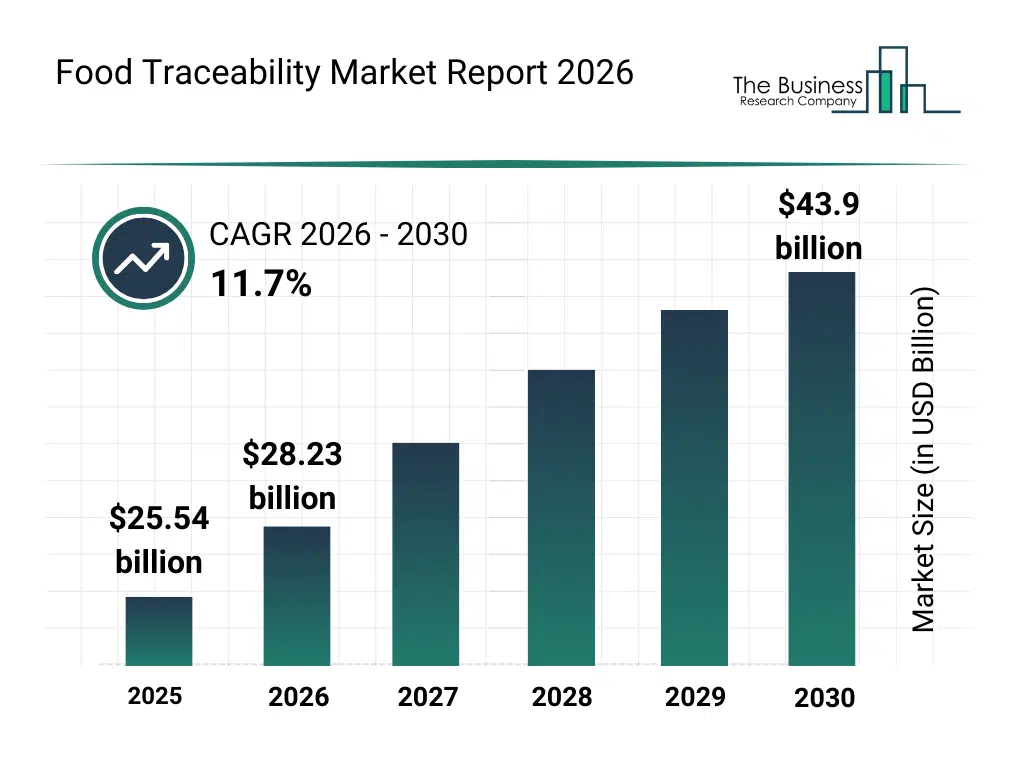
What Is The Food Traceability Market Size and Share 2026?
The food traceability market size has grown rapidly in recent years. It will grow from $25.54 billion in 2025 to $28.23 billion in 2026 at a compound annual growth rate (CAGR) of 10.5%. The growth in the historic period can be attributed to strengthening food safety regulations, rising consumer demand for product transparency, expansion of global food trade, increasing adoption of digital record-keeping systems, growth of organized food supply chains.What Is The Food Traceability Market Growth Forecast?
The food traceability market size is expected to see rapid growth in the next few years. It will grow to $43.9 billion in 2030 at a compound annual growth rate (CAGR) of 11.7%. The growth in the forecast period can be attributed to increasing investments in digital traceability platforms, rising adoption of smart labeling technologies, expansion of connected supply chain ecosystems, growing use of AI-enabled traceability analytics, increasing focus on fraud prevention and authenticity verification. Major trends in the forecast period include increasing adoption of blockchain-based traceability platforms, rising use of rfid and barcode technologies, growing integration of real-time supply chain monitoring, expansion of end-to-end food transparency solutions, enhanced focus on regulatory compliance tracking.
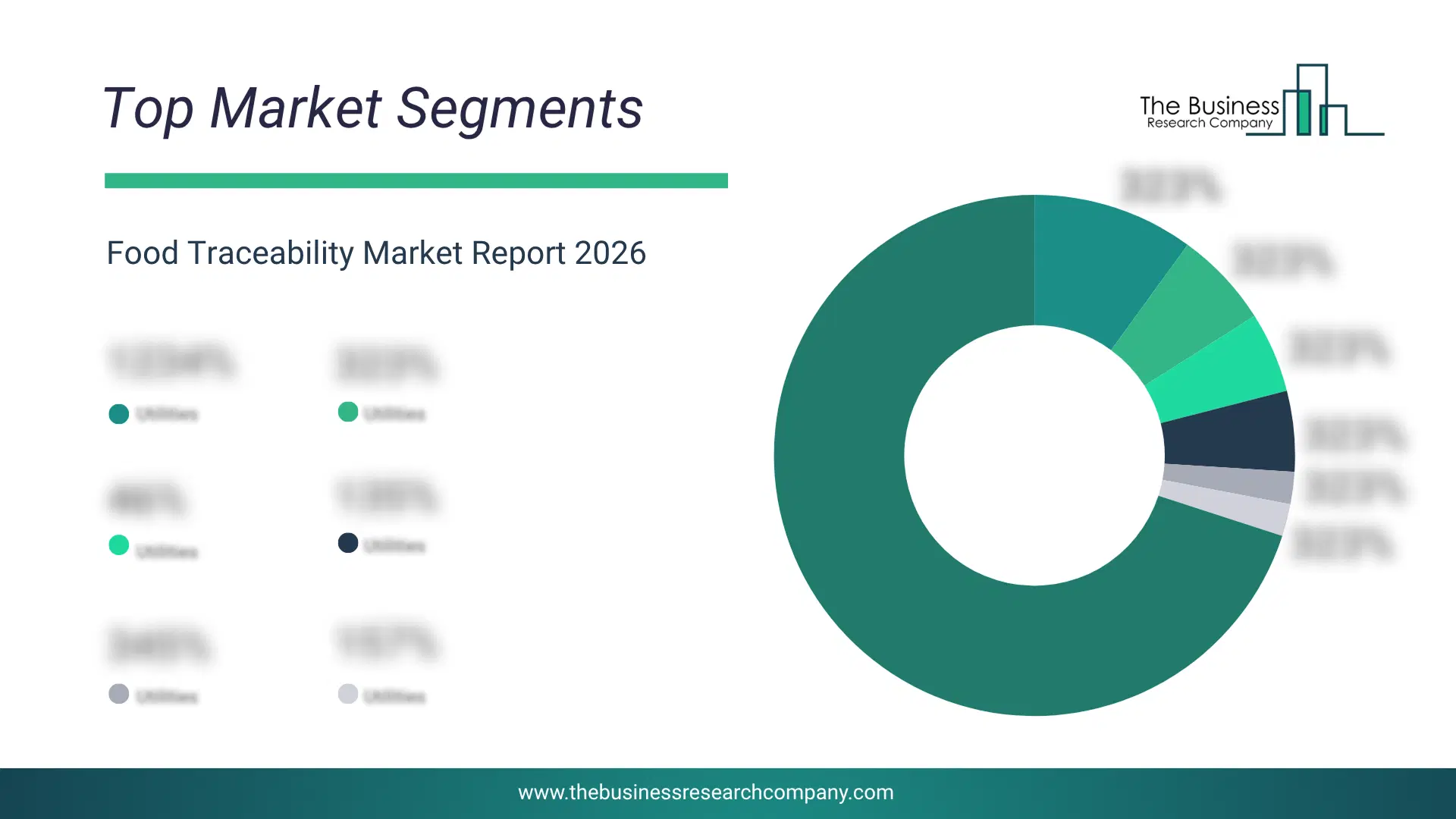
Global Food Traceability Market Segmentation
1) By Technology: Radio-Frequency Identification, Barcodes, Global Positioning System 2) By Application: Fresh Food Produce, Meat, Poultry And Seafood Products, Dairy Products, Beverage Products, Other Applications 3) By End-User: Retailers, Food Manufacturers, Foodservice Providers, Distributors, Consumers Subsegments: 1) By Radio-Frequency Identification (RFID): Active RFID, Passive RFID, Semi-passive RFID 2) By Barcodes: 1D Barcodes, 2D Barcodes, QR Codes 3) By Global Positioning System (GPS): GPS Tracking Devices, GPS-Based Location ServicesWhat Is The Driver Of The Food Traceability Market?
The increasing demand for sustainable food is expected to drive the food traceability market going forward. Sustainable food refers to food production, distribution, and consumption that is safe and healthy. It is produced without the use of toxic pesticides and chemicals, non-essential antibiotics, or growth promotion supplements. Food traceability plays a crucial role in promoting sustainable food production by providing consumers with information about the environmental and social impacts associated with their food choices. For instance, In April 2024, according to the National Association of Convenience Stores, a US-based trade association representing the convenience and fuel retailing industry, the 2024 survey results indicate that 80% of consumers are concerned about the environmental impact of their purchases, an increase from 68% in 2023 and 66% in 2022. Thus, the increasing demand for sustainable food enhance the food traceability industry.Key Players In The Global Food Traceability Market
Major companies operating in the food traceability market are International Business Machines Corp, Oracle Systems Corporation, Honeywell International Inc, Avery Dennison Corporation, Zebra Technologies Corp, SGS SA, ANTARES VISION S.p.A, OPTEL GROUP, iTradeNetwork Inc, Rfxcel Corporation, TE-FOOD International GmbH, Covectra Inc, SourceTrace Systems India Pvt Ltd, Bext360 Holdings Inc, Traceall Global Ltd, TrusTrace, FoodLogiQ, Merit-Trax Technologies Inc, Bar Code Integrators Inc, Cognex Corporation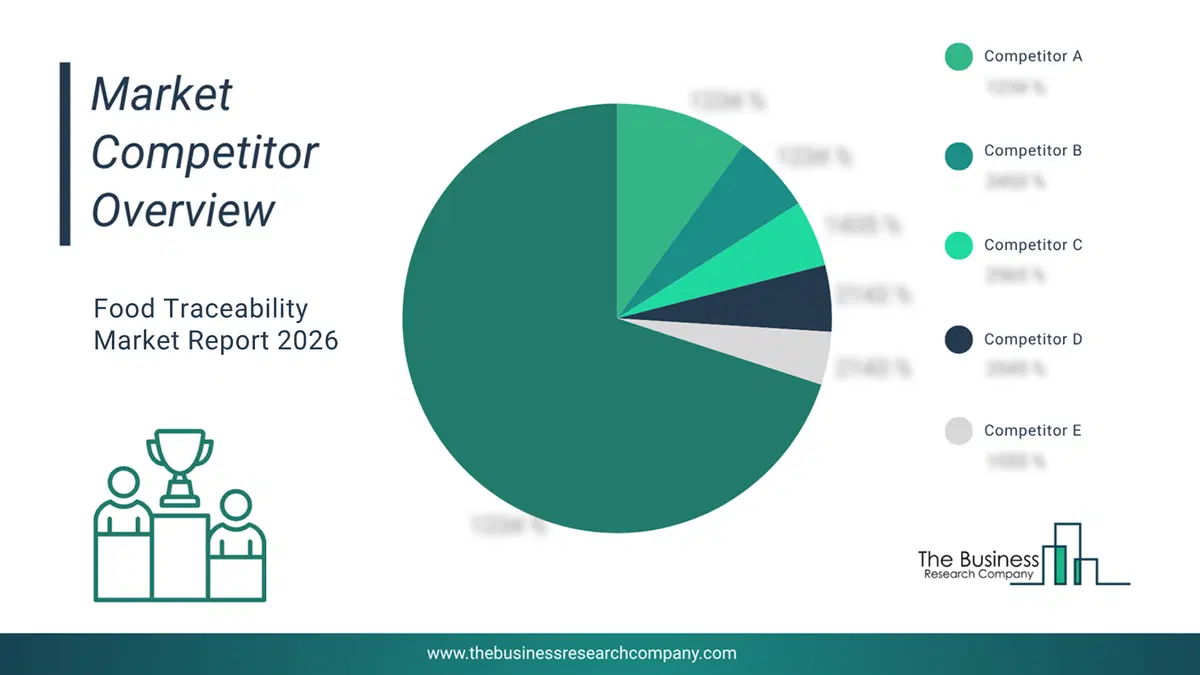
This chart is for illustrative purposes; the full report includes a detailed competitor analysis and comprehensive overview of the top 10 companies in the market.
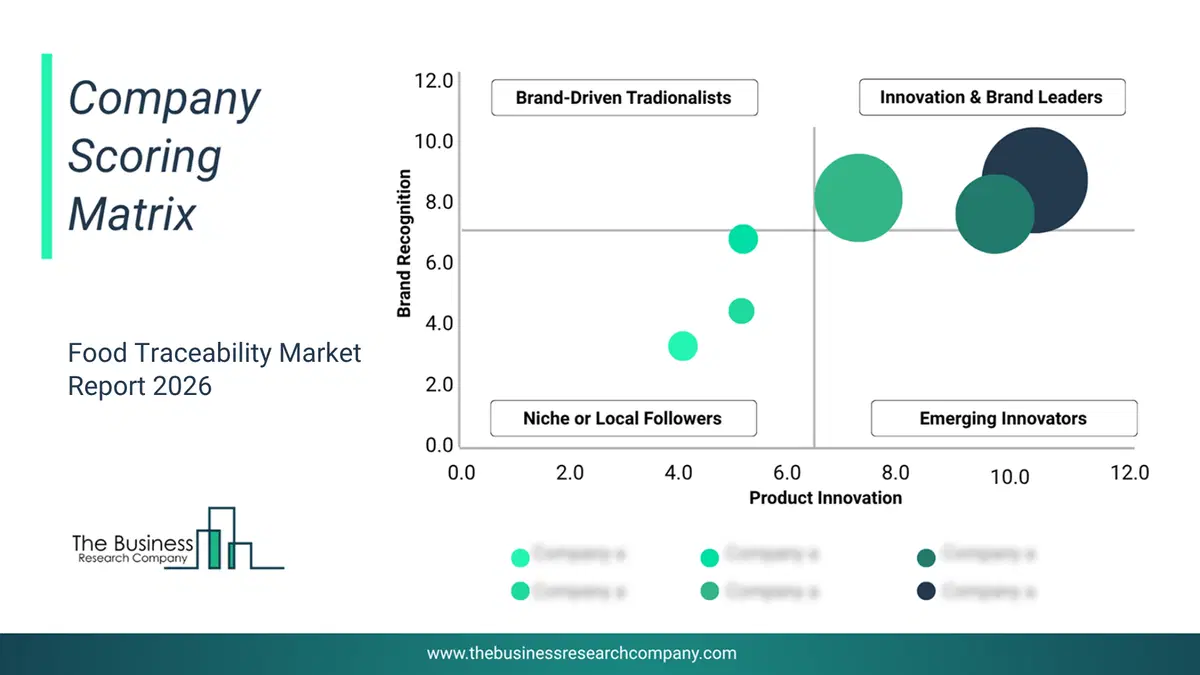
This chart maps companies by product innovation and brand strength, with bubble size indicating relative revenue, helping identify market leaders, challengers, and niche players. This is an illustrative chart; the full report provides a complete and accurate competitive analysis.
Global Food Traceability Market Trends and Insights
Major companies operating in the food traceability market are adopting blockchain technologies to address several challenges and gain a competitive edge in the market. Blockchain technologies are extensively used in food traceability to enhance transparency and safety in the food supply chain. For instance, in May 2023, OVO Farm Pvt. Ltd., an India-based producer of eggs and egg products, launched unique blockchain technology that enables traceability of their eggs at every level of the supply chain, from the farm to the final consumer. OVO Farm, through its main brand Kenko, provides high-quality, fresh and hygienic eggs, the authenticity of which can be verified by scanning the QR code included on each product. Through this blockchain technology, it makes sure the appropriate products reach the clients and guarantees quality.What Are Latest Mergers And Acquisitions In The Food Traceability Market?
In March 2023, TOMRA Systems ASA, a Norway-based provider of technology-led solutions, acquired a 14% ownership stake in Kezzler AS for $10.39 million. Through this acquisition, TOMRA will invest in a critical technology that will help speed the necessary transition to circularity and resource optimization. TOMRA's investment in Kezzler allows them to investigate and develop prospects in a strategic digital domain and considers traceability and transparency to be critical components of circular business models. Kezzler AS is a Norway-based technology company that provides traceability technology solutions for various industries, including food and beverage.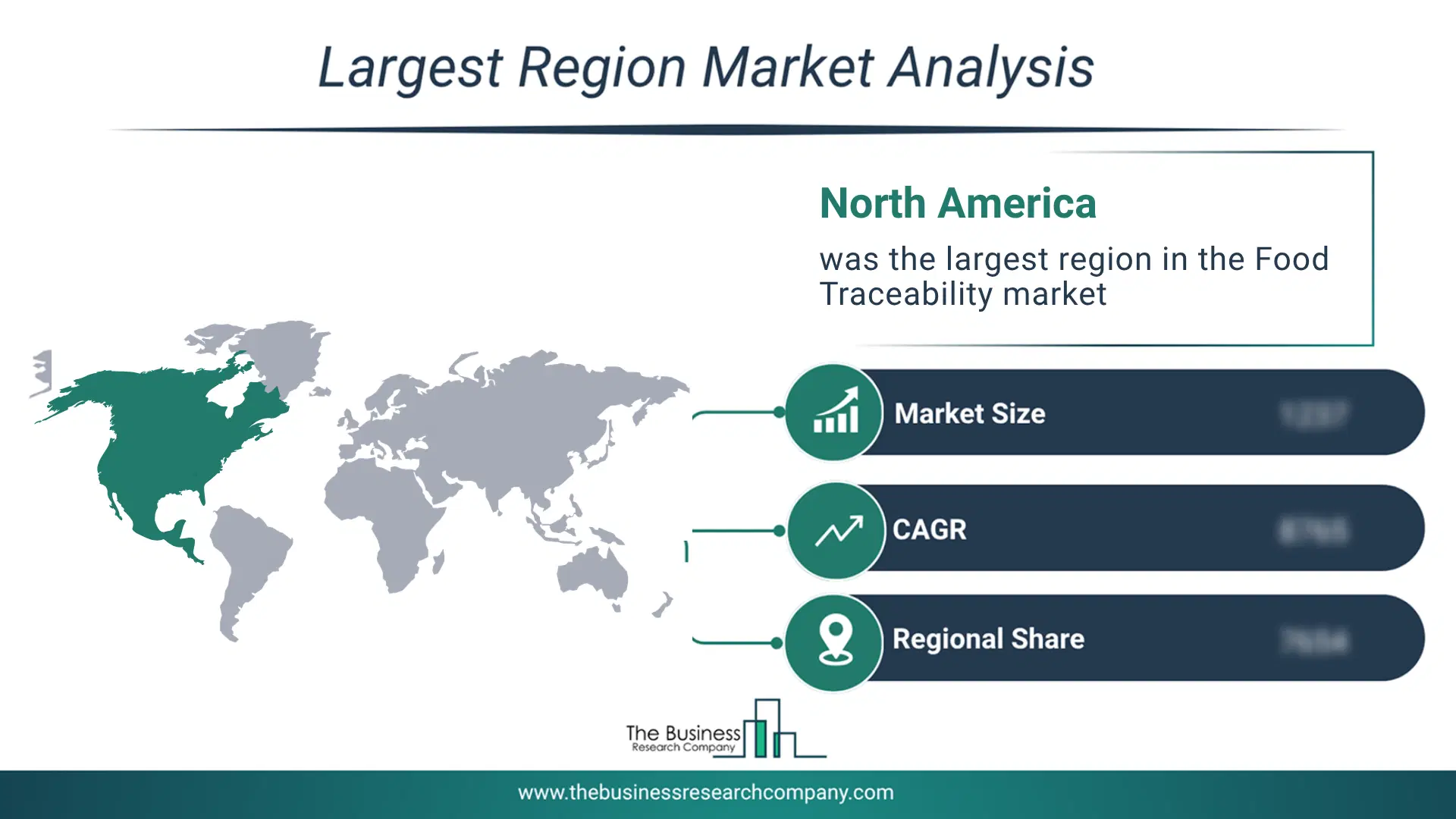
Regional Outlook
North America was the largest region in the food traceability market in 2025. Asia-Pacific is expected to be the fastest-growing region in the forecast period. The regions covered in this market report are Asia-Pacific, South East Asia, Western Europe, Eastern Europe, North America, South America, Middle East and Africa. The countries covered in this market report are Australia, Brazil, China, France, Germany, India, Indonesia, Japan, Taiwan, Russia, South Korea, UK, USA, Italy, Spain, CanadaWhat Defines the Food Traceability Market?
The food traceability market consists of revenues earned by entities by providing services such as tracking and monitoring, batch and lot identification and risk management. The market value includes the value of related goods sold by the service provider or included within the service offering. The food traceability market also includes sales of quality management software, poultry farm software and hybrid software. Values in this market are ‘factory gate’ values, that is the value of goods sold by the manufacturers or creators of the goods, whether to other entities (including downstream manufacturers, wholesalers, distributors and retailers) or directly to end customers. The value of goods in this market includes related services sold by the creators of the goods.How is Market Value Defined and Measured?
The market value is defined as the revenues that enterprises gain from the sale of goods and/or services within the specified market and geography through sales, grants, or donations in terms of the currency (in USD unless otherwise specified). The revenues for a specified geography are consumption values that are revenues generated by organizations in the specified geography within the market, irrespective of where they are produced. It does not include revenues from resales along the supply chain, either further along the supply chain or as part of other products.
This chart presents market attractiveness based on a quantitative evaluation of growth, competition, strategic alignment, and risk, offering a clear view of opportunity areas for decision-making. This chart is for illustrative purposes; the full report contains the complete analysis.

This chart highlights the Total Addressable Market (TAM) by estimating the maximum revenue opportunity using an assumption-driven approach, supporting strategic planning and opportunity sizing across markets. The chart is illustrative; the full report provides a more comprehensive analysis.
What Key Data and Analysis Are Included in the Food Traceability Market Report 2026?
The food traceability market research report is one of a series of new reports from The Business Research Company that provides market statistics, including industry global market size, regional shares, competitors with the market share, detailed market segments, market trends and opportunities, and any further data you may need to thrive in the food traceability industry. The market research report delivers a complete perspective of everything you need, with an in-depth analysis of the current and future state of the industry.Food Traceability Market Report Forecast Analysis
| Report Attribute | Details |
|---|---|
| Market Size Value In 2026 | $28.23 billion |
| Revenue Forecast In 2030 | $43.9 billion |
| Growth Rate | CAGR of 10.5% from 2026 to 2030 |
| Base Year For Estimation | 2025 |
| Actual Estimates/Historical Data | 2020-2025 |
| Forecast Period | 2026 - 2030 |
| Market Representation | Revenue in USD Billion and CAGR from 2026 to 2030 |
| Segments Covered | Technology, Application, End-User |
| Regional Scope | Asia-Pacific, Western Europe, Eastern Europe, North America, South America, Middle East, Africa |
| Country Scope | The countries covered in the report are Australia, Brazil, China, France, Germany, India, Indonesia, Japan, Taiwan, Russia, South Korea, UK, USA, Canada, Italy, Spain. |
| Key Companies Profiled | International Business Machines Corp, Oracle Systems Corporation, Honeywell International Inc, Avery Dennison Corporation, Zebra Technologies Corp, SGS SA, ANTARES VISION S.p.A, OPTEL GROUP, iTradeNetwork Inc, Rfxcel Corporation, TE-FOOD International GmbH, Covectra Inc, SourceTrace Systems India Pvt Ltd, Bext360 Holdings Inc, Traceall Global Ltd, TrusTrace, FoodLogiQ, Merit-Trax Technologies Inc, Bar Code Integrators Inc, Cognex Corporation |
| Customization Scope | Request for Customization |
| Pricing And Purchase Options | Explore Purchase Options |