
Contact Us
  Search
The Business Research Company Logo
Food Waste Management Market 2025
Published :May 2025
Pages :376
Format :PDF
Delivery Time :2-3 Business Days
Why 2-3 days? We update the report with the latest data and news before delivery. Let us know if you need us to expedite.
Report Price :$4,490.00

Food Waste Management Market 2025

By Waste Type (Cereals, Dairy And Dairy Product, Fruits And Vegetables, Meat And Poultry, Fish And Seafood, Oilseeds And Pulse, Roots And Tubers, Other Waste Types), By Service (Collection, Transportation, Disposal And Recycling), By Source (Residential, Commercia, Industrial), By Application (Feed, Fertilizers, Biofuel, Power Generation, Other Applications), By End User (Primary Food Producers, Food Manufacturers, Food Distributors And Suppliers , Food Service Providers, Municipalities And Households), And By Region, Opportunities And Strategies – Global Forecast To 2035
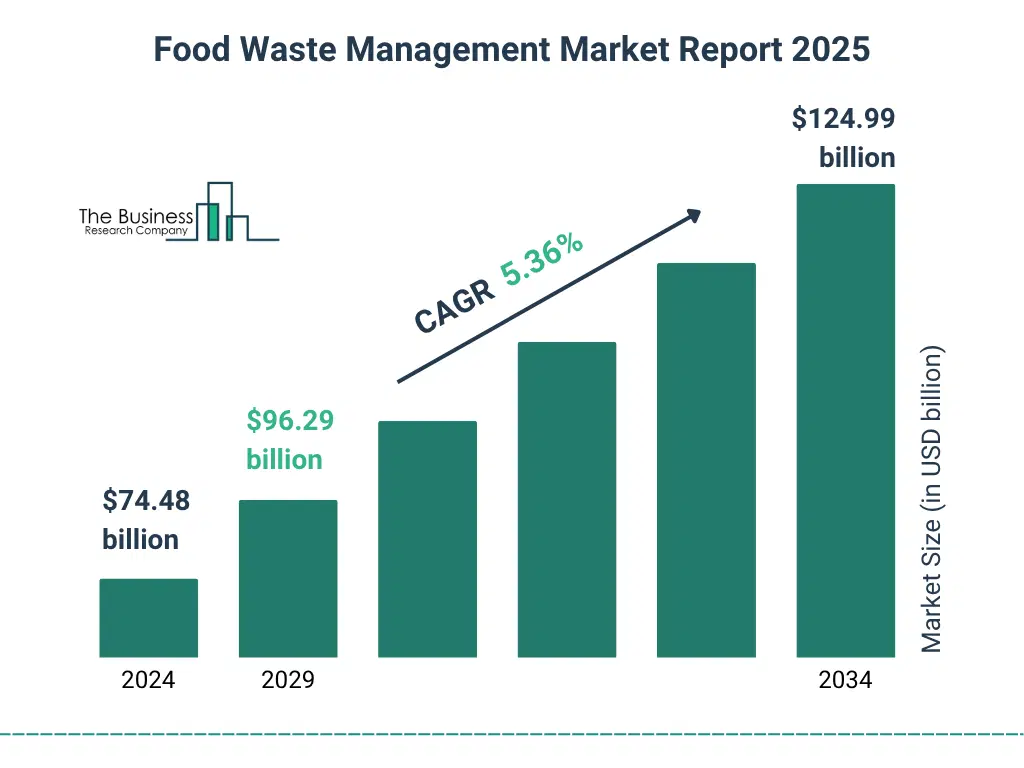
Food Waste Management Market Size and growth rate 2025 to 2029: Graph

Food Waste Management Market Definition

Food waste management refers to the processes and services involved in the collection, transportation, treatment and disposal of food waste generated across various sectors. It plays a critical role in mitigating environmental impact, reducing landfill usage and recovering valuable resources through recycling and repurposing. The food waste management market consists of sales of food waste management services by entities (organizations, sole traders and partnerships) specializing in collection, transportation and disposal and recycling of food waste.
Research Expert

Book your 30 minutes free consultation with our research experts

> Food Waste Management Market Size

The global food waste management market reached a value of nearly $74,483.16 million in 2024, having grown at a compound annual growth rate (CAGR) of 3.58% since 2019. The market is expected to grow from $74,483.16 million in 2024 to $96,287.35 million in 2029 at a rate of 5.27%. The market is then expected to grow at a CAGR of 5.36% from 2029 and reach $124,986.31 million in 2034. Growth in the historic period resulted from the rising food waste generation, expanding food service industry, rising awareness and environmental concerns and rising organic municipal waste. Factors that negatively affected growth in the historic period were complex regulatory frameworks and limited public awareness and engagement. Going forward, the favorable government incentives, adoption of circular economy practices, increasing demand for renewable energy and consumer demand for sustainable practices will drive the growth. Factor that could hinder the growth of the food waste management market in the future include high initial investment and lack of infrastructure.

Food Waste Management Market Drivers

The key drivers of the food waste management market include: Favorable Government Incentives Favorable government incentives are anticipated to drive the expansion of the food waste management market during the forecast period. Favorable government incentives refer to financial benefits, tax breaks, grants, or regulatory support provided by the government to encourage specific industries or activities. Favorable government incentives drive food waste management by providing financial support, tax benefits and regulatory frameworks that encourage businesses, farms and organizations to reduce waste and redistribute surplus food. For example, in January 2025, the UK government introduced a $19 million (£15 million) fund to tackle food waste on farms, providing grants starting at $25,000 (£20,000) to not-for-profit food redistribution groups in England. These funds help organizations invest in essential equipment, transportation and storage solutions. Consequently, government incentives are expected to play a crucial role in advancing the food waste management market.

Food Waste Management Market Restraints

The key restraints on the food waste management market include: High Initial Investment High initial investment costs are expected to restrain the growth of the food waste management market going forward. The initial investment refers to the upfront cost required to start a project, business, or initiative. This can include expenses such as equipment, infrastructure, licenses, training and other resources needed before generating returns. High initial investment costs have restrained food waste management by creating a financial barrier for businesses, especially small retailers and food service providers. For instance, in July 2024, Waste Mission, a UK-based provider of waste management service, found that food retailers in the UK spend over $63,000 (£50,000) annually disposing of food waste in landfills. However, by implementing a commercial food waste management plan and recycling food waste, they could save $8,800 (£7,000) each year. Therefore, high initial investment costs are expected to restrain the growth of the food waste management market.

Need data on a specific region in this market?

Opportunities And Recommendations In The Food Waste Management Market

Opportunities –The top opportunities in the food waste management markets segmented by waste type will arise in the fruits and vegetables segment, which will gain $5,384.85 million of global annual sales by 2029. The top opportunities in the food waste management markets segmented by service will arise in the collection segment, which will gain $9,702.81 million of global annual sales by 2029. The top opportunities in the food waste management markets segmented by source will arise in the residential segment, which will gain $9,828.09 million of global annual sales by 2029. The top opportunities in the food waste management markets segmented by application will arise in the feed segment, which will gain $10,730.82 million of global annual sales by 2029. The top opportunities in the food waste management markets segmented by end-user will arise in the municipalities and households segment, which will gain $7,870.38 million of global annual sales by 2029. The food waste management market size will gain the most in China at $4,061.14 million. Recommendations-To take advantage of the opportunities, The Business Research Company recommends the food waste management focus on implementing structured food waste management initiatives, focus on strengthening partnerships and advancing technology to drive food waste reduction, focus on driving growth through integrated and sustainable waste management solutions, focus on the dairy and dairy products segment to drive growth, expand in emerging markets, continue to focus on developed markets, focus on expanding distribution through strategic partnerships, focus on structuring tiered pricing models to capture different customer segments, focus on strengthening digital engagement and educational campaigns, focus on leveraging community initiatives and corporate partnerships, focus on targeting commercial end-users to drive growth in food waste management.
Chat with us