
Forage Feed Market Report 2026
Global Outlook – By Type (Pasture, Hay, Silage, Haylage), By Animal (Ruminants, Other Animals), By Form (Pellets, Cubes, Other Forms), By Distribution Channel (Online Stores, Specialty Stores, Other Distribution Channels) – Market Size, Trends, Strategies, and Forecast to 2030
Forage Feed Market Overview
• Forage Feed market size has reached to $99.06 billion in 2025 • Expected to grow to $129.39 billion in 2030 at a compound annual growth rate (CAGR) of 5.5% • Growth Driver: Expanding Livestock Numbers Driving Market Growth Amid Growing Consumer Preference For Animal-Derived Products And Enhanced Nutritional Requirements • Market Trend: Innovative Multi-Species Forage For Enhanced Livestock Nutrition And Soil Health • North America was the largest region in 2025 and Asia-Pacific is the fastest growing region.What Is Covered Under Forage Feed Market?
Forage feed refers to the edible parts of plants, excluding separated grains, that are consumed by grazing livestock or harvested for feeding. This includes grasses, legumes, and other herbaceous plants provided as pasture, hay, or silage. It serves as a primary source of fiber and essential nutrients, supporting digestion and overall health. Forage feed can be provided through grazing or harvested and stored for later use. The main types of forage feed are pasture, hay, silage, and haylage. Pasture feed refers to the natural vegetation, such as grasses, legumes, and other forage plants, that livestock graze on while being raised in open fields or pastureland. Pasture feed is formulated for various animals, including ruminants, poultry, swine, and others, and is available in different forms such as pellets, cubes, and more. It is distributed through multiple channels, including online stores, supermarkets, hypermarkets, specialty stores, and others.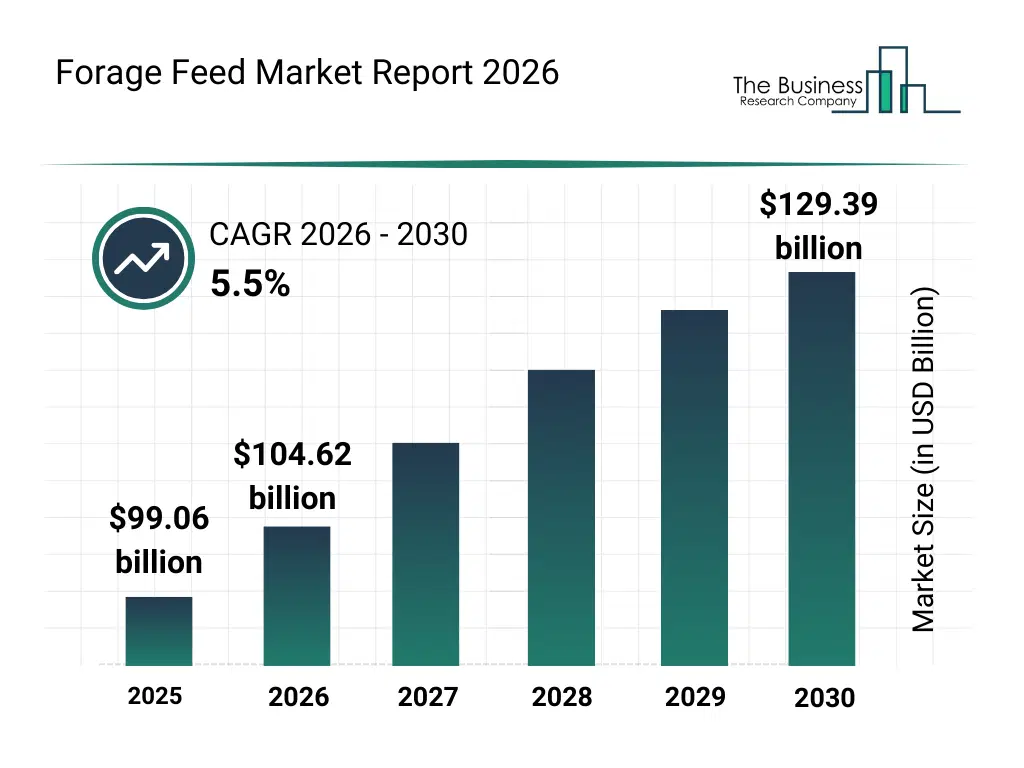
What Is The Forage Feed Market Size and Share 2026?
The forage feed market size has grown strongly in recent years. It will grow from $99.06 billion in 2025 to $104.62 billion in 2026 at a compound annual growth rate (CAGR) of 5.6%. The growth in the historic period can be attributed to expansion of livestock farming operations, increased demand for dairy and meat products, development of modern feed storage techniques, growth of commercial animal husbandry, availability of improved forage varieties.What Is The Forage Feed Market Growth Forecast?
The forage feed market size is expected to see strong growth in the next few years. It will grow to $129.39 billion in 2030 at a compound annual growth rate (CAGR) of 5.5%. The growth in the forecast period can be attributed to rising focus on sustainable livestock nutrition, increasing adoption of precision livestock farming, growth of feed quality monitoring systems, expansion of climate-resilient forage crops, rising demand for cost-efficient animal nutrition. Major trends in the forecast period include improved forage crop breeding practices, expansion of silage and haylage production, growing focus on nutrient-dense feed, increased mechanization of forage harvesting, adoption of precision feeding strategies.
Global Forage Feed Market Segmentation
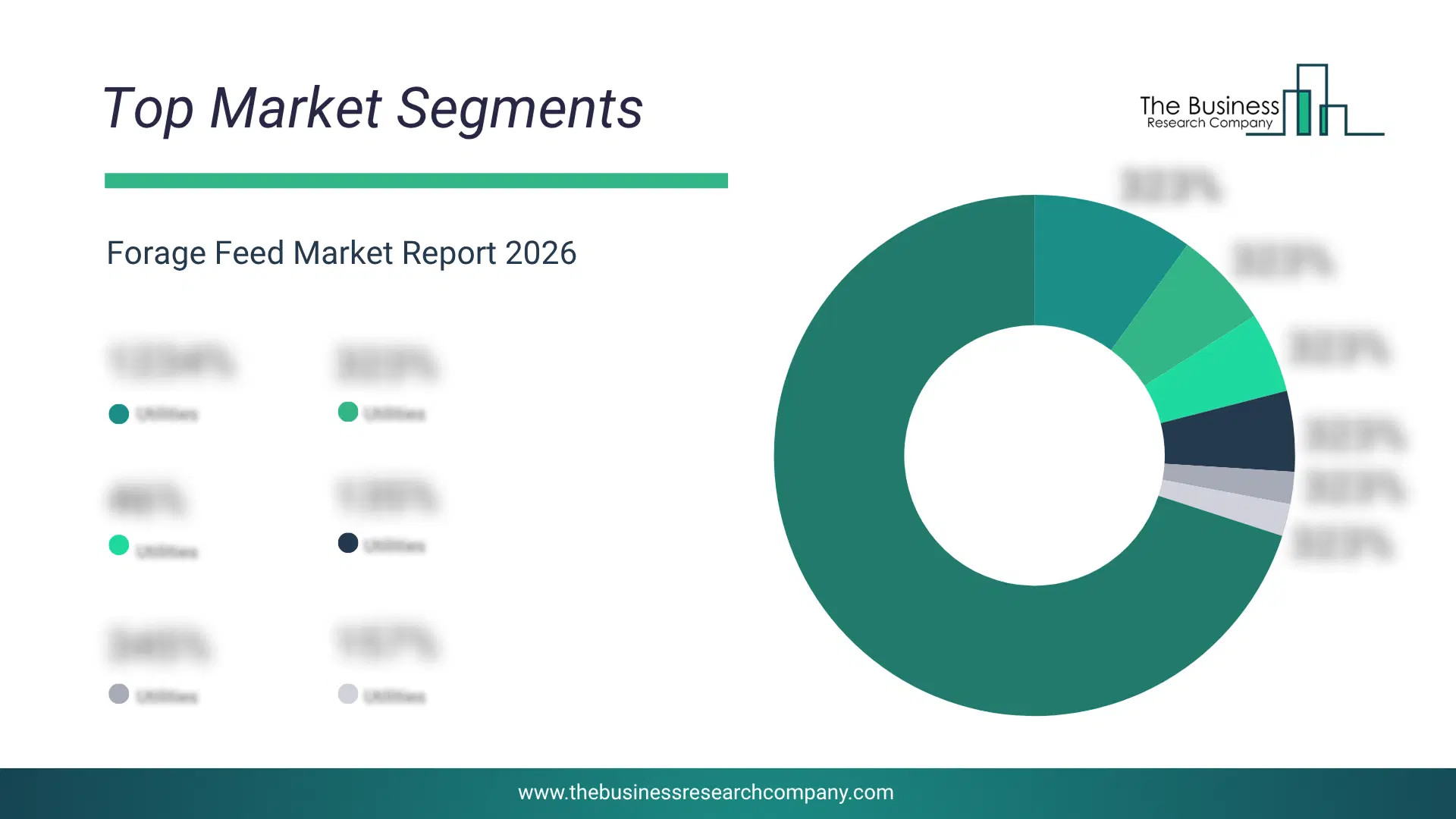
1) By Type: Pasture, Hay, Silage, Haylage 2) By Animal: Ruminants, Other Animals 3) By Form: Pellets, Cubes, Other Forms 4) By Distribution Channel: Online Stores, Specialty Stores, Other Distribution Channels Subsegments: 1) By Pasture: Legume Pasture, Grass Pasture, Mixed Pasture 2) By Hay: Alfalfa Hay, Timothy Hay, Clover Hay, Bermuda Grass Hay 3) By Silage: Corn Silage, Sorghum Silage, Grass Silage, Legume Silage 4) By Haylage: Alfalfa Haylage, Clover Haylage, Grass Haylage, Mixed HaylageWhat Is The Driver Of The Forage Feed Market?
The increasing livestock population is expected to drive the growth of the forage feed market going forward. Livestock population refers to the total number of domesticated animals raised for food, fiber, and other agricultural purposes, such as cattle, poultry, pigs, and sheep. It is increasing due to rising global demand for animal-based products, a growing population, and increasing income levels in developing countries, driving the need for more livestock for meat, dairy, and other agricultural industries. Forage feed is essential for livestock as it provides necessary fiber, nutrients, and energy for healthy digestion, growth, and productivity. For instance, in September 2023, according to Swineweb, a US-based online platform for digital information on the North American pork industry, in 2023, feeder cattle imports increased by over 19% year over year, and pork exports are anticipated to rise in 2023, reaching 6.8 billion pounds, marking a 7.2% increase from the previous year. Therefore, the increasing livestock population is driving the growth of the forage feed industry.Key Players In The Global Forage Feed Market
Major companies operating in the forage feed market are Cargill Inc., Charoen Pokphand Foods PCL, Evonik Industries AG, Land O'Lakes Inc., Royal DSM N.V., J. R. Simplot Company, Nutreco N.V., Trouw Nutrition, Wilbur Ellis Holdings Inc, ForFarmers N.V., Alltech Inc., Standlee Premium Products LLC, Riverina Australia Pty Ltd, Kemin Industries Inc., ADM Alliance Nutrition, NWF Agriculture, Al Dahra ACX Global Inc., Cornext Agri Pvt. Ltd., The Pure Feed Company, Lucerne Farms.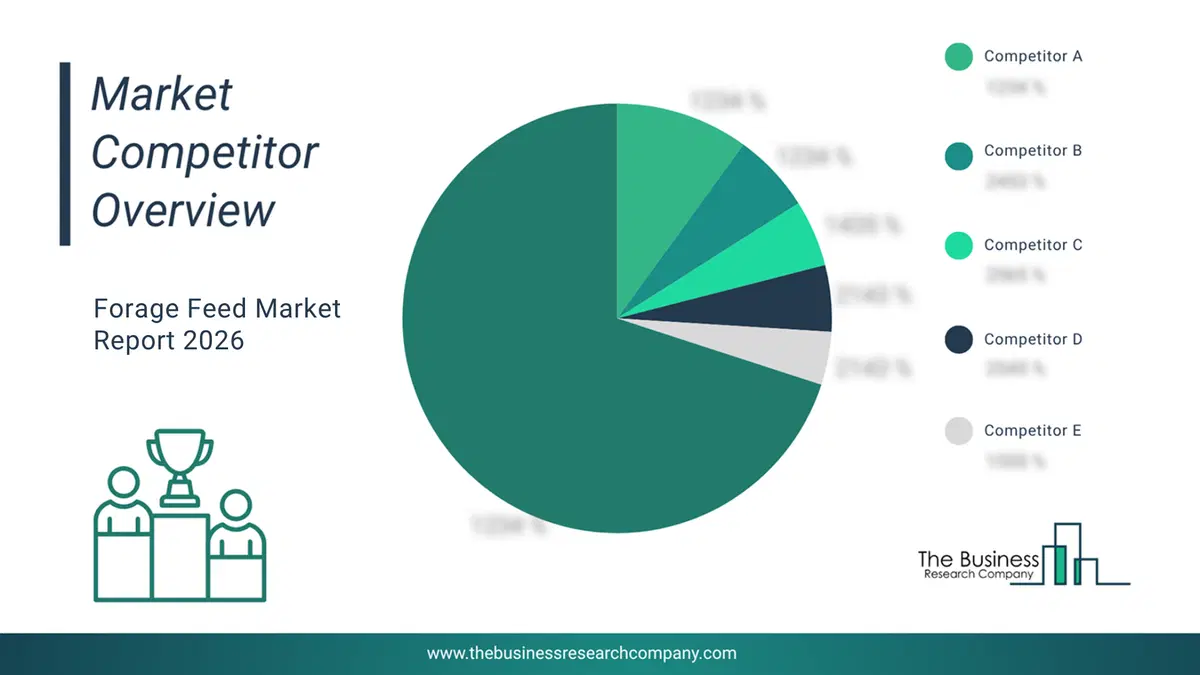
This chart is for illustrative purposes; the full report includes a detailed competitor analysis and comprehensive overview of the top 10 companies in the market.
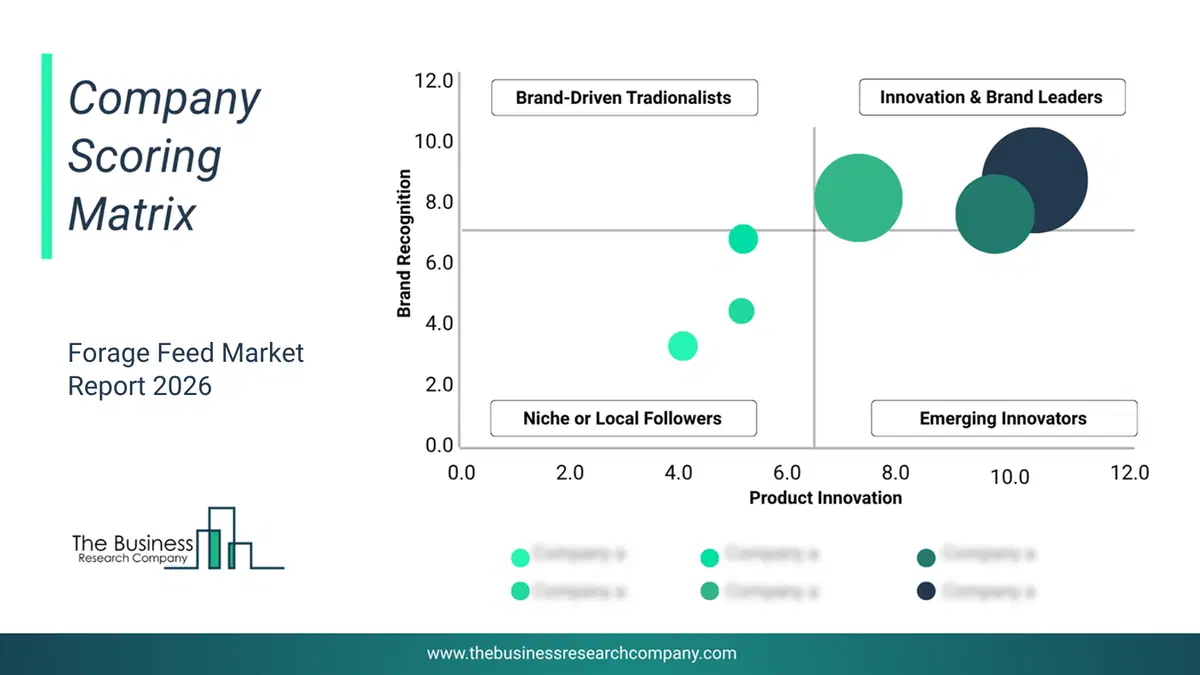
This chart maps companies by product innovation and brand strength, with bubble size indicating relative revenue, helping identify market leaders, challengers, and niche players. This is an illustrative chart; the full report provides a complete and accurate competitive analysis.
Global Forage Feed Market Trends and Insights
Major companies operating in the forage feed market are focusing on product innovation, such as multi-species forage, to enhance nutritional benefits, improve soil health, and increase livestock productivity. Multi-species forage refers to a diverse mix of forage plants, including grasses, legumes, and other herbaceous species, grown together to provide a balanced and nutrient-rich diet for various livestock species. For instance, in October 2024, Renovo Seed, a US-based seed manufacturing company, launched a new forage mix, OptiHarv. The mix consists of millets, peas, beans, barley, and brassicas, producing significant tonnage for baleage, haylage, or grazing. It offers a high-quality total meat ratio (TMR) and multiple harvests from one field. OptiHarv has excellent yield potential, crude protein levels, relative feed value, and total digestible nutrients. It can be used as a cover crop for producers enrolled in NRCS or carbon programs.What Are Latest Mergers And Acquisitions In The Forage Feed Market?
In October 2024, Phibro Animal Health Corporation, a US-based animal health and nutrition company, acquired medicated feed additives and water-soluble products from Zoetis Inc. for an undisclosed amount. This acquisition, encompassing 37 product lines, aims to enhance the company's animal health and nutrition portfolios, driving profitability and paving the way for future investments. Zoetis Inc. is a US-based pharmaceutical company that specializes in manufacturing medicine and vaccinations for pets and livestock.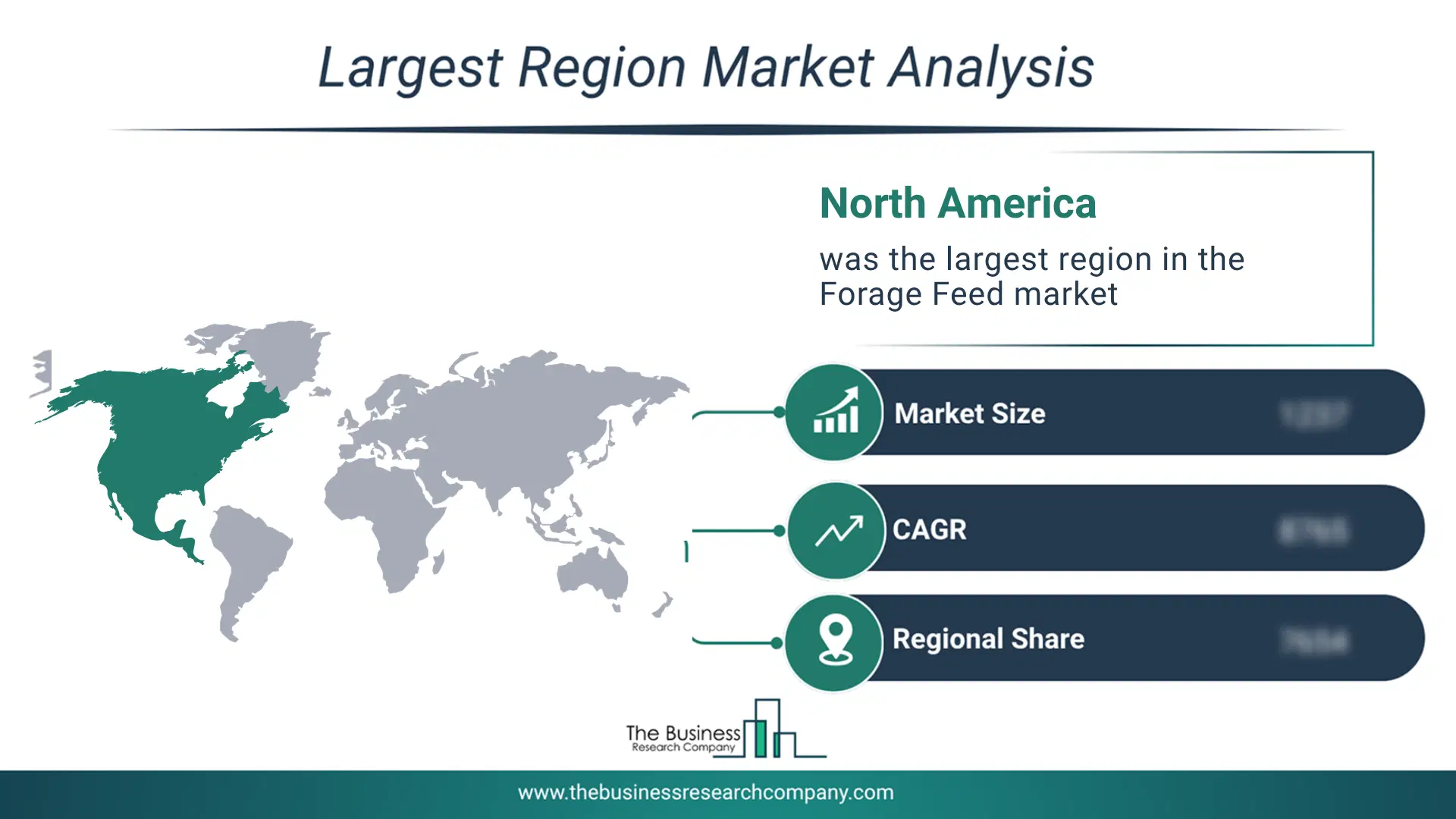
Regional Outlook
North America was the largest region in the forage feed market in 2025. Asia-Pacific is expected to be the fastest-growing region in the forecast period. The regions covered in this market report are Asia-Pacific, South East Asia, Western Europe, Eastern Europe, North America, South America, Middle East and Africa. The countries covered in this market report are Australia, Brazil, China, France, Germany, India, Indonesia, Japan, Taiwan, Russia, South Korea, UK, USA, Italy, Spain, CanadaWhat Defines the Forage Feed Market?
The forage feed market consists of sales of alfalfa, clover, forage blends and mixes, forage seed and additives, legume forage, and grass forage. Values in this market are ‘factory gate’ values, that is, the value of goods sold by the manufacturers or creators of the goods, whether to other entities (including downstream manufacturers, wholesalers, distributors, and retailers) or directly to end customers. The value of goods in this market includes related services sold by the creators of the goods.How is Market Value Defined and Measured?
The market value is defined as the revenues that enterprises gain from the sale of goods and/or services within the specified market and geography through sales, grants, or donations in terms of the currency (in USD unless otherwise specified). The revenues for a specified geography are consumption values that are revenues generated by organizations in the specified geography within the market, irrespective of where they are produced. It does not include revenues from resales along the supply chain, either further along the supply chain or as part of other products.
This chart presents market attractiveness based on a quantitative evaluation of growth, competition, strategic alignment, and risk, offering a clear view of opportunity areas for decision-making. This chart is for illustrative purposes; the full report contains the complete analysis.

This chart highlights the Total Addressable Market (TAM) by estimating the maximum revenue opportunity using an assumption-driven approach, supporting strategic planning and opportunity sizing across markets. The chart is illustrative; the full report provides a more comprehensive analysis.
What Key Data and Analysis Are Included in the Forage Feed Market Report 2026?
The forage feed market research report is one of a series of new reports from The Business Research Company that provides market statistics, including industry global market size, regional shares, competitors with the market share, detailed market segments, market trends and opportunities, and any further data you may need to thrive in the forage feed industry. The market research report delivers a complete perspective of everything you need, with an in-depth analysis of the current and future state of the industry.Forage Feed Market Report Forecast Analysis
| Report Attribute | Details |
|---|---|
| Market Size Value In 2026 | $104.62 billion |
| Revenue Forecast In 2030 | $129.39 billion |
| Growth Rate | CAGR of 5.6% from 2026 to 2030 |
| Base Year For Estimation | 2025 |
| Actual Estimates/Historical Data | 2020-2025 |
| Forecast Period | 2026 - 2030 |
| Market Representation | Revenue in USD Billion and CAGR from 2026 to 2030 |
| Segments Covered | Type, Animal, Form, Distribution Channel |
| Regional Scope | Asia-Pacific, Western Europe, Eastern Europe, North America, South America, Middle East, Africa |
| Country Scope | The countries covered in the report are Australia, Brazil, China, France, Germany, India, Indonesia, Japan, Taiwan, Russia, South Korea, UK, USA, Canada, Italy, Spain. |
| Key Companies Profiled | Cargill Inc., Charoen Pokphand Foods PCL, Evonik Industries AG, Land O'Lakes Inc., Royal DSM N.V., J. R. Simplot Company, Nutreco N.V., Trouw Nutrition, Wilbur Ellis Holdings Inc, ForFarmers N.V., Alltech Inc., Standlee Premium Products LLC, Riverina Australia Pty Ltd, Kemin Industries Inc., ADM Alliance Nutrition, NWF Agriculture, Al Dahra ACX Global Inc., Cornext Agri Pvt. Ltd., The Pure Feed Company, Lucerne Farms. |
| Customization Scope | Request for Customization |
| Pricing And Purchase Options | Explore Purchase Options |