
Force Sensor Market Report 2026
Global Outlook – By Type ( Tension Force Sensors, Compression Force Sensors, Tension And Compression Force Sensors), By Technology ( Strain Gauge, Load Cell, Force Sensitive Resistors, Other Technologies), By Operation ( Analog, Digital), By End-Use Industry ( Healthcare, Industrial Manufacturing, Automotive, Aerospace And Defense, Consumer Electronics, Other End-use Industries) – Market Size, Trends, Strategies, and Forecast to 2030
Force Sensor Market Overview
• Force Sensor market size has reached to $2.52 billion in 2025 • Expected to grow to $3.28 billion in 2030 at a compound annual growth rate (CAGR) of 5.5% • Growth Driver: Rising Industrial Robot Demand Boosts Force Sensor Market • Market Trend: Smart Sensors For Enhanced Digital Transformation • North America was the largest region in 2025 and Asia-Pacific is the fastest growing region.What Is Covered Under Force Sensor Market?
Force sensor is a device that measures applied force by converting it into an electrical signal. Commonly used in robotics, automotive testing, medical devices, and industrial automation, these sensors help monitor and control forces during operations. Their benefits include improved measurement accuracy, enhanced safety through real-time load monitoring, and valuable data for quality control and automation. The main force sensor includes tension force sensors, compression force sensors, and tension and compression force sensors. Tension force sensors refer to devices used to measure the amount of pulling or tension exerted on an object and are used to detect the force acting on the roller generated by the material tension in tensile testing, materials research, rope, and wire tension measurement, suspended hopper weighing, and aerospace process monitoring. The various technologies include strain gauges, load cells, force-sensitive resistors, and others that are operated by analog, and digital. These are applied in various end-use industries such as healthcare, industrial manufacturing, automotive, aerospace and defense, consumer electronics, and others.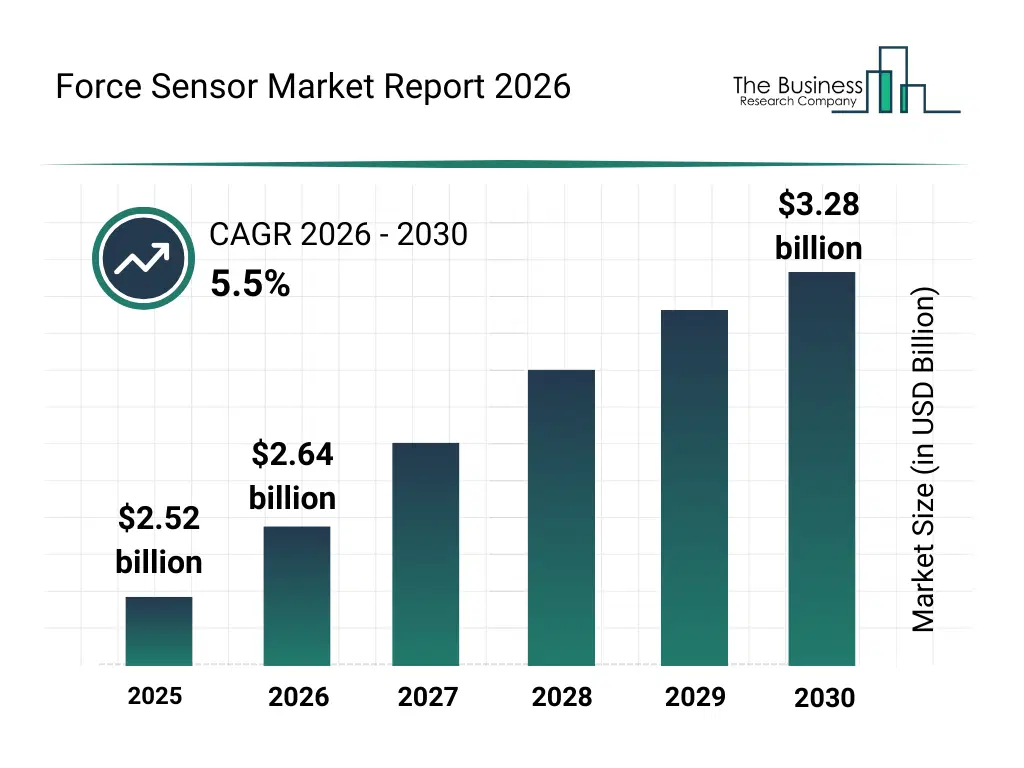
What Is The Force Sensor Market Size 2026 And Growth Rate?
The force sensor market size has grown steadily in recent years. It will grow from $2.52 billion in 2025 to $2.64 billion in 2026 at a compound annual growth rate (CAGR) of 4.7%. The growth in the historic period can be attributed to growth in industrial automation, early use in automotive testing applications, reliance on strain gauge load cells, rising adoption in medical device manufacturing, expansion of robotics in industrial operations.What Is The Force Sensor Market Growth Forecast?
The force sensor market size is expected to see strong growth in the next few years. It will grow to $3.28 billion in 2030 at a compound annual growth rate (CAGR) of 5.5%. The growth in the forecast period can be attributed to increasing demand for high-precision digital sensors, adoption of advanced force measurement in aerospace, expansion of multi-axis force sensing, development of lightweight sensor materials, rising need for real-time force monitoring in electronics manufacturing. Major trends in the forecast period include adoption of advanced robotic force-sensing technologies, integration of AI-enabled force measurement systems, expansion of IoT-connected load monitoring platforms, advancement of smart industrial automation controls, development of digitally enhanced sensor calibration solutions.
Global Force Sensor Market Segmentation
1) By Type: Tension Force Sensors, Compression Force Sensors, Tension And Compression Force Sensors 2) By Technology: Strain Gauge, Load Cell, Force Sensitive Resistors, Other Technologies 3) By Operation: Analog, Digital 4) By End-Use Industry: Healthcare, Industrial Manufacturing, Automotive, Aerospace And Defense, Consumer Electronics, Other End-use Industries Subsegments: 1) By Tension Force Sensors: Load Cells, Strain Gauge Sensors 2) By Compression Force Sensors: Load Cells, Piezoelectric Sensors 3) By Tension And Compression Force Sensors: Multi-Component Load Cells, Dual-Mode SensorsWhat Is The Driver Of The Force Sensor Market?
The increasing demand for industrial robots is expected to propel the growth of the force sensor market going forward. An industrial robot is a mechanical device designed to conduct production-related tasks in industrial settings automatically. Force sensors improve the design of robotic applications by providing improved control technologies that offer haptic input to a robot, allowing for improved overall performance. This function comprises validating grip pressures, assuring adequate balance, and giving tactile information to an external source. For instance, in September 2023, according to the International Federation of Robotics, a Germany-based professional non-profit organization, industrial robot installations in factories worldwide increased from 553,052 units in 2022 to 590,000 units in 2023, reflecting a growth of approximately 6.7%. Therefore, the adoption of industrial robots is driving the growth of the force sensor industry.Key Players In The Global Force Sensor Market
Major companies operating in the force sensor market are Siemens AG, Honeywell International Inc., ABB Ltd., Texas Instruments Incorporated, TE Connectivity Ltd., MinebeaMitsumi Inc., Alps Electric Co. Ltd, Omron Corporation, FANUC America Corporation, Sensata Technologies Inc, Mettler Toledo Inc., Spectris plc, Synaptics Inc., Baumer Holding AG, Kistler Group, Vishay Precision Group Inc., Flintec Group AB, OMEGA Engineering Inc., Gefran Group, PCB Piezotronics Inc., ATI Industrial Automation Inc., HBM Inc., Dytran Instruments Inc., FUTEK Advanced Sensor Technology Inc., Tekscan Inc., HITEC Sensor Developments Inc., Taiwan Alpha Electronic Co Ltd, Sensel, Interlink Electronics Inc., Strainsert Co
This chart is for illustrative purposes; the full report includes a detailed competitor analysis and comprehensive overview of the top 10 companies in the market.
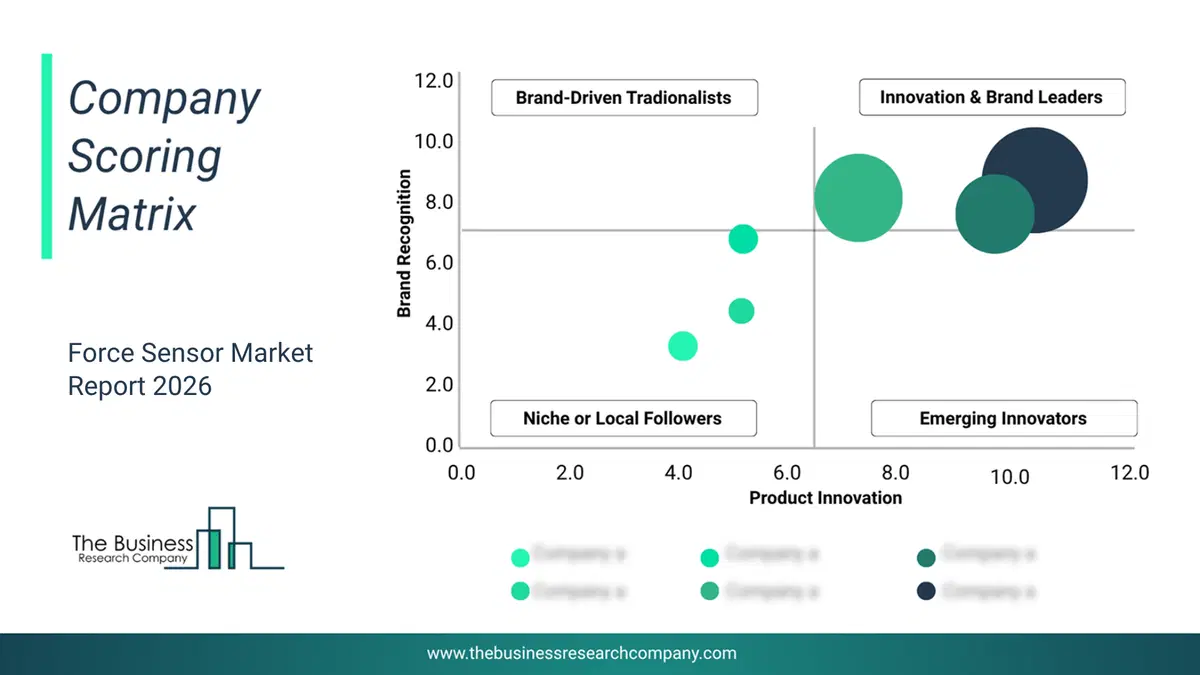
This chart maps companies by product innovation and brand strength, with bubble size indicating relative revenue, helping identify market leaders, challengers, and niche players. This is an illustrative chart; the full report provides a complete and accurate competitive analysis.
Global Force Sensor Market Trends and Insights
Major companies in the force sensor market are focused on developing smart sensors, such as smart mini force sensors, for enhanced digital transformation and to maximize their profits in the market. Smart mini force sensors are compact, digitally-enabled devices designed for precise measurement of forces in fast processes. For instance, in July 2023, HBK, a UK-based company that develops technology for measuring and managing sound, launched the U9C and C9C smart mini force sensors equipped with IO-Link, designed for rapid processes in assembly and automotive manufacturing. These compact and robust sensors offer a standardized interface to PLCs with IO-Link, facilitating digitization at the user's preferred pace. With digital signal processing, the sensors provide benefits such as detecting technical limit breaches, enabling predictive maintenance, and resisting EMC interferences. The sensors maintain compatibility with existing setups, ensuring ease of integration and cost savings.What Are Latest Mergers And Acquisitions In The Force Sensor Market?
In December 2023, Qorvo Inc., a US-based supplier of semiconductor solutions for connectivity and power applications, partnered with Luxshare. With this partnership, Qorvo aims to enhance operational efficiency and reduce capital intensity by transferring its assembly and test facilities to Luxshare Precision Industry, a trusted advanced contract manufacturer. Luxshare Precision Industry Co. Ltd.is a China-based manufacturing company that focuses on providing advanced sensors and services.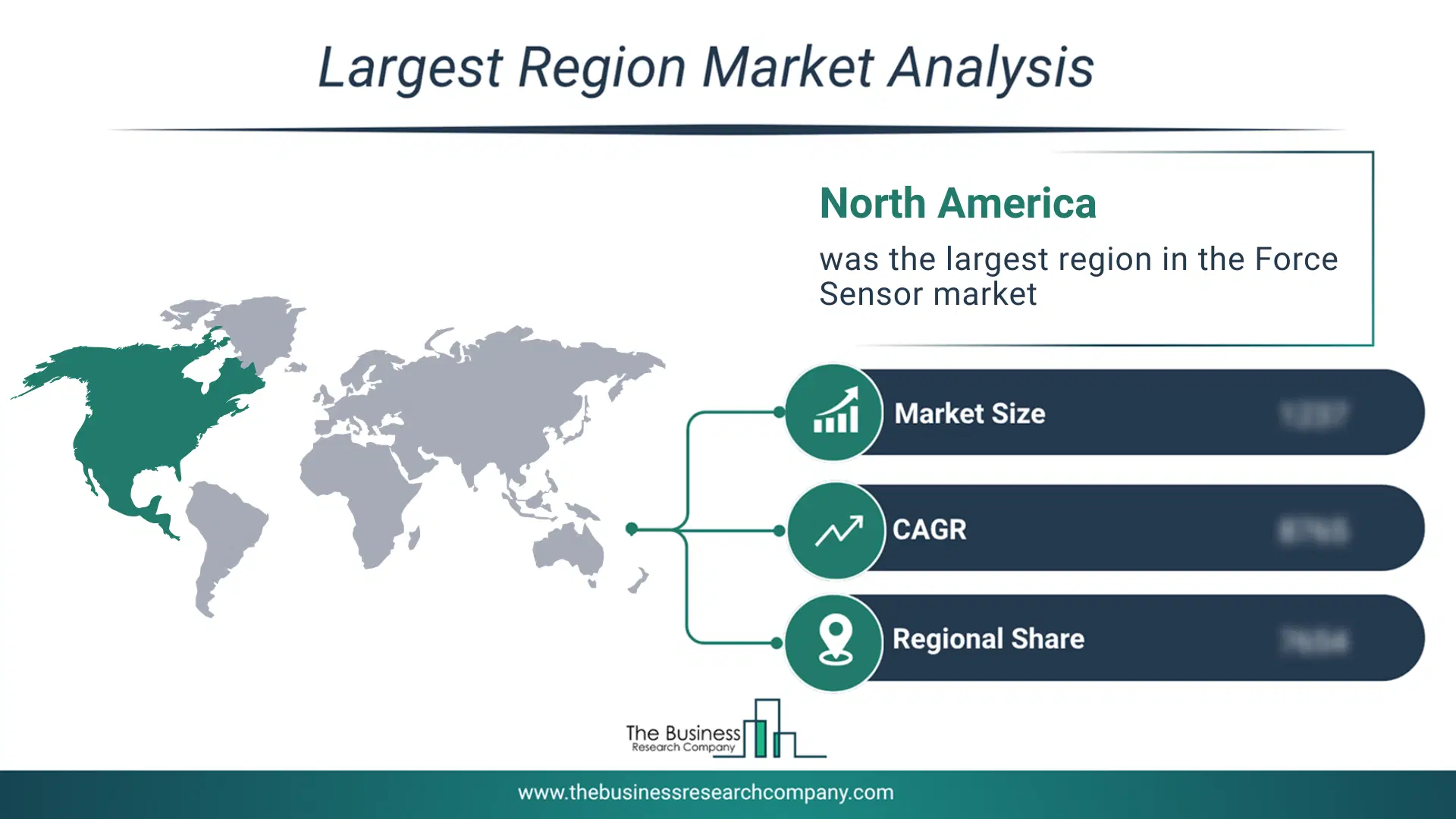
Regional Outlook
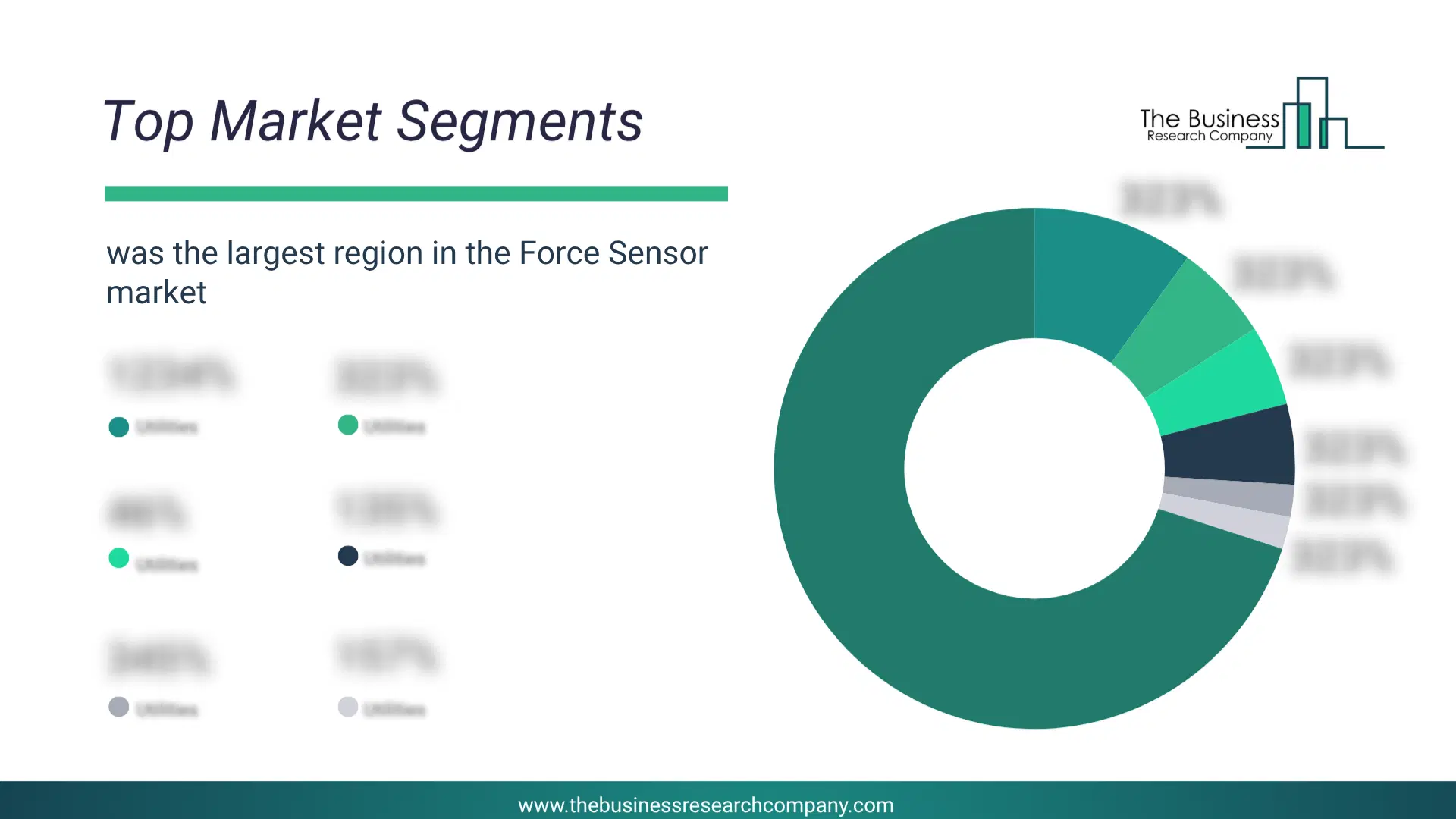
North America was the largest region in the force sensor market in 2025. Asia-Pacific is expected to be the fastest-growing region in the forecast period. The regions covered in this market report are Asia-Pacific, South East Asia, Western Europe, Eastern Europe, North America, South America, Middle East, Africa. The countries covered in this market report are Australia, Brazil, China, France, Germany, India, Indonesia, Japan, Taiwan, Russia, South Korea, UK, USA, Canada, Italy, Spain.What Defines the Force Sensor Market?
The force sensor market consists of revenues earned by entities by providing force calibrations, design and manufacture of custom loading fixtures & adapters, sensor troubleshooting & repair, calibration of signal conditioning equipment, complimentary sensor evaluations, and custom solutions force sensors. The market value includes the value of related goods sold by the service provider or included within the service offering. The force sensor market also includes sales of optical force sensors, ultrasonic force sensors, pneumatic load cells, hydraulic load cells, piezoelectric crystal load cells, inductive load cells, capacitive load cells, and magneto strictive load cells. Values in this market are ‘factory gate’ values, that is the value of goods sold by the manufacturers or creators of the goods, whether to other entities (including downstream manufacturers, wholesalers, distributors, and retailers) or directly to end customers. The value of goods in this market includes related services sold by the creators of the goods.How is Market Value Defined and Measured?
The market value is defined as the revenues that enterprises gain from the sale of goods and/or services within the specified market and geography through sales, grants, or donations in terms of the currency (in USD unless otherwise specified). The revenues for a specified geography are consumption values that are revenues generated by organizations in the specified geography within the market, irrespective of where they are produced. It does not include revenues from resales along the supply chain, either further along the supply chain or as part of other products.
This chart presents market attractiveness based on a quantitative evaluation of growth, competition, strategic alignment, and risk, offering a clear view of opportunity areas for decision-making. This chart is for illustrative purposes; the full report contains the complete analysis.

This chart highlights the Total Addressable Market (TAM) by estimating the maximum revenue opportunity using an assumption-driven approach, supporting strategic planning and opportunity sizing across markets. The chart is illustrative; the full report provides a more comprehensive analysis.
What Key Data and Analysis Are Included in the Force Sensor Market Report 2026?
The force sensor market research report is one of a series of new reports from The Business Research Company that provides market statistics, including industry global market size, regional shares, competitors with the market share, detailed market segments, market trends and opportunities, and any further data you may need to thrive in the force sensor industry. The market research report delivers a complete perspective of everything you need, with an in-depth analysis of the current and future state of the industry.Force Sensor Market Report Forecast Analysis
| Report Attribute | Details |
|---|---|
| Market Size Value In 2026 | $2.64 billion |
| Revenue Forecast In 2030 | $3.28 billion |
| Growth Rate | CAGR of 5.5% from 2026 to 2030 |
| Base Year For Estimation | 2025 |
| Actual Estimates/Historical Data | 2020-2025 |
| Forecast Period | 2026 - 2030 |
| Market Representation | Revenue in USD Billion and CAGR from 2026 to 2030 |
| Segments Covered | Type, Technology, Operation, End-Use Industry |
| Regional Scope | Asia-Pacific, Western Europe, Eastern Europe, North America, South America, Middle East, Africa |
| Country Scope | The countries covered in the report are Australia, Brazil, China, France, Germany, India, Indonesia, Japan, Taiwan, Russia, South Korea, UK, USA, Canada, Italy, Spain. |
| Key Companies Profiled | Siemens AG, Honeywell International Inc., ABB Ltd., Texas Instruments Incorporated, TE Connectivity Ltd., MinebeaMitsumi Inc., Alps Electric Co. Ltd, Omron Corporation, FANUC America Corporation, Sensata Technologies Inc, Mettler Toledo Inc., Spectris plc, Synaptics Inc., Baumer Holding AG, Kistler Group, Vishay Precision Group Inc., Flintec Group AB, OMEGA Engineering Inc., Gefran Group, PCB Piezotronics Inc., ATI Industrial Automation Inc., HBM Inc., Dytran Instruments Inc., FUTEK Advanced Sensor Technology Inc., Tekscan Inc., HITEC Sensor Developments Inc., Taiwan Alpha Electronic Co Ltd, Sensel, Interlink Electronics Inc., Strainsert Co |
| Customization Scope | Request for Customization |
| Pricing And Purchase Options | Explore Purchase Options |