
Forestry Machinery Market Report 2026
Global Outlook – By Type (Feller Bunchers, Harvester, Skidders, Loaders, Forwarders, Yarders, Other Types ), By Operation (Diesel, Electrical Hybrid), By Sales (Used Units, New Units) – Market Size, Trends, Strategies, and Forecast to 2035
Forestry Machinery Market Overview
• Forestry Machinery market size has reached to $9.95 billion in 2025 • Expected to grow to $13.09 billion in 2030 at a compound annual growth rate (CAGR) of 5.8% • Growth Driver: Rising Demand For Wood And Wood Products Fuels Growth In The Forestry Machinery Market • Market Trend: Driving Efficiency And Stability Through Technological Advancements • Europe was the largest region in 2025 and Asia-Pacific is the fastest growing region.Market Gains By 2030 – Top Opportunities By Segment
Market Gain identifies the most promising market opportunities by highlighting the segments or products expected to generate the highest incremental revenue growth over the next five years.
What Is Covered Under Forestry Machinery Market?
Forestry machinery refers to a wide range of equipment and vehicles used in the forestry industry to carry out various tasks, such as harvesting, processing, and transporting timber for logging or various other forestry services. They are used for both logging and land clearing in an agricultural setting. The main types of forestry machinery are feller bunchers, harvesters, skidders, loaders, forwarders, grapples, felling heads, harvesting heads, yarders, and others. A Feller Buncher refers to a type of heavy equipment that is essentially a large, self-propelled machine with a cutting head mounted on an articulated arm, similar to that of an excavator. It performs operations by using diesel and electrical hybrids, and it sells used units and new units.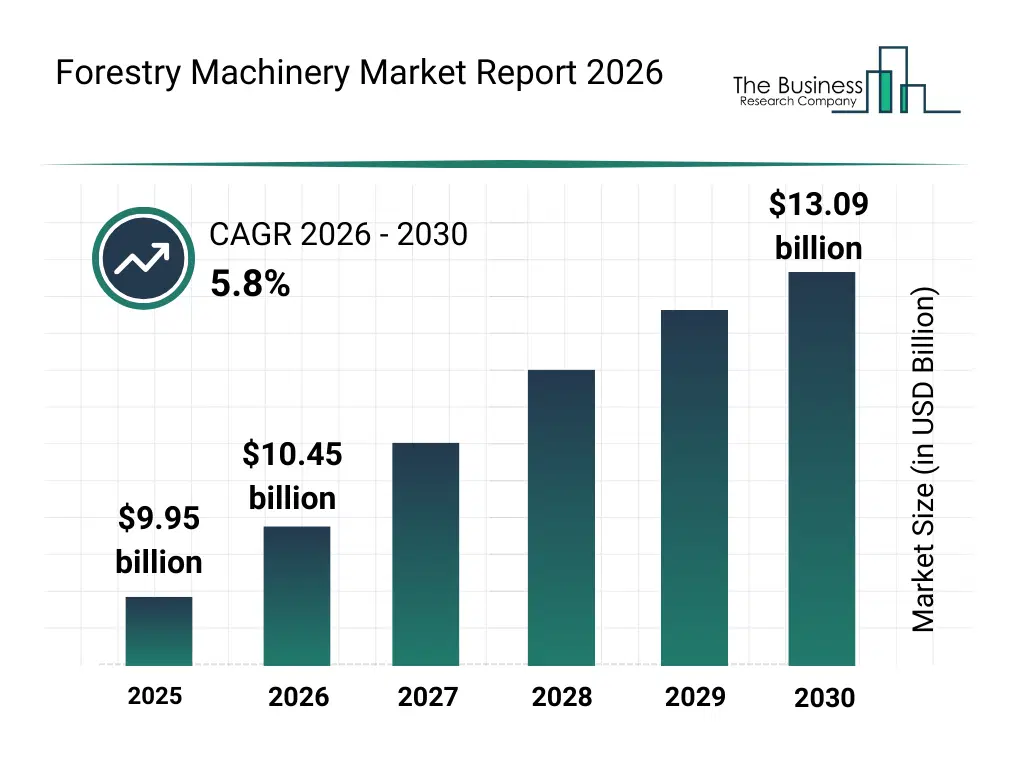
What Is The Forestry Machinery Market Size and Share 2026?
The forestry machinery market size has grown strongly in recent years. It will grow from $9.95 billion in 2025 to $10.45 billion in 2026 at a compound annual growth rate (CAGR) of 5.0%. The growth in the historic period can be attributed to expansion of commercial logging activities, growth of timber demand, increasing mechanization in forestry operations, availability of high-power forestry machinery, development of logging infrastructure.What Is The Forestry Machinery Market Growth Forecast?
The forestry machinery market size is expected to see strong growth in the next few years. It will grow to $13.09 billion in 2030 at a compound annual growth rate (CAGR) of 5.8%. The growth in the forecast period can be attributed to increasing adoption of electric and hybrid forestry machines, rising demand for precision harvesting solutions, expansion of sustainable forestry practices, growing integration of telematics in forestry equipment, increasing investment in low-emission machinery. Major trends in the forecast period include mechanized logging operations, adoption of hybrid forestry equipment, precision timber harvesting systems, high-capacity forwarding machinery, enhanced operator safety features.
Global Forestry Machinery Market Segmentation
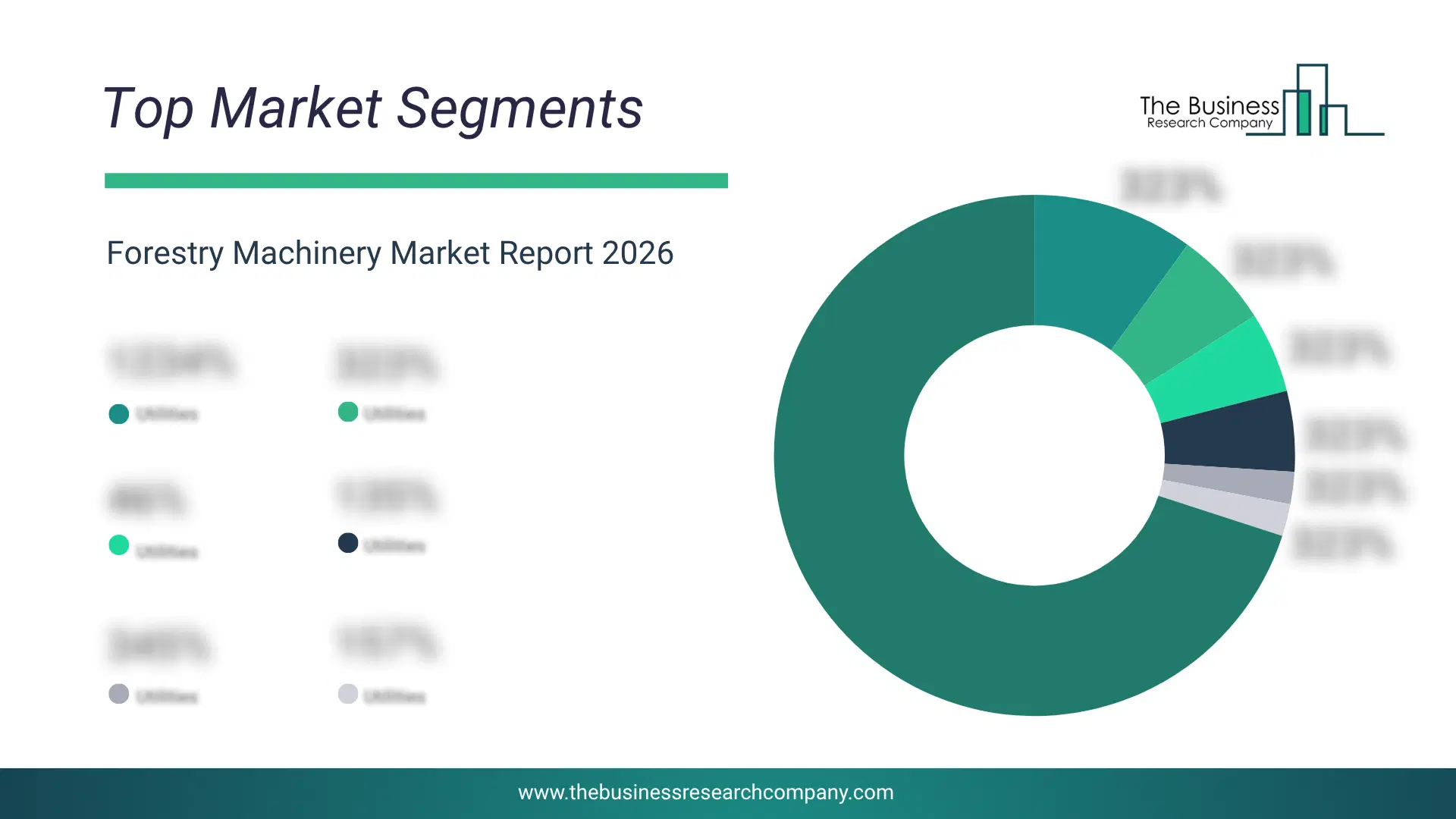
1) By Type: Feller Bunchers, Harvester, Skidders, Loaders, Forwarders, Yarders, Other Types 2) By Operation: Diesel, Electrical Hybrid 3) By Sales: Used Units, New Units Subsegments: 1) By Feller Bunchers: Tracked Feller Bunchers, Wheeled Feller Bunchers 2) By Harvester: Wheel Harvesters, Tracked Harvesters 3) By Skidders: Cable Skidders, Grapple Skidders 4) By Loaders: Tracked Loaders, Wheeled Loaders 5) By Forwarders: Tracked Forwarders, Wheeled Forwarders 6) By Yarders: Swing Yarders, Tower Yarders, Mobile Yarders, Cable Yarders 7) By Other Types: Grapples, Felling Heads, Harvesting Heads, Mulchers, Chippers, Stump Grinders The top segments in the forestry machinery market will be: • Diesel will reach $8102.7 Million by 2025. • Manual/Semi-Automatic will reach $6389.2 Million by 2025. • Fully Automatic will reach $3522.4 Million by 2025. • Feller Bunchers will reach $2734 Million by 2025. • Harvester will reach $2189.9 Million by 2025.What Is The Driver Of The Forestry Machinery Market?
Growing demand for wood and wood products is driving the forestry machinery market forward. Wood products refer to items or materials that are made from or derived from wood. The main function of forestry machinery is the clear-cut production of wood. The wood used for making wood products is harvested from forests using forestry machinery such as loggers and harvesters which makes large forestry tasks much easier. For instance, in September 2025, according to the UK Forestry Commission, a UK-based government agency, in 2023 about 3.9cbillioncm³ of wood was removed globally, with roughly 50% used as woodfuel and the rest as industrial roundwood, producing 445cmillioncm³ of sawnwood, 381cmillioncm³ of wood panels, and 401cmillionctonnes of paper or paperboard. Therefore, the growing demand for wood and wood products is driving the growth of the forestry machinery industry.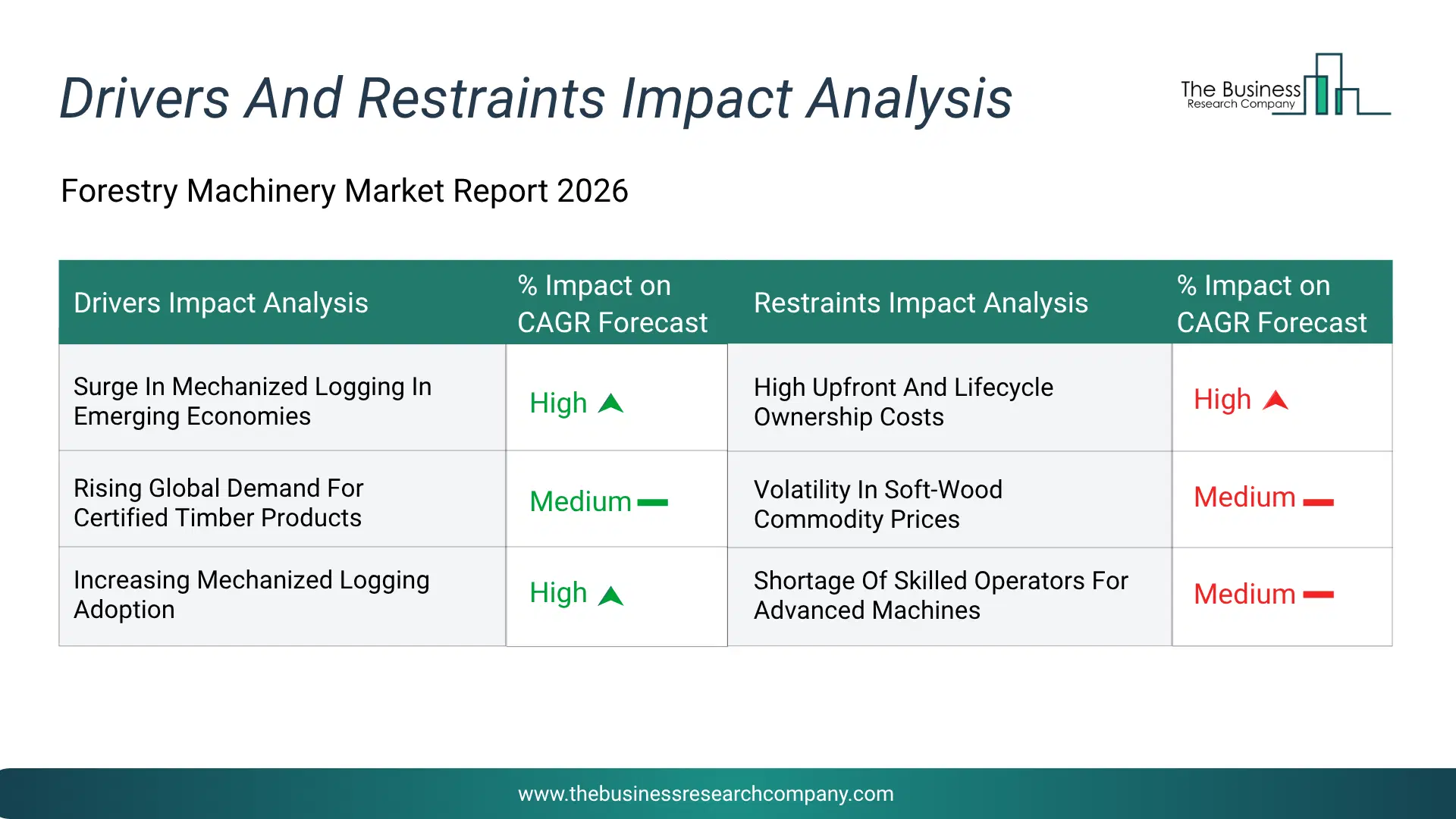
Infographic Chart Showing Key Market Drivers Analysis And Restraints For Forestry Machinery Market
The chart presents an impact analysis of key drivers and restraints, quantifying their relative influence on the market's growth rate and helping assess the balance between growth enablers and limiting factors. This chart offers a high-level perspective; the full report contains more detailed insights.
How Will The Drivers Impact Growth In The Global Forestry Machinery Market?
• Rising Global Demand For Sustainable Building Materials (High) – The rising global demand for sustainable building materials will become a key driver of growth in the forestry machinery market by 2030. Increasing adoption of eco-friendly construction materials such as timber, engineered wood and cross-laminated timber is driving higher demand for efficient timber harvesting and processing operations. Governments and construction companies are prioritizing sustainable infrastructure development to reduce carbon emissions and support green building initiatives. This trend is encouraging forestry operators to invest in advanced machinery, including harvesters, skidders and forwarders, to improve productivity and meet growing wood supply requirements. Additionally, technological advancements in forestry equipment are enhancing operational efficiency, safety and sustainability, further supporting the expansion of the forestry machinery market globally. As a result, the rising global demand for sustainable building materials is anticipated to contributing to a 2.0% annual growth in the market. • Expansion Of Bioenergy And Biomass Power Generation (Medium) – The expansion of bioenergy and biomass power generation will emerge as a major factor driving the expansion of the forestry machinery market by 2030. Rising global demand for renewable energy sources and increasing efforts to reduce greenhouse gas emissions are encouraging the use of biomass as an alternative to fossil fuels. Biomass power plants require large volumes of wood residues, forest waste and other biomass feedstocks, increasing the need for efficient harvesting, collection and transportation operations. This is driving demand for advanced forestry machinery such as harvesters, chippers, forwarders and mulchers that improve operational efficiency and productivity. Furthermore, supportive government policies and investments in clean energy infrastructure are expected to further accelerate market growth globally. Consequently, the expansion of bioenergy and biomass power generation is projected to contributing to a 1.5% annual growth in the market. • Expansion Of Wood Pellet And Biomass Fuel Production (Medium) – The growth of wood pellet and biomass fuel production will serve as a key growth catalyst for the forestry machinery market by 2030. Increasing global emphasis on renewable energy and carbon reduction initiatives is driving demand for biomass-based fuels as sustainable alternatives to fossil fuels. Wood pellets and biomass products require a steady supply of raw materials, including timber residues, wood chips and forest waste, which increases the need for efficient forestry operations. As a result, forestry companies are investing in advanced machinery such as harvesters, chippers, forwarders and mulchers to improve productivity and reduce operational costs. Additionally, supportive government policies promoting clean energy adoption are further accelerating demand for forestry equipment worldwide. Therefore, this growth of wood pellet and biomass fuel production is projected to supporting to a 1.0% annual growth in the market. • Expansion Of Reforestation And Afforestation Projects (Low) – The increase in reforestation and afforestation projects will become a significant driver contributing to the growth of the forestry machinery market by 2030. Governments, environmental organizations and private companies are increasingly investing in large-scale tree plantation initiatives to restore degraded land, reduce carbon emissions and support biodiversity conservation. These projects require advanced forestry equipment such as harvesters, forwarders, mulchers and planting machines to improve operational efficiency and reduce labor costs. In addition, rising global awareness regarding climate change and sustainable forest management is accelerating demand for modern machinery capable of handling large-scale forestry operations. As reforestation activities continue to increase worldwide, the adoption of forestry machinery is anticipated to grow steadily. Consequently, the increase in reforestation and afforestation projects is projected to contributing to a 0.5% annual growth in the market.How Will The Restraints Impact Growth In The Global Forestry Machinery Market?
• Shortage Of Skilled Operators (High) – Shortage of skilled operators is expected to restrain market growth during the forecast period. It creates operational, financial, regulatory, or commercial challenges that can increase costs, delay projects, reduce investments, or discourage purchasing decisions depending on the market. These challenges can reduce product adoption, affect business confidence, and limit the ability of companies to expand efficiently across key regions. This can disrupt long-term growth strategies and reduce the ability of companies to capitalize on emerging market opportunities. • Seasonal And Weather-Related Operational Challenges (Medium) – During the forecast period, seasonal and weather-related operational challenges is likely to limit market expansion. It creates operational, financial, regulatory, or commercial challenges that can increase costs, delay projects, reduce investments, or discourage purchasing decisions depending on the market. These challenges can reduce product adoption, affect business confidence, and limit the ability of companies to expand efficiently across key regions. As a result, organizations may postpone purchasing decisions, limiting demand across both established and emerging markets. • Trade War And Tariffs (Medium) – The market is expected to face challenges due to trade war and tariffs over the forecast period. It creates operational, financial, regulatory, or commercial challenges that can increase costs, delay projects, reduce investments, or discourage purchasing decisions depending on the market. These challenges can reduce product adoption, affect business confidence, and limit the ability of companies to expand efficiently across key regions. This may reduce production efficiency, extend project timelines, and create challenges in meeting evolving customer requirements.Key Players In The Global Forestry Machinery Market
Major companies operating in the forestry machinery market are John Deere, Komatsu Ltd., Caterpillar Inc., Tigercat International Inc., Ponsse Plc, Rottne Industri AB, Eco Log Sweden AB, Logset Oy, Vimek AB, Barko Hydraulics LLC, Bell Equipment Company SA (Pty) Ltd., Sennebogen LLC, Link-Belt Excavators, Morbark LLC, Terex Deutschland GmbH, Tanguay Machinery, Kesla Oyj, Sampo Rosenlew Ltd., HSM Maschinenbau GmbH, Albach Maschinenbau GmbH, Peterson Pacific Corp., Bandit Industries Inc.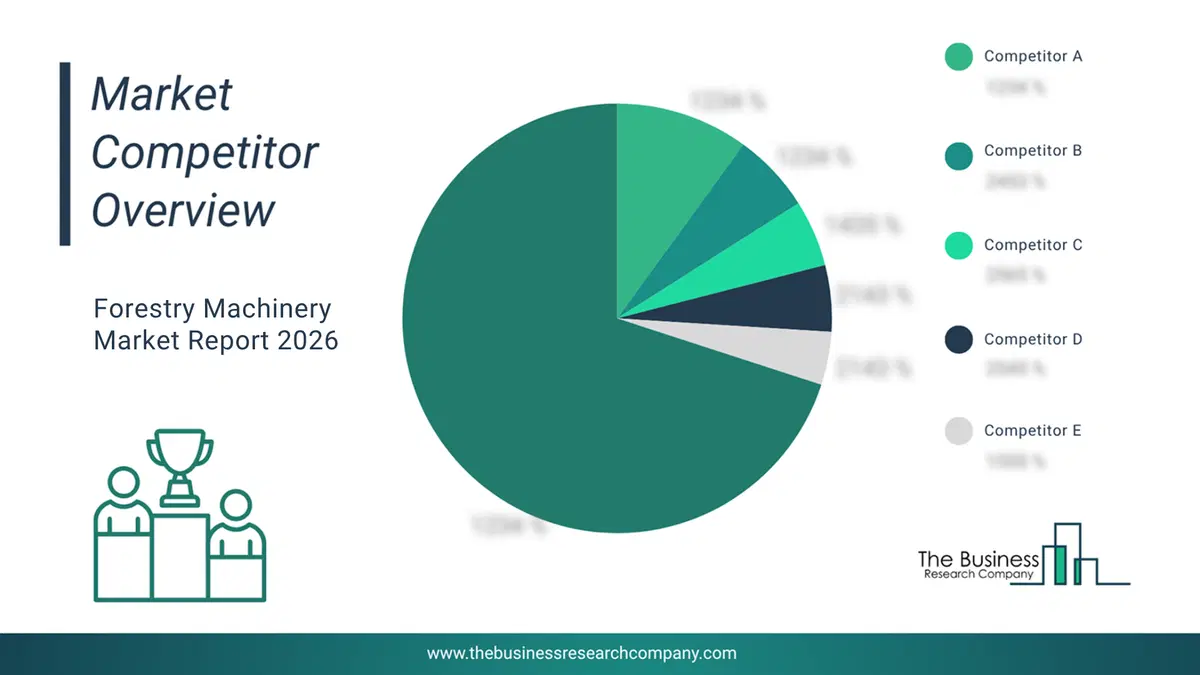
This chart is for illustrative purposes; the full report includes a detailed competitor analysis and comprehensive overview of the top 10 companies in the market.
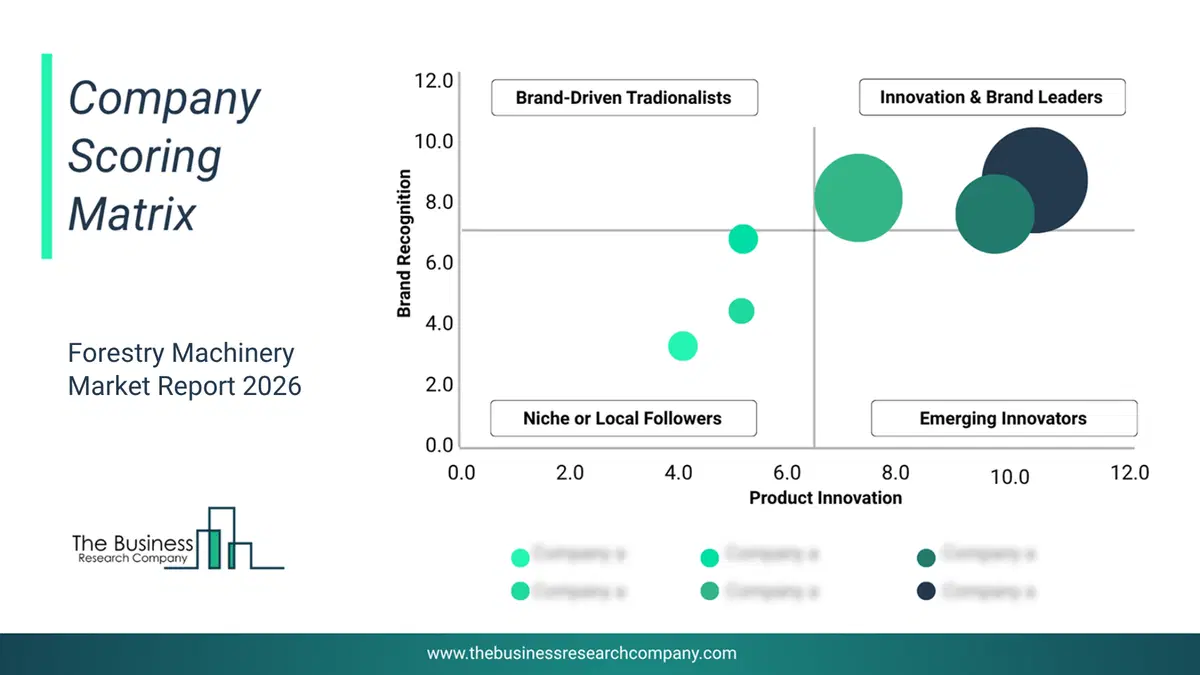
This chart maps companies by product innovation and brand strength, with bubble size indicating relative revenue, helping identify market leaders, challengers, and niche players. This is an illustrative chart; the full report provides a complete and accurate competitive analysis.
Global Forestry Machinery Market Trends and Insights
Major companies operating in the forestry machinery market are focusing on developing innovative solutions such as multi-pump hydraulic systems to enhance efficiency, stability, and precise handling on uneven terrain. Multi-pump hydraulic systems involve using multiple hydraulic pumps to provide higher output for boom and drive operations, while active frame lock stabilizes the machine frame during heavy lifting or when operating on slopes, improving safety and performance. For instance, in April 2024, Deere & Company, a US-based company specializing in agricultural, construction, and forestry machinery, launched its H Series harvesters and forwarders. This line, including the 1270H and 1470H harvesters and 2010H and 2510H forwarders, features increased engine power, advanced hydraulics, enhanced stability, and ergonomic cabins. Deere & Company's H Series aims to improve productivity, fuel efficiency, and operator comfort, meeting the evolving demands of modern forestry operations.What Are Latest Mergers And Acquisitions In The Forestry Machinery Market?
In Junec2023, DC Equipment Ltd., a New Zealand–based logging‑equipment manufacturer, acquired Madill, Inc. for an undisclosed amount. With this acquisition, DC Equipment aimed to integrate Madill’s century‑old legacy brand and IP to strengthen its position in global steep‑slope and cable logging markets, while expanding its product portfolio and geographic reach. Madill Inc. is a Canada-based machinery company that specializes in manufacturing forestry and logging equipment.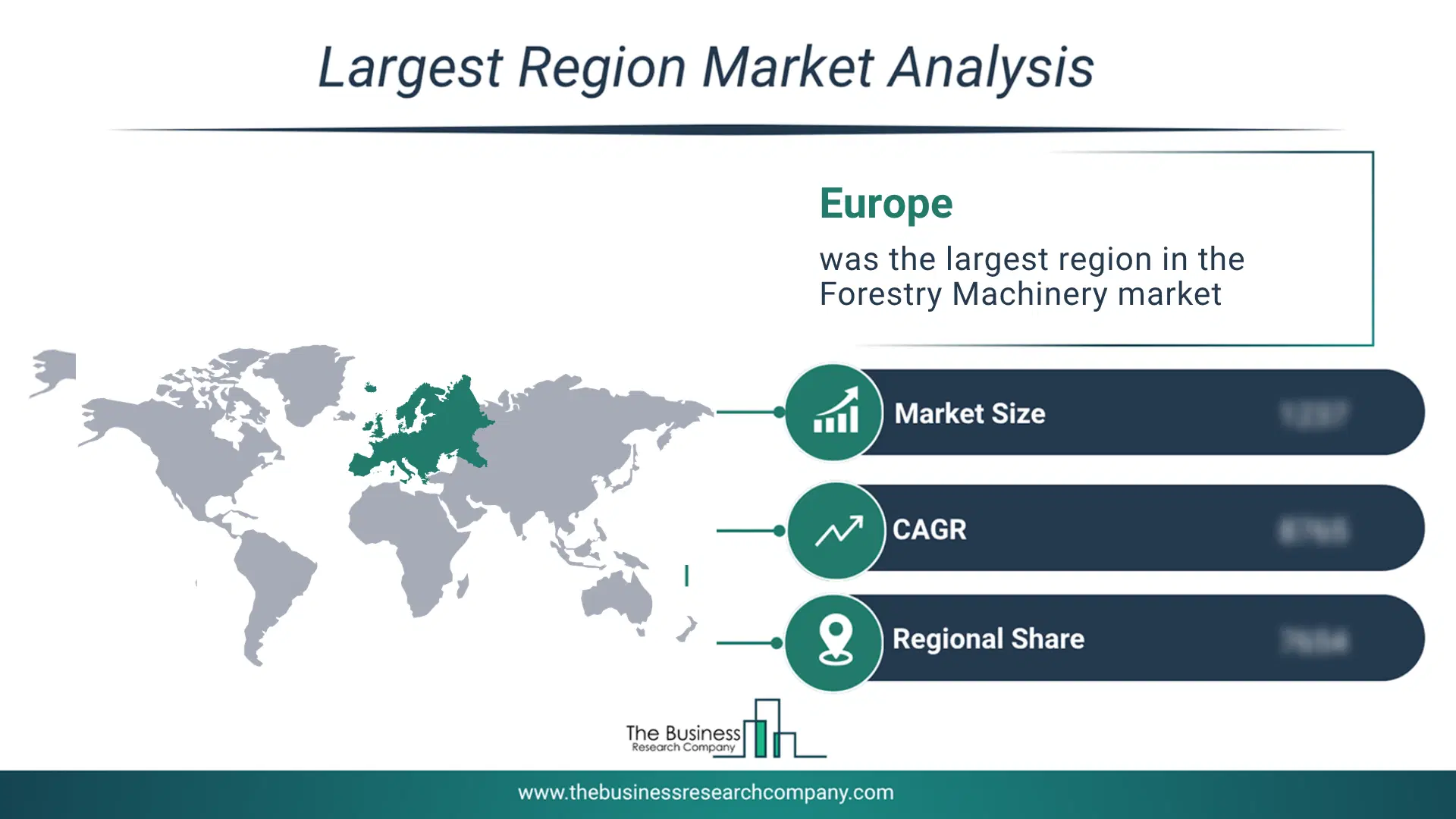
Regional Outlook
Europe was the largest region in the forestry machinery market in 2025.Asia-Pacific is expected to be the fastest-growing region in the global forestry machinery market report during the forecast period. The regions covered in this market report are Asia-Pacific, South East Asia, Western Europe, Eastern Europe, North America, South America, Middle East, Africa The countries covered in this market report are Australia, Brazil, China, France, Germany, India, Indonesia, Japan, Taiwan, Russia, South Korea, UK, USA, Canada, Italy, Spain.What Defines the Forestry Machinery Market?
The forestry machinery market consists of sales of mulchers, delimbers, chippers, and excavators. Values in this market are ‘factory gate’ values, that is, the value of goods sold by the manufacturers or creators of the goods, whether to other entities (including downstream manufacturers, wholesalers, distributors, and retailers) or directly to end customers. The value of goods in this market includes related services sold by the creators of the goods.How is Market Value Defined and Measured?
The market value is defined as the revenues that enterprises gain from the sale of goods and/or services within the specified market and geography through sales, grants, or donations in terms of the currency (in USD unless otherwise specified). The revenues for a specified geography are consumption values that are revenues generated by organizations in the specified geography within the market, irrespective of where they are produced. It does not include revenues from resales along the supply chain, either further along the supply chain or as part of other products.
This chart presents market attractiveness based on a quantitative evaluation of growth, competition, strategic alignment, and risk, offering a clear view of opportunity areas for decision-making. This chart is for illustrative purposes; the full report contains the complete analysis.

This chart highlights the Total Addressable Market (TAM) by estimating the maximum revenue opportunity using an assumption-driven approach, supporting strategic planning and opportunity sizing across markets. The chart is illustrative; the full report provides a more comprehensive analysis.
What Key Data and Analysis Are Included in the Forestry Machinery Market Report 2026?
The forestry machinery market research report is one of a series of new reports from The Business Research Company that provides market statistics, including industry global market size, regional shares, competitors with the market share, detailed market segments, market trends and opportunities, and any further data you may need to thrive in the forestry machinery industry. The market research report delivers a complete perspective of everything you need, with an in-depth analysis of the current and future state of the industry.Forestry Machinery Market Report Forecast Analysis
| Report Attribute | Details |
|---|---|
| Market Size Value In 2026 | $10.45 billion |
| Revenue Forecast In 2035 | $13.09 billion |
| Growth Rate | CAGR of 5.0% from 2026 to 2035 |
| Base Year For Estimation | 2025 |
| Actual Estimates/Historical Data | 2020-2025 |
| Forecast Period | 2026 - 2030 - 2035 |
| Market Representation | Revenue in USD Billion and CAGR from 2026 to 2035 |
| Segments Covered | Type, Operation, Sales |
| Regional Scope | Asia-Pacific, Western Europe, Eastern Europe, North America, South America, Middle East, Africa |
| Country Scope | The countries covered in the report are Australia, Brazil, China, France, Germany, India, ... |
| Key Companies Profiled | John Deere, Komatsu Ltd., Caterpillar Inc., Tigercat International Inc., Ponsse Plc, Rottne Industri AB, Eco Log Sweden AB, Logset Oy, Vimek AB, Barko Hydraulics LLC, Bell Equipment Company SA (Pty) Ltd., Sennebogen LLC, Link-Belt Excavators, Morbark LLC, Terex Deutschland GmbH, Tanguay Machinery, Kesla Oyj, Sampo Rosenlew Ltd., HSM Maschinenbau GmbH, Albach Maschinenbau GmbH, Peterson Pacific Corp., Bandit Industries Inc. |
| Customization Scope | Request for Customization |
| Pricing And Purchase Options | Explore Purchase Options |