

Forestry Software Market 2025
By Product Type (On-Premises Forestry Software, Cloud-Based Forestry Software), By Technology (Cut-To-Length, Geospatial, Fire Detection), By Application (Forest Management, Logging Management, Mapwork Harvester, Inventory And Logistics Management, Other Applications), And By Region, Opportunities And Strategies – Global Forecast To 2035
Forestry Software Market Definition
Forestry software refers to digital solutions developed to facilitate the planning, monitoring, and operational management of forestry resources and timberland. These tools are used by a diverse range of entities, including commercial forestry companies, logging contractors, government forestry departments, conservation organizations, landowners, and research institutions. Forestry software is used throughout the entire lifecycle of forest management, from initial land assessment and forest inventory through to harvesting operations, logistics coordination, and post-harvest regeneration. The forestry software market consists of sales by entities (organizations, sole traders and partnerships) of forestry software solutions that are designed to work in tandem with complementary technologies such as GIS (geographic information system) platforms, satellite imagery, LiDAR (light detection and ranging), drones, and IoT (internet of things)-based environmental sensors. They also complement equipment management and enterprise resource planning (ERP) systems used within large forestry operations. In some cases, forestry software substitutes more generic tools such as spreadsheet models, paper-based mapping systems, or generalized GIS tools that lack forestry-specific functionality.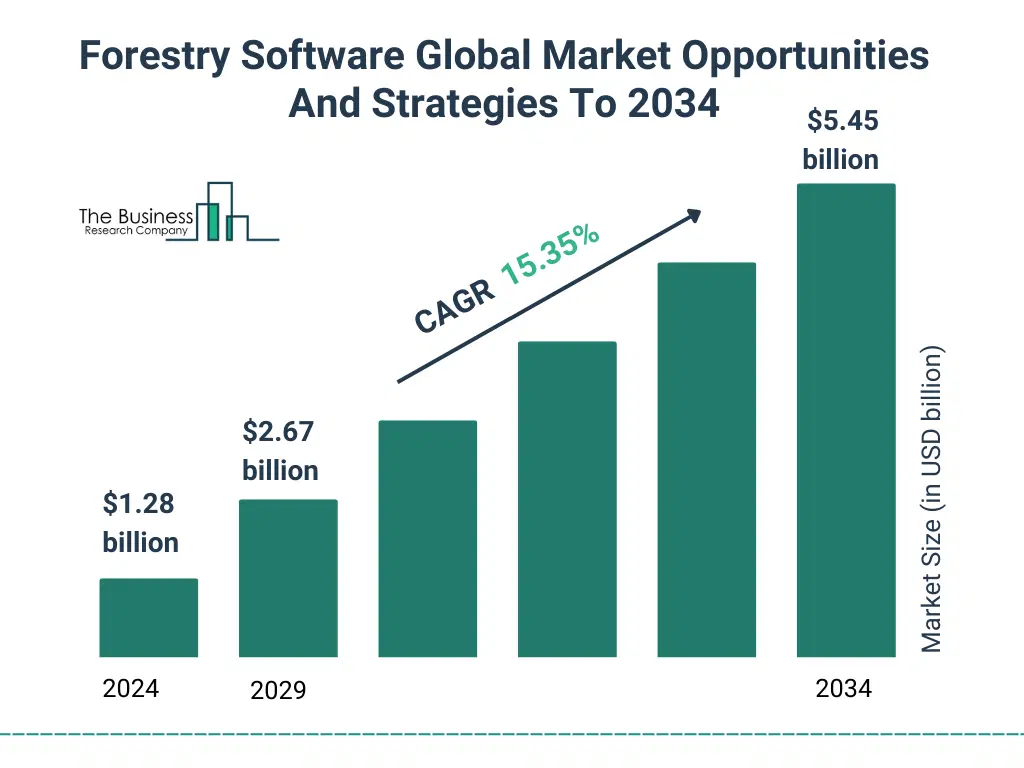
Forestry Software Market Size
The global forestry software market reached a value of nearly $1,277.23 million in 2024, having grown at a compound annual growth rate (CAGR) of 12.66% since 2019. The market is expected to grow from $1,277.23 million in 2024 to $2,666.80 million in 2029 at a rate of 15.86%. The market is then expected to grow at a CAGR of 15.35% from 2029 and reach $5,445.78 million in 2034. Growth in the historic period resulted from rising demand for wood certification and traceability, increasing demand for forest products, rising government initiatives and rising urban forestry and green infrastructure initiatives. Factors that negatively affected growth in the historic period were shortage of trained professionals and limited internet connectivity. Going forward, growing awareness of reforestation, expansion of the paper industry, rising demand for sustainable timber and rising interest in carbon credit will drive growth. Factors that could hinder the growth of the forestry software market in the future include data security concerns, technological obsolescence and impact of trade war and tariff.Forestry Software Market Drivers
The key drivers of the forestry software market include: Rising Demand For Sustainable Timber During the forecast period, the rising demand for sustainable timber drive the expansion of the forestry software market. Forestry software addresses the growing demand for sustainable timber by providing precise tracking of timber origin, growth cycles, and harvesting activities, ensuring adherence to environmental regulations and certification standards. It empowers forest managers to optimize resource utilization, streamline supply chain operations, and maintain transparency, thereby strengthening stakeholder confidence. Furthermore, it enables data-driven decision-making to drive sustainable forestry practices and reduce ecological impact. The rising demand for sustainable timber growth during the forecast period in 2024 is 1.20%.Forestry Software Market Restraints
The key restraints on the forestry software market include: Technological Obsolescence During the forecast period, technological obsolescence will pose a restraint on the growth of the forestry software market. Technological obsolescence affects forestry software by rendering older systems incompatible with modern tools, cloud platforms, or data analytics, limiting their efficiency and functionality. Companies relying on outdated software may face higher maintenance costs, slower processing, and reduced ability to integrate various technologies. This can hinder decision-making, operational efficiency, and competitiveness in the forestry sector. Growth affected by technological obsolescence during the forecast period in 2024 is -2.00%.Forestry Software Market Trends
Major trends shaping the forestry software market include: Pioneering Initiatives In Technology-Driven Forest Conservation Major companies operating in the forestry software market are focusing on adoption of artificial intelligence (AI), such as AI-based forestry solution, to enhance real-time forest monitoring, detect illegal activities, optimize resource management, and improve decision-making for sustainable forest conservation. An AI-based forestry solution refers to the use of artificial intelligence technologies, such as machine learning and satellite imagery analysis, to monitor, manage, and protect forests in real time. For instance, in April 2025, Madhya Pradesh Forest Department, an India-based state government agency, launched an AI-based real-time forest alert system, which employs satellite imagery, machine learning, and mobile field feedback to promptly detect and report incidents like land encroachment, illegal logging, and deforestation in five sensitive forest divisions as a pilot project. This pioneering initiative leverages Google Earth Engine and custom AI models to analyze changes in forest cover, sending immediate alerts with detailed location data to field staff for rapid on-ground action, thereby setting a precedent for proactive and technology-driven forest management in the country. Advancing Technology For Smarter Environmental Stewardship Major companies operating in the forestry software market are adopting strategic investments, such as seed funding, to support the development of advanced digital solutions, enhance forest management efficiency, and drive innovation in sustainable forestry practices. Seed funding refers to the initial capital provided to a startup or early-stage company to help develop its product, conduct market research, and cover early operational expenses. For instance, in August 2024, OCELL GmbH, a Germany-based climate tech startup, has secured $5 million in seed funding to accelerate the development of climate-friendly forest management solutions and to create high-value carbon credits using advanced software and AI-driven data. The funding round was led by impact venture capital AENU and Summiteer, with participation from notable business angels and the BOSCOR Group.Opportunities And Recommendations In The Forestry Software Market
Opportunities – The top opportunities in the forestry software market segmented by product type will arise in the cloud-based forestry software segment, which will gain $1,220.83 million of global annual sales by 2029. The top opportunities in the forestry software market segmented by technology will arise in the geospatial segment, which will gain $787.49 million of global annual sales by 2029. The top opportunities in the forestry software market segmented by application will arise in the mapwork harvester segment, which will gain $500.63 million of global annual sales by 2029. The forestry software market size will gain the most in the USA at $317.43 million. Recommendations- To take advantage of the opportunities, The Business Research Company recommends the forestry software companies to focus on expanding AI-driven forest intelligence platforms, focus on strategic seed funding to accelerate innovation, focus on strategic partnerships to accelerate adoption and scale, focus on scalable cloud-based settlement solutions, focus on cloud-based forestry software expansion, focus on accelerating growth in fire detection solutions, expand in emerging markets, focus on expanding direct and partner-led distribution channels, focus on building clear and flexible pricing structures, build credible market presence and strengthen buyer trust, expand targeted promotion with multi-channel engagement and focus on expanding mapwork harvester software capabilities.
Forestry Software Market Segmentation
The forestry software market is segmented by product type, by technology and by application.By Product Type –
The forestry software market is segmented by type into:
- a) On-Premises Forestry Software
- b) Cloud-Based Forestry Software
By Technology –
The forestry software market is segmented by technology into:
- a) Cut-To-Length
- b) Geospatial
- c) Fire Detection
By Application –
The forestry software market is segmented by application into:
- a) Forest Management
- b) Logging Management
- c) Mapwork Harvester
- d) Inventory And Logistics Management
- e) Other Applications
By Geography - The forestry software market is segmented by geography into:
- • China
- • India
- • Japan
- • Australia
- • Indonesia
- • South Korea
- • USA
- • Canada
- • Brazil
- • France
- • Germany
- • UK
- • Italy
- • Spain
- • Russia
-
o Asia Pacific
o Africa