
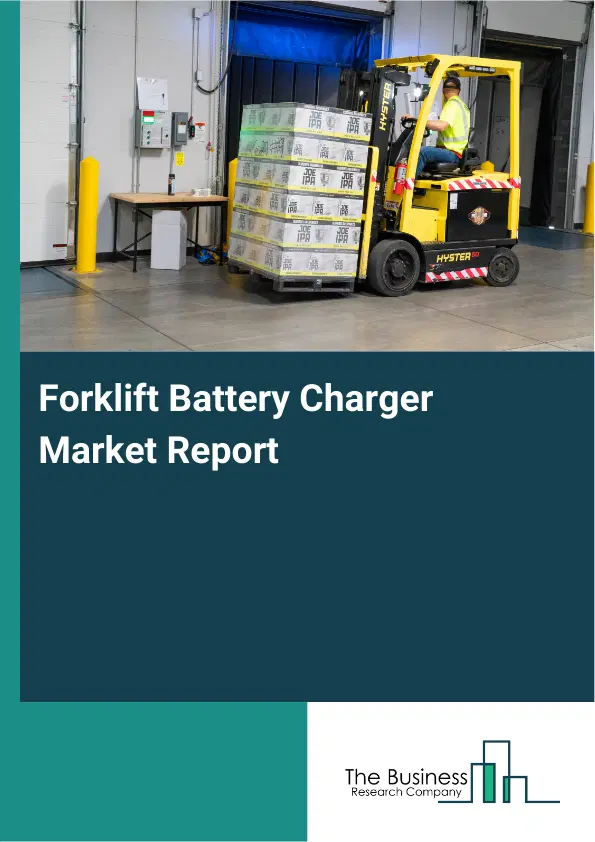
Forklift Battery Charger Market Report 2026
Global Outlook – By Battery Type (Sealed Lead Acid (SLA) Battery, Nickel-Cadmium Battery, Lithium Ion Battery), By Forklift Type (Counterbalance, Rough Terrain, Reach Trucks, Other Forklift Types), By Output Charging Current Rating (50A-150A, 151A-250A, Above 251A, Below 50A), By Installation Type (Onboard Chargers, Offboard Chargers), By End-User Industry (Manufacturing, Warehousing, Logistics, Retail, Other End-User Industries) – Market Size, Trends, Strategies, and Forecast to 2030
Forklift Battery Charger Market Overview
• Forklift Battery Charger market size has reached to $2.02 billion in 2025 • Expected to grow to $3.04 billion in 2030 at a compound annual growth rate (CAGR) of 8.5% • Growth Driver: Rapid Adoption Of Automation Driving Market Growth As Warehousing And Industrial Sectors Seek Efficient, Unattended Charging Solutions • Market Trend: Innovative Charging Solutions Drive Efficiency And Sustainability In Material Handling Equipment • North America was the largest region in 2025 and Asia-Pacific is the fastest growing region.What Is Covered Under Forklift Battery Charger Market?
Forklift battery chargers are specialized industrial devices designed to efficiently recharge electric forklift batteries, ensuring optimal performance and safety. These chargers regulate the charging process to prevent overheating and overcharging, safeguarding battery longevity and reliability. The main battery types in the forklift battery charger are sealed lead-acid (SLA) batteries, nickel-cadmium batteries, lithium-ion batteries, and others. SLA batteries are maintenance-free, eliminating the need for frequent water or electrolyte replenishment. Chargers cater to different forklift types such as counterbalance forklifts, rough terrain forklifts, reach trucks, and others. Output charging current ratings range from below 50A, 50A-150A, 151A-250A, and above 251A and are suitable for lead-acid batteries, lithium polymer batteries, and others. They find uses across diverse industries, including manufacturing, warehousing, logistics, retail, and others.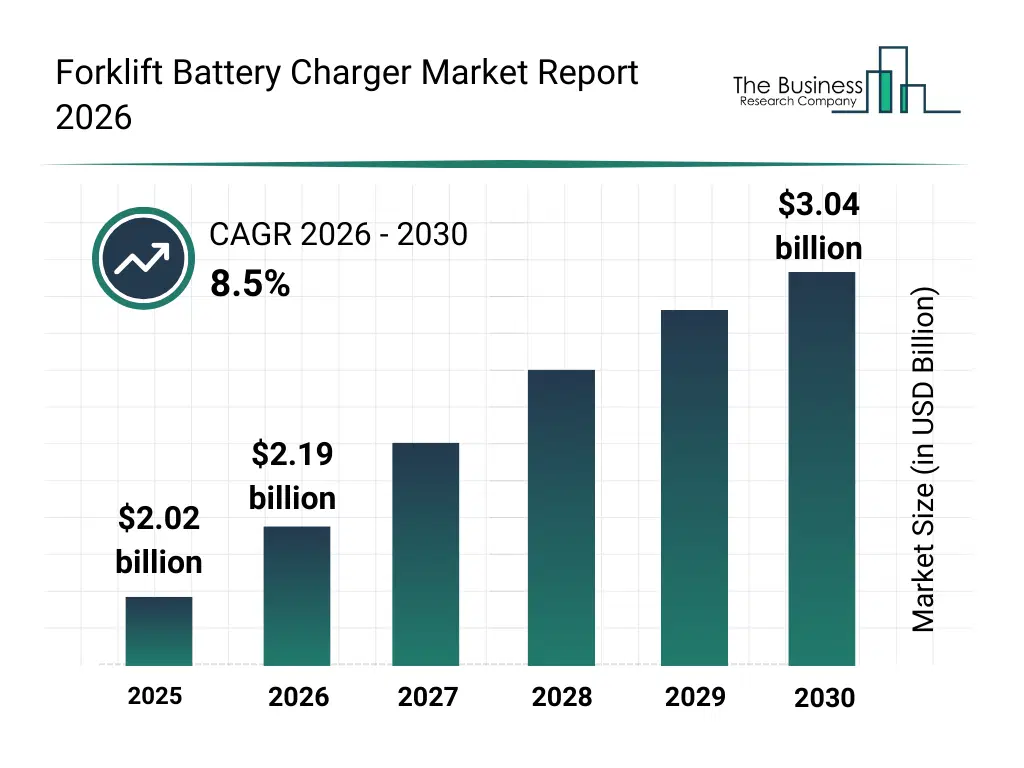
What Is The Forklift Battery Charger Market Size and Share 2026?
The forklift battery charger market size has grown strongly in recent years. It will grow from $2.02 billion in 2025 to $2.19 billion in 2026 at a compound annual growth rate (CAGR) of 8.5%. The growth in the historic period can be attributed to expansion of electric forklift adoption, growth of warehouse electrification, increasing demand for reliable charging systems, availability of lead-acid charging infrastructure, rising material handling automation.What Is The Forklift Battery Charger Market Growth Forecast?
The forklift battery charger market size is expected to see strong growth in the next few years. It will grow to $3.04 billion in 2030 at a compound annual growth rate (CAGR) of 8.5%. The growth in the forecast period can be attributed to increasing penetration of lithium-ion forklifts, rising demand for fast charging solutions, expansion of smart warehouse infrastructure, growing focus on energy management systems, increasing investments in battery safety technologies. Major trends in the forecast period include shift toward lithium-ion charging systems, smart battery charging solutions, fast charging infrastructure deployment, energy efficient charger design, integrated battery management systems.Tariff Impact On Forklift Battery Charger Market
Tariffs are impacting the forklift battery charger market by increasing the cost of imported power electronics, semiconductors, transformers, and charging control units. Manufacturing and logistics operators in North America and Europe are most affected due to dependence on imported chargers, while Asia-Pacific faces higher export-related component costs. These tariffs have raised overall charger prices and slowed replacement of legacy systems. At the same time, they are encouraging local charger manufacturing, regional sourcing of components, and innovation in high-efficiency charging technologies.
Global Forklift Battery Charger Market Segmentation
1) By Battery Type: Sealed Lead Acid (SLA) Battery, Nickel-Cadmium Battery, Lithium Ion Battery 2) By Forklift Type: Counterbalance, Rough Terrain, Reach Trucks, Other Forklift Types 3) By Output Charging Current Rating: 50A-150A, 151A-250A, Above 251A, Below 50A 4) By Installation Type: Onboard Chargers, Offboard Chargers 5) By End-User Industry: Manufacturing, Warehousing, Logistics, Retail, Other End-User Industries Subsegments: 1) By Sealed Lead Acid (SLA) Battery: Absorbent Glass Mat (AGM) Batteries, Gel Cell Batteries 2) By Nickel-Cadmium Battery: Sintered Plate Ni-Cd Batteries, Pocket Plate Ni-Cd Batteries 3) By Lithium-Ion Battery: Lithium Iron Phosphate (LiFePO4) Batteries, Lithium Nickel Manganese Cobalt Oxide (NMC) BatteriesWhat Is The Driver Of The Forklift Battery Charger Market?
The growing adoption of automation is expected to drive the growth of the forklift battery charger market going forward. Automation in material handling use automated systems and robots to optimize the movement, storage, and management of goods in warehouses and industries. The growing preference for automation is driven by the need for increased efficiency, reduced labor costs, enhanced safety, and improved accuracy in warehousing and industrial operations. Forklift battery chargers in automation enable efficient, unattended charging, optimizing fleet uptime and reducing manual intervention in warehouse and industrial operations. For instance, in October 2024, according to the International Federation of Robotics, a Germany-based non-profit organization, the number of industrial robots operating globally in factories reached over 4.2 million units in 2023, marking a 10% increase compared to the previous year. Annual installations of new industrial robots reached 541,302 units in 2023, maintaining a record high for the third consecutive year. This growth reflects continued automation demands. Therefore, the growing adoption of automation is driving the growth of the forklift battery charger industry.Key Players In The Global Forklift Battery Charger Market
Major companies operating in the forklift battery charger market are Shanghai Sange Electric S&T Co.Ltd, Jungheinrich AG, Crown Equipment Corporation, Exide Technologies, Fronius International GmbH, Hawker Powersource, Micropower, Power Designers Sibex, Delta-Q Technologies, ElCon Chargers, PosiCharge, Advanced Charging Technologies (ACT), PBM SRL, Applied Energy Solutions (AES), ATIB Elettronica S.r.l., Microtex, EFFIC, Rhyl Co. Ltd, Guangzhou Evaisun Industrial Co. Ltd., Delta Electronics, Inc.
This chart is for illustrative purposes; the full report includes a detailed competitor analysis and comprehensive overview of the top 10 companies in the market.
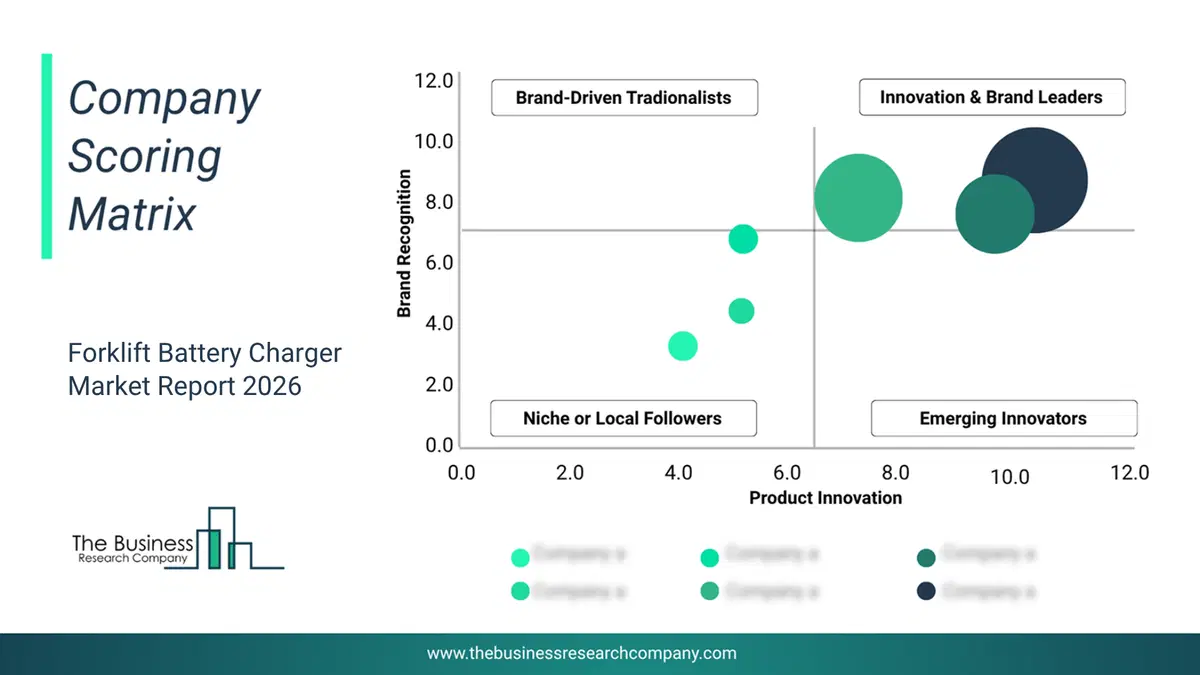
This chart maps companies by product innovation and brand strength, with bubble size indicating relative revenue, helping identify market leaders, challengers, and niche players. This is an illustrative chart; the full report provides a complete and accurate competitive analysis.
Global Forklift Battery Charger Market Trends and Insights
Major companies operating in the forklift battery charger market are focusing on technological advancements such as high-frequency smart charging technology, to boost efficiency, save energy, and add smart features such as remote monitoring and adaptive charging. High-frequency smart charging technology uses high-frequency power and intelligent algorithms for fast, efficient, and adaptive battery charging. For instance, in March 2023, Mitsubishi Logisnext Americas Inc., a US-based machinery manufacturing company, launched triathlon lithium-ion battery and charger solutions for the unicarriers product line. This enhances forklift performance, efficiency, and sustainability through advanced lithium-ion technology. These solutions provide benefits such as rapid charging, longer operational durations, and minimal maintenance requirements, addressing the growing need for eco-friendly and energy-efficient material handling equipment. This innovation aligns with market trends prioritizing sustainable operations and improved productivity in warehouse and industrial settings.What Are Latest Mergers And Acquisitions In The Forklift Battery Charger Market?
In April 2023, EnerSys, a US-based battery manufacturing company, acquired Industrial Battery and Charger Services Limited (IBCS) for an undisclosed amount. This acquisition will bolster its motive power service capabilities and enhance its market presence in the UK industrial battery and charger sector, supporting its growth and customer service expansion. Industrial Battery and Charger Services Limited (IBCS) is a UK-based machinery manufacturing company that specializes in industrial battery and charger solutions.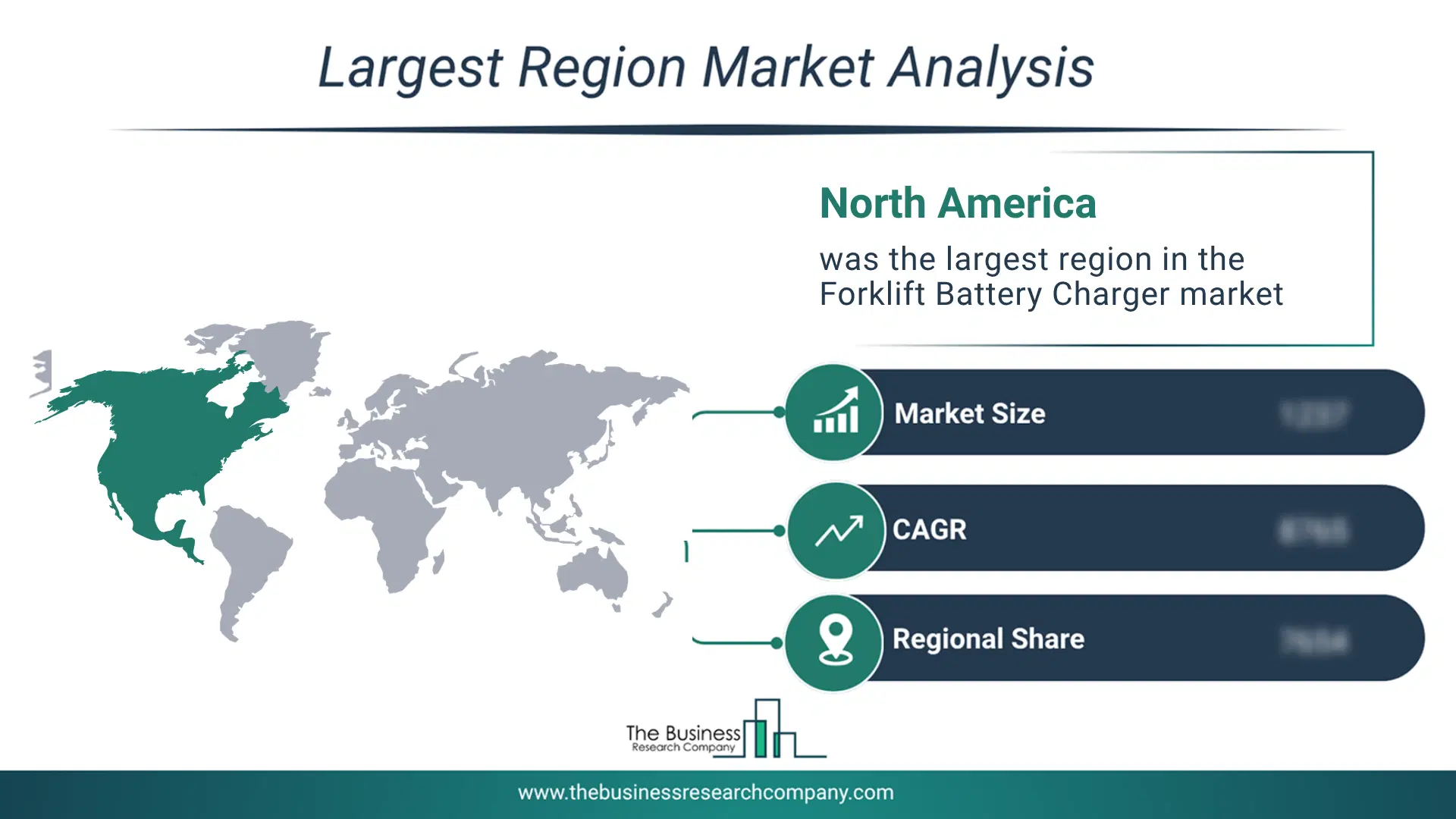
Regional Outlook
North America was the largest region in the forklift battery charger market in 2025. Asia-Pacific is expected to be the fastest-growing region in the forecast period. The regions covered in this market report are Asia-Pacific, South East Asia, Western Europe, Eastern Europe, North America, South America, Middle East, Africa The countries covered in this market report are Australia, Brazil, China, France, Germany, India, Indonesia, Japan, Taiwan, Russia, South Korea, UK, USA, Canada, Italy, Spain.What Defines the Forklift Battery Charger Market?
The forklift battery charger market includes sales of single-phase and three-phase chargers, portable chargers, high-frequency chargers, and battery management systems. Values in this market are ‘factory gate’ values, that is the value of goods sold by the manufacturers or creators of the goods, whether to other entities (including downstream manufacturers, wholesalers, distributors and retailers) or directly to end customers. The value of goods in this market includes related services sold by the creators of the goods.How is Market Value Defined and Measured?
The market value is defined as the revenues that enterprises gain from the sale of goods and/or services within the specified market and geography through sales, grants, or donations in terms of the currency (in USD unless otherwise specified). The revenues for a specified geography are consumption values that are revenues generated by organizations in the specified geography within the market, irrespective of where they are produced. It does not include revenues from resales along the supply chain, either further along the supply chain or as part of other products.
This chart presents market attractiveness based on a quantitative evaluation of growth, competition, strategic alignment, and risk, offering a clear view of opportunity areas for decision-making. This chart is for illustrative purposes; the full report contains the complete analysis.

This chart highlights the Total Addressable Market (TAM) by estimating the maximum revenue opportunity using an assumption-driven approach, supporting strategic planning and opportunity sizing across markets. The chart is illustrative; the full report provides a more comprehensive analysis.
What Key Data and Analysis Are Included in the Forklift Battery Charger Market Report 2026?
The forklift battery charger market research report is one of a series of new reports from The Business Research Company that provides market statistics, including industry global market size, regional shares, competitors with the market share, detailed market segments, market trends and opportunities, and any further data you may need to thrive in the forklift battery charger industry. The market research report delivers a complete perspective of everything you need, with an in-depth analysis of the current and future state of the industry.Forklift Battery Charger Market Report Forecast Analysis
| Report Attribute | Details |
|---|---|
| Market Size Value In 2026 | $2.19 billion |
| Revenue Forecast In 2030 | $3.04 billion |
| Growth Rate | CAGR of 8.5% from 2026 to 2030 |
| Base Year For Estimation | 2025 |
| Actual Estimates/Historical Data | 2020-2025 |
| Forecast Period | 2026 - 2030 |
| Market Representation | Revenue in USD Billion and CAGR from 2026 to 2030 |
| Segments Covered | Battery Type, Forklift Type, Output Charging Current Rating, Installation Type, End-User Industry |
| Regional Scope | Asia-Pacific, Western Europe, Eastern Europe, North America, South America, Middle East, Africa |
| Key Companies Profiled | Shanghai Sange Electric S&T Co.Ltd, Jungheinrich AG, Crown Equipment Corporation, Exide Technologies, Fronius International GmbH, Hawker Powersource, Micropower, Power Designers Sibex, Delta-Q Technologies, ElCon Chargers, PosiCharge, Advanced Charging Technologies (ACT), PBM SRL, Applied Energy Solutions (AES), ATIB Elettronica S.r.l., Microtex, EFFIC, Rhyl Co. Ltd, Guangzhou Evaisun Industrial Co. Ltd., Delta Electronics, Inc. |
| Customization Scope | Request for Customization |
| Pricing And Purchase Options | Explore Purchase Options |