
Free Space Optics (FSO) Market Report 2026
Global Outlook – By Component (Transmitters, Receivers, Modulators, Demodulators), By Platform (Terrestrial Platform, Satellite Platform, Airborne Platform), By Modulation (Amplitude, Phase, Polarization), By Application (Storage Area Network, Data Transmission, Mobile Backhaul, Enterprise Connectivity, Disaster Recovery, Defense, Satellite, Other Applications), By End-User (Corporate, Commercial) – Market Size, Trends, Strategies, and Forecast to 2035
Free Space Optics (FSO) Market Overview
• Free Space Optics (FSO) market size has reached to $1.6 billion in 2025 • Expected to grow to $5.01 billion in 2030 at a compound annual growth rate (CAGR) of 25.7% • Growth Driver: 5G Networks Fueling Free Space Optics (FSO) Market Growth • Market Trend: Companies Focusing On Enhanced Bandwidth Solutions • North America was the largest region in 2025 and Asia-Pacific is the fastest growing region.
What Is Covered Under Free Space Optics (FSO) Market?
Free space optics (FSO) is a communication technology that uses light beams to transmit data through free space, such as air or a vacuum, instead of optical fibers or cables. It employs lasers or light-emitting diodes (LEDs) to send information encoded in optical signals, offering high bandwidth and low latency communication. FSO is particularly useful in scenarios where laying cables is impractical or expensive, such as in urban areas or across long distances. The main types of components in free space optics (FSO) are transmitters, receivers, modulators, demodulators, and others. Transmitters are devices that send signals using light beams in free-space optics and convert electrical signals into optical signals to transmit data wirelessly. Platforms such as terrestrial platforms, satellite platforms, and airborne platforms include modulation categories such as amplitude, frequency, phase, and polarization used in applications such as storage area networks, data transmission, mobile backhaul, enterprise connectivity, disaster recovery, defense, satellites, and others used by end-users, including corporations and commercial.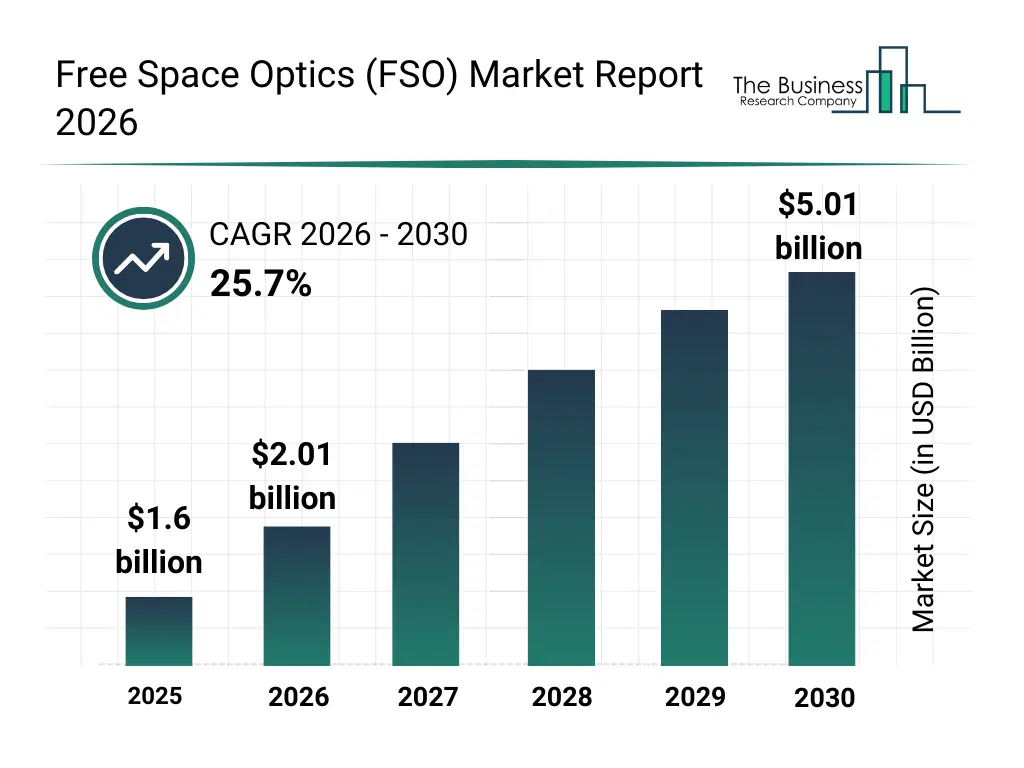
What Is The Free Space Optics (FSO) Market Size and Share 2026?
The free space optics (fso) market size has grown exponentially in recent years. It will grow from $1.6 billion in 2025 to $2.01 billion in 2026 at a compound annual growth rate (CAGR) of 25.7%. The growth in the historic period can be attributed to growth of enterprise data transmission needs, expansion of metropolitan networks, adoption of optical networking technologies, increasing demand for low-latency communication, limitations of physical cabling.What Is The Free Space Optics (FSO) Market Growth Forecast?
The free space optics (fso) market size is expected to see exponential growth in the next few years. It will grow to $5.01 billion in 2030 at a compound annual growth rate (CAGR) of 25.7%. The growth in the forecast period can be attributed to increasing investments in smart infrastructure, rising demand for resilient communication networks, expansion of enterprise connectivity solutions, growing deployment in defense and satellite communications, advancements in modulation and beam steering technologies. Major trends in the forecast period include increasing adoption of high-bandwidth optical wireless links, rising use of fso in urban connectivity, growing integration with hybrid fiber networks, expansion of long-range optical communication systems, enhanced focus on network resilience.Global Free Space Optics (FSO) Market Segmentation
1) By Component: Transmitters, Receivers, Modulators, Demodulators 2) By Platform: Terrestrial Platform, Satellite Platform, Airborne Platform 3) By Modulation: Amplitude, Phase, Polarization 4) By Application: Storage Area Network, Data Transmission, Mobile Backhaul, Enterprise Connectivity, Disaster Recovery, Defense, Satellite, Other Applications 5) By End-User: Corporate, Commercial Subsegments: 1) By Transmitters: Laser Diodes, Light Emitting Diodes (LEDs), Laser Modules, Other Transmitters 2) By Receivers: Photodetectors, Avalanche Photodiodes (APDs), Photodiode Arrays, Other Receivers 3) By Modulators: Electro-Optic Modulators (EOMs), Acousto-Optic Modulators (AOMs), Mach-Zehnder Modulators, Other Modulators 4) By Demodulators: Direct Detection Demodulators, Coherent Detection Demodulators, Homodyne Demodulators, Heterodyne Demodulators, Other DemodulatorsWhat Is The Driver Of The Free Space Optics (FSO) Market?
The expansion of 5G networks is expected to propel the growth of the free space optics (FSO) market going forward. 5G refers to the fifth generation of wireless cellular technology and provides better capacity, more reliable connections, and faster upload and download rates than earlier networks. The 5G network expansion is fueled by the increasing need for fast and reliable data connectivity due to the widespread adoption of smartphones, tablets, IoT devices, and similar connected technologies. 5G networks can leverage Free Space Optics (FSO) for high-speed data transmission, offering an alternative to traditional fiber optics, especially in urban areas with high network demand. FSO's ability to transmit data through free-light signals can complement 5G's aim for ultra-fast, low-latency connectivity. For instance, in September 2023, according to 5G Americas, a US-based industry trade organization, North America's 5G penetration rate reached an exceptional 40%, with a growth rate of 25.5% in the first half of 2023. Moreover, projections indicate North America's 5G connections will reach a remarkable 669 million by 2028. Therefore, the expansion of 5G networks is driving the growth of the free space optics (FSO) industry.Key Players In The Global Free Space Optics (FSO) Market
Major companies operating in the free space optics (fso) market are Mitsubishi Electric Corporation, LightPointe Communications Inc., fSONA Networks Corporation, Laser Light Communications LLC, Aoptix Technologies Inc., CableFree (Wireless Excellence Ltd.), Airlinx Communications Inc., Optelix Pty Ltd, Anova Technologies Inc., LightBee Corporation, Mostcom Ltd., CommConnect Group Inc., PAV Data Systems Ltd., Cailabs, Eodyne Systems LLC, Plaintree Systems Inc., EC SYSTEM, General Atomics, BridgeSat Inc., Mynaric AGGlobal Free Space Optics (FSO) Market Trends and Insights
Major companies operating in the free space optics (FSO) market are focusing on developing technologically advanced products that provide greater bandwidths such as tactical free-space optical communications systems, to meet growing demands for high-speed, secure data transmission. A tactical free-space optical communications system is a communication technology that utilizes optical signals transmitted through free space (i.e. air) to establish communication links between tactical assets such as military units, vehicles, or unmanned aerial vehicles (UAVs). For instance, in May 2023, RTX Corporation, a US-based aerospace and defense company, launched the NexGen Optix, a tactical free-space optical communications system designed to facilitate high-speed, secure data transfer even in demanding environments. The company has engineered a system that offers enhanced bandwidth within a compact, lightweight, and energy-efficient design, surpassing traditional optical systems. NexGen Optix employs laser instead of radio frequencies for communication, reducing susceptibility to detection, interference, and jamming.What Are Latest Mergers And Acquisitions In The Free Space Optics (FSO) Market?
In April 2024, Luxium Solutions, a US-based provider of advanced engineered materials and solutions, acquired PLX Inc. for an undisclosed amount. The acquisition of PLX broadens Luxium's offering of detection-enabling technologies by enhancing its suite of photonics products, providing a step change in the expanded scope of offerings to meet the demanding needs of customers. PLX Inc. is a US-based provider of advanced optical technologies, including free space optics (FSO).Regional Insights
North America was the largest region in the free space optics (FSO) market in 2025. Asia-Pacific is expected to be the fastest-growing region in the forecast period. The regions covered in this market report are Asia-Pacific, South East Asia, Western Europe, Eastern Europe, North America, South America, Middle East, Africa. The countries covered in this market report are Australia, Brazil, China, France, Germany, India, Indonesia, Japan, Taiwan, Russia, South Korea, UK, USA, Canada, Italy, Spain.What Defines the Free Space Optics (FSO) Market?
The free space optics (FSO) market consists of revenues earned by entities by providing services such as high-speed internet access, point-to-point communication, and secure communications. The market value includes the value of related goods sold by the service provider or included within the service offering. The free space optics (FSO) market also includes sales of optical transceivers, point-to-point FSO systems, and multi-point FSO systems. Values in this market are ‘factory gate’ values, that is the value of goods sold by the manufacturers or creators of the goods, whether to other entities (including downstream manufacturers, wholesalers, distributors and retailers) or directly to end customers. The value of goods in this market includes related services sold by the creators of the goods.How is Market Value Defined and Measured?
The market value is defined as the revenues that enterprises gain from the sale of goods and/or services within the specified market and geography through sales, grants, or donations in terms of the currency (in USD unless otherwise specified). The revenues for a specified geography are consumption values that are revenues generated by organizations in the specified geography within the market, irrespective of where they are produced. It does not include revenues from resales along the supply chain, either further along the supply chain or as part of other products.What Key Data and Analysis Are Included in the Free Space Optics (FSO) Market Report 2026?
The free space optics (fso) market research report is one of a series of new reports from The Business Research Company that provides market statistics, including industry global market size, regional shares, competitors with the market share, detailed market segments, market trends and opportunities, and any further data you may need to thrive in the free space optics (fso) industry. The market research report delivers a complete perspective of everything you need, with an in-depth analysis of the current and future state of the industry.Free Space Optics (FSO) Market Report Forecast Analysis
| Report Attribute | Details |
|---|---|
| Market Size Value In 2026 | $2.01 billion |
| Revenue Forecast In 2035 | $5.01 billion |
| Growth Rate | CAGR of 25.7% from 2026 to 2035 |
| Base Year For Estimation | 2025 |
| Actual Estimates/Historical Data | 2020-2025 |
| Forecast Period | 2026 - 2030 - 2035 |
| Market Representation | Revenue in USD Billion and CAGR from 2026 to 2035 |
| Segments Covered | Component, Platform, Modulation, Application, End-User |
| Regional Scope | Asia-Pacific, Western Europe, Eastern Europe, North America, South America, Middle East, Africa |
| Country Scope | The countries covered in the report are Australia, Brazil, China, France, Germany, India, ... |
| Key Companies Profiled | Mitsubishi Electric Corporation, LightPointe Communications Inc., fSONA Networks Corporation, Laser Light Communications LLC, Aoptix Technologies Inc., CableFree (Wireless Excellence Ltd.), Airlinx Communications Inc., Optelix Pty Ltd, Anova Technologies Inc., LightBee Corporation, Mostcom Ltd., CommConnect Group Inc., PAV Data Systems Ltd., Cailabs, Eodyne Systems LLC, Plaintree Systems Inc., EC SYSTEM, General Atomics, BridgeSat Inc., Mynaric AG |
| Customization Scope | Request for Customization |
| Pricing And Purchase Options | Explore Purchase Options |