Contact Us
  Search
The Business Research Company Logo
Free Space Optics (FSO) Market 2025
Published :May 2025
Pages :352
Format :PDF
Delivery Time :2-3 Business Days
Why 2-3 days? We update the report with the latest data and news before delivery. Let us know if you need us to expedite.
Report Price :$4,490.00

Free Space Optics (FSO) Market 2025

By Component (Transmitters, Receivers, Modulators, Demodulators, Other Components), By Platform (Terrestrial Platform, Satellite Platform, Airborne Platform), By Modulation (Amplitude, Frequency, Phase, Polarization), By Application (Storage Area Network, Data Transmission, Mobile Backhaul, Enterprise Connectivity, Disaster Recovery, Defense, Satellite, Other Applications), By End-User (Corporate, Commercial), And By Region, Opportunities And Strategies – Global Forecast To 2035

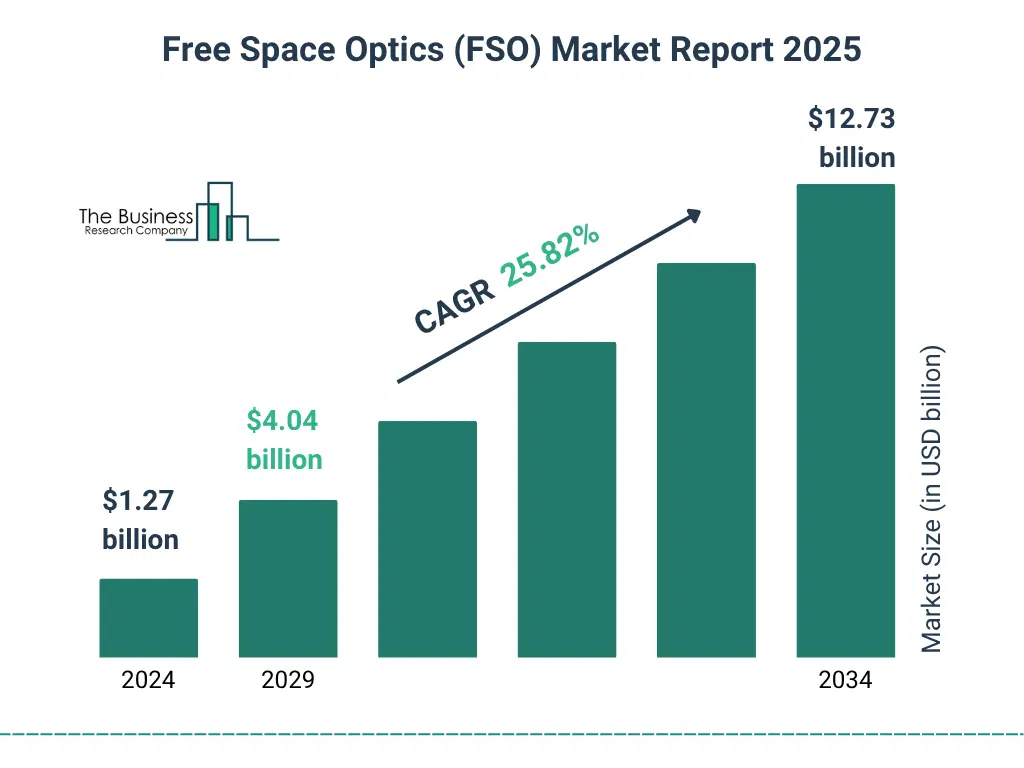
Free Space Optics (FSO) Market Size and growth rate 2025 to 2029: Graph

Free Space Optics (FSO) Market Definition

Free Space Optics (FSO) refers to a wireless communication technology that uses light to transmit data through free space, such as air or vacuum, without the need for fiber optic cables or physical infrastructure. FSO technology is primarily utilized for high-speed, long-distance communication in environments where traditional wired or radio frequency solutions are impractical or cost prohibitive. The free space optics (FSO) market consists of sales, by entities (organizations, sole traders, or partnerships), of free space optics (FSO) that develop, manufacture and deploy FSO systems and related components for transmitting data over optical beams. These systems are used for applications such as data transmission, mobile backhaul, disaster recovery, satellite communication and defense networking. FSO technology is employed in diverse environments, including urban areas, remote locations and space-based communication systems, providing a reliable alternative to traditional fiber-optic networks.

Research Expert

Book your 30 minutes free consultation with our research experts

Free Space Optics (FSO) Market Size

The global free space optics (FSO) market reached a value of nearly $1,272.23 million in 2024, having grown at a compound annual growth rate (CAGR) of 16.17% since 2019. The market is expected to grow from $1,272.23 million in 2024 to $4,036.93 million in 2029 at a rate of 25.98%. The market is then expected to grow at a CAGR of 25.82% from 2029 and reach $12,729.10 million in 2034. Growth in the historic period resulted from the growing aerospace and defense industries, increased adoption of cloud-based services, growth in smart cities initiatives and growing telecommunication sector. Factors that negatively affected growth in the historic period was growing concerns about data security. Going forward, increasing deployment of 5G networks, increasing urbanization, strong economic growth in emerging markets, rise in digital transformation and favorable government initiatives will drive the growth. Factor that could hinder the growth of the free free space optics (FSO) market in the future include limited availability of skilled personnel and technical expertise.

Free Space Optics (FSO) Market Drivers

The key drivers of the free space optics (FSO) market include: Increasing Deployment Of 5G Networks The increasing deployment of 5G networks is expected to propel the growth of the free space optics (FSO) market in the forecast period. As 5G networks expand, the demand for high capacity backhaul solutions to connect base stations and small cells increases. Traditional fiber-optic deployment can be costly and time-consuming, especially in urban environments with right-of-way challenges and in remote areas where fiber installation is impractical. FSO technology, which uses laser beams to transmit data through the air, offers a cost-effective, high-speed alternative to fiber, enabling rapid deployment of 5G backhaul links without the need for extensive physical infrastructure. For instance, in June 2024, according to the Mobility Report released by Telefonaktiebolaget LM Ericsson, a Sweden-based multinational networking and telecommunications company, over 160 million new 5G subscriptions were added globally in the first quarter of 2024, totaling over 1.7 billion. For the entire year, nearly 600 million new subscriptions are expected. In India, 5G subscriptions reached 119 million by the end of 2023, achieving a 10% penetration rate. The report forecasts that by the end of 2029, India's 5G subscriptions will grow to approximately 840 million, accounting for 65% of all mobile subscriptions in the region. Additionally, in April 2023, according to 5G Americas, a US-based industry trade organization composed of leading telecommunications service providers and manufacturers, in 2022, there were 1.05 billion 5G wireless connections worldwide, a 76% increase from the end of 2021. Further, this number is expected to reach 1.9 billion by the end of 2023 and 5.9 billion by the end of 2027. Thus, the increasing deployment of 5G networks aims to propel the growth of the free free space optics (FSO) market.

Free Space Optics (FSO) Market Restraints

The key restraints on the free space optics (FSO) market include: Limited Availability Of Skilled Personnel And Technical Expertise The limited availability of skilled personnel and technical expertise is expected to restrict the growth of the free space optics (FSO) market in the forecast period. FSO technology requires specialized knowledge in optics, telecommunications and atmospheric physics. The limited pool of trained professionals makes it difficult for organizations to quickly scale their FSO operations, thereby slowing market growth. For instance, in February 2025, a study commissioned by the Fiber Broadband Association (FBA), a non-profit association and the Power and Communication Contractors Association (PCCA), a national trade association, predicts a shortage of broadband workers, estimating that 28,000 additional construction workers and 30,000 additional technicians are needed to execute current federal and state broadband funding plans between now and 2030. Therefore, the limited availability of skilled personnel and technical expertise may hinder the growth of the free space optics (FSO) market.

Need data on a specific region in this market?

Opportunities And Recommendations In The Free Space Optics (FSO) Market

Opportunities – The top opportunities in the free space optics (FSO) market segmented by component will arise in the transmitters segment, which will gain $1,123.07 million of global annual sales by 2029. The top opportunities in the free space optics (FSO) market segmented by platform will arise in the terrestrial platform segment, which will gain $1,055.54 million of global annual sales by 2029. The top opportunities in the free space optics (FSO) market segmented by modulation will arise in the amplitude segment, which will gain $1,408.36 million of global annual sales by 2029. The top opportunities in the free space optics (FSO) market segmented by application will arise in the data transmission segment, which will gain $777.69 million of global annual sales by 2029. The top opportunities in the free space optics (FSO) market segmented by end-user will arise in the corporate segment, which will gain $1,699.72 million of global annual sales by 2029.The free free space optics (FSO) market size will gain the most in the USA at $664.69 million. Recommendations- To take advantage of the opportunities, The Business Research Company recommends the free space optics (FSO) companies to focus on advancing high-bandwidth tactical communication solutions, focus on the transmitters segment to maximize growth potential, focus on satellite platform to maximize growth potential, focus on amplitude modulation to drive market expansion, expand in emerging markets, focus on expanding distribution channels through strategic geographic and sectoral targeting, focus on tiered pricing strategies to improve market penetration and profitability, focus on strategic partnerships and government collaboration for market expansion, focus on targeted education and technical communication to build market trust, focus on the satellite segment to maximize long-term growth and focus on the corporate segment to drive sustainable market leadership.
Chat with us