
Frequency-Hopping Drone Link Market Report 2026
Global Outlook – By Product Type (Fixed-Wing Drones, Rotary-Wing Drones, Hybrid Drones), By Component (Transmitter, Receiver, Antenna, Software, Other Components), By Frequency Band (Ultra High Frequency (UHF), Very High Frequency (VHF), L-Band, S-Band, Other Frequency Bands), By Application (Military And Defense, Commercial, Industrial, Agriculture, Other Applications), By End-User (Government, Commercial, Consumer) – Market Size, Trends, Strategies, and Forecast to 2030
Frequency-Hopping Drone Link Market Overview
• Frequency-Hopping Drone Link market size has reached to $1.39 billion in 2025 • Expected to grow to $2.89 billion in 2030 at a compound annual growth rate (CAGR) of 15.6% • Growth Driver: Increasing Demand For Secure And Reliable Data Transmission Driving The Growth Of The Market Due To Rising Digital Communication And Cyber Threats • Market Trend: New Industrial Drone Features Frequency-Hopping Link, High-Resolution Imaging, And Advanced Autonomous Capabilities • North America was the largest region in 2025 and Asia-Pacific is the fastest growing region.What Is Covered Under Frequency-Hopping Drone Link Market?
A frequency-hopping drone link refers to a communication system used in drones that rapidly switches frequencies within a specified range during transmission. This technique enhances security by making it difficult for unauthorized parties to intercept or jam the signal. It also improves reliability by reducing interference from other devices operating on similar frequencies. The main product types of frequency-hopping drone links are fixed-wing drones, rotary-wing drones, and hybrid drones. Fixed-wing drones refer to unmanned aerial vehicles (UAVs) that use a rigid wing to generate lift, allowing them to glide through the air and cover long distances efficiently, typically requiring forward motion to stay aloft. They utilize various components, such as transmitters, receivers, antennas, software, and others, operating across different frequency bands, including ultra-high frequency (UHF), very high frequency (VHF), L-band, S-band, and others. Frequency-hopping drone links are used in various applications, including military and defense, commercial, industrial, agriculture, and others, with key end users being government agencies, commercial enterprises, and individual consumers.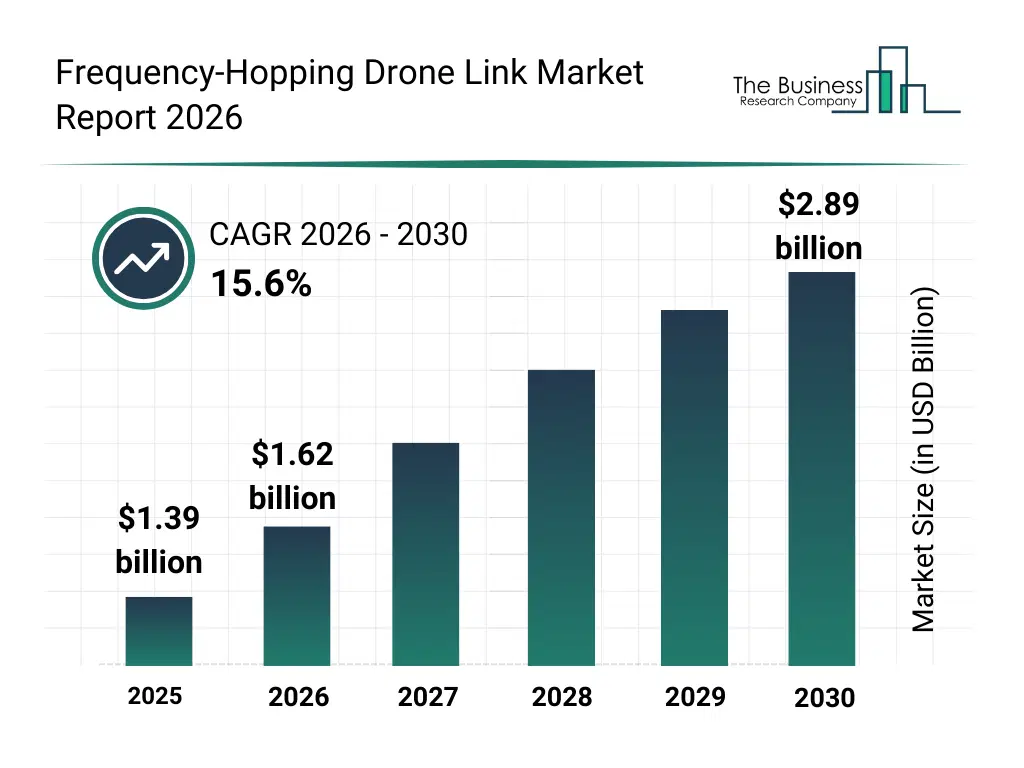
What Is The Frequency-Hopping Drone Link Market Size and Share 2026?
The frequency-hopping drone link market size has grown rapidly in recent years. It will grow from $1.39 billion in 2025 to $1.62 billion in 2026 at a compound annual growth rate (CAGR) of 16.5%. The growth in the historic period can be attributed to advancements in frequency-hopping and spread-spectrum communication technologies, growing adoption of drones for surveillance and commercial operations, development of secure and resilient transceivers, increasing demand for interference-resistant communication links, improvements in encryption hardware and software-defined radios for drones.What Is The Frequency-Hopping Drone Link Market Growth Forecast?
The frequency-hopping drone link market size is expected to see rapid growth in the next few years. It will grow to $2.89 billion in 2030 at a compound annual growth rate (CAGR) of 15.6%. The growth in the forecast period can be attributed to expansion of frequency-hopping links in commercial and industrial drone applications, integration of ai-driven network management for dynamic frequency allocation, rising adoption of secure data transmission for sensitive operations, increasing investment in high-performance onboard communication modules, collaborations between drone manufacturers and telecom providers for enhanced connectivity solutions. Major trends in the forecast period include growing shift toward secure drone communication protocols, rising adoption of frequency-hopping systems for anti-jamming protection, increasing integration of sdr-based drone communication modules, expansion of long-range encrypted drone data links, growing demand for interference-resistant drone networks in dense environments.
Global Frequency-Hopping Drone Link Market Segmentation
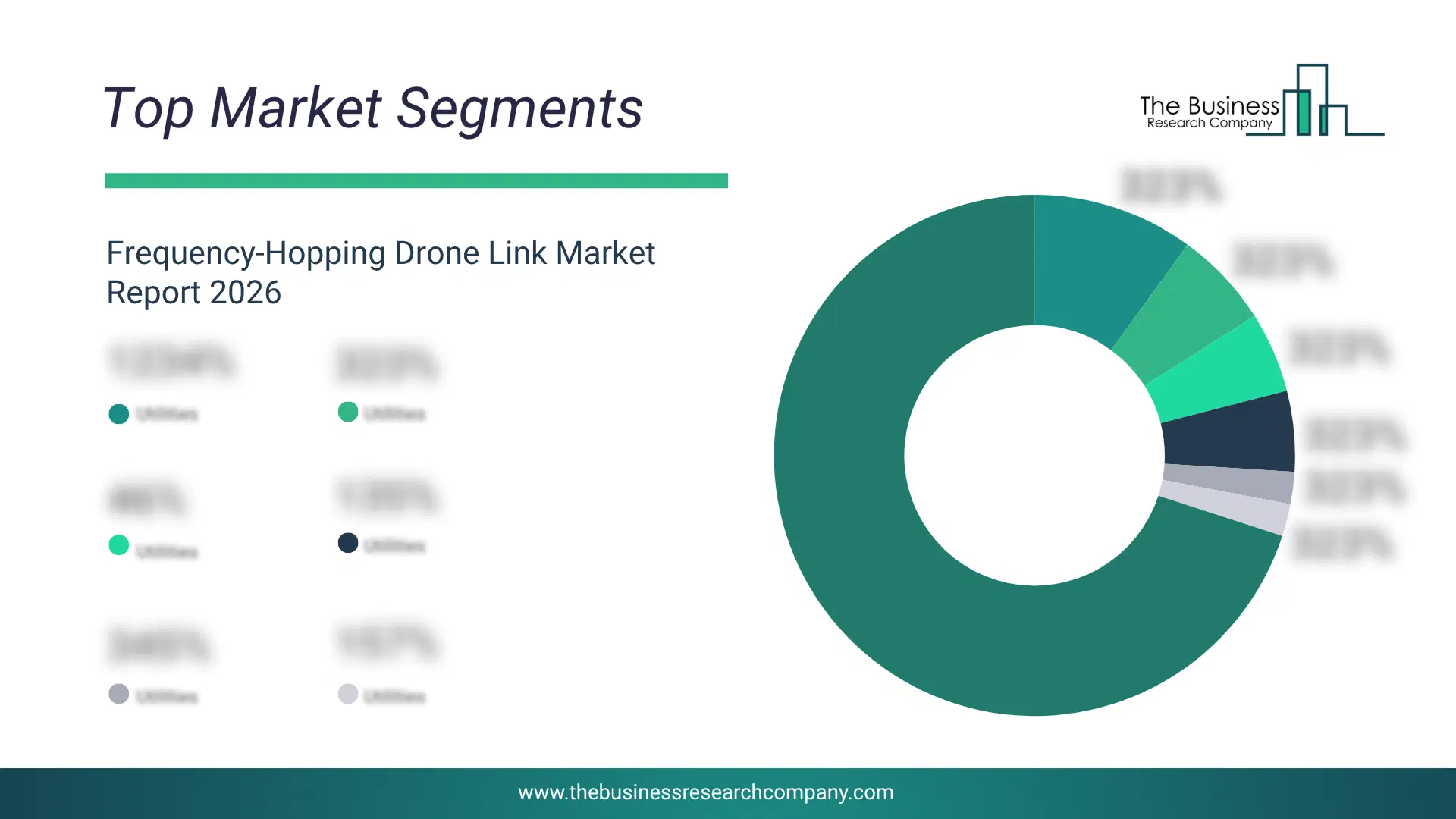
1) By Product Type: Fixed-Wing Drones, Rotary-Wing Drones, Hybrid Drones 2) By Component: Transmitter, Receiver, Antenna, Software, Other Components 3) By Frequency Band: Ultra High Frequency (UHF), Very High Frequency (VHF), L-Band, S-Band, Other Frequency Bands 4) By Application: Military And Defense, Commercial, Industrial, Agriculture, Other Applications 5) By End-User: Government, Commercial, Consumer Subsegments: 1) By Fixed-Wing Drones: Conventional Fixed-Wing Drones, High-Altitude Long-Endurance (HALE) Drones, Medium-Altitude Long-Endurance (MALE) Drones, Tactical Fixed-Wing Drones, Small Fixed-Wing Drones 2) By Rotary-Wing Drones: Quadcopters, Hexacopters, Octocopters, Single-Rotor Helicopter Drones, Coaxial Rotor Drones 3) By Hybrid Drones: Vertical Take-Off And Landing (VTOL) Fixed-Wing Hybrid Drones, Tiltrotor Hybrid Drones, Tail-Sitter Hybrid Drones, Compound Helicopter Hybrid DronesWhat Is Driver Of The Frequency-Hopping Drone Link Market?
The increasing adoption of drones is expected to propel the growth of the frequency-hopping drone link market going forward. Drones refer to unmanned aerial vehicles (UAVs) that operate without an onboard human pilot, controlled remotely or autonomously for various applications. The adoption of drones is rising due to their ability to significantly reduce operational costs while improving efficiency across industries. Frequency-hopping drone links are used in drones to ensure secure, reliable, and interference-resistant communication between the UAV and its control system. For instance, in July 2024, according to the State Council Information Office (SCIO), a China-based government agency responsible for coordinating China’s public information, by the end of 2023, China’s registered drone fleet reached 1.27 million units, marking a 32.2% year-over-year increase, while civilian drones logged 23.11 million flight hours, reflecting an 11.8% annual growth in operational activity. Therefore, the increasing adoption of drones is driving the growth of the frequency-hopping drone link industry.Key Players In The Global Frequency-Hopping Drone Link Market
Major companies operating in the frequency-hopping drone link market are General Dynamics Corporation, Northrop Grumman Corporation, BAE Systems, Thales Group, L3Harris Technologies, Leonardo S.p.A., Elbit Systems Ltd., Rohde & Schwarz, Teledyne FLIR LLC, AeroVironment Inc., Parrot SA, Meteksan Defence Industry Inc., Doodle Labs LLC, Uavionix, FreeWave Technologies Inc., ideaForge Technologies Ltd., UAVOS Inc., Microhard Systems Inc., Tualcom, Shenzhen Xingkai Technology Co. Ltd.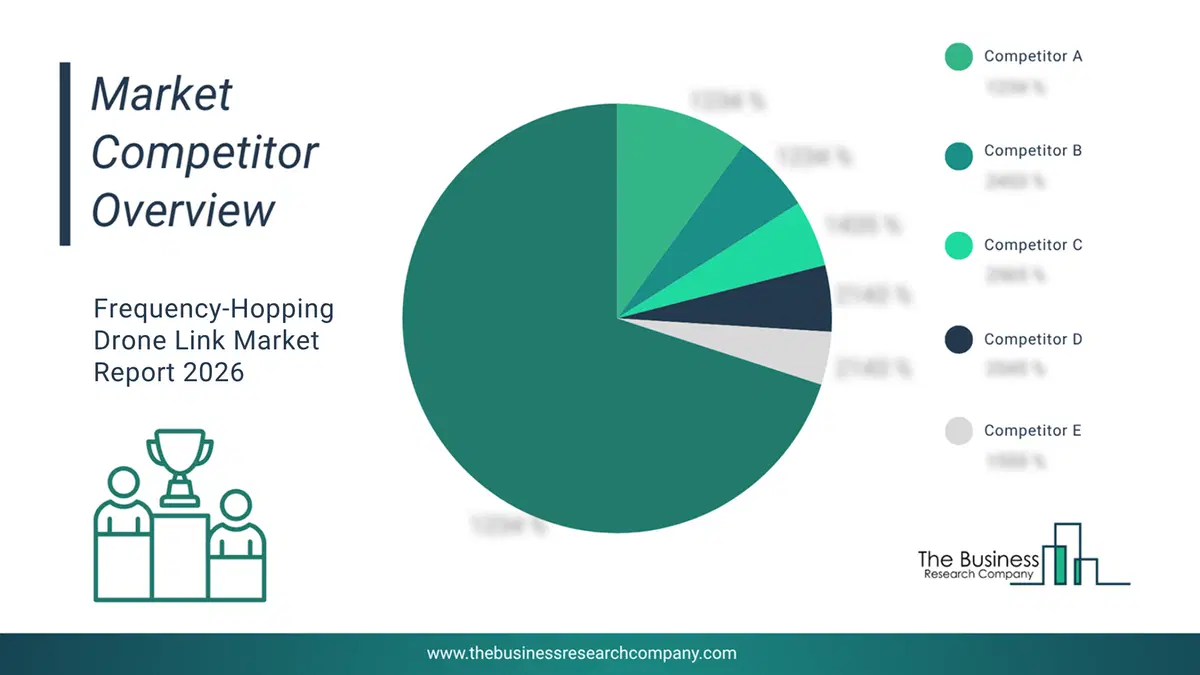
This chart is for illustrative purposes; the full report includes a detailed competitor analysis and comprehensive overview of the top 10 companies in the market.
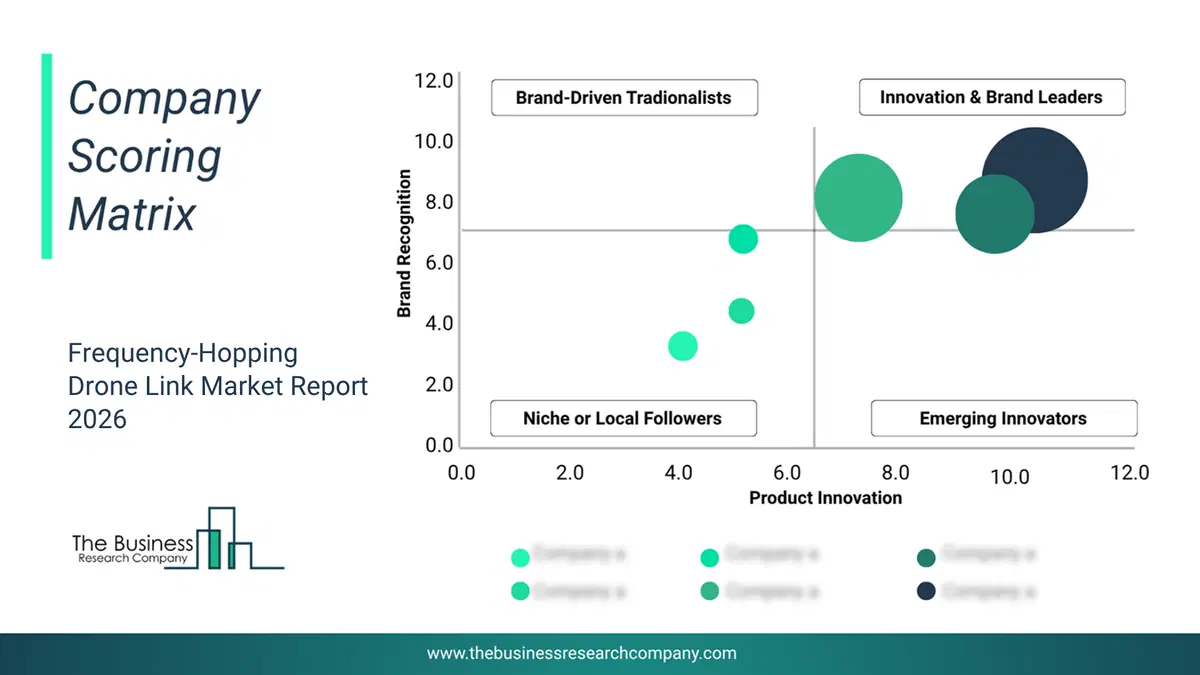
This chart maps companies by product innovation and brand strength, with bubble size indicating relative revenue, helping identify market leaders, challengers, and niche players. This is an illustrative chart; the full report provides a complete and accurate competitive analysis.
Global Frequency-Hopping Drone Link Market Trends and Insights
Major companies in the frequency-hopping drone link market are focusing on advanced technologies like high-resolution imaging, which enables capturing highly detailed images with superior clarity and significant zoom capabilities. For instance, in March 2024, Autel Robotics, a China-based aerial drone manufacturer, announced its new flagship industrial drone, the Autel Alpha. This drone features significant enhancements in performance, autonomous flight, anti-interference, obstacle avoidance, and imaging, with a rugged, weather-resistant design. It offers up to 40 minutes of flight time, IP55-rated all-weather operation, and a 20 km video transmission range. Equipped with a DG-L35T gimbal, it supports 560x hybrid zoom, dual thermal cameras for short- and long-range thermal imaging, starlight night vision, 35x optical zoom, and a laser rangefinder. Additional features include omnidirectional obstacle avoidance, RTK-enhanced precision, and a foldable, portable frame, making it well-suited for demanding applications such as public safety, search and rescue, and critical inspections.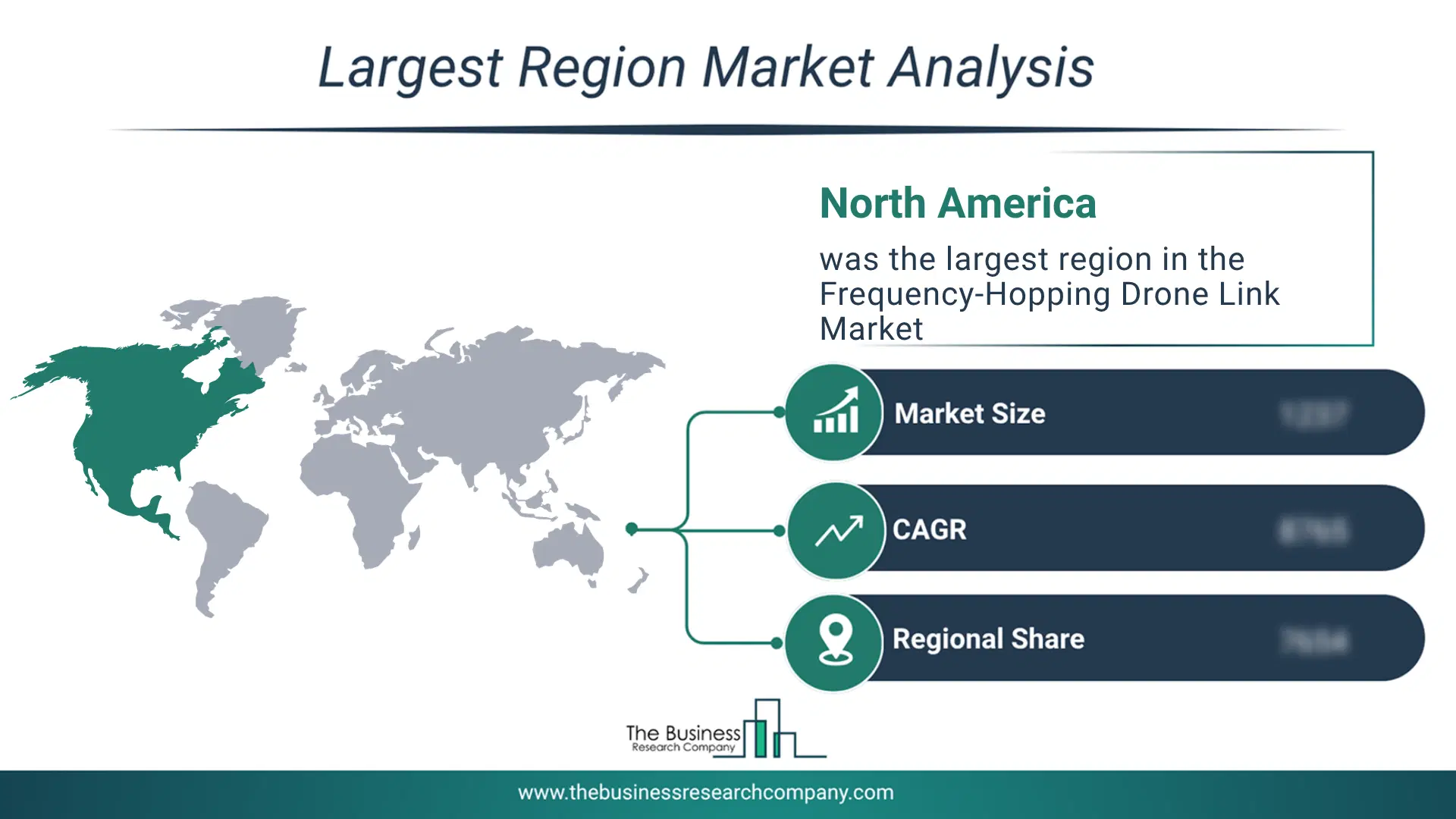
Regional Insights
North America was the largest region in the frequency-hopping drone link market in 2025. Asia-Pacific is expected to be the fastest-growing region in the forecast period. The regions covered in this market report are Asia-Pacific, South East Asia, Western Europe, Eastern Europe, North America, South America, Middle East, Africa. The countries covered in this market report are Australia, Brazil, China, France, Germany, India, Indonesia, Japan, Taiwan, Russia, South Korea, UK, USA, Canada, Italy, SpainWhat Defines the Frequency-Hopping Drone Link Market?
The frequency-hopping drone link market consists of revenues earned by entities by providing services such as commercial drone operations, network integration, surveillance services, data transmission, and analytics services. The market value includes the value of related goods sold by the service provider or included within the service offering. The frequency-hopping drone link market also includes sales of frequency-hopping transceivers, secure communication modules, software-defined radios (SDRs), encryption hardware, and onboard drone communication systems. Values in this market are ‘factory gate’ values, that is, the value of goods sold by the manufacturers or creators of the goods, whether to other entities (including downstream manufacturers, wholesalers, distributors, and retailers) or directly to end customers. The value of goods in this market includes related services sold by their creators.How is Market Value Defined and Measured?
The market value is defined as the revenues that enterprises gain from the sale of goods and/or services within the specified market and geography through sales, grants, or donations in terms of the currency (in USD unless otherwise specified). The revenues for a specified geography are consumption values that are revenues generated by organizations in the specified geography within the market, irrespective of where they are produced. It does not include revenues from resales along the supply chain, either further along the supply chain or as part of other products.
This chart presents market attractiveness based on a quantitative evaluation of growth, competition, strategic alignment, and risk, offering a clear view of opportunity areas for decision-making. This chart is for illustrative purposes; the full report contains the complete analysis.

This chart highlights the Total Addressable Market (TAM) by estimating the maximum revenue opportunity using an assumption-driven approach, supporting strategic planning and opportunity sizing across markets. The chart is illustrative; the full report provides a more comprehensive analysis.
What Key Data and Analysis Are Included in the Frequency-Hopping Drone Link Market Report 2026?
The frequency-hopping drone link market research report is one of a series of new reports from The Business Research Company that provides market statistics, including industry global market size, regional shares, competitors with the market share, detailed market segments, market trends and opportunities, and any further data you may need to thrive in the frequency-hopping drone link industry. The market research report delivers a complete perspective of everything you need, with an in-depth analysis of the current and future state of the industry.Frequency-Hopping Drone Link Market Report Forecast Analysis
| Report Attribute | Details |
|---|---|
| Market Size Value In 2026 | $1.62 billion |
| Revenue Forecast In 2030 | $2.89 billion |
| Growth Rate | CAGR of 15.6% from 2026 to 2030 |
| Base Year For Estimation | 2025 |
| Actual Estimates/Historical Data | 2020-2025 |
| Forecast Period | 2026 - 2030 |
| Market Representation | Revenue in USD Billion and CAGR from 2026 to 2030 |
| Segments Covered | Product Type, Component, Frequency Band, Application, End-User |
| Regional Scope | Asia-Pacific, Western Europe, Eastern Europe, North America, South America, Middle East, Africa |
| Country Scope | The countries covered in the frequency-hopping drone link market report are Australia, Brazil, China, France, Germany, India, Indonesia, Japan, Taiwan, Russia, South Korea, UK, USA, Canada, Italy, Spain |
| Key Companies Profiled | General Dynamics Corporation, Northrop Grumman Corporation, BAE Systems, Thales Group, L3Harris Technologies, Leonardo S.p.A., Elbit Systems Ltd., Rohde & Schwarz, Teledyne FLIR LLC, AeroVironment Inc., Parrot SA, Meteksan Defence Industry Inc., Doodle Labs LLC, Uavionix, FreeWave Technologies Inc., ideaForge Technologies Ltd., UAVOS Inc., Microhard Systems Inc., Tualcom, Shenzhen Xingkai Technology Co. Ltd. |
| Customization Scope | Request for Customization |
| Pricing And Purchase Options | Explore Purchase Options |