
Front End Reinforcement Bars Market Report 2026
Global Outlook – By Product Type (Steel Bars, Aluminum Bars, Composite Bars, Other Product Types), By Distribution Channel (Direct Sales, Distributors Or Wholesalers, Online Retail, Other Distribution Channels), By Application (Vehicle Type) (Passenger Cars, Sport Utility Vehicle (SUVs) And Crossovers, Light Commercial Vehicles (LCVs), Heavy Commercial Vehicles (HCVs), Electric Vehicles (EVs)), By End-User (Automobile Manufacturers (OEMs), Automotive Component Suppliers, Aftermarket Or Replacement Parts Providers, Other End-Users) – Market Size, Trends, Strategies, and Forecast to 2030
Front End Reinforcement Bars Market Overview
• Front End Reinforcement Bars market size has reached to $53.5 billion in 2025 • Expected to grow to $75.85 billion in 2030 at a compound annual growth rate (CAGR) of 7.2% • Growth Driver: Increasing Infrastructure Development Is Fueling The Growth Of The Market Due To Rising Public Construction Outlays • Market Trend: Low-Carbon Aluminum Crash-Management Systems Using High Post-Consumer Scrap Content Are Advancing Front-End Reinforcement Bars • Asia-Pacific was the largest region in 2025 and North America is the fastest growing region.What Is Covered Under Front End Reinforcement Bars Market?
Front end reinforcement bars are structural beams mounted across the front of a vehicle behind the bumper cover, typically made from steel, aluminum, or composite materials and attached to the frame through crash boxes. Their purpose is to absorb and distribute impact energy in a front collision to protect occupants and critical components and to help the vehicle meet crash-safety requirements. The main product types of front end reinforcement bars include deformed bars, mild steel bars, thermo-mechanically treated bars, and others. Deformed bars are steel reinforcing bars with patterned ribs or indentations rolled into the surface to improve mechanical interlock with surrounding concrete and enhance bond strength and crack control in reinforced members such as beams, slabs, columns, and bridges. It is distributed through direct sales, distributors or wholesalers, online retail, and others and is applied for residential, commercial, industrial, and infrastructure purposes. It is used by several end-users, including construction, transportation, energy, and others.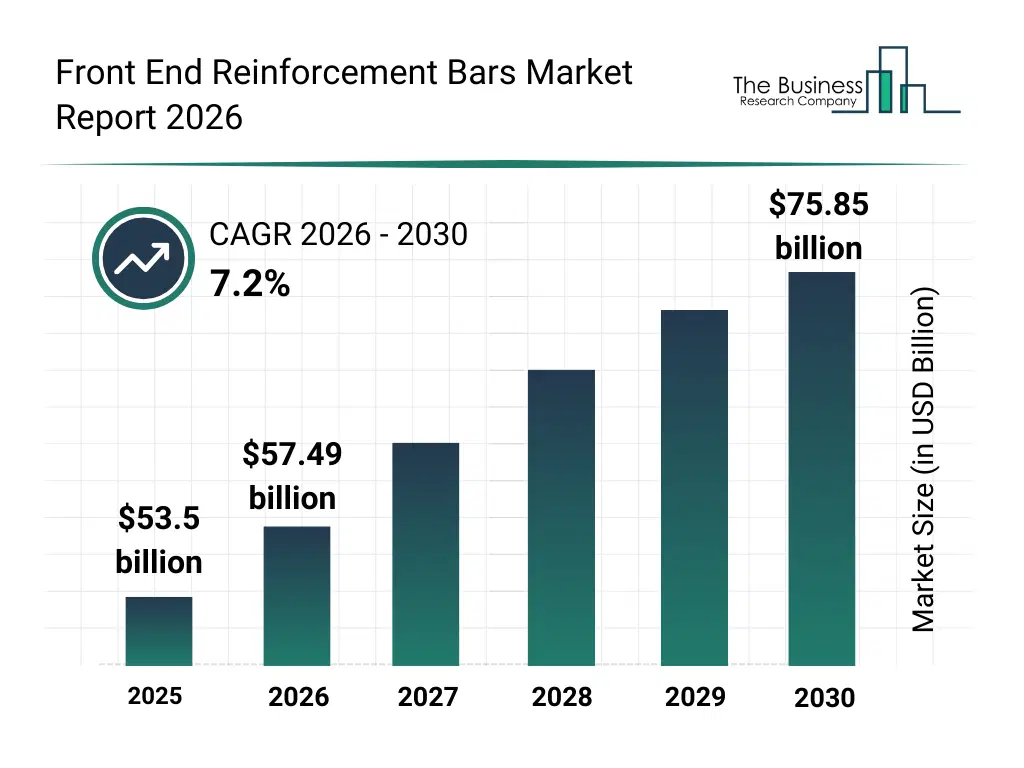
What Is The Front End Reinforcement Bars Market Size and Share 2026?
The front end reinforcement bars market size has grown strongly in recent years. It will grow from $53.5 billion in 2025 to $57.49 billion in 2026 at a compound annual growth rate (CAGR) of 7.5%. The growth in the historic period can be attributed to growth in automotive production, increasing safety regulations and crash-test standards, rising demand for durable and high-strength materials, expansion of commercial and residential vehicle fleets, development of advanced steel and aluminum processing technologies.What Is The Front End Reinforcement Bars Market Growth Forecast?
The front end reinforcement bars market size is expected to see strong growth in the next few years. It will grow to $75.85 billion in 2030 at a compound annual growth rate (CAGR) of 7.2%. The growth in the forecast period can be attributed to growth in electric and hybrid vehicle adoption, increasing emphasis on vehicle safety features, rising demand for lightweight composite materials, expansion of automotive infrastructure projects, focus on advanced corrosion-resistant and high-performance reinforcement bars. Major trends in the forecast period include rising adoption of high-strength steel and aluminum front end reinforcement bars, increasing use of composite materials in crash boxes, expansion of front end reinforcement bars in automotive safety features, growing focus on lightweight and fuel-efficient vehicle designs, rising preference for corrosion-resistant and long-life reinforcement bars.
Global Front End Reinforcement Bars Market Segmentation
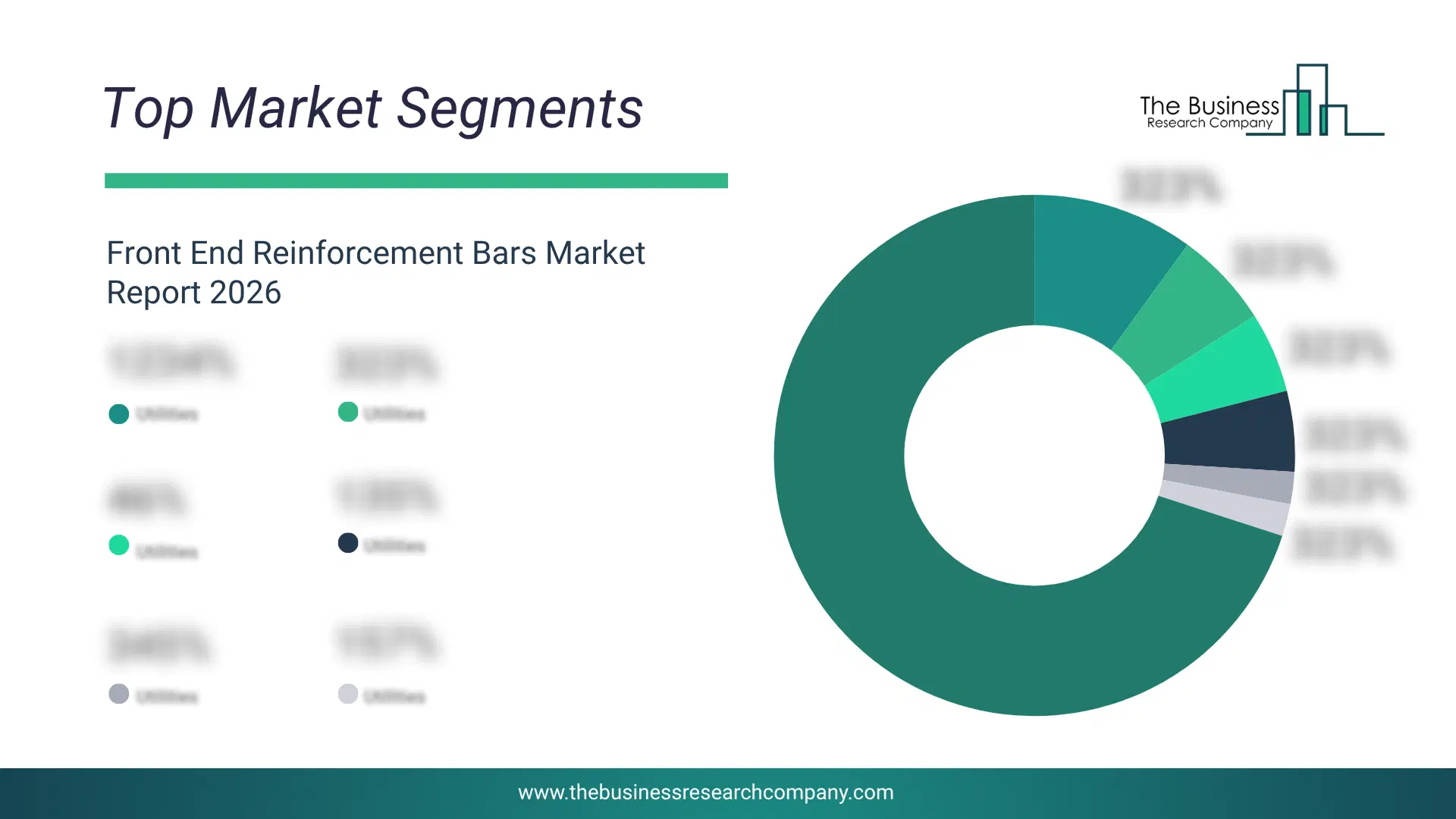
1) By Product Type: Steel Bars, Aluminum Bars, Composite Bars, Other Product Types 2) By Distribution Channel: Direct Sales, Distributors Or Wholesalers, Online Retail, Other Distribution Channels 3) By Application (Vehicle Type): Passenger Cars, Sport Utility Vehicle (SUVs) And Crossovers, Light Commercial Vehicles (LCVs), Heavy Commercial Vehicles (HCVs), Electric Vehicles (EVs) 4) By End-User: Automobile Manufacturers (OEMs), Automotive Component Suppliers, Aftermarket Or Replacement Parts Providers, Other End-Users Subsegments: 1) By Steel Bars: High-Strength Low-Alloy (HSLA) Steel Bars, Stainless Steel Bars, Galvanized Steel Bars 2) By Aluminum Bars: Extruded Aluminum Bars, High-Strength Aluminum Alloy Bars 3) By Composite Bars: Fiber Reinforced Polymer (FRP) Bars, Basalt Fiber Reinforced Bars, Carbon Fiber Reinforced Bars 4) By Other Product Types: Epoxy Coated Bars, Micro-Alloyed BarsWhat Is The Driver Of The Front End Reinforcement Bars Market?
The increasing infrastructure development is expected to propel the growth of the front end reinforcement bars market going forward. Infrastructure development refers to building and upgrading public assets such as highways, bridges, transit systems, water and wastewater networks, airports, and energy corridors. The increase in infrastructure development is due to rising public outlays to replace aging assets and expand capacity for mobility, logistics, and urban services. Front-end reinforcement bars are beneficial for infrastructure projects because they enhance the tensile strength of concrete structures, allowing them to withstand heavy loads and environmental stress without cracking or deforming. For instance, in February 2024, according to Census Bureau, a US-based government agency, public construction spending reached $437.7 billion, marking a 16.3% increase from 2022, with highway construction accounting for $133.6 billion, an 18.0% year-over-year rise, reflecting intensified infrastructure development activity. Therefore, the increasing infrastructure development is driving the growth of the front end reinforcement bars industry.Key Players In The Global Front End Reinforcement Bars Market
Major companies operating in the front end reinforcement bars market report are ArcelorMittal SA, POSCO Holdings, Nippon Steel Corp., Hebei Iron and Steel Group Co. Ltd., Thyssenkrupp AG, Nucor Corporation, Tata Steel Limited, JSW Steel Limited, Hyundai Steel Company, Kobe Steel Limited, Ternium SA, Voestalpine Group, Novolipetsk Steel Group, Gerdau Sociedade Anônima, Reliance Steel & Aluminum Co., Steel Authority of India Limited, SSAB AB, Shagang Group Company Limited, Commercial Metals Company, Jindal Steel & Power Limited.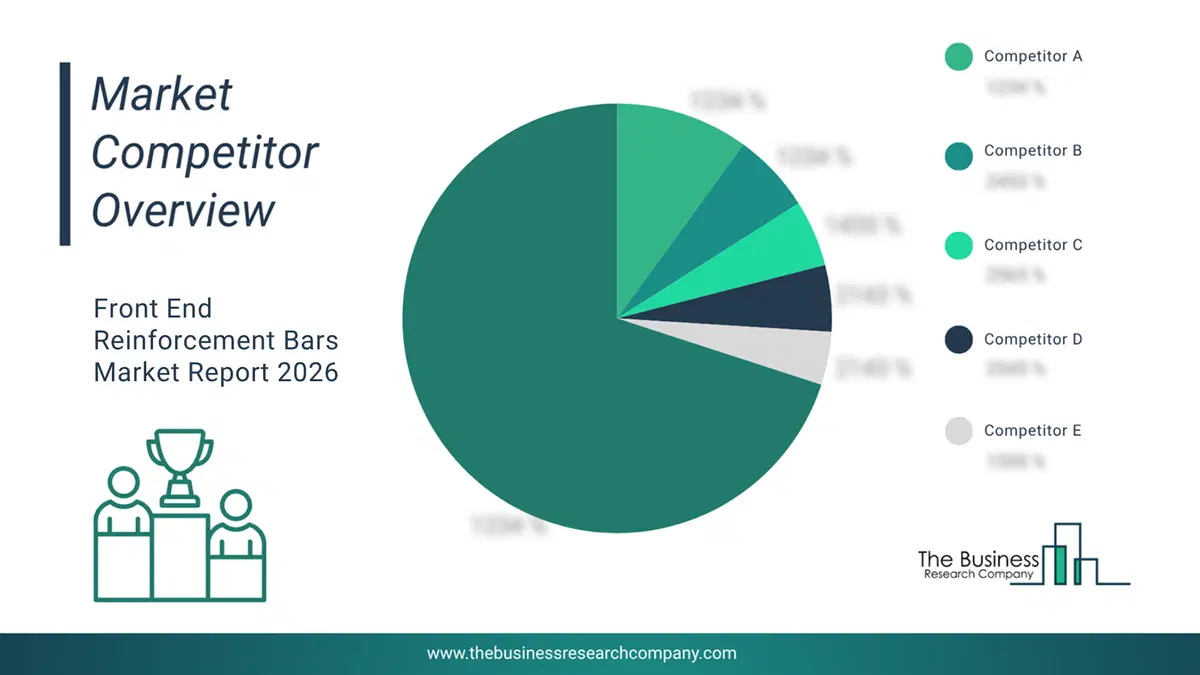
This chart is for illustrative purposes; the full report includes a detailed competitor analysis and comprehensive overview of the top 10 companies in the market.
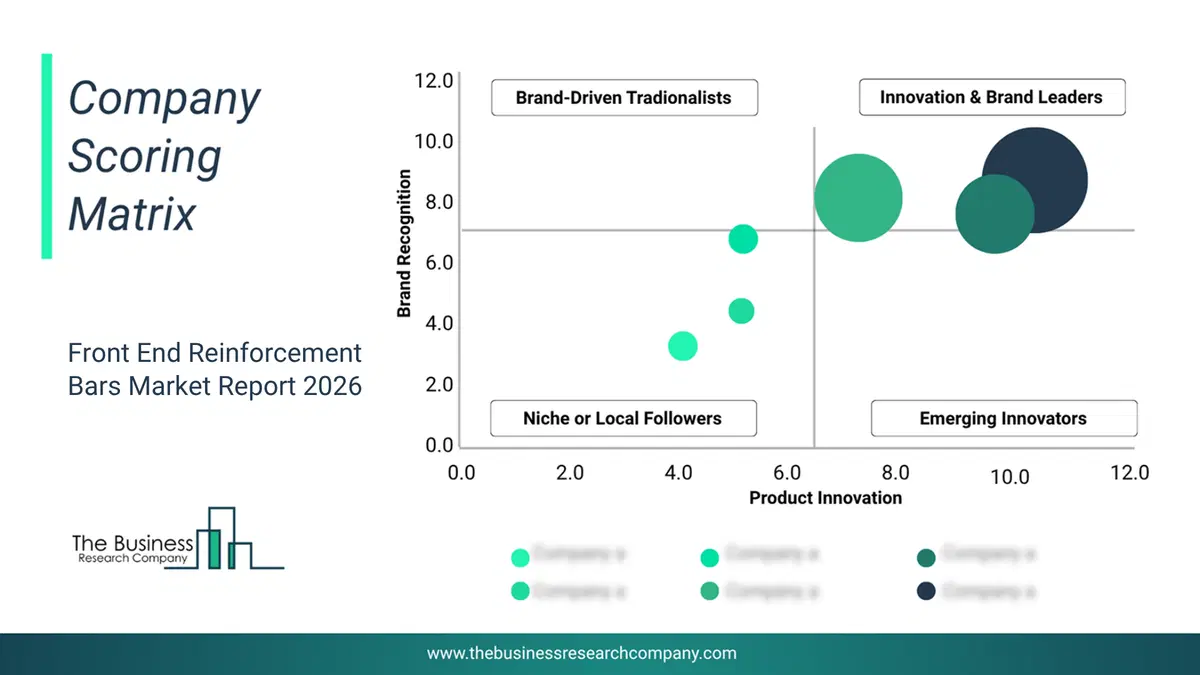
This chart maps companies by product innovation and brand strength, with bubble size indicating relative revenue, helping identify market leaders, challengers, and niche players. This is an illustrative chart; the full report provides a complete and accurate competitive analysis.
Global Front End Reinforcement Bars Market Trends and Insights
Major companies operating in the front end reinforcement bars market are focusing on developing low-carbon aluminum crash-management systems (cms), to cut embodied carbon while maintaining crash performance. A crash-management system is the integrated front-end structure front bumper beam (the reinforcement bar), crush cans and energy absorbers engineered to absorb and redistribute impact energy and protect occupants, when built from high-recycled 6xxx aluminum alloys, it reduces weight and lifecycle emissions without sacrificing strength. For instance, in September 2025, Constellium, a France-based provider of aluminum products, launched crash-management systems (cms) prototypes made from >90% post-consumer aluminum scrap at Cenex 2025, built on its high-strength alloy platform and targeted to keep embodied CO₂ under ~2 tCO₂ per ton of aluminum. The lightweight front bumper beams offer high energy absorption with substantially lower embedded CO₂, aligning with automakers’ goals for sustainability and improved range efficiency through reduced vehicle mass. They function as the primary crash-load path at the vehicle’s front end, enhancing occupant protection while allowing for repairable and modular front-end structures.What Are Latest Mergers And Acquisitions In The Front End Reinforcement Bars Market?
In July 2023, Samvardhana Motherson Automotive Systems Group B.V. (SMRPBV), a Netherlands-based automotive components manufacturer, acquired SAS Autosystemtechnik GmbH & Co. KG for an undisclosed amount. With this acquisition, Samvardhana Motherson aims to broaden its global module-assembly footprint, especially cockpit and front-end modules, enhancing customer proximity and capability to integrate structural crash parts such as bumper reinforcement bars across major original equipment manufacturer programs. SAS Autosystemtechnik is a Germany-based provider of front-end reinforcement bars.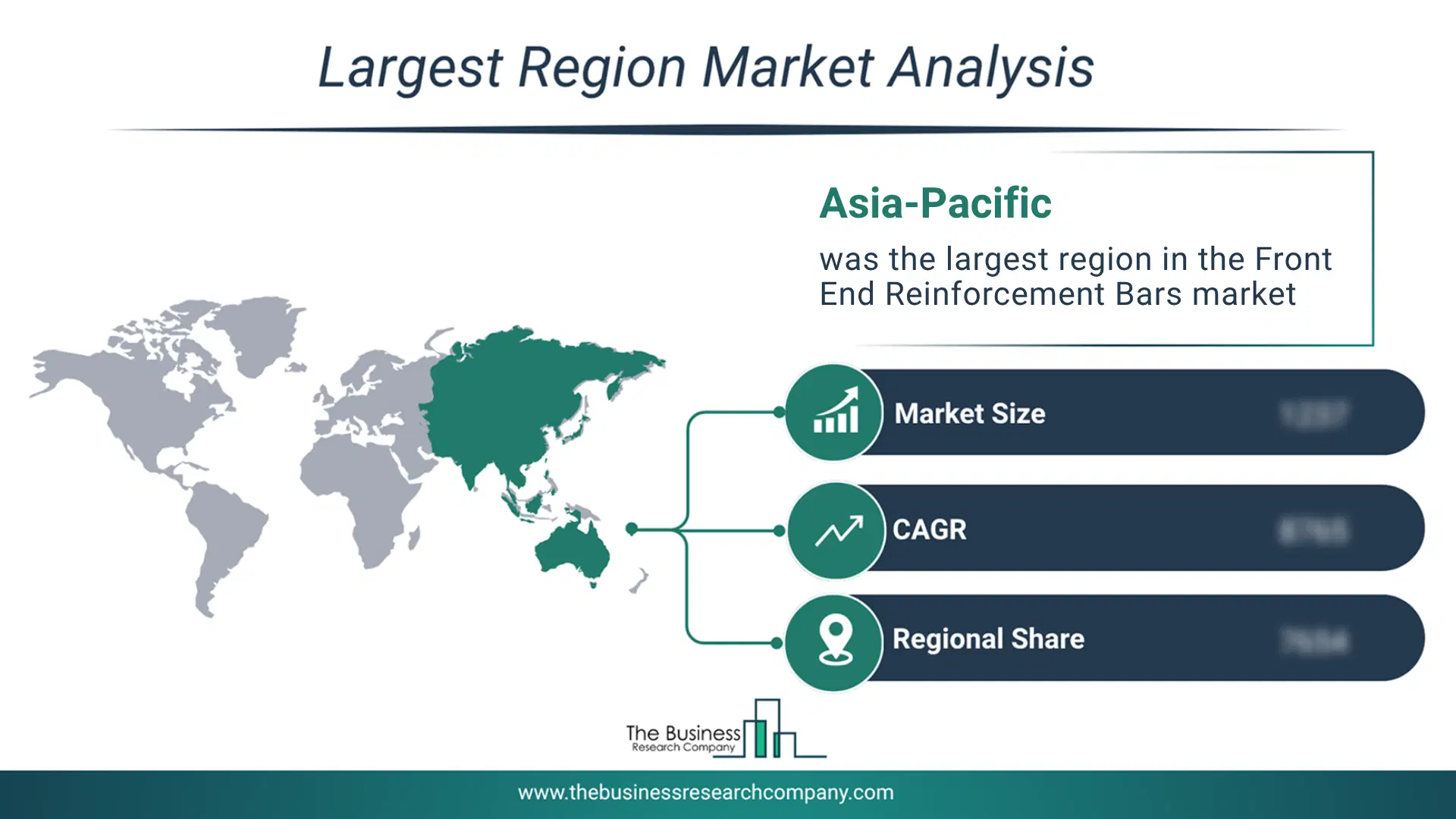
Regional Outlook
Asia-Pacific was the largest region in the front end reinforcement bars market in 2025. North America is expected to be the fastest-growing region in the forecast period. The regions covered in the front end reinforcement bars market are Asia-Pacific, South East Asia, Western Europe, Eastern Europe, North America, South America, Middle East, Africa. The countries covered in the front end reinforcement bars market are Australia, Brazil, China, France, Germany, India, Indonesia, Japan, Taiwan, Russia, South Korea, UK, USA, Canada, Italy, Spain.What Defines the Front End Reinforcement Bars Market?
The front end reinforcement bars market consists of sales of steel front-end reinforcement bars, aluminum front-end reinforcement bars, carbon-fiber-reinforced polymer front-end reinforcement bars, advanced high-strength steel (hot-stamped) front-end reinforcement bars, and hybrid metal composite front-end reinforcement bars. Values in this market are ‘factory gate’ values, that is the value of goods sold by the manufacturers or creators of the goods, whether to other entities (including downstream manufacturers, wholesalers, distributors and retailers) or directly to end customers. The value of goods in this market includes related services sold by the creators of the goods.How is Market Value Defined and Measured?
The market value is defined as the revenues that enterprises gain from the sale of goods and/or services within the specified market and geography through sales, grants, or donations in terms of the currency (in USD unless otherwise specified). The revenues for a specified geography are consumption values that are revenues generated by organizations in the specified geography within the market, irrespective of where they are produced. It does not include revenues from resales along the supply chain, either further along the supply chain or as part of other products.
This chart presents market attractiveness based on a quantitative evaluation of growth, competition, strategic alignment, and risk, offering a clear view of opportunity areas for decision-making. This chart is for illustrative purposes; the full report contains the complete analysis.

This chart highlights the Total Addressable Market (TAM) by estimating the maximum revenue opportunity using an assumption-driven approach, supporting strategic planning and opportunity sizing across markets. The chart is illustrative; the full report provides a more comprehensive analysis.
What Key Data and Analysis Are Included in the Front End Reinforcement Bars Market Report 2026?
The front end reinforcement bars market research report is one of a series of new reports from The Business Research Company that provides market statistics, including Market Report 2026?global market size, regional shares, competitors with the market share, detailed market segments, market trends and opportunities, and any further data you may need to thrive in the front end reinforcement bars Market Report 2026? The market research report delivers a complete perspective of everything you need, with an in-depth analysis of the current and future state of the Market Report 2026?Front End Reinforcement Bars Market Report Forecast Analysis
| Report Attribute | Details |
|---|---|
| Market Size Value In 2026 | $57.49 billion |
| Revenue Forecast In 2030 | $75.85 billion |
| Growth Rate | CAGR of 7.5% from 2026 to 2030 |
| Base Year For Estimation | 2025 |
| Actual Estimates/Historical Data | 2020-2025 |
| Forecast Period | 2026 - 2030 |
| Market Representation | Revenue in USD Billion and CAGR from 2026 to 2030 |
| Segments Covered | Product Type, Distribution Channel, Application (Vehicle Type), End-User |
| Regional Scope | Asia-Pacific, Western Europe, Eastern Europe, North America, South America, Middle East, Africa |
| Country Scope | The countries covered in the report are Australia, Brazil, China, France, Germany, India, Indonesia, Japan, Taiwan, Russia, South Korea, UK, USA, Canada, Italy, Spain. |
| Key Companies Profiled | ArcelorMittal SA, POSCO Holdings, Nippon Steel Corp., Hebei Iron and Steel Group Co. Ltd., Thyssenkrupp AG, Nucor Corporation, Tata Steel Limited, JSW Steel Limited, Hyundai Steel Company, Kobe Steel Limited, Ternium SA, Voestalpine Group, Novolipetsk Steel Group, Gerdau Sociedade Anônima, Reliance Steel & Aluminum Co., Steel Authority of India Limited, SSAB AB, Shagang Group Company Limited, Commercial Metals Company, Jindal Steel & Power Limited. |
| Customization Scope | Request for Customization |
| Pricing And Purchase Options | Explore Purchase Options |