
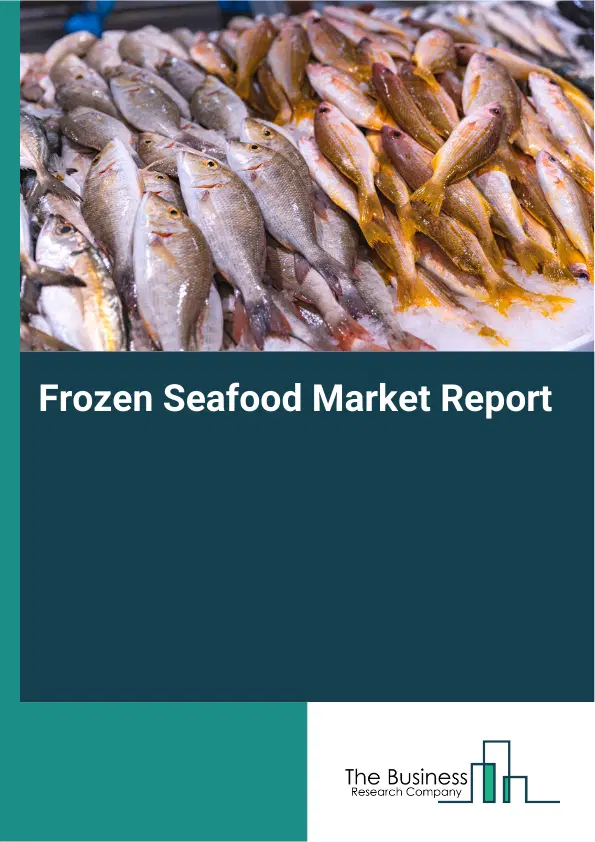
Frozen Seafood Market Report 2026
Global Outlook – By Category (Fish, Crustaceans, Shellfish, Mollusca), By Nature (Organic, Conventional), By Distribution Channel (Business-To-Business (B2B), Business-To-consumer (B2C)), By End User (Food Processing Industry, Food Service Provider, Retail And Household) – Market Size, Trends, Strategies, and Forecast to 2035
Frozen Seafood Market Overview
• Frozen Seafood market size has reached to $24.84 billion in 2025 • Expected to grow to $32.51 billion in 2030 at a compound annual growth rate (CAGR) of 5.5% • Growth Driver: Growing Appetite For Seafood Boosts Demand For Frozen Seafood Market • Market Trend: Frozen Shrimp Biscuits Meets Shifting Consumer Tastes • Asia-Pacific was the largest region in 2025.What Is Covered Under Frozen Seafood Market?
Frozen seafood refers to a type of seafood that has been frozen to maintain the natural quality of the fish by lowering the average temperature to -18 °C or below and then kept at a temperature of -18 °C or lower. The main types of frozen seafood are fish, crustaceans, shellfish, mollusks, and other types. Crustaceans refer to the group of marine arthropods which include shrimp, crabs, and lobsters. The various nature includes organic and conventional. These are distributed through various distribution channels such as business-to-business, and business-to-consumer and are used by various end users such as the food processing industry, food service providers, retail and household.
What Is The Frozen Seafood Market Size and Share 2026?
The frozen seafood market size has grown strongly in recent years. It will grow from $24.84 billion in 2025 to $26.22 billion in 2026 at a compound annual growth rate (CAGR) of 5.6%. The growth in the historic period can be attributed to expansion of global seafood trade, rising consumption of protein-rich diets, growth of industrial seafood processing, improved cold storage facilities, increasing urban seafood consumption.What Is The Frozen Seafood Market Growth Forecast?
The frozen seafood market size is expected to see strong growth in the next few years. It will grow to $32.51 billion in 2030 at a compound annual growth rate (CAGR) of 5.5%. The growth in the forecast period can be attributed to increasing demand for convenient protein sources, expansion of retail frozen seafood offerings, rising investments in sustainable fishing, growing focus on traceability, increasing preference for premium frozen seafood. Major trends in the forecast period include growing demand for long-shelf-life seafood products, expansion of frozen fish and shellfish consumption, increasing focus on quality preservation techniques, rising adoption of blast freezing methods, higher demand for value-added seafood products.
Global Frozen Seafood Market Segmentation
1) By Category: Fish, Crustaceans, Shellfish, Mollusca 2) By Nature: Organic, Conventional 3) By Distribution Channel: Business-To-Business (B2B), Business-To-consumer (B2C) 4) By End User: Food Processing Industry, Food Service Provider, Retail And Household Subsegments: 1) By Fish: Salmon, Tuna, Cod, Haddock 2) By Crustaceans: Shrimp, Crabs, Lobsters, Prawns 3) By Shellfish: Oysters, Clams, Mussels, Scallops 4) By Mollusca: Squid, Octopus, CuttlefishWhat Is The Driver Of The Frozen Seafood Market?
The rising consumption of seafood is expected to propel the growth of the frozen seafood market going forward. Seafood is any sort of sea life that is considered edible by humans. Consumers are preferring seafood as it provides various health benefits, and freezing seafood helps to maintain its color, texture, shape, and flavor. As a result, the rising consumption of seafood increases the demand for the frozen seafood market. For instance, in March 2024, according to the data from the Department of Agriculture, Fisheries, and Forestry, conducted by the Australian Bureau of Agricultural and Resource Economics, an Australia-based government agency, an estimated Aquaculture's share of seafood production value is set to grow from 60% in 2023–24 to 64% by 2028–29, reflecting a rising demand for high-quality seafood, with its total real value projected at $2.21 billion by 2028–29. Therefore, rising consumption of seafood drives the frozen seafood industry.What Is The Driver Of The Frozen Seafood Market?
The rising consumption of seafood is expected to propel the growth of the frozen seafood market going forward. Seafood is any sort of sea life that is considered edible by humans. Consumers are preferring seafood as it provides various health benefits, and freezing seafood helps to maintain its color, texture, shape, and flavor. As a result, the rising consumption of seafood increases the demand for the frozen seafood market. For instance, in March 2024, according to the data from the Department of Agriculture, Fisheries, and Forestry, conducted by the Australian Bureau of Agricultural and Resource Economics, an Australia-based government agency, an estimated Aquaculture's share of seafood production value is set to grow from 60% in 2023–24 to 64% by 2028–29, reflecting a rising demand for high-quality seafood, with its total real value projected at $2.21 billion by 2028–29. Therefore, rising consumption of seafood drives the frozen seafood industry.Global Frozen Seafood Market Trends and Insights
Major companies operating in the frozen seafood market are focused on developing innovative products, such as frozen shrimp biscuits, to cater to evolving consumer preferences, enhance their product portfolios, and maintain a competitive edge in the dynamic market landscape. Frozen Shrimp Biscuits refer to a seafood product featuring shrimp combined with biscuit dough, designed to be stored in a frozen state and prepared by consumers for a convenient and flavorful meal or snack. For instance, in February 2023, Red Lobster Hospitality LLC, a US-based casual dining restaurant chain, introduced its inaugural line of retail seafood products, bringing the zest of its renowned dishes to the frozen aisle. The new retail entrées, such as Cheddar Bay Biscuit Shrimp, blending the iconic biscuit with flavorful shrimp, and Coconut Shrimp Bites, offer a convenient way to savor delectable seafood at any time. Whether for a swift and hassle-free dinner, a delightful party appetizer, or a go-to late-night shrimp snack, this range of new seafood products expands on the existing retail offerings, providing a variety of options for seafood enthusiasts.What Are Latest Mergers And Acquisitions In The Frozen Seafood Market?
In September 2023, Mark Foods, a US-based seafood company, acquired Arista Industries for an undisclosed amount. This strategic acquisition aims to enhance Mark Foods' portfolio by expanding its reach in frozen seafood offerings, improving supply chain efficiencies, and leveraging Arista Industries' established distribution network. Arista Industries is a US-based company operating in frozen seafoodRegional Outlook
Asia-Pacific was the largest region in the frozen seafood market share in 2025. The regions covered in this market report are Asia-Pacific, South East Asia, Western Europe, Eastern Europe, North America, South America, Middle East and Africa. The countries covered in this market report are Australia, Brazil, China, France, Germany, India, Indonesia, Japan, Taiwan, Russia, South Korea, UK, USA, Italy, Spain, CanadaWhat Defines the Frozen Seafood Market?
The frozen seafood market consists of sales of marine pelagic, marine demersal, and diadromous. Values in this market are ‘factory gate’ values, that is the value of goods sold by the manufacturers or creators of the goods, whether to other entities (including downstream manufacturers, wholesalers, distributors, and retailers) or directly to end customers. The value of goods in this market includes related services sold by the creators of the goods.How is Market Value Defined and Measured?
The market value is defined as the revenues that enterprises gain from the sale of goods and/or services within the specified market and geography through sales, grants, or donations in terms of the currency (in USD unless otherwise specified). The revenues for a specified geography are consumption values that are revenues generated by organizations in the specified geography within the market, irrespective of where they are produced. It does not include revenues from resales along the supply chain, either further along the supply chain or as part of other products.What Key Data and Analysis Are Included in the Frozen Seafood Market Report 2026?
The frozen seafood market research report is one of a series of new reports from The Business Research Company that provides market statistics, including industry global market size, regional shares, competitors with the market share, detailed market segments, market trends and opportunities, and any further data you may need to thrive in the frozen seafood industry. The market research report delivers a complete perspective of everything you need, with an in-depth analysis of the current and future state of the industry.Frozen Seafood Market Report Forecast Analysis
| Report Attribute | Details |
|---|---|
| Market Size Value In 2026 | $26.22 billion |
| Revenue Forecast In 2035 | $32.51 billion |
| Growth Rate | CAGR of 5.6% from 2026 to 2035 |
| Base Year For Estimation | 2025 |
| Actual Estimates/Historical Data | 2020-2025 |
| Forecast Period | 2026 - 2030 - 2035 |
| Market Representation | Revenue in USD Billion and CAGR from 2026 to 2035 |
| Segments Covered | Category, Nature, Distribution Channel, End User |
| Regional Scope | Asia-Pacific, Western Europe, Eastern Europe, North America, South America, Middle East, Africa |
| Country Scope | The countries covered in the report are Australia, Brazil, China, France, Germany, India, ... |
| Key Companies Profiled | Toyo Suisan Kaisha Ltd., Maruha Nichiro Corporation, Mowi ASA, Nippon Suisan Kaisha Ltd., Thai Union Group Public Company Limited, Nomad Foods Limited, Findus Group Limited, Lerøy Seafood Group ASA, AquaChile S.A., Empresas AquaChile S.A., Royal Greenland A/S, High Liner Foods Inc., Ocean Beauty Seafoods LLC, Tassal Group Limited, Pacific Seafood, Clearwater Seafoods Incorporated, Trident Seafoods Corporation, Bumble Bee Foods LLC, Surapon Foods Public Company Limited, Apex Frozen Foods Limited, Beaver Street Fisheries Inc., Mazetta Company LLC, Cooke Aquaculture Inc., Alliance Select Foods International Inc., Siam Canadian Group Limited, J. Sykes & Sons, Castlerock Inc., Tri Marine International Inc., Friosur S.A. |
| Customization Scope | Request for Customization |
| Pricing And Purchase Options | Explore Purchase Options |