
Fructooligosaccharides Market Report 2026
Global Outlook – By Source (Chicory, Sucrose), By Form (Powder, Liquid), By Application (Food And Beverages, Animal Feed, Dietary Supplements, Infant Formula, Other Applications) – Market Size, Trends, Strategies, and Forecast to 2030
Fructooligosaccharides Market Overview
• Fructooligosaccharides market size has reached to $3.17 billion in 2025 • Expected to grow to $4.53 billion in 2030 at a compound annual growth rate (CAGR) of 7.2% • Growth Driver: Rising Obesity Prevenance Fuel Growth In The Fructooligosaccharides Market • Market Trend: Development Of Short-Chain Fructooligosaccharides (scFOS) To Enhance Sugar Reduction And Gut Health • North America was the largest region and fastest growing region.Market Gains By 2030 – Top Opportunities By Segment
Market Gain identifies the most promising market opportunities by highlighting the segments or products expected to generate the highest incremental revenue growth over the next five years.
What Is Covered Under Fructooligosaccharides Market?
Fructooligosaccharides (FOS) are a type of carbohydrate composed of short fructose chains, occurring naturally in various plants such as blue agave, chicory root, and bananas. They are nondigestible, providing a low-calorie, sweet alternative to sugar, and have been linked to several health benefits, including prebiotic effects, improved mineral absorption, and decreased cholesterol levels. The main source types of fructooligosaccharides are chicory and sucrose. Chicory is a type of plant that is used to produce fructooligosaccharides (FOS) through enzymatic conversion of sucrose. The various forms include powder, and liquid that are used in various applications such as food and beverages, animal feed, dietary supplements, infant formula, pharmaceuticals, and others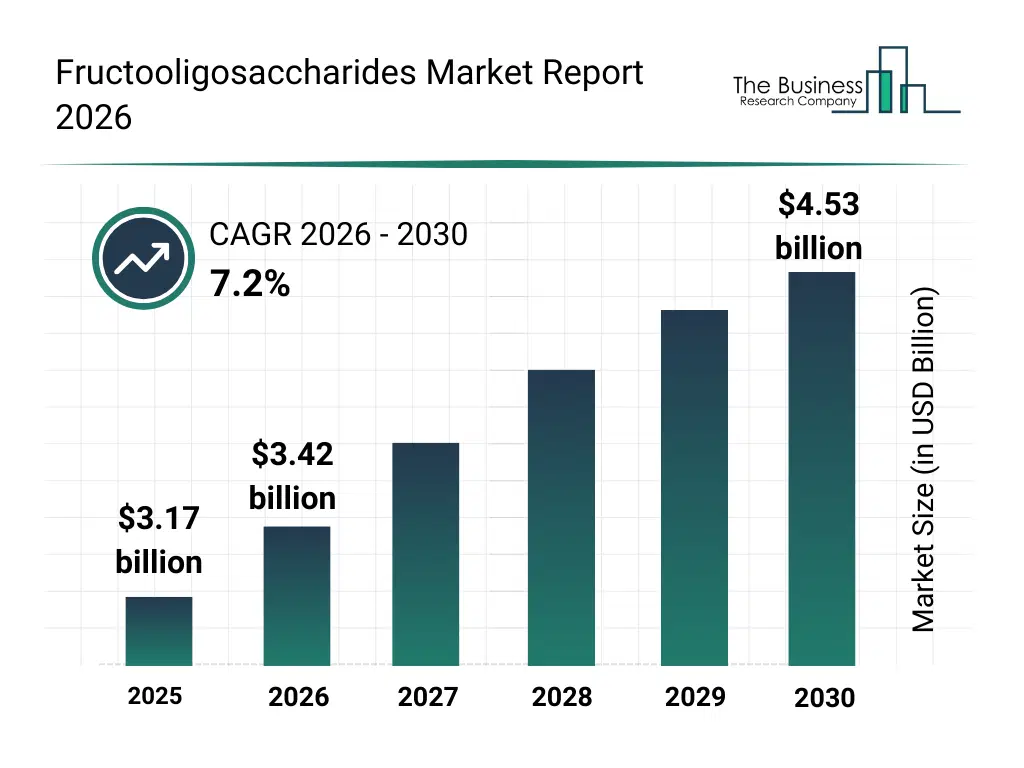
What Is The Fructooligosaccharides Market Size and Share 2026?
The fructooligosaccharides market size has grown strongly in recent years. It will grow from $3.17 billion in 2025 to $3.42 billion in 2026 at a compound annual growth rate (CAGR) of 8.1%. The growth in the historic period can be attributed to rising consumer health awareness, expansion of functional foods, demand for sugar alternatives, growth in dietary supplements, infant nutrition market growth.What Is The Fructooligosaccharides Market Growth Forecast?
The fructooligosaccharides market size is expected to see strong growth in the next few years. It will grow to $4.53 billion in 2030 at a compound annual growth rate (CAGR) of 7.2%. The growth in the forecast period can be attributed to preventive healthcare adoption, microbiome research expansion, clean label food demand, aging population nutrition needs, functional beverage innovation. Major trends in the forecast period include growing demand for prebiotic ingredients, increasing use in functional food formulations, rising adoption in infant nutrition products, expansion of low-calorie sweetener applications, focus on gut health and digestive wellness.
Global Fructooligosaccharides Market Segmentation
1) By Source: Chicory, Sucrose 2) By Form: Powder, Liquid 3) By Application: Food And Beverages, Animal Feed, Dietary Supplements, Infant Formula, Other Applications Subsegments: 1) By Chicory: Chicory Root Extract, Chicory Inulin-Based FOS, High-Purity Chicory FOS 2) By Sucrose: Sucrose-Based FOS, Sugar Beet- And Sugar Cane-Derived FOS The top segments in the fructooligosaccharides market will be: • Chicory will reach $2.94 Billion by 2030. • Sucrose will reach $1.57 Billion by 2030.What Is The Driver Of The Fructooligosaccharides Market?
The increasing prevalence of obesity is expected to propel the growth of the fructooligosaccharides market going forward. Obesity is a long-term health condition characterized by an excessive accumulation of body fat that can negatively impact health. The prevalence of obesity is due to the widespread availability of high-calorie, high-fat, and high-sugar foods, sedentary lifestyles, and reduced physical activity in daily life. Fructooligosaccharides (FOS) are used as a dietary supplement or functional ingredient in foods to aid in obesity management potentially. Fructooligosaccharides (FOS) enhance lipids and glucose metabolism, potentially contributing to better energy utilization and weight management. For instance, in March 2023, according to the World Heart Foundation, a Switzerland-based non-government community, around 2.3 billion adults and children are obese or overweight globally, and it is expected to reach 2.7 billion by 2025. Therefore, increasing concerns about obesity drive the fructooligosaccharides industry.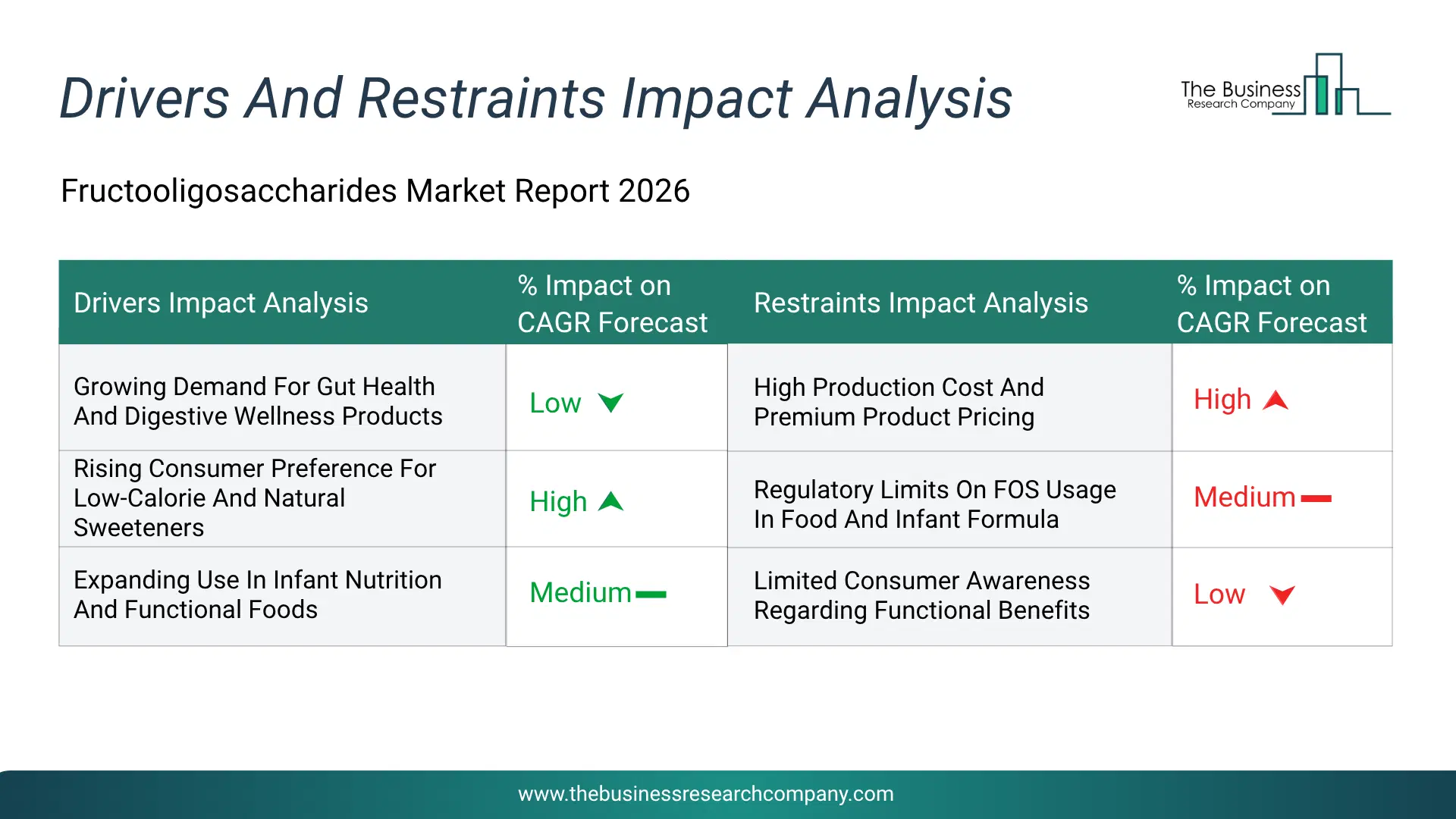
Infographic Chart Showing Key Market Drivers Analysis And Restraints For Fructooligosaccharides Market
The chart presents an impact analysis of key drivers and restraints, quantifying their relative influence on the market's growth rate and helping assess the balance between growth enablers and limiting factors. This chart offers a high-level perspective; the full report contains more detailed insights.
How Will The Drivers Impact Growth In The Global Fructooligosaccharides Market?
• Growing Demand For Gut Health And Digestive Wellness Products (Low) – During the forecast period, the growing demand for gut health and digestive wellness products is expected to become a key growth driver for the fructooligosaccharides market by 2030. Growing demand for gut health and digestive wellness is a major driver for the fructooligosaccharides market because fructooligosaccharides act as prebiotics that support the growth of beneficial gut bacteria. Consumers are becoming more aware of the importance of digestive health in maintaining overall well-being and immunity, leading to higher demand for functional food ingredients. Food and beverage manufacturers are increasingly incorporating fructooligosaccharides into dairy products, infant formula, nutritional supplements, and health drinks. Their ability to improve digestive health while providing low-calorie sweetness further enhances their appeal. • Rising Consumer Preference For Low-Calorie And Natural Sweeteners (High) – During the forecast period, the rising consumer preference for low-calorie and natural sweeteners is expected to emerge as a major factor driving the expansion of the fructooligosaccharides market by 2030. Rising consumer preference for low-calorie and natural sweeteners is driving the fructooligosaccharides market as more people seek healthier alternatives to refined sugar. Fructooligosaccharides provide mild sweetness with fewer calories while also offering prebiotic benefits, making them suitable for health-conscious consumers. Food and beverage manufacturers are increasingly using them in sugar-reduced products, functional foods, dairy products, and beverages to meet changing consumer preferences. The growing prevalence of obesity and diabetes has further encouraged the adoption of low-calorie sweetening ingredients. • Expanding Use In Infant Nutrition And Functional Foods (Medium) – During the forecast period, the expanding use in infant nutrition and functional foods is expected to act as a key growth catalyst for the fructooligosaccharides market by 2030. Expanding use in infant nutrition and functional foods is driving the fructooligosaccharides market because these ingredients help support digestive health and promote the growth of beneficial gut bacteria. Fructooligosaccharides are increasingly added to infant formula to more closely resemble the benefits of human breast milk for gut health. They are also widely used in functional foods, dairy products, cereals, and nutritional beverages to enhance their health benefits. Growing consumer demand for foods that support immunity and overall wellness is encouraging manufacturers to include fructooligosaccharides in new product formulations.How Will The Restraints Impact Growth In The Global Fructooligosaccharides Market?
• High Production Cost And Premium Product Pricing (Low) – During the forecast period, the high production cost and premium product pricing act as a restraint on the fructooligosaccharides market because the manufacturing process requires specialized raw materials and advanced processing technologies. These higher production costs result in premium-priced products compared to conventional sweeteners and dietary fibers. Price-sensitive consumers and food manufacturers may choose lower-cost alternatives, limiting the adoption of fructooligosaccharides. The challenge is particularly significant in developing markets where affordability strongly influences purchasing decisions. As a result, high costs can slow market expansion despite the growing demand for healthy food ingredients. • Regulatory Limits On FOS Usage In Food And Infant Formula (High) – During the forecast period, the regulatory limits on FOS usage in food and infant formula restrain the fructooligosaccharides market because manufacturers must comply with strict safety and labeling requirements in different countries. Regulatory authorities often specify the permitted levels of fructooligosaccharides that can be added to food and infant nutrition products. Meeting these regulations can increase product development time and compliance costs for manufacturers. Differences in regulatory standards across regions also make global product launches more challenging. These factors can slow the adoption and commercialization of fructooligosaccharides in certain markets. • Limited Consumer Awareness Regarding Functional Benefits (Medium) – During the forecast period, the limited consumer awareness regarding functional benefits acts as a restraint on the Fructooligosaccharides market because many consumers remain unfamiliar with the digestive health benefits associated with prebiotic ingredients. Lack of awareness reduces demand for FOS-based products compared with more established dietary fiber and sweetener alternatives. Food manufacturers may also hesitate to introduce FOS ingredients without strong consumer recognition and market demand. Increased education and marketing efforts are required to improve acceptance. As a result, limited awareness can restrict broader adoption of fructooligosaccharides.Key Players In The Global Fructooligosaccharides Market
Major companies operating in the fructooligosaccharides market are Beneo GmbH, Sensus, Cosucra Groupe Warcoing, Baolingbao Biology Co. Ltd., Quantum Hi-Tech (China) Biological Co. Ltd., Galam Ltd., Tereos Group, Südzucker AG, Beghin-Meiji SA, CJ CheilJedang, Nissin Sugar Co. Ltd., Meiji Holdings Co. Ltd., Yakult Honsha Co. Ltd., Ingredion Incorporated, Tate & Lyle PLC, Cargill Incorporated, Nippon Beet Sugar Manufacturing, Baolingbao Health Food, Shandong Bailong Chuangyuan Bio-Tech, Fujian Zhuoyue New Energy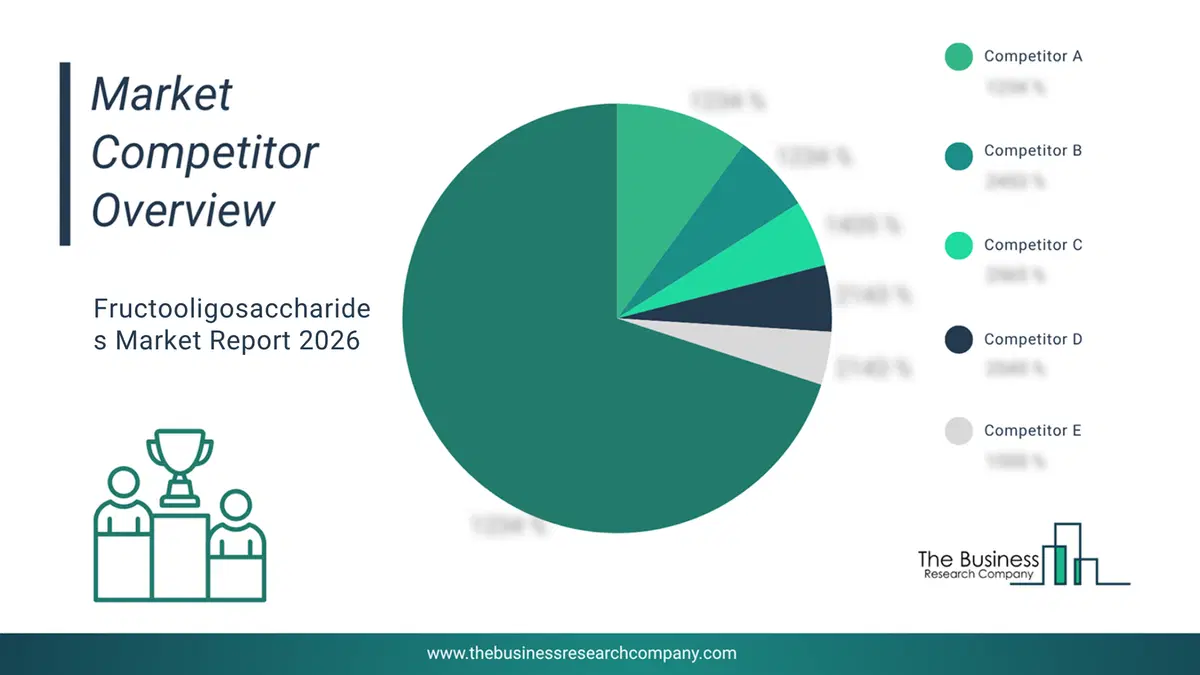
This chart is for illustrative purposes; the full report includes a detailed competitor analysis and comprehensive overview of the top 10 companies in the market.
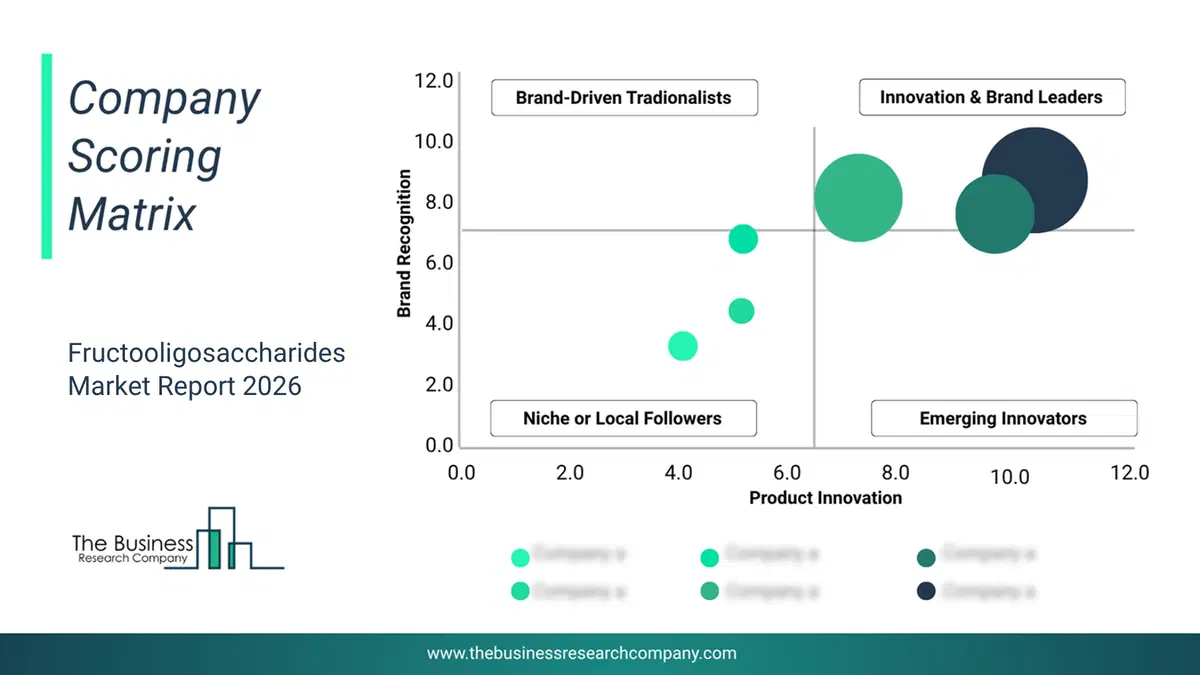
This chart maps companies by product innovation and brand strength, with bubble size indicating relative revenue, helping identify market leaders, challengers, and niche players. This is an illustrative chart; the full report provides a complete and accurate competitive analysis.
Global Fructooligosaccharides Market Trends and Insights
Major companies are operating in the Fructooligosaccharides (FOS) market focusing on developing innovative product such as short-chain fructooligosaccharides (scFOS) for sugar reduction and prebiotic benefits to enhance nutritional profile, improve digestive health, and reduce caloric intake. A short-chain fructooligosaccharide (scFOS) is composed of 3–4 fructose units with a terminal glucose unit, resisting digestion in the small intestine and serving as dietary fiber; compared with traditional sweeteners such as sucrose or high-fructose corn syrup, scFOS provides mild sweetness, lowers caloric content, and supports gut microbiota growth. For instance, in May 2023, BENEO GmbH, a Germany-based functional-ingredients company, launched Beneo-scL85, a short-chain fructooligosaccharide syrup designed for sugar reduction and fiber enrichment. The product is derived from beet sugar, offers good solubility and mild sweetness, can be used in bakery, dairy, and cereal applications, and helps manufacturers achieve lower-sugar front-of-pack nutrition labeling while supporting gut health.What Are Latest Mergers And Acquisitions In The Fructooligosaccharides Market?
In February 2025, SEQENS, a France-based provider of specialty chemicals and enzyme-driven bioprocessing solutions, partnered with Applexion to expand its global reach in the fructooligosaccharides (FOS) segment by leveraging Applexion’s distribution capabilities to accelerate adoption of enzyme-based scFOS production technologies. Applexion, a U.S.-based provider of distribution and supply-chain solutions for the agro-food industry, will distribute SEQENZYM FT, enhancing the availability of high-purity prebiotic FOS ingredients worldwide.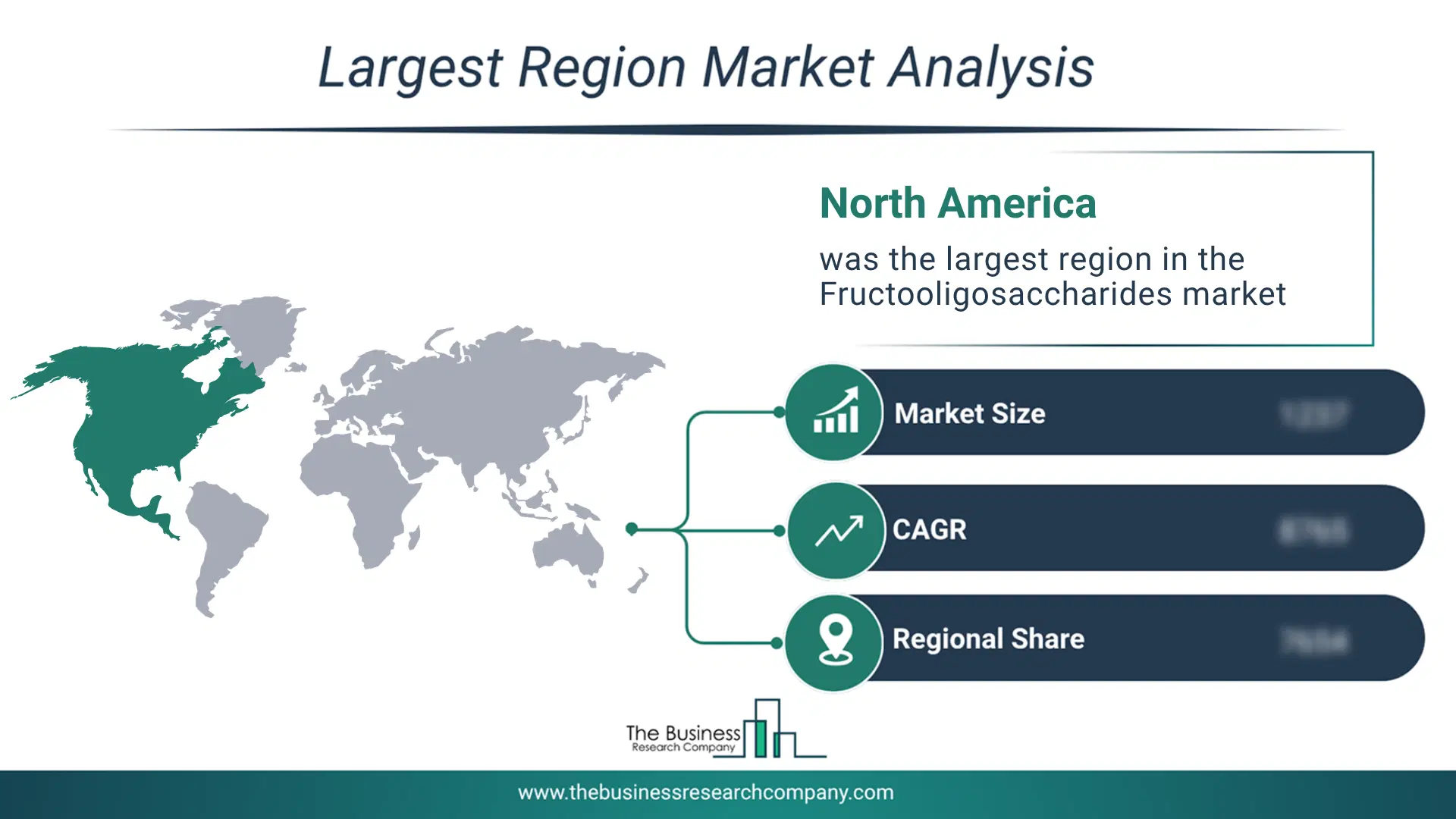
Regional Insights
North America was the largest region in the fructooligosaccharides market in 2025. Asia-Pacific is expected to be the fastest-growing region in the forecast period. The regions covered in this market report are Asia-Pacific, South East Asia, Western Europe, Eastern Europe, North America, South America, Middle East, Africa The countries covered in this market report are Australia, Brazil, China, France, Germany, India, Indonesia, Japan, Taiwan, Russia, South Korea, UK, USA, Canada, Italy, SpainWhat Defines the Fructooligosaccharides Market?
The fructooligosaccharides market consists of sales of Inulin-derived fructooligosaccharides, Levan-type fructooligosaccharides, Neosugar, and Synthesized fructooligosaccharides. Values in this market are ‘factory gate’ values, that is the value of goods sold by the manufacturers or creators of the goods, whether to other entities (including downstream manufacturers, wholesalers, distributors, and retailers) or directly to end customers. The value of goods in this market includes related services sold by the creators of the goods.How is Market Value Defined and Measured?
The market value is defined as the revenues that enterprises gain from the sale of goods and/or services within the specified market and geography through sales, grants, or donations in terms of the currency (in USD unless otherwise specified). The revenues for a specified geography are consumption values that are revenues generated by organizations in the specified geography within the market, irrespective of where they are produced. It does not include revenues from resales along the supply chain, either further along the supply chain or as part of other products.
This chart presents market attractiveness based on a quantitative evaluation of growth, competition, strategic alignment, and risk, offering a clear view of opportunity areas for decision-making. This chart is for illustrative purposes; the full report contains the complete analysis.

This chart highlights the Total Addressable Market (TAM) by estimating the maximum revenue opportunity using an assumption-driven approach, supporting strategic planning and opportunity sizing across markets. The chart is illustrative; the full report provides a more comprehensive analysis.
What Key Data and Analysis Are Included in the Fructooligosaccharides Market Report 2026?
The fructooligosaccharides market research report is one of a series of new reports from The Business Research Company that provides market statistics, including industry global market size, regional shares, competitors with the market share, detailed market segments, market trends and opportunities, and any further data you may need to thrive in the fructooligosaccharides industry. The market research report delivers a complete perspective of everything you need, with an in-depth analysis of the current and future state of the industry.Fructooligosaccharides Market Report Forecast Analysis
| Report Attribute | Details |
|---|---|
| Market Size Value In 2026 | $3.42 billion |
| Revenue Forecast In 2030 | $4.53 billion |
| Growth Rate | CAGR of 8.1% from 2026 to 2030 |
| Base Year For Estimation | 2025 |
| Actual Estimates/Historical Data | 2020-2025 |
| Forecast Period | 2026 - 2030 |
| Market Representation | Revenue in USD Billion and CAGR from 2026 to 2030 |
| Segments Covered | Source, Form, Application |
| Regional Scope | Asia-Pacific, Western Europe, Eastern Europe, North America, South America, Middle East, Africa |
| Country Scope | The countries covered in the report are Australia, Brazil, China, France, Germany, India, ... |
| Key Companies Profiled | Beneo GmbH, Sensus, Cosucra Groupe Warcoing, Baolingbao Biology Co. Ltd., Quantum Hi-Tech (China) Biological Co. Ltd., Galam Ltd., Tereos Group, Südzucker AG, Beghin-Meiji SA, CJ CheilJedang, Nissin Sugar Co. Ltd., Meiji Holdings Co. Ltd., Yakult Honsha Co. Ltd., Ingredion Incorporated, Tate & Lyle PLC, Cargill Incorporated, Nippon Beet Sugar Manufacturing, Baolingbao Health Food, Shandong Bailong Chuangyuan Bio-Tech, Fujian Zhuoyue New Energy |
| Customization Scope | Request for Customization |
| Pricing And Purchase Options | Explore Purchase Options |