
Fruit And Vegetable Processing Market Report 2026
Global Outlook – By Product Type (Fresh-Cut, Canned, Frozen, Dried And Dehydrated, Convenience ), By Operation Type (Automatic, Semi-Automatic), By Material (Fruits, Vegetables), By Processing Systems (Large-Scale Processing, Intermediate-Scale Processing, Small-Scale Processing), By Equipment Type (Pre-Processing, Peeling Or Inspection Or Slicing, Washing And Dewatering, Fillers, Packaging And Handling, Seasoning Systems, Other Equipment) – Market Size, Trends, Strategies, and Forecast to 2030
Fruit And Vegetable Processing Market Overview
• Fruit And Vegetable Processing market size has reached to $255.85 billion in 2025 • Expected to grow to $384.62 billion in 2030 at a compound annual growth rate (CAGR) of 8.6% • Growth Driver: Surging Consumer Demand For Frozen Food Propels Growth In Fruit And Vegetable Processing Market • Market Trend: Smart Sorting Technology Replaces Manual Inspection Methods • North America was the largest region in 2025 and Asia-Pacific is the fastest growing region.What Is Covered Under Fruit And Vegetable Processing Market?
Fruit and vegetable processing refers to a method of increasing shelf life and retaining the quality of fruits and vegetables for long-term preservation. When fruits and vegetables are processed, such as by preparing juices, jams, and jellies, their shelf life is extended. A processing step consists of preparing the raw material. The main product types of fruit and vegetable processing are fresh, fresh-cut, canned, frozen, dried and dehydrated, and convenient. Fresh refers to fruit and vegetable products that are minimally processed to increase their functionality without greatly affecting their freshness. The product tastes fresh, has no change in appearance, and retains its nutritional value. The operation types are automatic and semi-automatic, and the materials are fruits, and vegetables. The processing systems are large-scale processing, intermediate-scale processing, and small-scale processing, and also equipment types include pre-processing, peeling/inspection/slicing, washing and dewatering, fillers, packaging and handling, seasoning systems, and other types of equipment.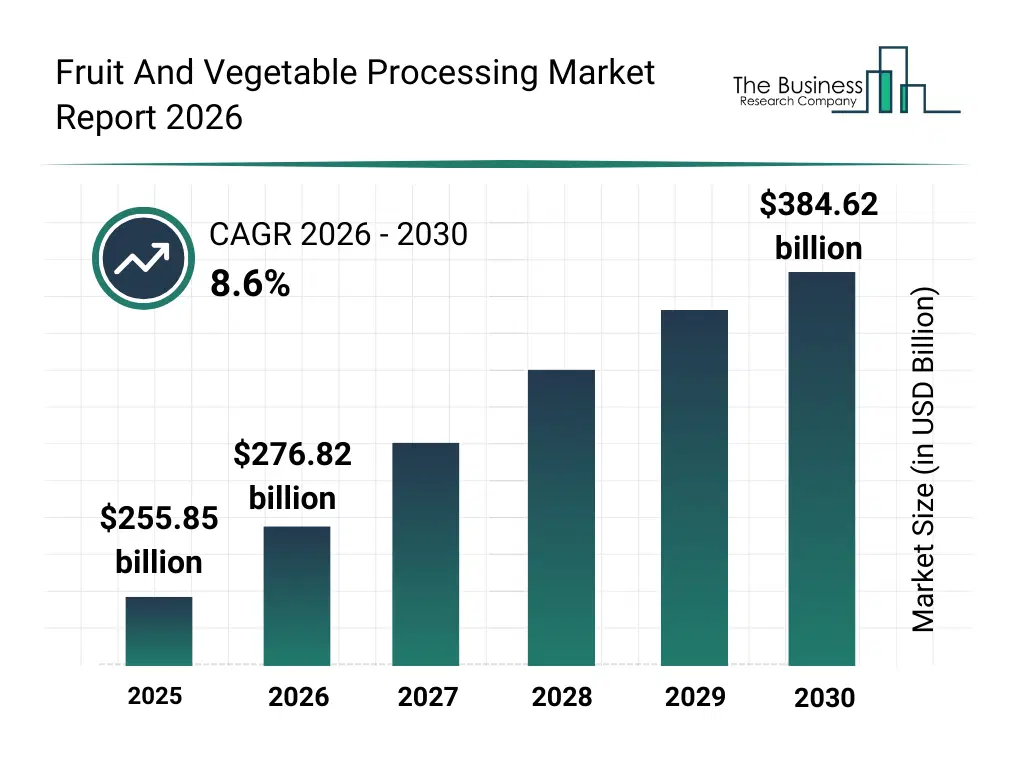
What Is The Fruit And Vegetable Processing Market Size and Share 2026?
The fruit and vegetable processing market size has grown strongly in recent years. It will grow from $255.85 billion in 2025 to $276.82 billion in 2026 at a compound annual growth rate (CAGR) of 8.2%. The growth in the historic period can be attributed to expansion of food preservation practices, rising consumption of packaged fruits and vegetables, growth of cold storage infrastructure, adoption of mechanized processing equipment, increased urban food demand.What Is The Fruit And Vegetable Processing Market Growth Forecast?
The fruit and vegetable processing market size is expected to see strong growth in the next few years. It will grow to $384.62 billion in 2030 at a compound annual growth rate (CAGR) of 8.6%. The growth in the forecast period can be attributed to growing investments in advanced processing technologies, rising demand for ready-to-eat produce, expansion of small and medium processing facilities, increasing focus on food waste reduction, adoption of smart processing systems. Major trends in the forecast period include expansion of automated processing lines, rising demand for frozen and convenience products, growing adoption of hygienic processing systems, increased focus on shelf-life extension techniques, enhanced use of energy-efficient equipment.
Global Fruit And Vegetable Processing Market Segmentation
1) By Product Type: Fresh-Cut, Canned, Frozen, Dried And Dehydrated, Convenience 2) By Operation Type: Automatic, Semi-Automatic 3) By Material: Fruits, Vegetables 4) By Processing Systems: Large-Scale Processing, Intermediate-Scale Processing, Small-Scale Processing 5) By Equipment Type: Pre-Processing, Peeling Or Inspection Or Slicing, Washing And Dewatering, Fillers, Packaging And Handling, Seasoning Systems, Other Equipment Subsegments: 1) By Fresh-Cut: Fresh-Cut Fruits, Fresh-Cut Vegetables 2) By Canned: Canned Fruits, Canned Vegetables 3) By Frozen: Frozen Fruits, Frozen Vegetables 4) By Dried And Dehydrated: Dried Fruits, Dehydrated Vegetables 6) By Convenience: Ready-To-Eat Fruits, Ready-To-Eat Vegetables, Pre-Packaged SnacksWhat Is The Driver Of The Fruit And Vegetable Processing Market?
The rising demand for frozen foods is expected to boost the growth of the fruit and vegetable processing market going forward. Frozen food refers to food items that have undergone a process of freezing to preserve them for an extended period. The efficacy of freezing as a preservation method, extending the shelf life of fruits and vegetables, fuels the demand for processing these items to produce frozen products, thereby minimizing food waste and ensuring availability throughout the year. For instance, in July 2024, according to the American Frozen Food Institute (AFFI), a US-based national trade association, in 2023, frozen fruit saw an 8.8% increase in unit sales over the first half of the year. Therefore, the rising demand for frozen foods is driving the growth of the fruit and vegetable processing industry.Key Players In The Global Fruit And Vegetable Processing Market
Major companies operating in the fruit and vegetable processing market are Del Monte Foods, Bühler Holding AG, Alfa Laval AB, JBT Corporation, Syntegon Technology GmbH, Krones AG, Bigtem, FENCO Food Machinery SRL, Dole PLC, Heat and Control Inc., Conagra Foods, The Agrana Group, Nestlé S.A., Olam International, SVZ International, Archer Daniels Midland Company, Kraft Heinz Company, GEA Group, Robert Bosch GmbH, Tetra Laval International S.A., SPX Flow Inc., KHS GmbH, HRS Process Systems Ltd., Turatti Srl, Sormac B.V., Vanmark Corporation, Key Technology Inc., TOMRA Systems ASA
This chart is for illustrative purposes; the full report includes a detailed competitor analysis and comprehensive overview of the top 10 companies in the market.
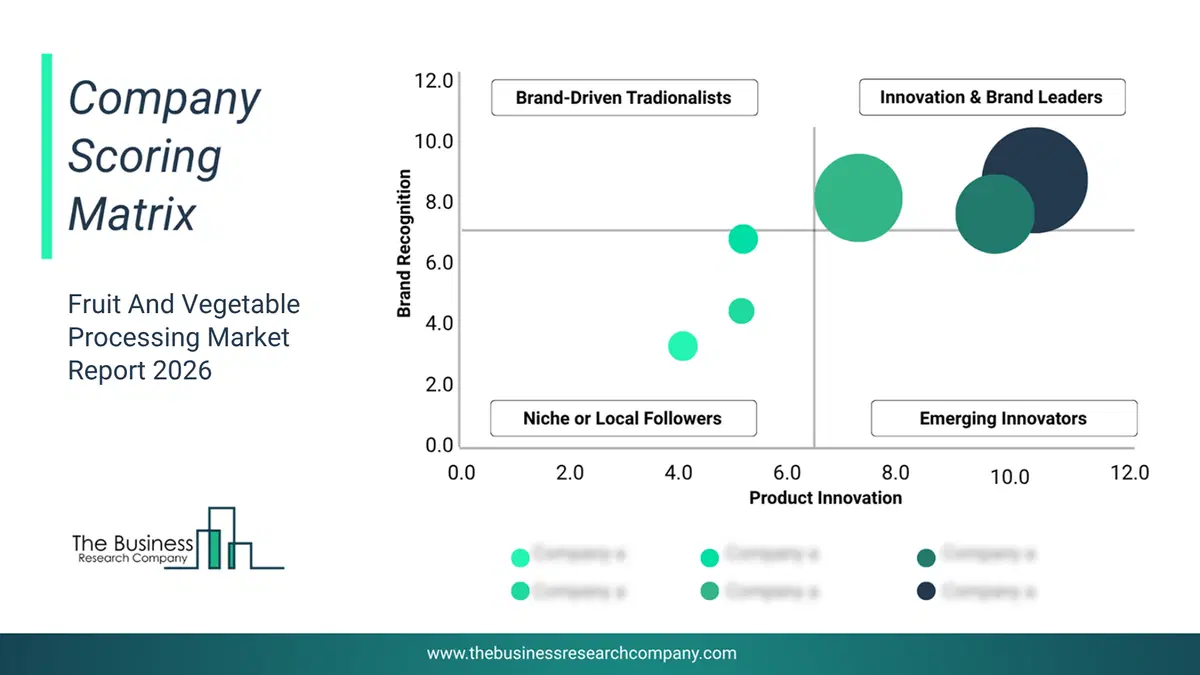
This chart maps companies by product innovation and brand strength, with bubble size indicating relative revenue, helping identify market leaders, challengers, and niche players. This is an illustrative chart; the full report provides a complete and accurate competitive analysis.
Global Fruit And Vegetable Processing Market Trends and Insights
Major companies operating in the fruit and vegetable processing market are focusing on developing advanced solutions, such as AI-powered sorting solutions, to replace traditional manual sorting methods. An AI-powered solution refers to a technology that improves operational efficiency, enhances accuracy, reduces waste, and supports sustainable production. For instance, in October 2024, Tomra Systems ASA, a Norway-based food technology company, introduced its LUCAi AI solution at Fruit Attraction 2024. This innovation replaces conventional manual sorting by analyzing complex image patterns of vegetables such as carrots and peppers to ensure high-precision sorting and defect removal. Integrated with TOMRA’s sorting machines like the TOMRA 5A, it offers a seamless automated processing experience. The AI solution improves sorting accuracy, enhances food safety, simplifies processing operations, and helps reduce waste while supporting sustainability initiatives in the fruit and vegetable sector.What Are Latest Mergers And Acquisitions In The Fruit And Vegetable Processing Market?
In September 2024, Tweet/Garot Mechanical Inc., a US-based design, engineering, fabrication, and installation of plumbing, heating, air conditioning, and ventilation systems, acquired G.J. Olney Inc. for an undisclosed amount. Through this acquisition, Tweet/Garot Mechanical Inc. aims to enhance its presence in the food and beverage industry by incorporating G.J. Olney’s established product line into its portfolio. This integration allows for a broader range of innovative solutions in fruit and vegetable processing, reinforcing Tweet Garot's commitment to quality and growth in the sector. G.J. Olney Inc. is a US-based company focused on delivering innovative machinery and services for fruit and vegetable processing to enhance efficiency in food production.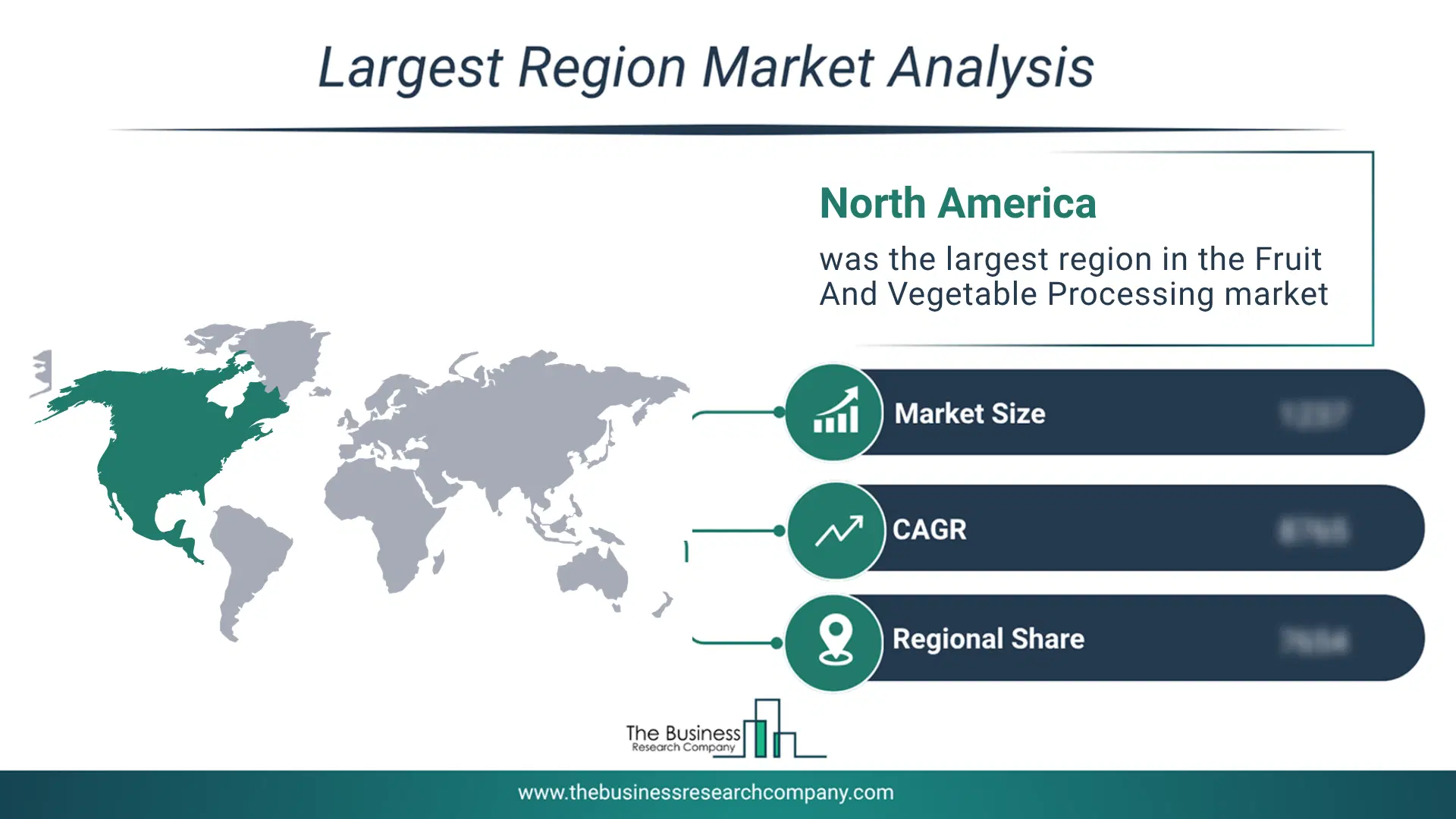
Regional Outlook
North America was the largest region in the fruit and vegetable processing market share in 2025. Asia-Pacific is expected to be the fastest-growing region in the forecast period. The regions covered in this market report are Asia-Pacific, South East Asia, Western Europe, Eastern Europe, North America, South America, Middle East and Africa. The countries covered in this market report are Australia, Brazil, China, France, Germany, India, Indonesia, Japan, Taiwan, Russia, South Korea, UK, USA, Italy, Spain, CanadaWhat Defines the Fruit And Vegetable Processing Market?
The fruit and vegetable processing market consist of sales of cleaning, trimming, and peeling, followed by cooking, canning, or freezing of fruit and vegetable processing products. Values in this market are ‘factory gate’ values, that is the value of goods sold by the manufacturers or creators of the goods, whether to other entities (including downstream manufacturers, wholesalers, distributors, and retailers) or directly to end customers. The value of goods in this market includes related services sold by the creators of the goods.How is Market Value Defined and Measured?
The market value is defined as the revenues that enterprises gain from the sale of goods and/or services within the specified market and geography through sales, grants, or donations in terms of the currency (in USD unless otherwise specified). The revenues for a specified geography are consumption values that are revenues generated by organizations in the specified geography within the market, irrespective of where they are produced. It does not include revenues from resales along the supply chain, either further along the supply chain or as part of other products.
This chart presents market attractiveness based on a quantitative evaluation of growth, competition, strategic alignment, and risk, offering a clear view of opportunity areas for decision-making. This chart is for illustrative purposes; the full report contains the complete analysis.

This chart highlights the Total Addressable Market (TAM) by estimating the maximum revenue opportunity using an assumption-driven approach, supporting strategic planning and opportunity sizing across markets. The chart is illustrative; the full report provides a more comprehensive analysis.
What Key Data and Analysis Are Included in the Fruit And Vegetable Processing Market Report 2026?
The fruit and vegetable processing market research report is one of a series of new reports from The Business Research Company that provides market statistics, including industry global market size, regional shares, competitors with the market share, detailed market segments, market trends and opportunities, and any further data you may need to thrive in the fruit and vegetable processing industry. The market research report delivers a complete perspective of everything you need, with an in-depth analysis of the current and future state of the industry.Fruit And Vegetable Processing Market Report Forecast Analysis
| Report Attribute | Details |
|---|---|
| Market Size Value In 2026 | $276.82 billion |
| Revenue Forecast In 2030 | $384.62 billion |
| Growth Rate | CAGR of 8.2% from 2026 to 2030 |
| Base Year For Estimation | 2025 |
| Actual Estimates/Historical Data | 2020-2025 |
| Forecast Period | 2026 - 2030 |
| Market Representation | Revenue in USD Billion and CAGR from 2026 to 2030 |
| Segments Covered | Product Type, Operation Type, Material, Processing Systems, Equipment Type |
| Regional Scope | Asia-Pacific, Western Europe, Eastern Europe, North America, South America, Middle East, Africa |
| Country Scope | The countries covered in the report are Australia, Brazil, China, France, Germany, India, Indonesia, Japan, Taiwan, Russia, South Korea, UK, USA, Canada, Italy, Spain. |
| Key Companies Profiled | Del Monte Foods, Bühler Holding AG, Alfa Laval AB, JBT Corporation, Syntegon Technology GmbH, Krones AG, Bigtem, FENCO Food Machinery SRL, Dole PLC, Heat and Control Inc., Conagra Foods, The Agrana Group, Nestlé S.A., Olam International, SVZ International, Archer Daniels Midland Company, Kraft Heinz Company, GEA Group, Robert Bosch GmbH, Tetra Laval International S.A., SPX Flow Inc., KHS GmbH, HRS Process Systems Ltd., Turatti Srl, Sormac B.V., Vanmark Corporation, Key Technology Inc., TOMRA Systems ASA |
| Customization Scope | Request for Customization |
| Pricing And Purchase Options | Explore Purchase Options |