
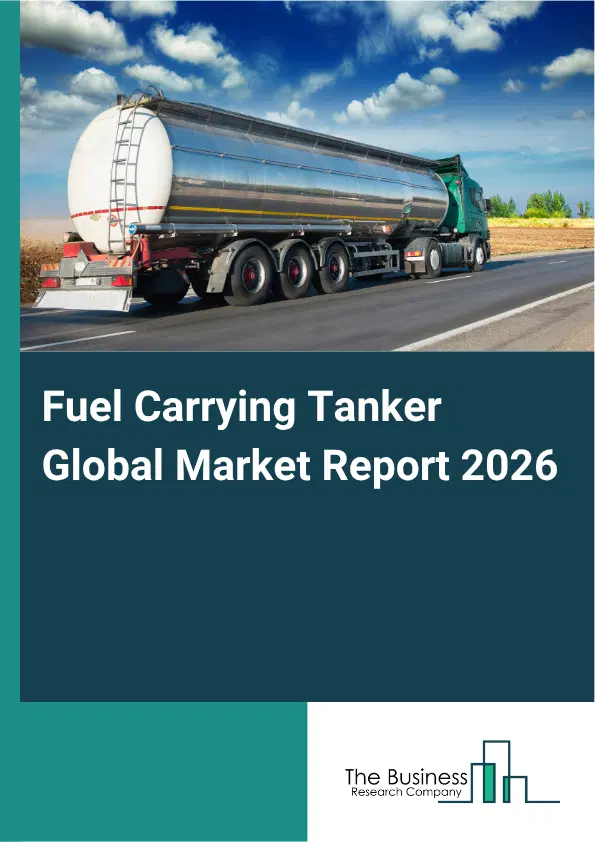
Fuel Carrying Tanker Market Report 2026
Global Outlook – By Product Type (Road Fuel Tankers, Rail Fuel Tankers, Marine Fuel Tankers, Aviation Fuel Tankers), By Tank Material (Aluminum Tankers, Stainless Steel Tankers, Carbon Steel Tankers, Composite Material Tankers), By Fuel Type (Gasoline, Diesel, Chemical Fuels, Liquefied Petroleum Gas, Biofuels), By Capacity (Small, Medium, Large), By Application (Fuel Distribution, Industrial Fuel Transportation, Aviation Fuel Supply, Marine Fuel Transportation, Mining Operations, Construction Activities) – Market Size, Trends, Strategies, and Forecast to 2030
Fuel Carrying Tanker Market Report 2026 Market Overview
• Fuel Carrying Tanker Market Report 2026 market size has reached to $4.83 billion in 2025 • Expected to grow to $6.61 billion in 2030 at a compound annual growth rate (CAGR) of 6.4% • Growth Driver: Growing Demand From The Petroleum And Natural Gas Industry Driving The Market Growth Due To Rising Crude Oil Production • Market Trend: Advancing On-Demand Fuel Delivery Through Mobile Refueling Innovations • North America was the largest region in 2025 and Asia-Pacific is the fastest growing region.What Is Covered Under Fuel Carrying Tanker Market?
A fuel-carrying tanker is a specialized vehicle equipped with a large tank designed for the safe transportation of liquid substances in bulk quantities. It is engineered with durable construction, compartmentalized storage options, and safety features to ensure secure handling and transport under varying road and environmental conditions. The main product types of fuel carrying tanker include road fuel tankers, rail fuel tankers, marine fuel tankers, and aviation fuel tankers. Road fuel tankers refer to transportation vehicles specifically designed for the safe storage and movement of liquid fuels across road networks. These products are manufactured using tank materials such as aluminum tankers, stainless steel tankers, carbon steel tankers, and composite material tankers and are used for fuel types including gasoline, diesel, chemical fuels, liquefied petroleum gas, and biofuels. These products are available in capacities such as small, medium, and large and the various applications involved are fuel distribution, industrial fuel transportation, aviation fuel supply, marine fuel transportation, mining operations, and construction activities.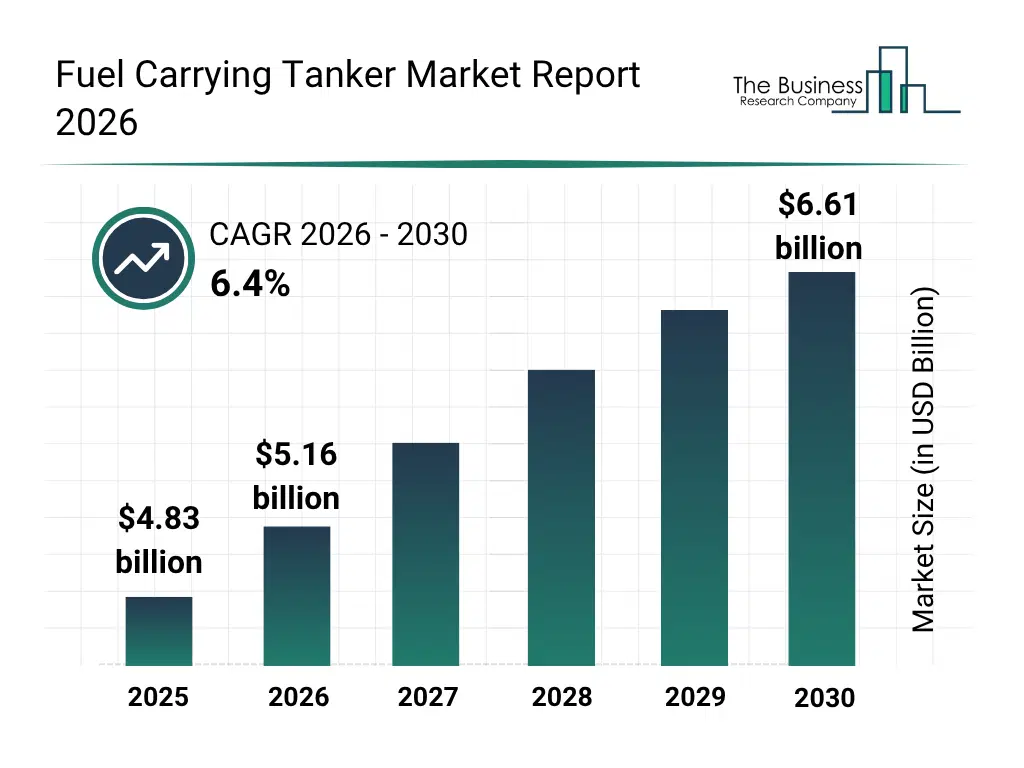
What Is The Fuel Carrying Tanker Market Size and Share 2026?
The fuel carrying tanker market size has grown strongly in recent years. It will grow from $4.83 billion in 2025 to $5.16 billion in 2026 at a compound annual growth rate (CAGR) of 6.8%. The growth in the historic period can be attributed to growth in industrial fuel demand, expansion of road freight and logistics networks, rising crude oil and petroleum consumption, development of highway infrastructure, increasing adoption of bulk fuel transportation systems.What Is The Fuel Carrying Tanker Market Growth Forecast?
The fuel carrying tanker market size is expected to see strong growth in the next few years. It will grow to $6.61 billion in 2030 at a compound annual growth rate (CAGR) of 6.4%. The growth in the forecast period can be attributed to transition toward alternative fuels and biofuels logistics, rising demand for efficient last mile fuel delivery systems, stricter environmental and safety regulations, expansion of aviation and marine fuel infrastructure, growth in mining and large-scale construction activities. Major trends in the forecast period include advanced compartmentalized tanker design for multi-fuel segregation, corrosion resistant and lightweight composite tanker materials adoption, enhanced spill containment and emergency safety systems integration, modular loading and unloading system standardization for faster turnaround, stringent hazardous fuel handling and regulatory compliance enhancement.
Global Fuel Carrying Tanker Market Segmentation
1) By Product Type: Road Fuel Tankers, Rail Fuel Tankers, Marine Fuel Tankers, Aviation Fuel Tankers 2) By Tank Material: Aluminum Tankers, Stainless Steel Tankers, Carbon Steel Tankers, Composite Material Tankers 3) By Fuel Type: Gasoline, Diesel, Chemical Fuels, Liquefied Petroleum Gas, Biofuels 4) By Capacity: Small, Medium, Large 5) By Application: Fuel Distribution, Industrial Fuel Transportation, Aviation Fuel Supply, Marine Fuel Transportation, Mining Operations, Construction Activities Subsegments: 1) By Road Fuel Tankers: Rigid Fuel Tankers, Semi Trailer Fuel Tankers, Multi Compartment Tankers, Mini Fuel Tankers, Hazardous Material Fuel Tankers 2) By Rail Fuel Tankers: Pressurized Rail Tank Cars, Non Pressurized Rail Tank Cars, Cryogenic Rail Tankers, Insulated Rail Fuel Tankers, General Service Rail Tankers 3) By Marine Fuel Tankers: Crude Oil Tankers, Product Tankers, Chemical Tankers, Bunker Fuel Tankers 4) By Aviation Fuel Tankers: Airport Refueling Tankers, Hydrant Dispenser Vehicles, Mobile Aviation Fuel Bowser Tankers, Jet Fuel Transport Tankers, Aircraft Refueling TrucksWhat Is The Driver Of The Fuel Carrying Tanker Market?
The growing demand from the petroleum and natural gas industries is expected to propel the growth of the fuel-carrying tanker market going forward. The petroleum and natural gas industry encompasses the exploration, extraction, refining, and distribution of crude oil and natural gas resources. e. The petroleum and natural gas industries' demand is rising primarily due to rapid expansion in domestic crude oil production, as increased drilling activity and enhanced well productivity across major oil-producing regions continue to push output to record levels. The surge in petroleum and natural gas output directly increases the need for fuel-carrying tankers to transport larger volumes of crude oil and refined products across domestic and international supply chains. For instance, in April 2024, according to the U.S. Energy Information Administration (EIA), a US-based principal agency of the U.S. Federal Statistical System, in 2023, U.S. natural gas exports reached a record average of 20 billion cubic feet per day (Bcf/d), marking an increase of approximately 10% over 2022. Among these exports, liquefied natural gas (LNG) shipments rose by around 12%, or roughly 1.3 Bcf/d, compared with the previous year. Therefore, the growing demand from the petroleum and natural gas industries is driving the growth of the fuel-carrying tanker market.Key Players In The Global Fuel Carrying Tanker Market
Major companies operating in the fuel carrying tanker market report are Amthor International, Burch Tank & Truck Inc., CIMC Vehicles (Group) Co. Ltd., Dragon Products Ltd, Dr.-Ing. Ulrich Esterer GmbH & Co. Fahrzeugaufbauten und Anlagen KG, Feldbinder Spezialfahrzeugwerke GmbH, Kässbohrer Transport Technik GmbH, LAG Trailers NV, LBT Inc., MAC Trailer Manufacturing Inc., Maisonneuve Citerne, Oilmens Equipment Corporation, Seneca Tank LLC, Stephens Tanker, STOKOTA NV, Tremcar Inc., Westmor Industries LLC
This chart is for illustrative purposes; the full report includes a detailed competitor analysis and comprehensive overview of the top 10 companies in the market.
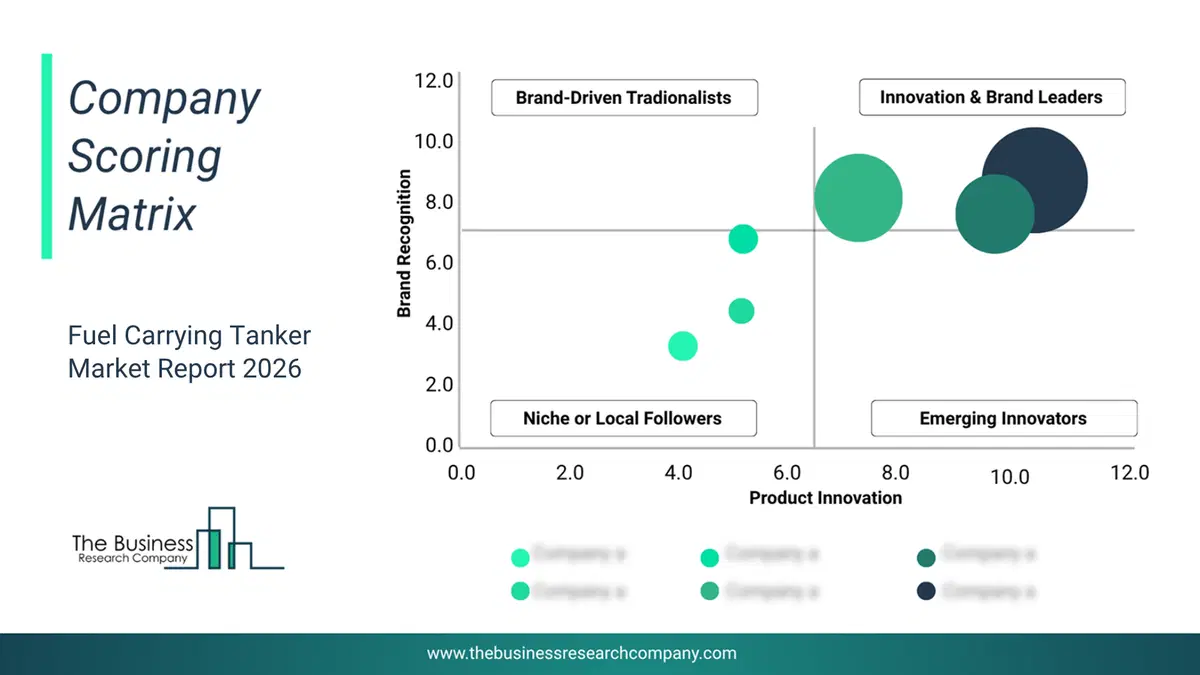
This chart maps companies by product innovation and brand strength, with bubble size indicating relative revenue, helping identify market leaders, challengers, and niche players. This is an illustrative chart; the full report provides a complete and accurate competitive analysis.
Global Fuel Carrying Tanker Market Trends and Insights
Major companies operating in the fuel-carrying tanker market are focusing on developing innovative solutions such as mobile refueling units to enable on-demand fuel delivery, improve operational efficiency, and support fuel access in remote or high-demand locations. A mobile refueling unit (MRU) is a fuel-carrying vehicle or portable system that delivers and dispenses fuel directly to vehicles and equipment at their location. For instance, in February 2025, Shell Oman Marketing Company SAOG, an Oman-based energy company, launched a next-generation mobile fuel tanker to revolutionize fuel logistics in Oman. It enables flexible fuel distribution to locations without fixed service stations, supporting Oman's growing transportation and industrial sectors. The tanker is equipped with advanced safety systems, digital monitoring capabilities, and efficient fuel dispensing technology to enhance operational reliability and customer convenience.What Are Latest Mergers And Acquisitions In The Fuel Carrying Tanker Market?
In March 2025, TerraVest Industries Inc., a Canada-based manufacturing company, acquired Engineered Transportation International for $546 million. With this acquisition, TerraVest aims to expand its manufacturing capabilities, enhance its production capacity, and strengthen its range of tanker trailer and truck body products for safer and more efficient industrial energy transportation. Engineered Transportation International is a US-based manufacturing company that offers fuel-carrying tankers.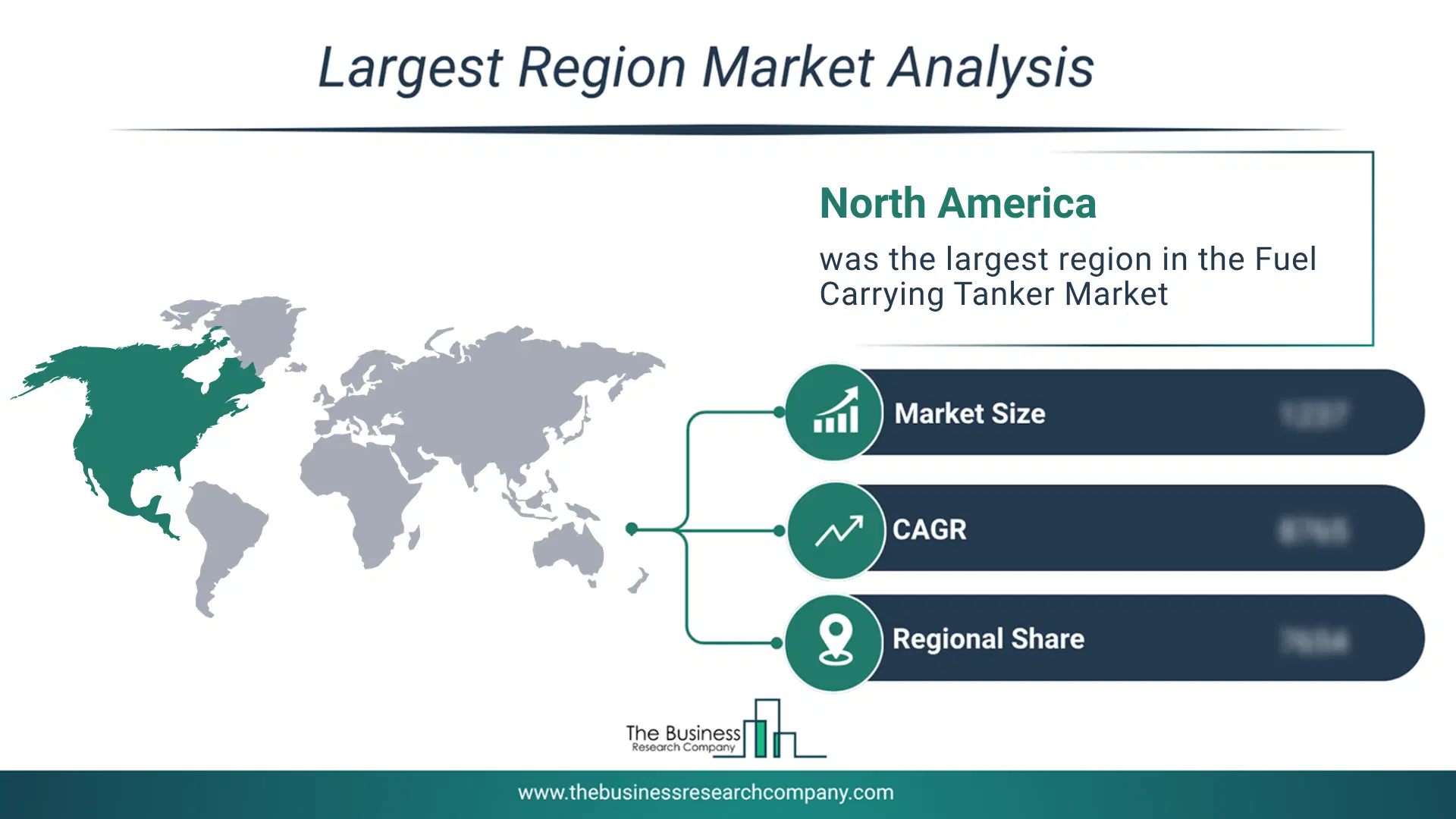
Regional Outlook
North America was the largest region in the fuel carrying tanker market in 2025. Asia-Pacific is expected to be the fastest-growing region in the forecast period. The regions covered in this market report are Asia-Pacific, South East Asia, Western Europe, Eastern Europe, North America, South America, Middle East, Africa. The countries covered in this market report are Australia, Brazil, China, France, Germany, India, Indonesia, Japan, Taiwan, Russia, South Korea, UK, USA, Canada, Italy, Spain.What Defines the Fuel Carrying Tanker Market?
The fuel-carrying tanker market consists of sales of off-road fuel tankers, underground fuel transport tankers, and vacuum-assisted fuel tankers. Values in this market are ‘factory gate’ values, that is, the value of goods sold by the manufacturers or creators of the goods, whether to other entities (including downstream manufacturers, wholesalers, distributors, and retailers) or directly to end customers. The value of goods in this market includes related services sold by the creators of the goods.How is Market Value Defined and Measured?
The market value is defined as the revenues that enterprises gain from the sale of goods and/or services within the specified market and geography through sales, grants, or donations in terms of the currency (in USD unless otherwise specified). The revenues for a specified geography are consumption values that are revenues generated by organizations in the specified geography within the market, irrespective of where they are produced. It does not include revenues from resales along the supply chain, either further along the supply chain or as part of other products.
This chart presents market attractiveness based on a quantitative evaluation of growth, competition, strategic alignment, and risk, offering a clear view of opportunity areas for decision-making. This chart is for illustrative purposes; the full report contains the complete analysis.

This chart highlights the Total Addressable Market (TAM) by estimating the maximum revenue opportunity using an assumption-driven approach, supporting strategic planning and opportunity sizing across markets. The chart is illustrative; the full report provides a more comprehensive analysis.
What Key Data and Analysis Are Included in the Fuel Carrying Tanker Market Report 2026?
The fuel carrying tanker market research report is one of a series of new reports from The Business Research Company that provides market statistics, including industry global market size, regional shares, competitors with the market share, detailed market segments, market trends and opportunities, and any further data you may need to thrive in the fuel carrying tanker industry. The market research report delivers a complete perspective of everything you need, with an in-depth analysis of the current and future state of the industry.Fuel Carrying Tanker Market Report Forecast Analysis
| Report Attribute | Details |
|---|---|
| Market Size Value In 2026 | $5.16 billion |
| Revenue Forecast In 2030 | $6.61 billion |
| Growth Rate | CAGR of 6.4% from 2026 to 2030 |
| Base Year For Estimation | 2025 |
| Actual Estimates/Historical Data | 2020-2025 |
| Forecast Period | 2026 - 2030 |
| Market Representation | Revenue in USD Billion and CAGR from 2026 to 2030 |
| Segments Covered | Product Type, Tank Material, Fuel Type, Capacity, Application |
| Regional Scope | Asia-Pacific, Western Europe, Eastern Europe, North America, South America, Middle East, Africa |
| Country Scope | The countries covered in the report are Australia, Brazil, China, France, Germany, India, Indonesia, Japan, Taiwan, Russia, South Korea, UK, USA, Canada, Italy, Spain. |
| Key Companies Profiled | Amthor International, Burch Tank & Truck Inc., CIMC Vehicles (Group) Co. Ltd., Dragon Products Ltd, Dr.-Ing. Ulrich Esterer GmbH & Co. Fahrzeugaufbauten und Anlagen KG, Feldbinder Spezialfahrzeugwerke GmbH, Kässbohrer Transport Technik GmbH, LAG Trailers NV, LBT Inc., MAC Trailer Manufacturing Inc., Maisonneuve Citerne, Oilmens Equipment Corporation, Seneca Tank LLC, Stephens Tanker, STOKOTA NV, Tremcar Inc., Westmor Industries LLC |
| Customization Scope | Request for Customization |
| Pricing And Purchase Options | Explore Purchase Options |