
Fuel Cell Commercial Vehicle Market Report 2026
Global Outlook – By Vehicle (Light Commercial Vehicles, Medium Commercial Vehicles, Heavy Commercial Vehicles, Buses, Other Vehicle Types), By Power Range (Below 100 Kilowatts, 100–200 Kilowatts, 200–300 Kilowatts, 300–500 Kilowatts, Above 500 Kilowatts), By Hydrogen Storage Type (Compressed Hydrogen, Liquid Hydrogen, Metal Hydride Storage, Chemical Hydrogen Storage, Cryo Compressed Hydrogen), By Fuel Cell Type (Proton Exchange Membrane Fuel Cells, Solid Oxide Fuel Cells, Alkaline Fuel Cells, Phosphoric Acid Fuel Cells), By End User (Logistics And Transportation, Public Transport, Construction And Mining, Urban Delivery And Last Mile Operators, Other Commercial And Industrial Users) – Market Size, Trends, Strategies, and Forecast to 2035
Fuel Cell Commercial Vehicle Market Overview
• Fuel Cell Commercial Vehicle market size has reached to $2.31 billion in 2025 • Expected to grow to $8.85 billion in 2030 at a compound annual growth rate (CAGR) of 30.7% • Growth Driver: Growth Of Logistics And Freight Transportation Activities Driving The Market Demand For Long-Range Zero-Emission Commercial Vehicles • Market Trend: Innovations In Fuel Cell Commercial Vehicle Technology Support Zero-Emission Freight Transportation • Asia-Pacific was the largest region and fastest growing region.What Is Covered Under Fuel Cell Commercial Vehicle Market?
A fuel cell commercial vehicle is a commercial vehicle propelled by electric motors whose electrical energy is generated wholly or partly by a hydrogen fuel cell system. The fuel cell converts hydrogen and oxygen into electricity, with water and heat as reaction products, while the vehicle may also incorporate a battery or other energy-storage system. The main vehicle types of fuel cell commercial vehicles include light commercial vehicles, medium commercial vehicles, heavy commercial vehicles, buses, and other vehicle types. Light commercial vehicles refer to fuel cell powered vehicles designed for transporting goods or passengers over short and medium distances while reducing dependence on conventional fuels. These vehicles are available across power ranges below 100 kilowatts, 100–200 kilowatts, 200–300 kilowatts, 300–500 kilowatts, and above 500 kilowatts, and use compressed hydrogen, liquid hydrogen, metal hydride storage, chemical hydrogen storage, and cryo compressed hydrogen. They incorporate proton exchange membrane fuel cells, solid oxide fuel cells, alkaline fuel cells, and phosphoric acid fuel cells, and are serving end users such as logistics and transportation, public transport, construction and mining, urban delivery and last mile operators, and other commercial and industrial users.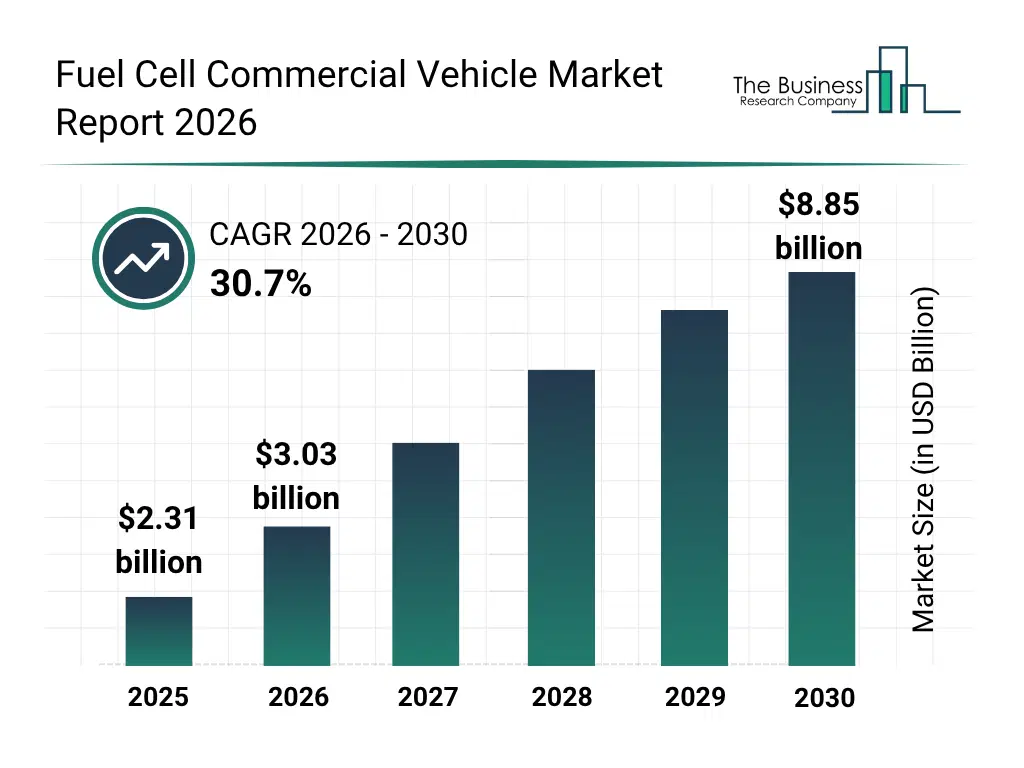
What Is The Fuel Cell Commercial Vehicle Market Size and Share 2026?
The fuel cell commercial vehicle market size has grown exponentially in recent years. It will grow from $2.31 billion in 2025 to $3.03 billion in 2026 at a compound annual growth rate (CAGR) of 31.1%. The growth in the historic period can be attributed to increasing demand for zero-emission commercial transportation, government incentives for hydrogen mobility, growing deployment of fuel cell buses, rising investments in hydrogen production infrastructure, increasing fleet decarbonization initiatives.What Is The Fuel Cell Commercial Vehicle Market Growth Forecast?
The fuel cell commercial vehicle market size is expected to see exponential growth in the next few years. It will grow to $8.85 billion in 2030 at a compound annual growth rate (CAGR) of 30.7%. The growth in the forecast period can be attributed to expansion of hydrogen refueling networks, declining fuel cell system costs, increasing adoption of long-haul fuel cell trucks, growing availability of green hydrogen, stricter commercial vehicle emission regulations. Major trends in the forecast period include expansion of hydrogen fuel cell heavy-duty trucks, development of high-capacity hydrogen storage systems, advancements in fuel cell durability and efficiency, growth of hydrogen refueling infrastructure for commercial fleets, increasing driving range of fuel cell commercial vehicles.Tariff Impact On Fuel Cell Commercial Vehicle Market
Tariffs are impacting the fuel cell commercial vehicle market by increasing the costs of imported fuel cell stacks, hydrogen storage systems, power electronics, batteries, and other vehicle components. Heavy commercial vehicles and buses are likely to experience greater cost pressure, particularly in North America, Europe, and Asia-Pacific due to interconnected automotive and hydrogen technology supply chains. However, tariffs may encourage regional manufacturing, localized hydrogen technology supply chains, and domestic production of fuel cell components, potentially improving supply-chain resilience and supporting long-term market development.
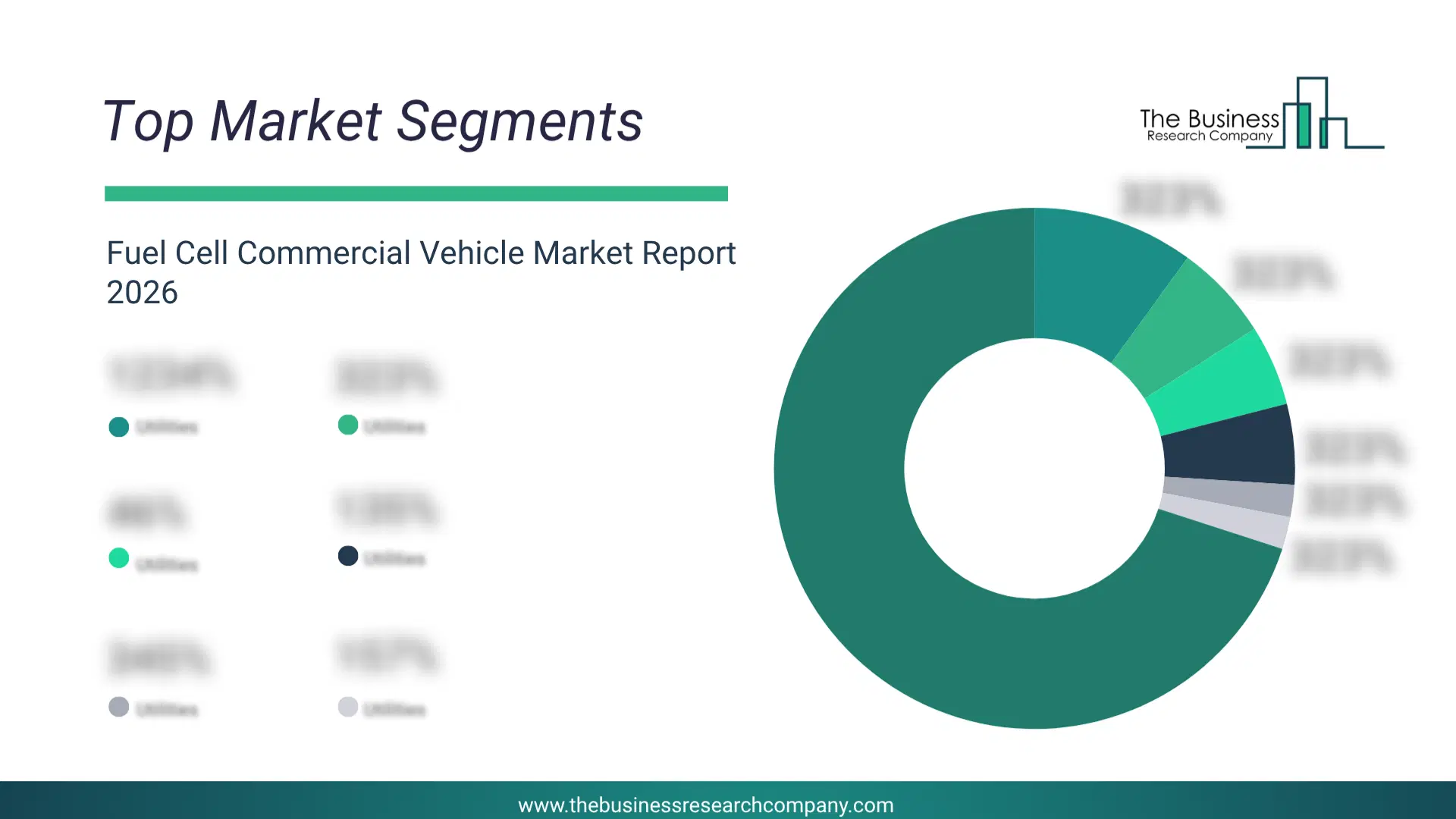
Global Fuel Cell Commercial Vehicle Market Segmentation
2) By Power Range: Below 100 Kilowatts, 100–200 Kilowatts, 200–300 Kilowatts, 300–500 Kilowatts, Above 500 Kilowatts 3) By Hydrogen Storage Type: Compressed Hydrogen, Liquid Hydrogen, Metal Hydride Storage, Chemical Hydrogen Storage, Cryo Compressed Hydrogen 4) By Fuel Cell Type: Proton Exchange Membrane Fuel Cells, Solid Oxide Fuel Cells, Alkaline Fuel Cells, Phosphoric Acid Fuel Cells 5) By End User: Logistics And Transportation, Public Transport, Construction And Mining, Urban Delivery And Last Mile Operators, Other Commercial And Industrial Users Subsegments: 1) By Light Commercial Vehicles: Delivery Vans, Cargo Vans, Chassis Cab Vehicles, Panel Vans 2) By Medium Commercial Vehicles: Medium Duty Distribution Trucks, Box Trucks, Refrigerated Trucks, Flatbed Trucks 3) By Heavy Commercial Vehicles: Long Haul Trucks, Regional Haul Trucks, Heavy Duty Tractor Units, Heavy Duty Rigid Trucks 4) By Buses: City Buses, Intercity Buses, Coach Buses, Airport Shuttle Buses 5) By Other Vehicle Types: Pickup Trucks, Utility Service Vehicles, Municipal Service Vehicles, Airport Ground Support VehiclesWhat Is The Driver Of The Fuel Cell Commercial Vehicle Market?
The growth of logistics and freight transportation activities is expected to propel the growth of the fuel cell commercial vehicle market going forward. Logistics and freight transportation activities refer to the movement, storage, and distribution of goods across supply chains through road, rail, air, and maritime transportation systems. The growth of logistics and freight transportation activities is rising due to the increasing expansion of e-commerce, which is driving higher demand for the frequent movement of goods across regional and international supply chains. The growth in logistics and freight transportation activities is driving demand for fuel cell commercial vehicles, as fleet operators require long-range, fast-refueling, and zero-emission vehicles to transport goods efficiently while meeting increasingly stringent emissions regulations. For instance, in July 2026, according to an article published by Eurostat, a Luxembourg-based statistical office of the European Union, road freight transport in the European Union increased from 1,869 billion tonne-kilometres in 2024 to 1,886 billion tonne-kilometres in 2025, representing a growth of approximately 0.9%. The total weight of goods transported by road also increased by 1.8% to 13.3 billion tonnes in 2025, indicating continued demand for heavy commercial vehicle transportation and supporting the need for high-performance lubricants designed to protect engines operating under demanding conditions. Therefore, the growth of logistics and freight transportation activities is driving the growth of the fuel cell commercial vehicle industry.Key Players In The Global Fuel Cell Commercial Vehicle Market
Major companies operating in the fuel cell commercial vehicle market are Toyota Motor Corporation, Hyundai Motor Company, Daimler Truck AG, Scania AB, Volvo Group, Tata Motors Limited, Cummins Inc., XCMG Group, Hino Motors Ltd., MAN Truck & Bus SE, FAW Jiefang Group Co. Ltd., Foton Motor Group Co. Ltd., Ashok Leyland Limited, Yutong Bus Co. Ltd., Dongfeng Motor Corporation, Wrightbus, Ballard Power Systems Inc., Quantron AG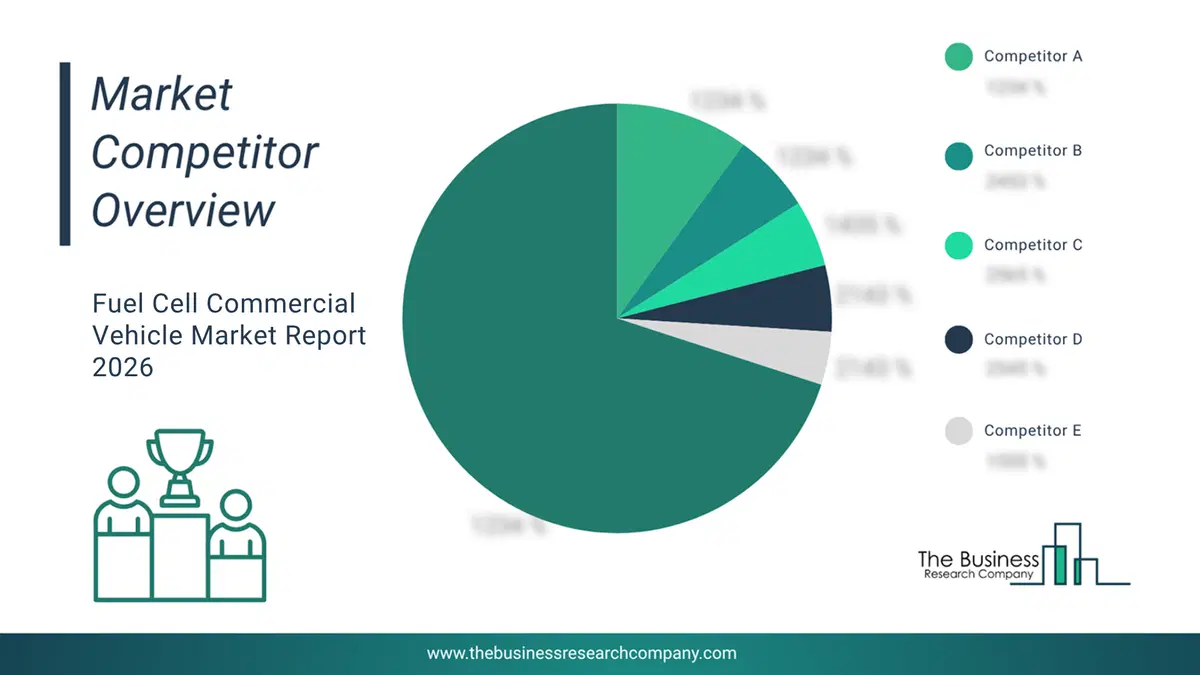
This chart is for illustrative purposes; the full report includes a detailed competitor analysis and comprehensive overview of the top 10 companies in the market.
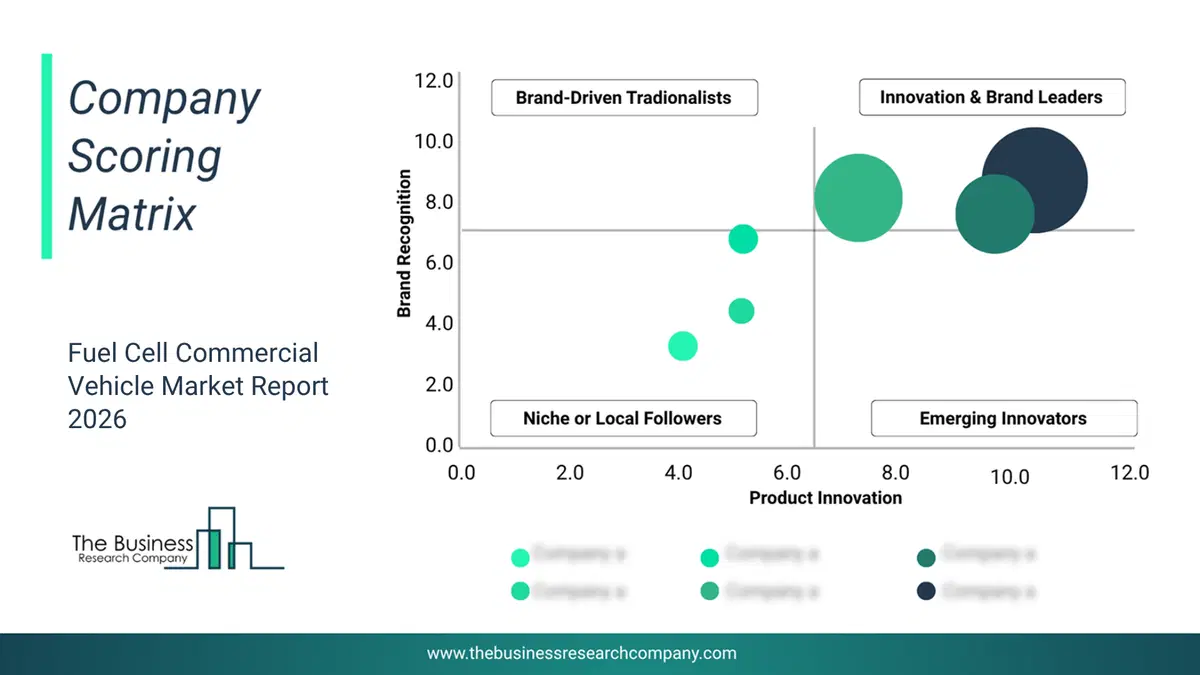
This chart maps companies by product innovation and brand strength, with bubble size indicating relative revenue, helping identify market leaders, challengers, and niche players. This is an illustrative chart; the full report provides a complete and accurate competitive analysis.
Global Fuel Cell Commercial Vehicle Market Trends and Insights
Major companies operating in the fuel cell commercial vehicle market are focusing on introducing advanced hydrogen-powered commercial trucks to expand zero-emission freight transportation, improve operational efficiency, and support the decarbonization of heavy-duty logistics. Hydrogen fuel cell commercial trucks are heavy-duty vehicles that generate electricity through hydrogen fuel cells to power electric motors, offering a long driving range and fast refueling with zero tailpipe emissions. For instance, in May 2026, Hyundai Translead, a US-based trailer manufacturing company, announced the commercial launch of XCIENT Fuel Cell Trucks in Canada. The launch expands the availability of hydrogen-powered heavy-duty trucks for commercial fleet operators, enabling zero tailpipe emission freight transportation with extended driving range and rapid refueling. It also accelerates the adoption of hydrogen fuel cell technology across the North American commercial vehicle market.What Are Latest Mergers And Acquisitions In The Fuel Cell Commercial Vehicle Market?
In August 2025, Horizon Fuel Cell Group, a Singapore-based hydrogen fuel cell technology company, acquired the hydrogen vehicle intellectual property (IP) of Hyzon Motors Inc. for an undisclosed amount. Through this acquisition, Horizon Fuel Cell Group aims to expand its fuel cell commercial vehicle portfolio by integrating Hyzon's hydrogen truck technology, continuing support for Hyzon's global customer base, and advancing the deployment of hydrogen-powered heavy-duty commercial vehicles. Hyzon Motors Inc. is a US-based manufacturer of fuel cell commercial vehicles.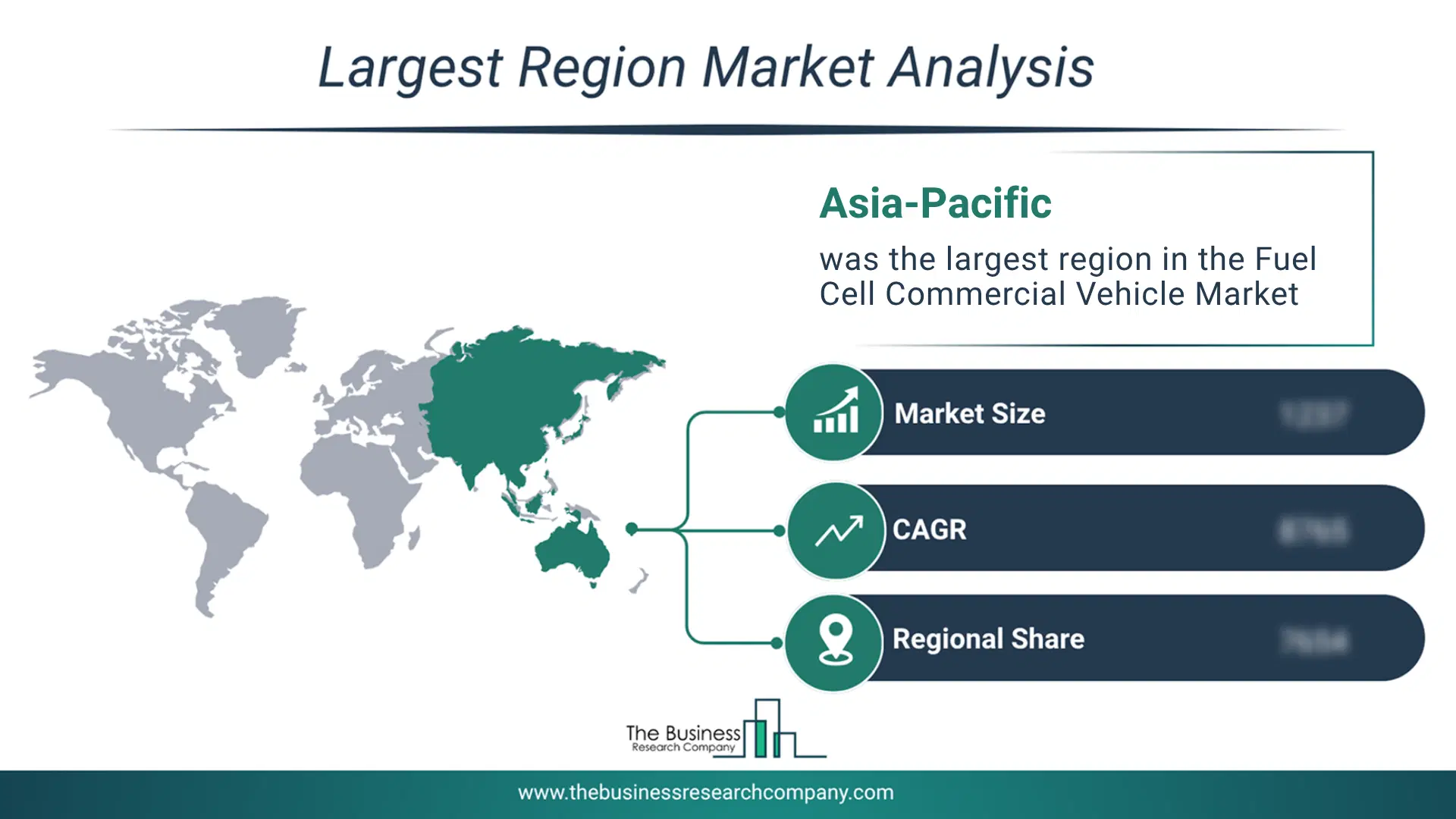
Regional Outlook/Insights
Asia-Pacific was the largest region in the fuel cell commercial vehicle market in 2025. Asia-Pacific is expected to be the fastest-growing region in the forecast period. The regions covered in this market report are Asia-Pacific, South East Asia, Western Europe, Eastern Europe, North America, South America, Middle East, Africa. The countries covered in this market report are Australia, Brazil, China, France, Germany, India, Indonesia, Japan, Taiwan, Russia, South Korea, UK, USA, Canada, Italy, Spain.What Defines the Fuel Cell Commercial Vehicle Market?
The fuel cell commercial vehicle market consists of sales of fuel cell commercial trucks, fuel cell buses, fuel cell delivery vans, fuel cell heavy-duty trucks, fuel cell medium-duty trucks, fuel cell transit buses, and fuel cell commercial utility vehicles. Values in this market are 'factory gate' values, that is, the value of goods sold by the manufacturers or creators of the goods, whether to other entities (including downstream manufacturers, wholesalers, distributors, and retailers) or directly to end customers. The value of goods in this market includes related services sold by the creators of the goods.How is Market Value Defined and Measured?
The market value is defined as the revenues that enterprises gain from the sale of goods and/or services within the specified market and geography through sales, grants, or donations in terms of the currency (in USD unless otherwise specified). The revenues for a specified geography are consumption values that are revenues generated by organizations in the specified geography within the market, irrespective of where they are produced. It does not include revenues from resales along the supply chain, either further along the supply chain or as part of other products.
This chart presents market attractiveness based on a quantitative evaluation of growth, competition, strategic alignment, and risk, offering a clear view of opportunity areas for decision-making. This chart is for illustrative purposes; the full report contains the complete analysis.

This chart highlights the Total Addressable Market (TAM) by estimating the maximum revenue opportunity using an assumption-driven approach, supporting strategic planning and opportunity sizing across markets. The chart is illustrative; the full report provides a more comprehensive analysis.
What Key Data and Analysis Are Included in the Fuel Cell Commercial Vehicle Market Report 2026?
The fuel cell commercial vehicle market research report is one of a series of new reports from The Business Research Company that provides market statistics, including industry global market size, regional shares, competitors with the market share, detailed market segments, market trends and opportunities, and any further data you may need to thrive in the fuel cell commercial vehicle industry. The market research report delivers a complete perspective of everything you need, with an in-depth analysis of the current and future state of the industry.Fuel Cell Commercial Vehicle Market Report Forecast Analysis
| Report Attribute | Details |
|---|---|
| Market Size Value In 2026 | $3.03 billion |
| Revenue Forecast In 2030 | $8.85 billion |
| Growth Rate | CAGR of 30.7% from 2026 to 2035 |
| Base Year For Estimation | 2025 |
| Actual Estimates/Historical Data | 2020-2025 |
| Forecast Period | 2026 - 2030 |
| Market Representation | Revenue in USD Billion and CAGR from 2026 to 2030 |
| Segments Covered | Vehicle, Power Range, Hydrogen Storage Type, Fuel Cell Type, End User |
| Regional Scope | Asia-Pacific, Western Europe, Eastern Europe, North America, South America, Middle East, Africa |
| Country Scope | The countries covered in the report are Australia, Brazil, China, France, Germany, India, Indonesia, Japan, Taiwan, Russia, South Korea, UK, USA, Canada, Italy, Spain. |
| Customization Scope | Request for Customization |
| Pricing And Purchase Options | Explore Purchase Options |