
Fuel Cell Electric Vehicle Market 2026
By Type (Proton Exchange Membrane Fuel Cell, Phosphoric Acid Fuel Cell, Other Types), By Range (Short Range, Long Range), By Vehicle Type (Passenger Vehicles, Light Commercial Vehicles, Heavy Commercial Vehicles), And By Region, Opportunities And Strategies – Global Forecast To 2035
Fuel Cell Electric Vehicle Market Definition
A fuel cell electric vehicle (FCEV) is a type of vehicle that uses hydrogen fuel cells to produce electricity through an electrochemical reaction between hydrogen and oxygen, generating only water vapor as emission. These vehicles are primarily used by individual consumers, commercial fleet operators and public transport agencies that seek environmentally friendly alternatives to internal combustion engine vehicles. Fuel cell electric vehicles (FCEVs) are commonly used when there is a need for zero-emission transportation with faster refuelling times and longer driving ranges compared to battery electric vehicles. They serve as a complementary solution to battery electric vehicles and are substitutes for gasoline, diesel and hybrid vehicles. The fuel cell electric vehicle market consists of sales, by entities (organizations, sole traders, or partnerships), of fuel cell electric vehicles that are designed to offer zero-emission transportation, faster refuelling and longer driving ranges compared to battery electric vehicles. The market includes passenger cars, commercial fleet vehicles and public transport applications, all aimed at reducing carbon emissions, improving energy efficiency and supporting the transition toward cleaner mobility solutions.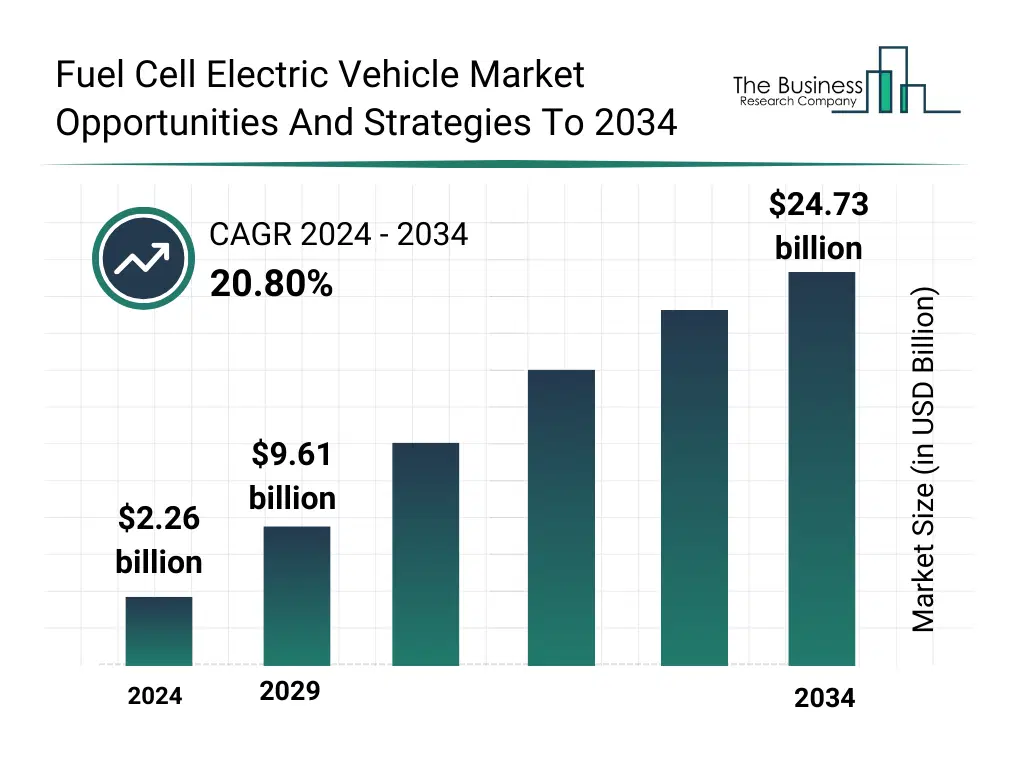
Fuel Cell Electric Vehicle Market Size
The global fuel cell electric vehicle market reached a value of nearly $2,264.98 million in 2024, having grown at a compound annual growth rate (CAGR) of 6.88% since 2019. The market is expected to grow from $2,264.98 million in 2024 to $9,613.84 million in 2029 at a rate of 33.53%. The market is then expected to grow at a CAGR of 20.80% from 2029 and reach $24,732.16 million in 2034. Growth in the historic period resulted from the integration of large-scale renewables, global decarbonization and net-zero targets, advancements in fuel cell and hydrogen technologies and rising adoption in commercial and heavy-duty vehicles. Factors that negatively affected growth in the historic period were high cost of fuel cell systems and competition from battery electric vehicles. Going forward, rising government funding for hydrogen research and pilot projects, increasing public and private sector initiatives for hydrogen adoption, stringent emission reduction regulations and shift toward zero-emission mobility solutions will drive the growth. Factor that could hinder the growth of the fuel cell electric vehicle market in the future include limited hydrogen refueling infrastructure, insufficient public awareness and trade war and tariffs.Fuel Cell Electric Vehicle Market Drivers
The key drivers of the fuel cell electric vehicle market include: Integration Of Large-Scale Renewables The integration of large-scale renewables supported the growth of the fuel cell electric vehicle market in the historic period. The expansion of solar, wind and hydro power generation enabled the production of green hydrogen through electrolysis, providing a sustainable fuel alternative with minimal carbon emissions. This alignment between renewable energy and hydrogen production strengthened the environmental appeal of fuel cell electric vehicles and enhanced their role in clean mobility initiatives. Moreover, increased investments in renewable infrastructure and government-backed decarbonization policies created favorable conditions for the development and deployment of hydrogen-powered vehicles. For example, in October 2025, Hyundai Motor Company, a South Korea–based automaker, reported a sharp rise in fuel cell electric vehicle (FCEV) demand, with its Q3 2025 sales reaching 3,828 units, a 161% increase compared with Q3 2024. Therefore, the integration of large-scale renewables drove the growth of the fuel cell electric vehicle market.Fuel Cell Electric Vehicle Market Restraints
The key restraints on the fuel cell electric vehicle market include: High Cost Of Fuel Cell Systems High cost of fuel cell systems hindered the growth of the fuel cell electric vehicle market in the historic period. The complex manufacturing process and reliance on expensive materials, such as platinum catalysts, significantly increased production costs. Additionally, limited economies of scale and underdeveloped supply chains restricted cost reduction opportunities. As a result, fuel cell electric vehicle (FCEV)s were priced higher than conventional and battery-electric vehicles, reducing their competitiveness in the market. The high initial investment required for hydrogen infrastructure and fuel production further added to the overall expense. These economic challenges slowed consumer adoption and limited large-scale commercialization of fuel cell vehicles. For example, in July 2025, Stellantis N.V., a Netherlands-based automaker, discontinued its hydrogen fuel-cell vehicle program, stating in its press release that high fuel-cell system costs and limited economic viability were key factors behind the decision. Stellantis noted that it would redirect resources toward more commercially viable electrification pathways, including battery-electric platforms. Therefore, high cost of fuel cell systems hindered the growth of the fuel cell electric vehicle market.Fuel Cell Electric Vehicle Market Trends
Major trends shaping the Fuel Cell Electric Vehicle market include: Hydrogen-Powered Heavy-Duty Innovation Accelerates Carbon-Neutral Transportation Goals Major companies operating in the fuel cell electric vehicle market are focusing on developing next-generation hydrogen-powered vehicles, expanding partnerships for fuel cell technology integration and enhancing vehicle range, performance and refuelling efficiency to accelerate the transition toward carbon-neutral transportation. For instance, in October 2025, Hino Motors Ltd., a Japan-based commercial vehicle manufacturing company, has introduced Japan’s first mass-produced fuel cell heavy-duty truck, the Hino Profia Z FCV, developed in collaboration with Toyota Motor Corporation, a Japan-based automotive company. Based on the Hino Profia (700 Series), the truck features two Toyota MIRAI fuel cell stacks adapted for heavy-duty use, offering a driving range of around 650 km and a refuelling time of 15–30 minutes. Hino aims to advance carbon neutrality through diverse powertrain solutions, with fuel cell technology positioned as an ideal option for long-haul transport due to its range, efficiency and quick refuelling capability. Innovative Hydrogen Mobility Concept Advances Sustainable Transportation Vision Companies operating in the fuel cell electric vehicle market are focusing on introducing advanced hydrogen-powered models with enhanced range, performance and design innovation, while leveraging connected technologies and brand-specific hydrogen strategies to strengthen their leadership in the global shift toward sustainable mobility. For instance, in October 2024, Hyundai Motor Company, a South Korea-based automotive manufacturing company, unveiled the INITIUM hydrogen fuel cell electric vehicle (FCEV) concept at its “Clearly Committed” event in Seoul, marking a bold step toward sustainable hydrogen mobility. Representing Hyundai’s 27 years of hydrogen innovation, INITIUM previews a production model set to debut in 2025. Featuring the new “Art of Steel” design language, the SUV offers a driving range of over 650 km and 150 kW motor output, combining strength, aerodynamics and advanced safety. Equipped with Vehicle-to-Load (V2L) power capabilities and FCEV-specific route planning, INITIUM underscores Hyundai’s HTWO brand vision to lead the global transition toward a hydrogen-powered future.Opportunities And Recommendations In The Fuel Cell Electric Vehicle Market
Opportunities – The top opportunities in the fuel cell electric vehicle markets segmented by type will arise in the proton exchange membrane fuel cell segment, which will gain $5,425.96 million of global annual sales by 2029. The top opportunities in the fuel cell electric vehicle markets segmented by range will arise in the long-range segment, which will gain $5,893.33 million of global annual sales by 2029. The top opportunities in the fuel cell electric vehicle markets segmented by vehicle type will arise in the heavy commercial vehicles segment, which will gain $4,659.91 million of global annual sales by 2029. The fuel cell electric vehicle market size will gain the most in China at $2,098.19 million. Recommendations- To take advantage of the opportunities, The Business Research Company recommends the fuel cell electric vehicle companies to focus on advancing hydrogen mobility and connected technologies, focus on next-generation hydrogen fcev innovation and integration, focus on expanding hydrogen-powered commercial vehicles, focus on advancing fuel cell components and strategic partnerships, focus on advancing hydrogen fuel cell technology and expanding applications, focus on proton exchange membrane fuel cell segment, focus on long-range fuel cell vehicles, expand in emerging markets, continue to focus on developed markets, focus on expanding distribution networks for fuel cell vehicles, focus on strategic and competitive pricing, focus on awareness campaigns, focus on incentive-based promotions, focus on targeted end-user engagement.
Fuel Cell Electric Vehicle Market Segmentation
The fuel cell electric vehicle market is segmented by type, by range and by vehicle type.By Type –
The fuel cell electric vehicle market is segmented by type into:
- a) Proton Exchange Membrane Fuel Cell
- b) Phosphoric Acid Fuel Cell
- c) Other Types
By Range –
The fuel cell electric vehicle s market is segmented by range into:
- a) Short-Range
- b) Long-Range
By Vehicle Type –
The fuel cell electric vehicle market is segmented by vehicle type into:
- a) Passenger Vehicles
- b) Light Commercial Vehicles
- c) Heavy Commercial Vehicles
By Geography - The fuel cell electric vehicle market is segmented by geography into:
- • China
- • India
- • Japan
- • Australia
- • Indonesia
- • South Korea
- • Bangladesh
- • Thailand
- • Vietnam
- • Malaysia
- • Singapore
- • Phillipines
- • Hong kong
- • New Zealand
- • USA
- • Canada
- • Mexico
- • Brazil
- • Argentina
- • Chile
- • Colombiia
- • Peru
- • France
- • Germany
- • UK
- • Italy
- • Spain
- • Austria
- • Belgium
- • Denmark
- • Finland
- • Ireland
- • Netherland
- • Norway
- • Portugal
- • Sweden
- • Switzerland
- • Russia
- • Czech Republic
- • Poland
- • Romania
- • Ukraine
- • Saudi Arabia
- • Israel
- • Iran
- • Turkey
- • UAE o Africa
- • Egypt
- • Nigeria
- • South Africa
-
o Asia Pacific