
Fuel Cell Powertrain Market Report 2026
Global Outlook – By Component (Fuel Cell System, Battery System, Drive System, Hydrogen Storage System, Other Components), By Power Output (Less Than 150 kW, 150-250 kW, Greater Than 250kW,), By Drive Type (Rear-Wheel Drive (RWD), Front-Wheel Drive (FWD), All-Wheel Drive (AWD)), By Vehicle Type (Passenger Cars, Commercial Vehicle, Buses, Other Vehicle Types) – Market Size, Trends, Strategies, and Forecast to 2030
Fuel Cell Powertrain Market Overview
• Fuel Cell Powertrain market size has reached to $0.82 billion in 2025 • Expected to grow to $5.24 billion in 2030 at a compound annual growth rate (CAGR) of 43.7% • Growth Driver: Surge In Clean Energy Vehicles Enhanced Fuel Cell Powertrain Market • Market Trend: Innovative Advance Solutions Enhanced Fuel Cell Powertrain Market Growth • Asia-Pacific was the largest region in 2025.What Is Covered Under Fuel Cell Powertrain Market?
A fuel cell powertrain is a type of electric powertrain used in fuel cell electric vehicles (FCEVs). It generates electricity using a fuel cell, which combines hydrogen and oxygen to produce electricity, and then uses this electricity to power an electric motor. Fuel cells produce electricity through an electrochemical reaction between hydrogen and oxygen, typically using a proton exchange membrane (PEM) or solid oxide electrolyte. The main types of fuel cell powertrain are fuel cell system, battery system, drive system, hydrogen storage system, and others. A fuel cell system refers to a technology that generates electricity through a chemical reaction between hydrogen and oxygen, typically used to power vehicles or provide energy. The power outage ranges from less than 150 kW, 150 to 250 kW, and greater than 250 kW, across drive types including rear-wheel drive (RWD), front-wheel drive (FWD), and all-wheel drive (AWD). The vehicles utilizing these powertrains encompass passenger cars, commercial vehicles, buses, and others.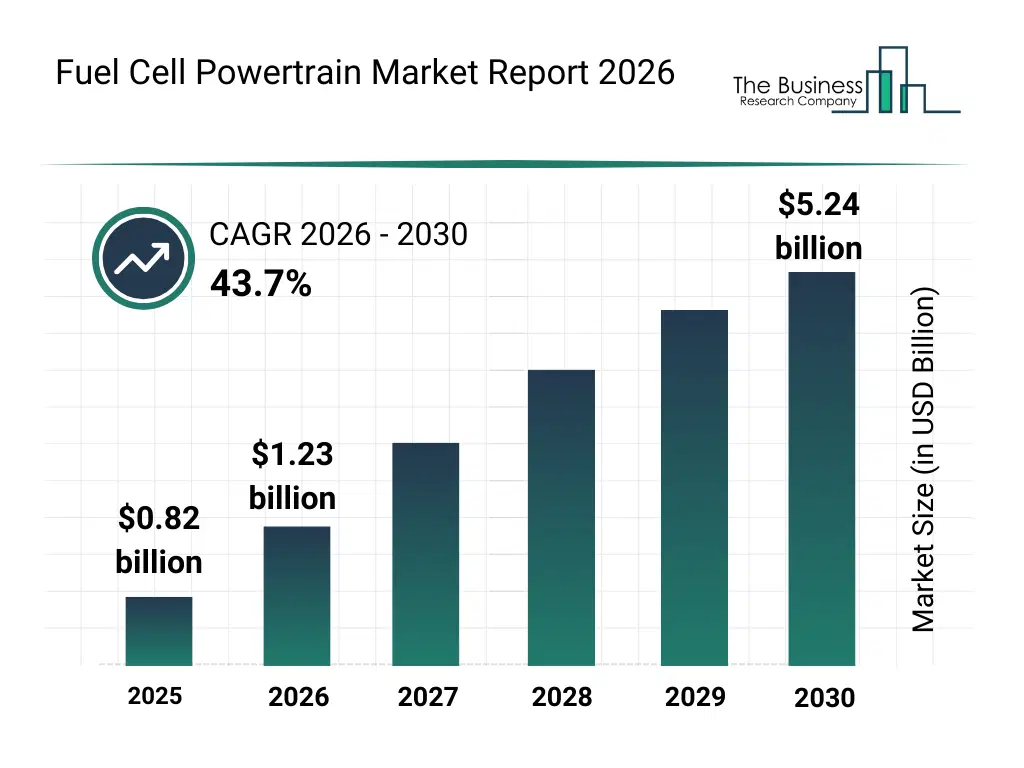
What Is The Fuel Cell Powertrain Market Size and Share 2026?
The fuel cell powertrain market size has grown exponentially in recent years. It will grow from $0.82 billion in 2025 to $1.23 billion in 2026 at a compound annual growth rate (CAGR) of 49.5%. The growth in the historic period can be attributed to early fuel cell research programs, government backed hydrogen pilots, automotive decarbonization initiatives, advancements in PEM technology, initial commercial fleet trials.What Is The Fuel Cell Powertrain Market Growth Forecast?
The fuel cell powertrain market size is expected to see exponential growth in the next few years. It will grow to $5.24 billion in 2030 at a compound annual growth rate (CAGR) of 43.7%. The growth in the forecast period can be attributed to expansion of hydrogen refueling networks, rising zero emission mandates, scaling of fuel cell manufacturing, cost reduction in hydrogen storage, integration with electric drivetrains. Major trends in the forecast period include rising integration of hydrogen powertrains, increasing focus on modular powertrain architectures, advancements in power density optimization, growing adoption in heavy duty mobility, improvement in thermal and energy management.
Global Fuel Cell Powertrain Market Segmentation
1) By Component: Fuel Cell System, Battery System, Drive System, Hydrogen Storage System, Other Components 2) By Power Output: Less Than 150 kW, 150-250 kW, Greater Than 250kW, 3) By Drive Type: Rear-Wheel Drive (RWD), Front-Wheel Drive (FWD), All-Wheel Drive (AWD) 4) By Vehicle Type: Passenger Cars, Commercial Vehicle, Buses, Other Vehicle Types Subsegments: 1) By Fuel Cell System: Proton Exchange Membrane Fuel Cells (Pemfc), Solid Oxide Fuel Cells (Sofc), Alkaline Fuel Cells (Afc), Phosphoric Acid Fuel Cells (Pafc) 2) By Battery System: Lithium-Ion Batteries, Nickel-Metal Hydride (Nimh) Batteries, Solid-State Batteries 3) By Drive System: Electric Motors, Power Electronics (Inverters, Converters), Transmission Systems 4) By Hydrogen Storage System: Compressed Hydrogen Storage, Liquefied Hydrogen Storage, Hydrogen Storage In Metal Hydrides 5) By Other Components: Hydrogen Compression Systems, Cooling Systems, Air Management SystemsWhat Is The Driver Of The Fuel Cell Powertrain Market?
The growing adoption of clean energy vehicles is expected to propel the growth of the fuel cell powertrain market going forward. Clean energy vehicles (CEVs) are vehicles that use alternative fuels or energy sources instead of traditional fossil fuels such as gasoline or diesel. The demand for fuel cell powertrains arises from the need for sustainable transportation solutions that offer zero-emission propulsion, address environmental concerns, advance energy efficiency, and reduce reliance on fossil fuels. Clean energy vehicles employ fuel cell powertrains to convert hydrogen fuel into electricity through an electrochemical process, enabling emission-free propulsion and contributing to a sustainable transportation ecosystem. For instance, in January 2024, according to a report published by Kelley Blue Book, a US-based Cox Automotive company, in 2023, a record 1.2 million car buyers in the United States chose electric vehicles, which accounted for 7.6% of the entire U.S. vehicle market, up from 5.9% in 2022. Therefore, the growing adoption of clean energy vehicles is driving growth in the fuel cell powertrain industry.Key Players In The Global Fuel Cell Powertrain Market
Major companies operating in the fuel cell powertrain market report include Toyota Motor Corporation, Mercedes-Benz Group AG, Ford Motor Company, General Motors Company, Bayerische Motoren Werke AG, Honda Motor Co. Ltd., SAIC Motor Corp. Ltd., Hyundai Motor Company, Hitachi Ltd., Siemens AG, Nissan Motor Co. Ltd., Audi AG, BYD Company Ltd., Panasonic Corporation, Renault Group, Volvo Group, ZF Friedrichshafen AG, Continental AG, Magna International Inc., Denso Corporation, Tata Motors Limited, Cummins Inc., Valeo SA, Plug Power Inc., Ballard Power Systems Inc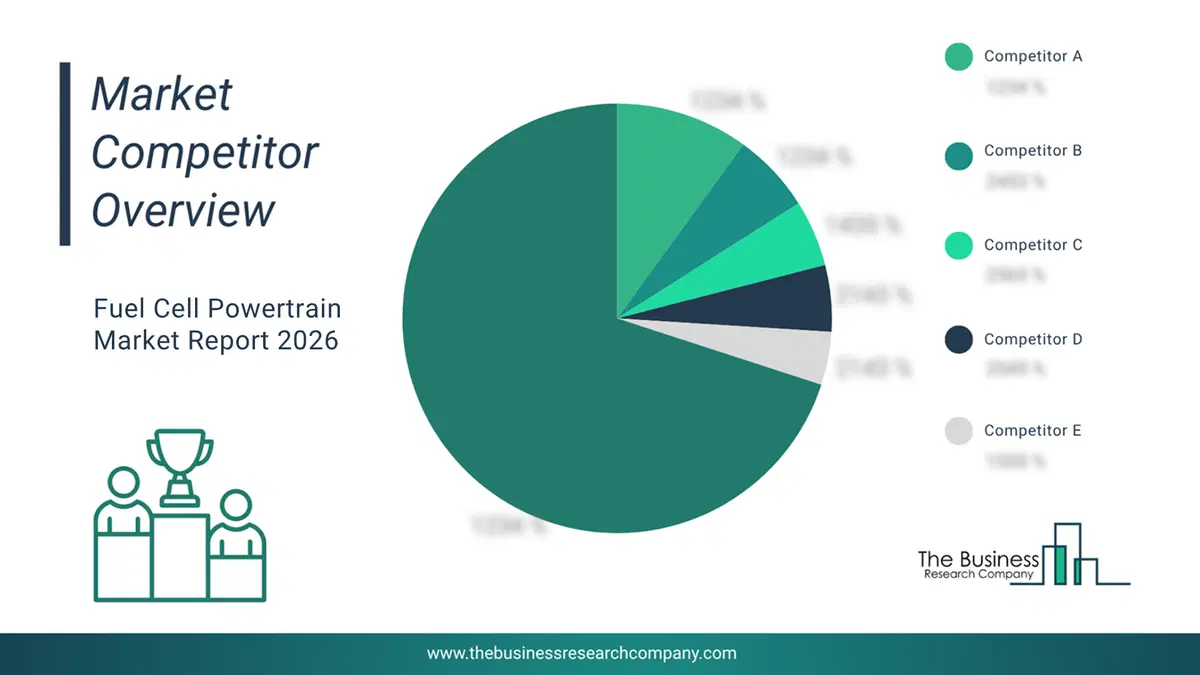
This chart is for illustrative purposes; the full report includes a detailed competitor analysis and comprehensive overview of the top 10 companies in the market.
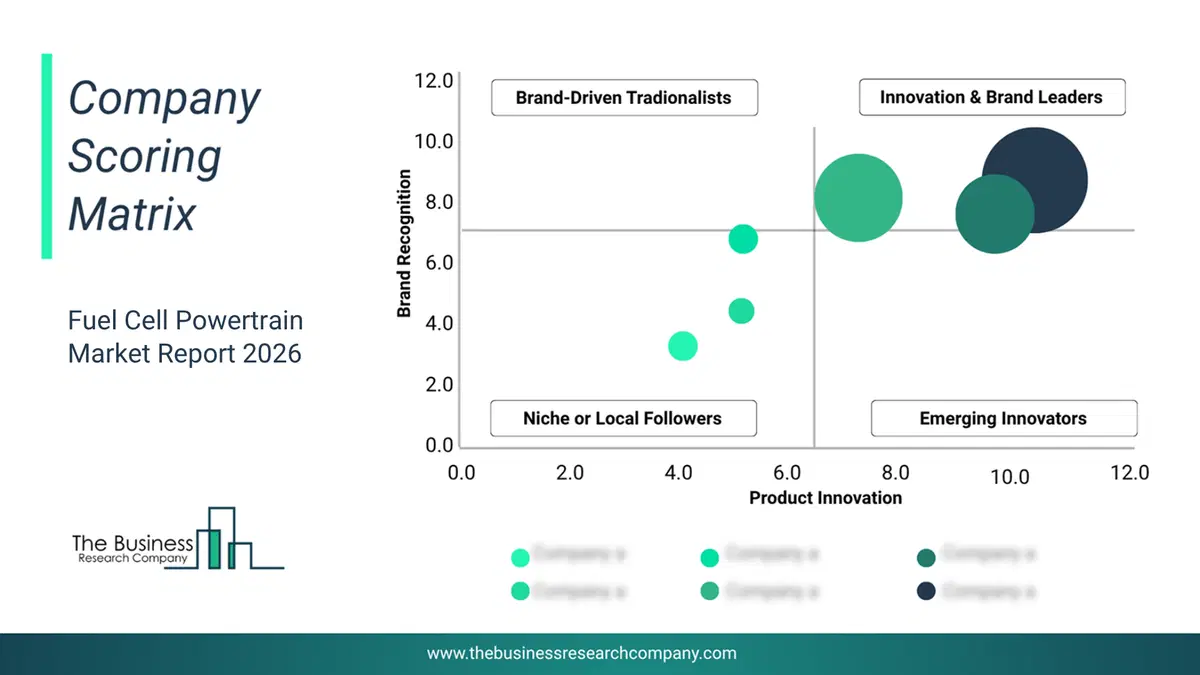
This chart maps companies by product innovation and brand strength, with bubble size indicating relative revenue, helping identify market leaders, challengers, and niche players. This is an illustrative chart; the full report provides a complete and accurate competitive analysis.
Global Fuel Cell Powertrain Market Trends and Insights
Major companies operating in the fuel cell powertrain market are focusing on developing advanced fuel cell technologies, such as single-stack 200kW powertrains, to enhance performance and efficiency in various applications. A single-stack 200kW powertrain refers to a fuel cell setup that generates up to 200 kilowatts of power using a single stack of fuel cells, which is used for high-efficiency energy conversion in vehicles or stationary power applications. For instance, in March 2024, Hyzon, a US-based hydrogen fuel cell technology developer, launched a 200kW Prime Mover, featuring a single-stack fuel cell system and powertrain. This vehicle is tailored to meet the rigorous operational needs of heavy-duty road transport. Hyzon integrated its advanced fuel cell technology and 200kW FCEV powertrain initially into a cabover vehicle, a popular design among fleets in Australia, New Zealand, and Europe.What Are Latest Mergers And Acquisitions In The Fuel Cell Powertrain Market?
In June 2025, PowerCell Sweden AB, a Sweden-based clean energy technology company, partnered with Bosch GmbH to accelerate fuel cell adoption in China. With this partnership, PowerCell Sweden AB and Bosch GmbH aim to jointly develop fuel cell systems for commercial and industrial applications, advancing sustainable mobility and decarbonization efforts. Bosch GmbH is a Germany-based technology and engineering company that specializes in mobility solutions, industrial technology, and fuel cell systems for commercial and industrial applications.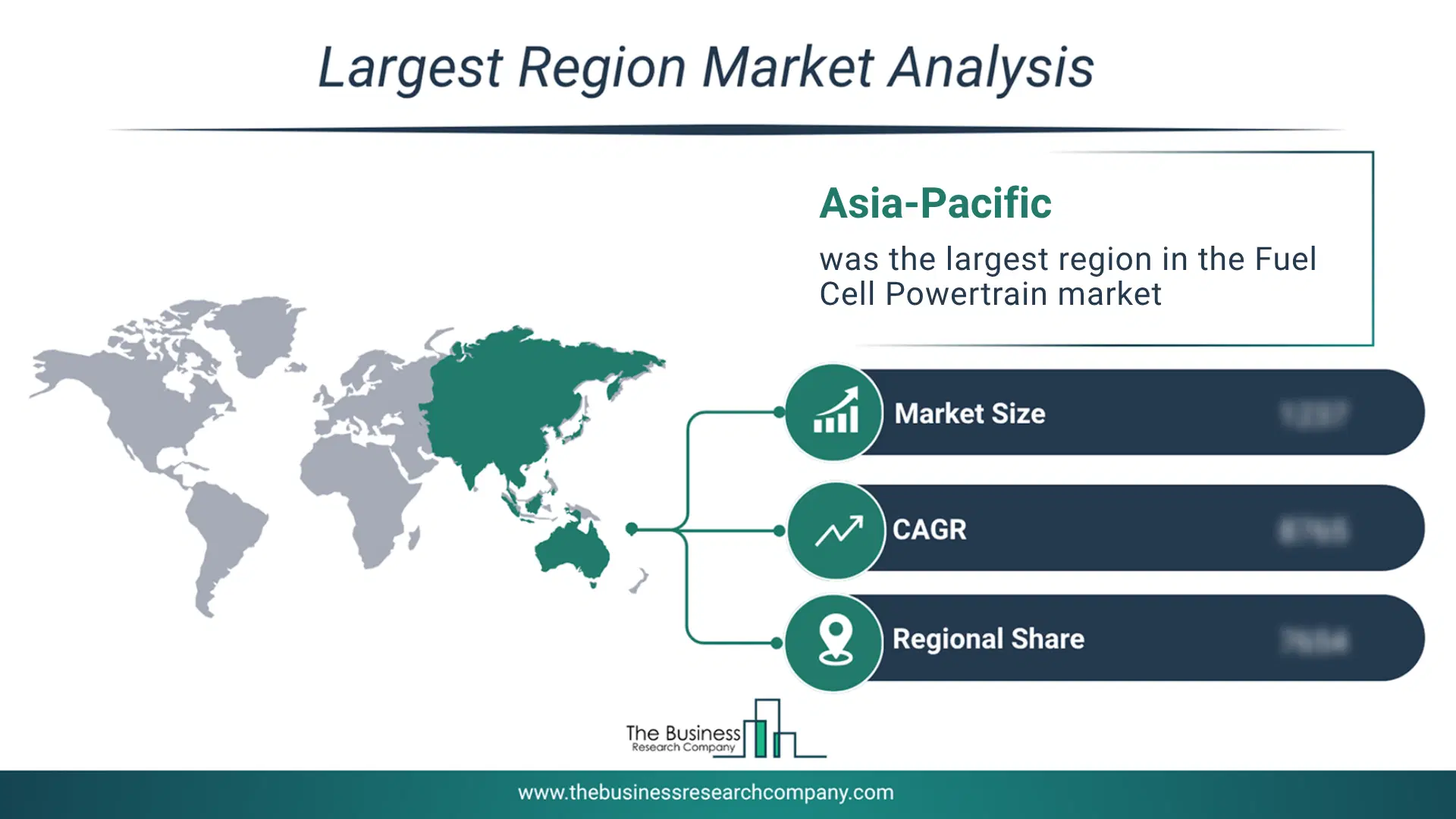
Regional Outlook
Asia-Pacific was the largest region in the fuel cell powertrain market in 2025. The regions covered in this market report include Asia-Pacific, South East Asia, Western Europe, Eastern Europe, North America, South America, Middle East, Africa. The countries covered in this market report include Australia, Brazil, China, France, Germany, India, Indonesia, Japan, Taiwan, Russia, South Korea, UK, USA, Canada, Italy, SpainWhat Defines the Fuel Cell Powertrain Market?
The fuel cell powertrain market consists of sales of fuel cell stacks, hydrogen tanks, power converters, and integrated systems. Values in this market are ‘factory gate’ values, that is the value of goods sold by the manufacturers or creators of the goods, whether to other entities (including downstream manufacturers, wholesalers, distributors and retailers) or directly to end customers. The value of goods in this market includes related services sold by the creators of the goods.How is Market Value Defined and Measured?
The market value is defined as the revenues that enterprises gain from the sale of goods and/or services within the specified market and geography through sales, grants, or donations in terms of the currency (in USD unless otherwise specified). The revenues for a specified geography are consumption values that are revenues generated by organizations in the specified geography within the market, irrespective of where they are produced. It does not include revenues from resales along the supply chain, either further along the supply chain or as part of other products.
This chart presents market attractiveness based on a quantitative evaluation of growth, competition, strategic alignment, and risk, offering a clear view of opportunity areas for decision-making. This chart is for illustrative purposes; the full report contains the complete analysis.

This chart highlights the Total Addressable Market (TAM) by estimating the maximum revenue opportunity using an assumption-driven approach, supporting strategic planning and opportunity sizing across markets. The chart is illustrative; the full report provides a more comprehensive analysis.
What Key Data and Analysis Are Included in the Fuel Cell Powertrain Market Report 2026?
The fuel cell powertrain market research report is one of a series of new reports from The Business Research Company that provides market statistics, including industry global market size, regional shares, competitors with the market share, detailed market segments, market trends and opportunities, and any further data you may need to thrive in the fuel cell powertrain industry. The market research report delivers a complete perspective of everything you need, with an in-depth analysis of the current and future state of the industry.Fuel Cell Powertrain Market Report Forecast Analysis
| Report Attribute | Details |
|---|---|
| Market Size Value In 2026 | $1.23 billion |
| Revenue Forecast In 2030 | $5.24 billion |
| Growth Rate | CAGR of 49.5% from 2026 to 2030 |
| Base Year For Estimation | 2025 |
| Actual Estimates/Historical Data | 2020-2025 |
| Forecast Period | 2026 - 2030 - 2030 |
| Market Representation | Revenue in USD Billion and CAGR from 2026 to 2030 |
| Segments Covered | Component, Power Output, Drive Type, Vehicle Type |
| Regional Scope | Asia-Pacific, Western Europe, Eastern Europe, North America, South America, Middle East, Africa |
| Country Scope | The countries covered in the report are Australia, Brazil, China, France, Germany, India, Indonesia, Japan, Taiwan, Russia, South Korea, UK, USA, Canada, Italy, Spain. |
| Key Companies Profiled | Toyota Motor Corporation, Mercedes-Benz Group AG, Ford Motor Company, General Motors Company, Bayerische Motoren Werke AG, Honda Motor Co. Ltd., SAIC Motor Corp. Ltd., Hyundai Motor Company, Hitachi Ltd., Siemens AG, Nissan Motor Co. Ltd., Audi AG, BYD Company Ltd., Panasonic Corporation, Renault Group, Volvo Group, ZF Friedrichshafen AG, Continental AG, Magna International Inc., Denso Corporation, Tata Motors Limited, Cummins Inc., Valeo SA, Plug Power Inc., Ballard Power Systems Inc |
| Customization Scope | Request for Customization |
| Pricing And Purchase Options | Explore Purchase Options |