
Fuel Cell Thermal Management System Market Report 2026
Global Outlook – By Type (Air-Cooled, Liquid-Cooled), By Component (Heat Exchangers, Cooling Plates, Pumps, Fans, Sensors, Other Components), By Fuel Cell Type (Proton Exchange Membrane Fuel Cell (PEMFC), Solid Oxide Fuel Cell (SOFC), Molten Carbonate Fuel Cell (MCFC), Phosphoric Acid Fuel Cell (PAFC), Other Fuel Cell Types), By Application (Automotive, Stationary Power, Portable Power, Other Applications), By End-User (Transportation, Power Generation, Industrial, Other End-Users) – Market Size, Trends, Strategies, and Forecast to 2030
Fuel Cell Thermal Management System Market Overview
• Fuel Cell Thermal Management System market size has reached to $1.23 billion in 2025 • Expected to grow to $3.03 billion in 2030 at a compound annual growth rate (CAGR) of 19.8% • Growth Driver: Growing Emphasis On Renewable Energy Fueling The Growth Of The Market Due To Rising Demand For Clean And Sustainable Power • Market Trend: Advanced Thermal Management Optimizes Energy Utilization • North America was the largest region in 2025 and Asia-Pacific is the fastest growing region.What Is Covered Under Fuel Cell Thermal Management System Market?
A fuel cell thermal management system is an integrated assembly of components and control mechanisms designed to regulate and maintain optimal temperature ranges within a fuel cell to ensure optimal performance, efficiency, and longevity. It helps to maintain the fuel cell within a safe operating temperature range, preventing overheating or excessive cooling, which could degrade materials or reduce power output. It also supports consistent power generation and system reliability under varying load and environmental conditions. The main types of fuel cell thermal management system are air-cooled and liquid-cooled. An air-cooled fuel cell thermal management system is a configuration that uses airflow to remove excess heat from a fuel cell, maintaining optimal operating temperatures and ensuring consistent performance and efficiency. The components in this system are heat exchangers, cooling plates, pumps, fans, sensors, and others with different fuel cell types such as proton exchange membrane fuel cell (PEMFC), solid oxide fuel cell (SOFC), molten carbonate fuel cell (MCFC), phosphoric acid fuel cell (PAFC), and others, It is applied in automotive, stationary power, portable power, and others, serving end-users such as transportation, power generation, industrial, and others.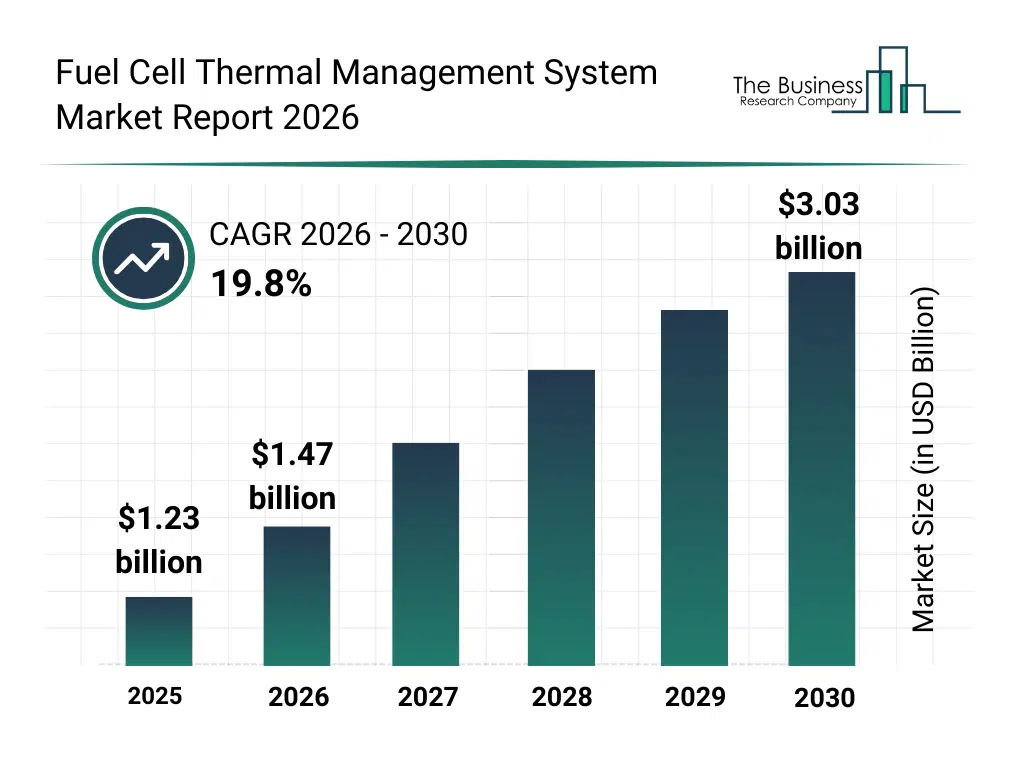
What Is The Fuel Cell Thermal Management System Market Size and Share 2026?
The fuel cell thermal management system market size has grown exponentially in recent years. It will grow from $1.23 billion in 2025 to $1.47 billion in 2026 at a compound annual growth rate (CAGR) of 20.1%. The growth in the historic period can be attributed to expansion of fuel cell vehicle pilot programs, advancements in heat exchanger efficiency, early deployment of stationary fuel cell systems, rising investments in hydrogen infrastructure, increasing focus on fuel cell reliability.What Is The Fuel Cell Thermal Management System Market Growth Forecast?
The fuel cell thermal management system market size is expected to see rapid growth in the next few years. It will grow to $3.03 billion in 2030 at a compound annual growth rate (CAGR) of 19.8%. The growth in the forecast period can be attributed to increasing commercialization of hydrogen-powered vehicles, rising adoption of fuel cells in heavy-duty transport, expansion of distributed power generation systems, growing demand for high-efficiency thermal control, increasing integration of smart thermal management systems. Major trends in the forecast period include increasing adoption of liquid-cooled fuel cell systems, rising integration of advanced thermal sensors, growing demand for compact thermal management solutions, expansion of modular cooling architectures, enhanced focus on fuel cell durability.
Global Fuel Cell Thermal Management System Market Segmentation
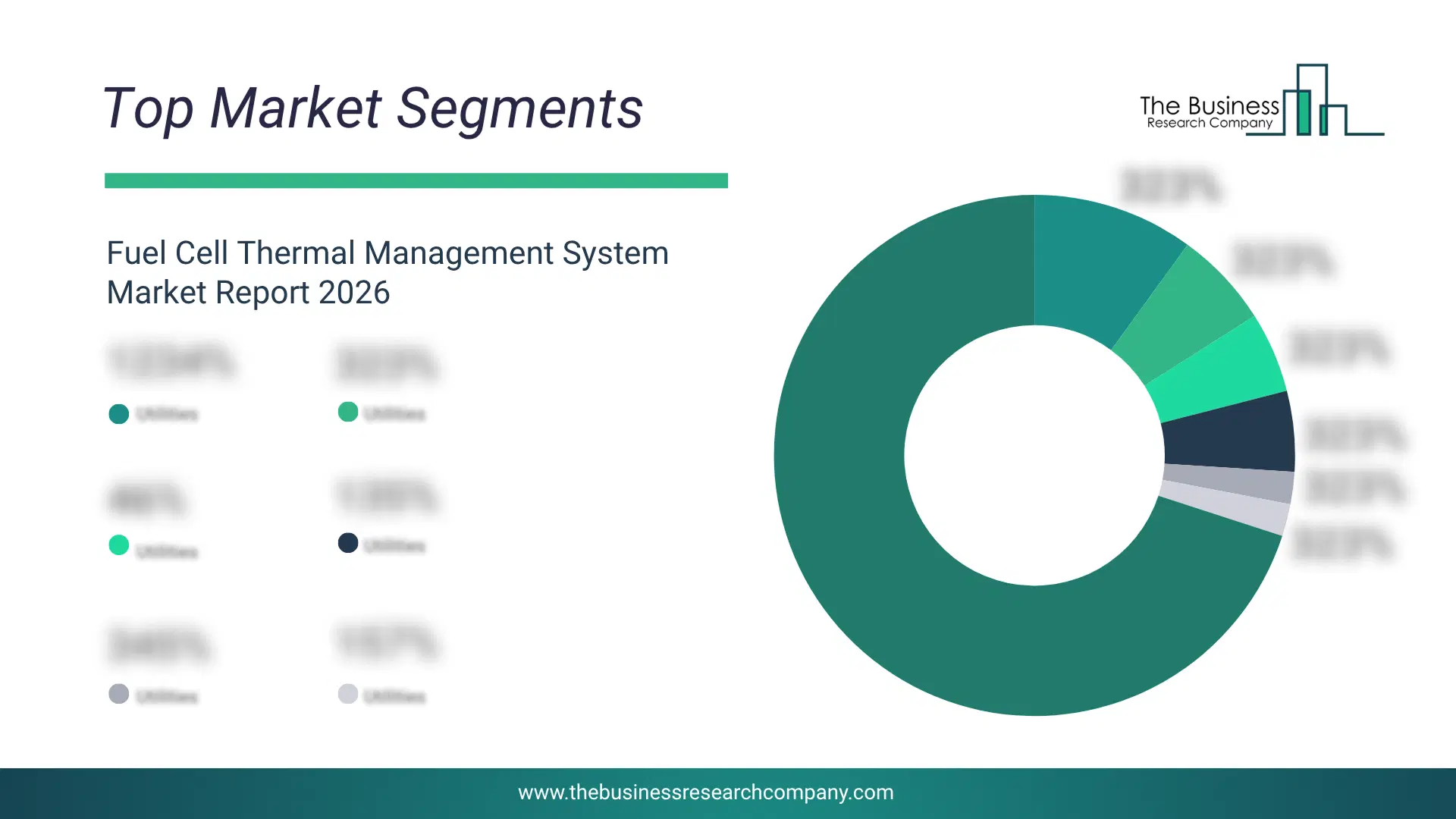
1) By Type: Air-Cooled, Liquid-Cooled 2) By Component: Heat Exchangers, Cooling Plates, Pumps, Fans, Sensors, Other Components 3) By Fuel Cell Type: Proton Exchange Membrane Fuel Cell (PEMFC), Solid Oxide Fuel Cell (SOFC), Molten Carbonate Fuel Cell (MCFC), Phosphoric Acid Fuel Cell (PAFC), Other Fuel Cell Types 4) By Application: Automotive, Stationary Power, Portable Power, Other Applications 5) By End-User: Transportation, Power Generation, Industrial, Other End-Users Subsegments: 1) By Air-Cooled: Radiators, Blowers, Ducts, Thermal Insulation 2) By Liquid-Cooled: Coolant Reservoirs, Pipes, Valves, Thermostats, Expansion TanksWhat Is The Driver Of The Fuel Cell Thermal Management System Market?
The growing emphasis on renewable energy is expected to propel the growth of the fuel cell thermal management system market going forward. Renewable energy refers to energy derived from natural processes that are continuously replenished, such as sunlight, wind, water, geothermal heat, and biomass, offering an eco-friendly alternative that reduces greenhouse gas emissions. The growing emphasis on renewable energy is due to rising demand for cleaner, sustainable power that reduces carbon emissions, lowers dependency on fossil fuels, and supports environmental preservation for future generations. Fuel cell thermal management systems enhance renewable energy applications by efficiently regulating the temperature of fuel cell stacks, ensuring optimal performance and longevity. They improve energy conversion efficiency and system reliability, supporting clean and sustainable power generation. For instance, in March 2025, according to the International Renewable Energy Agency (IRENA), a United Arab Emirates-based intergovernmental organization, the renewable energy capacity grew from 3,862,881 megawatts (MW) in 2023 to 4,448,051 megawatts (MW) in 2024. Therefore, the growing emphasis on renewable energy is driving the fuel cell thermal management system industry.Key Players In The Global Fuel Cell Thermal Management System Market
Major companies operating in the fuel cell thermal management system market are Robert Bosch GmbH, BorgWarner Inc., MAHLE GmbH, Dana Incorporated, Valeo SA, Denso Corporation, Webasto Group SE, Modine Manufacturing Company, Hanon Systems Co. Ltd., Grayson Thermal Systems Ltd., VOSS Automotive GmbH, KELVION Holding GmbH, Kuraray Co. Ltd., Sanhua Automotive Co. Ltd., Laird Thermal Systems, Boyd Corporation, TI Fluid Systems, Advanced Cooling Technologies Inc., API Heat Transfer Inc., SGL Carbon SE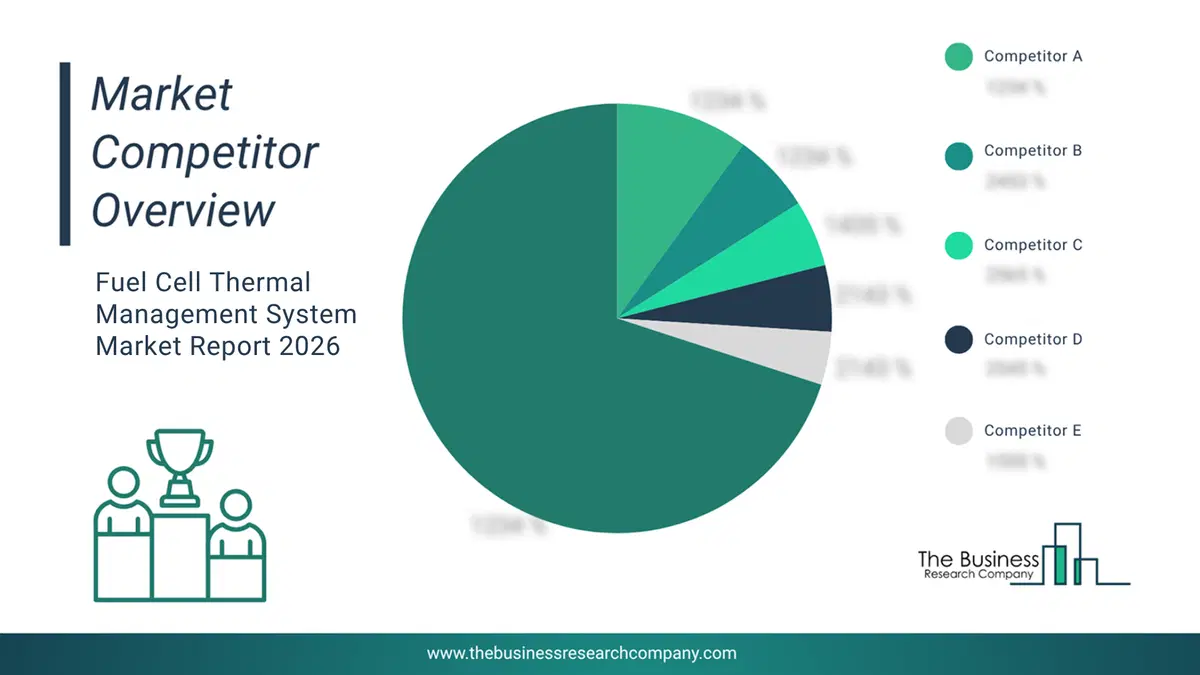
This chart is for illustrative purposes; the full report includes a detailed competitor analysis and comprehensive overview of the top 10 companies in the market.
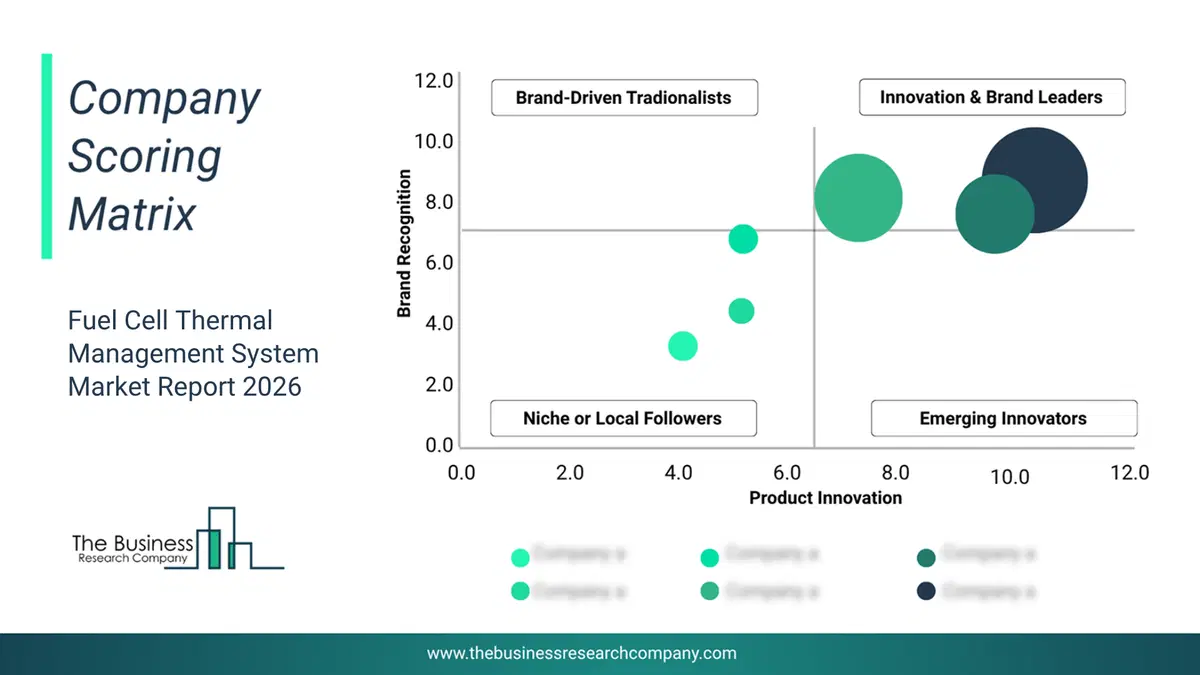
This chart maps companies by product innovation and brand strength, with bubble size indicating relative revenue, helping identify market leaders, challengers, and niche players. This is an illustrative chart; the full report provides a complete and accurate competitive analysis.
Global Fuel Cell Thermal Management System Market Trends and Insights
Major companies operating in the fuel cell thermal management system market are focusing on developing innovative products, such as fuel cell heat exchangers, to enhance fuel cell system efficiency and thermal management under demanding operational conditions. A fuel cell heat exchanger is a device designed to transfer thermal energy between gas and liquid streams within fuel cell systems to regulate temperature, improve efficiency, and manage energy losses. For instance, in March 2023, Alfa Laval, a Sweden-based provider of specialized heat transfer, separation, and fluid handling technologies, launched AlfaNova GL50. This is a compact, asymmetric gas-to-liquid plate heat exchanger capable of handling high-temperature gas flows and condensing water vapor, optimizing energy utilization in fuel cell systems. Its robust design, low pressure drops, and high efficiency support advanced thermal management, making it suitable for both industrial-scale fuel cell applications and other high-demand energy processes such as hydrogen cooling and waste heat recovery.What Are Latest Mergers And Acquisitions In The Fuel Cell Thermal Management System Market?
In January 2025, Hankook & Company Group, a South Korea-based battery manufacturing company, acquired Hanon Systems for an undisclosed amount. The acquisition has strengthened Hankook & Company Group’s standing as a leading automotive parts provider, with Hanon Systems officially integrated as a subsidiary under Korean corporate law. This expansion increases the Group’s global assets, placing it among the top 30 companies in Korea by net assets. Hanon Systems is a South Korea-based manufacturer of fuel cell thermal management systems.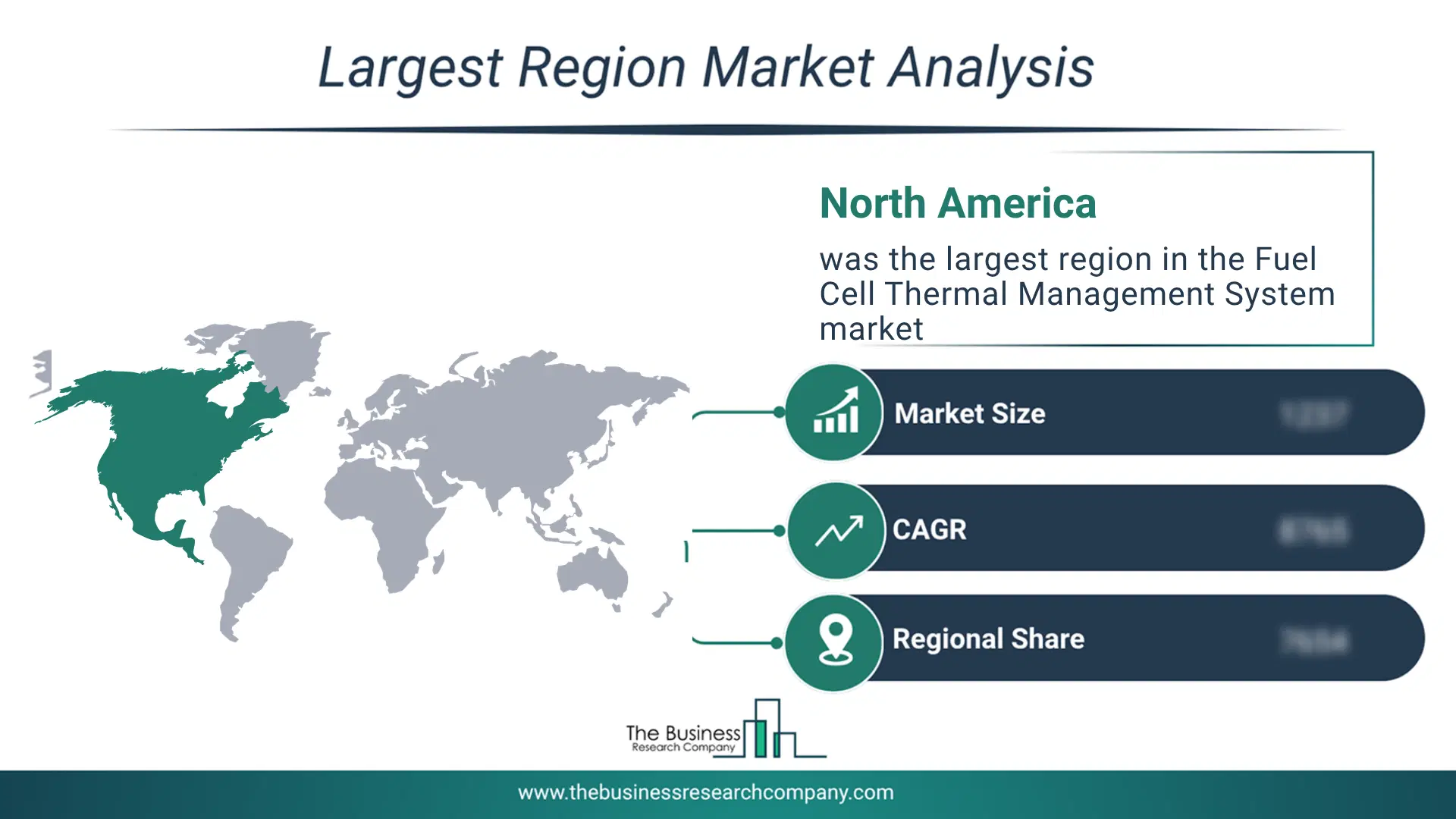
Regional Outlook
North America was the largest region in the fuel cell thermal management system market in 2025. Asia-Pacific is expected to be the fastest-growing region in the forecast period. The regions covered in this market report are Asia-Pacific, South East Asia, Western Europe, Eastern Europe, North America, South America, Middle East, Africa. The countries covered in this market report are Australia, Brazil, China, France, Germany, India, Indonesia, Japan, Taiwan, Russia, South Korea, UK, USA, Canada, Italy, SpainWhat Defines the Fuel Cell Thermal Management System Market?
The fuel cell thermal management system market consists of sales of temperature control devices, cooling and heating components, control units, and related software systems used to manage the temperature of fuel cells. Values in this market are ‘factory gate’ values, that is, the value of goods sold by the manufacturers or creators of the goods, whether to other entities (including downstream manufacturers, wholesalers, distributors, and retailers) or directly to end customers. The value of goods in this market includes related services sold by the creators of the goods.How is Market Value Defined and Measured?
The market value is defined as the revenues that enterprises gain from the sale of goods and/or services within the specified market and geography through sales, grants, or donations in terms of the currency (in USD unless otherwise specified). The revenues for a specified geography are consumption values that are revenues generated by organizations in the specified geography within the market, irrespective of where they are produced. It does not include revenues from resales along the supply chain, either further along the supply chain or as part of other products.
This chart presents market attractiveness based on a quantitative evaluation of growth, competition, strategic alignment, and risk, offering a clear view of opportunity areas for decision-making. This chart is for illustrative purposes; the full report contains the complete analysis.

This chart highlights the Total Addressable Market (TAM) by estimating the maximum revenue opportunity using an assumption-driven approach, supporting strategic planning and opportunity sizing across markets. The chart is illustrative; the full report provides a more comprehensive analysis.
What Key Data and Analysis Are Included in the Fuel Cell Thermal Management System Market Report 2026?
The fuel cell thermal management system market research report is one of a series of new reports from The Business Research Company that provides market statistics, including Market Report 2026?global market size, regional shares, competitors with the market share, detailed market segments, market trends and opportunities, and any further data you may need to thrive in the fuel cell thermal management system Market Report 2026? The market research report delivers a complete perspective of everything you need, with an in-depth analysis of the current and future state of the Market Report 2026?Fuel Cell Thermal Management System Market Report Forecast Analysis
| Report Attribute | Details |
|---|---|
| Market Size Value In 2026 | $1.47 billion |
| Revenue Forecast In 2030 | $3.03 billion |
| Growth Rate | CAGR of 20.1% from 2026 to 2030 |
| Base Year For Estimation | 2025 |
| Actual Estimates/Historical Data | 2020-2025 |
| Forecast Period | 2026 - 2030 - 2030 |
| Market Representation | Revenue in USD Billion and CAGR from 2026 to 2030 |
| Segments Covered | Type, Component, Fuel Cell Type, Application, End-User |
| Regional Scope | Asia-Pacific, Western Europe, Eastern Europe, North America, South America, Middle East, Africa |
| Country Scope | The countries covered in the report are Australia, Brazil, China, France, Germany, India, Indonesia, Japan, Taiwan, Russia, South Korea, UK, USA, Canada, Italy, Spain. |
| Key Companies Profiled | Robert Bosch GmbH, BorgWarner Inc., MAHLE GmbH, Dana Incorporated, Valeo SA, Denso Corporation, Webasto Group SE, Modine Manufacturing Company, Hanon Systems Co. Ltd., Grayson Thermal Systems Ltd., VOSS Automotive GmbH, KELVION Holding GmbH, Kuraray Co. Ltd., Sanhua Automotive Co. Ltd., Laird Thermal Systems, Boyd Corporation, TI Fluid Systems, Advanced Cooling Technologies Inc., API Heat Transfer Inc., SGL Carbon SE |
| Customization Scope | Request for Customization |
| Pricing And Purchase Options | Explore Purchase Options |