
Fuel Cell Vehicle-to-Grid (V2G) Market Report 2026
Global Outlook – By Vehicle Type (Passenger Vehicles, Commercial Vehicles, Buses, Other Vehicle Types), By Technology (Proton Exchange Membrane Fuel Cells, Phosphoric Acid Fuel Cells, Solid Oxide Fuel Cells, Other Technologies), By Power Rating (Below 100 kW, 100–200 kW, Above 200 kW), By Application (Peak Power Supply, Emergency Power, Frequency Regulation, Other Applications), By End-User (Residential, Commercial, Industrial, Utilities) – Market Size, Trends, Strategies, and Forecast to 2030
Fuel Cell Vehicle-to-Grid (V2G) Market Overview
• Fuel Cell Vehicle-to-Grid (V2G) market size has reached to $1.21 billion in 2025 • Expected to grow to $4.18 billion in 2030 at a compound annual growth rate (CAGR) of 28.1% • Growth Driver: Increasing Deployment Of Smart Grids Fueling The Growth Of The Market Due To Enhancing Grid Stability And Efficient Energy Management • Market Trend: Advanced Bidirectional Charging Boosts Grid Resilience And Energy Security • North America was the largest region in 2025.What Is Covered Under Fuel Cell Vehicle-to-Grid (V2G) Market?
A fuel cell vehicle-to-grid (V2G) refers to an advanced energy interaction framework in which hydrogen-powered fuel cell vehicles not only draw electricity from the grid for auxiliary functions but also store and discharge surplus electrical energy back to the grid through bidirectional power flow, thereby supporting energy balance, grid stability, and efficient resource utilization. It is primarily utilized to enhance renewable energy integration, optimize electricity demand management, and contribute to the development of smart grid infrastructures. The main vehicle types of fuel cell vehicle-to-grid (V2G) are passenger vehicles, commercial vehicles, buses, and others. Passenger vehicles are hydrogen-powered cars equipped to both draw electricity from and supply energy back to the grid or home. The technologies utilized include proton exchange membrane fuel cells, phosphoric acid fuel cells, solid oxide fuel cells, and others, with power rating below 100 kW, 100–200 kW, and above 200 kW. It finds applications in peak power supply, emergency power, frequency regulation, and others, serving key end users such as residential, commercial, industrial, and utilities.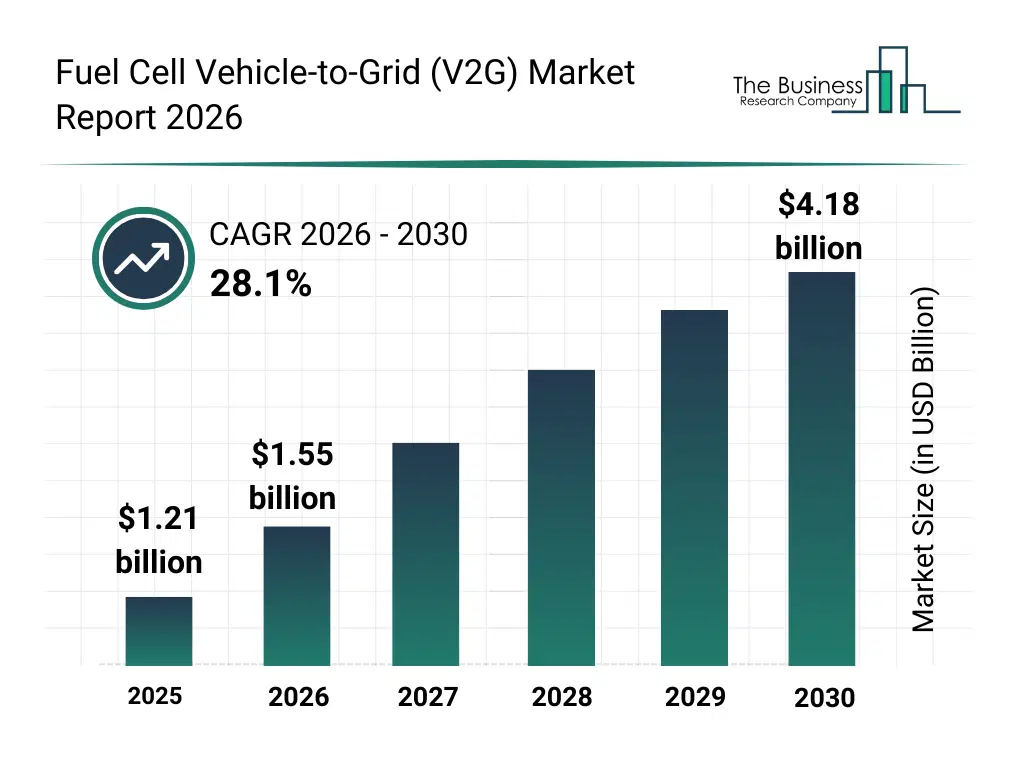
What Is The Fuel Cell Vehicle-to-Grid (V2G) Market Size and Share 2026?
The fuel cell vehicle-to-grid (v2g) market size has grown exponentially in recent years. It will grow from $1.21 billion in 2025 to $1.55 billion in 2026 at a compound annual growth rate (CAGR) of 28.4%. The growth in the historic period can be attributed to smart grid development, early fuel cell adoption, renewable energy integration, grid stability needs, government pilot programs.What Is The Fuel Cell Vehicle-to-Grid (V2G) Market Growth Forecast?
The fuel cell vehicle-to-grid (v2g) market size is expected to see exponential growth in the next few years. It will grow to $4.18 billion in 2030 at a compound annual growth rate (CAGR) of 28.1%. The growth in the forecast period can be attributed to grid decarbonization targets, hydrogen infrastructure expansion, vehicle-to-grid standardization, AI-based energy management, utility-scale energy balancing. Major trends in the forecast period include integration of fuel cell vehicles with smart grids, growth of bidirectional charging systems, adoption of grid support applications, expansion of renewable energy integration, pilot v2g projects.
Global Fuel Cell Vehicle-to-Grid (V2G) Market Segmentation
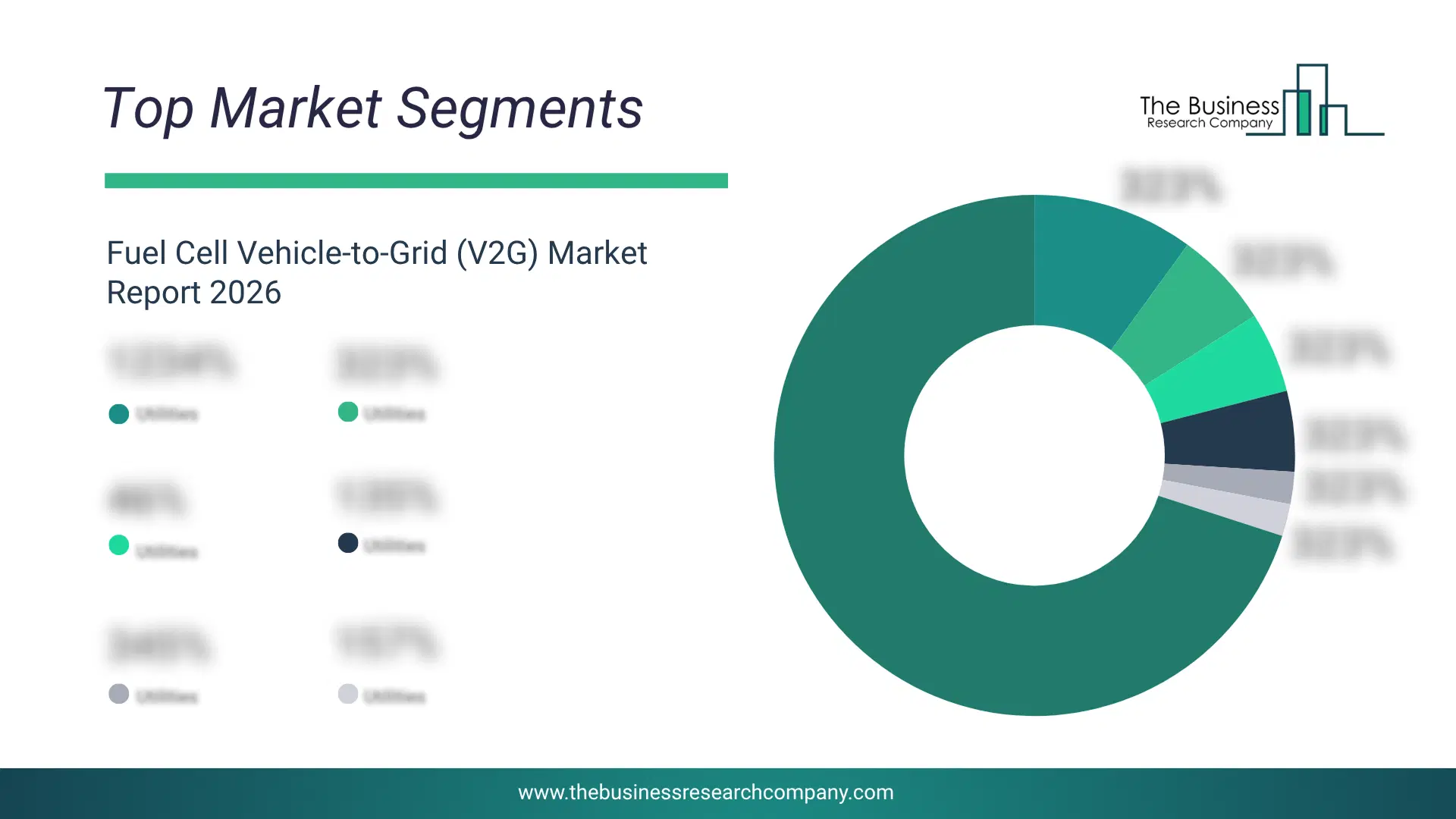
1) By Vehicle Type: Passenger Vehicles, Commercial Vehicles, Buses, Other Vehicle Types 2) By Technology: Proton Exchange Membrane Fuel Cells, Phosphoric Acid Fuel Cells, Solid Oxide Fuel Cells, Other Technologies 3) By Power Rating: Below 100 kW, 100–200 kW, Above 200 kW 4) By Application: Peak Power Supply, Emergency Power, Frequency Regulation, Other Applications 5) By End-User: Residential, Commercial, Industrial, Utilities Subsegments: 1) By Passenger Vehicles: Sedans, Sport Utility Vehicles, Hatchbacks, Coupes, Luxury Vehicles 2) By Commercial Vehicles: Light Commercial Vehicles, Medium Commercial Vehicles, Heavy Commercial Vehicles, Delivery Vans, Pickup Trucks 3) By Buses: City Buses, Intercity Buses, Shuttle Buses, Tourist Coaches 4) By Other Vehicle Types: Two Wheelers, Three Wheelers, Off Road Vehicles, Special Purpose VehiclesWhat Is The Driver Of The Fuel Cell Vehicle-to-Grid (V2G) Market?
The increasing deployment of smart grids is expected to propel the growth of the fuel cell vehicle-to-grid (V2G) market going forward. A smart grid is a modern electricity network that uses digital tools to manage and deliver power more efficiently and reliably. The rise in smart grids is driven by the growing need for more reliable electricity, as it helps prevent power outages and ensures a steady energy supply to homes and businesses. Fuel cell vehicle-to-grid (V2G) systems support smart grids by enabling bidirectional energy flow between vehicles and the power network, enhancing grid stability and reliability. They optimize renewable energy utilization and provide flexible energy management, improving overall efficiency and resilience of the electricity system. For instance, in July 2023, according to the International Energy Agency (IEA), a France-based intergovernmental organization, global electricity grid investments are rising, with Europe allocating EUR 584 billion by 2030 (EUR 170 billion for digitalization), China investing USD 442 billion (2021–2025), Japan funding USD 155 billion (2022), and the US providing USD 10.5 billion (2022) for grid modernization. Therefore, the increasing deployment of smart grids is driving the growth of the fuel cell vehicle-to-grid (V2G) industry.Key Players In The Global Fuel Cell Vehicle-to-Grid (V2G) Market
Major companies operating in the fuel cell vehicle-to-grid (v2g) market report include Toyota Motor Corporation, TotalEnergies SE, Ford Motor Company, BMW Group, Honda Motor Co. Ltd., Mitsubishi Corporation, Hyundai Motor Company, Nissan Motor Corporation, Kia Corporation, Panasonic Corporation, Renault Group, Contemporary Amperex Technology Co. Limited, Toshiba Corporation, GS Yuasa International Ltd., Doosan Fuel Cell Co. Ltd., SFC Energy AG, Ballard Power Systems Inc., Nuvera Fuel Cells LLC, AFC Energy plc, Automotive Energy Supply Corporation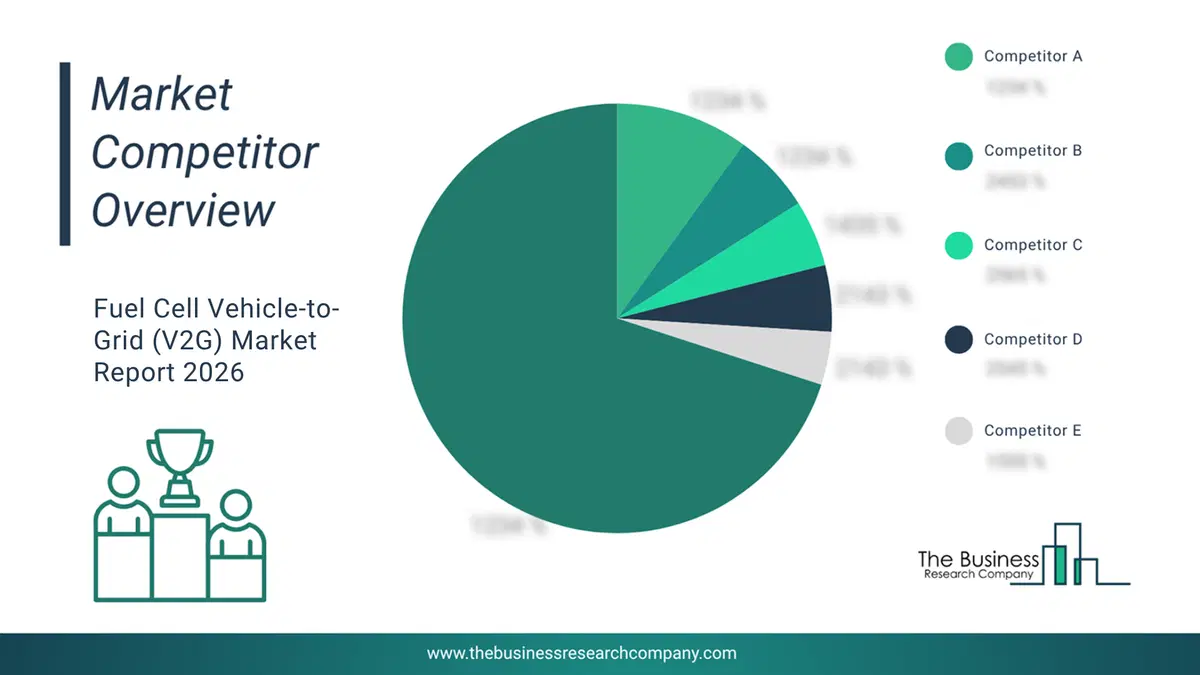
This chart is for illustrative purposes; the full report includes a detailed competitor analysis and comprehensive overview of the top 10 companies in the market.
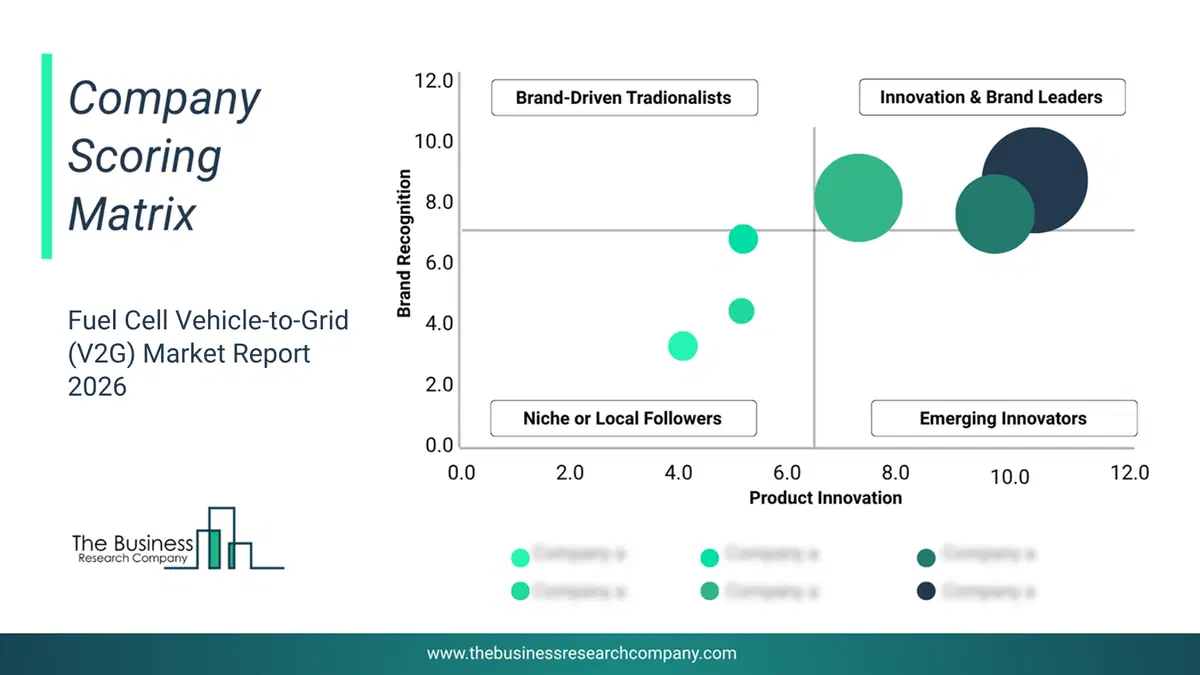
This chart maps companies by product innovation and brand strength, with bubble size indicating relative revenue, helping identify market leaders, challengers, and niche players. This is an illustrative chart; the full report provides a complete and accurate competitive analysis.
Global Fuel Cell Vehicle-to-Grid (V2G) Market Trends and Insights
Major companies operating in the fuel cell vehicle-to-grid (V2G) market are focusing on developing advanced products, such as bidirectional charging systems, to boost grid resilience, enhance energy independence for consumers, and maximize the utilization of renewable energy. Bidirectional charging systems refer to advanced mechanisms that allow energy to flow both to and from an electric vehicle's battery, enabling the vehicle to power a home (V2H) or send electricity back to the grid (V2G). For instance, in July 2025, Star Charge, a China-based leading EV charging solutions provider, launched the Halo bidirectional DC charger in Australia. The Halo is a 22 kW AC and 22 kW DC wall charger featuring vehicle-to-everything (V2X) technology, allowing it to support a range of applications from home backup power to grid services. It includes automatic switching between charging and discharging modes, enabling seamless energy management and increased energy security for households and businesses.What Are Latest Mergers And Acquisitions In The Fuel Cell Vehicle-to-Grid (V2G) Market?
In April 2025, Nuvve Holding Corp., a US-based green energy technology company, acquired Fermata Energy LLC for an undisclosed amount. With this acquisition, Nuvve aims to strengthen its V2G market position by integrating Fermata Energy’s bidirectional charging tech and customer base, accelerating intelligent energy solutions and expanding grid services for commercial and residential applications. Fermata Energy LLC is a US-based renewable energy tech company specializing in fuel cell vehicle-to-grid (V2G) systems.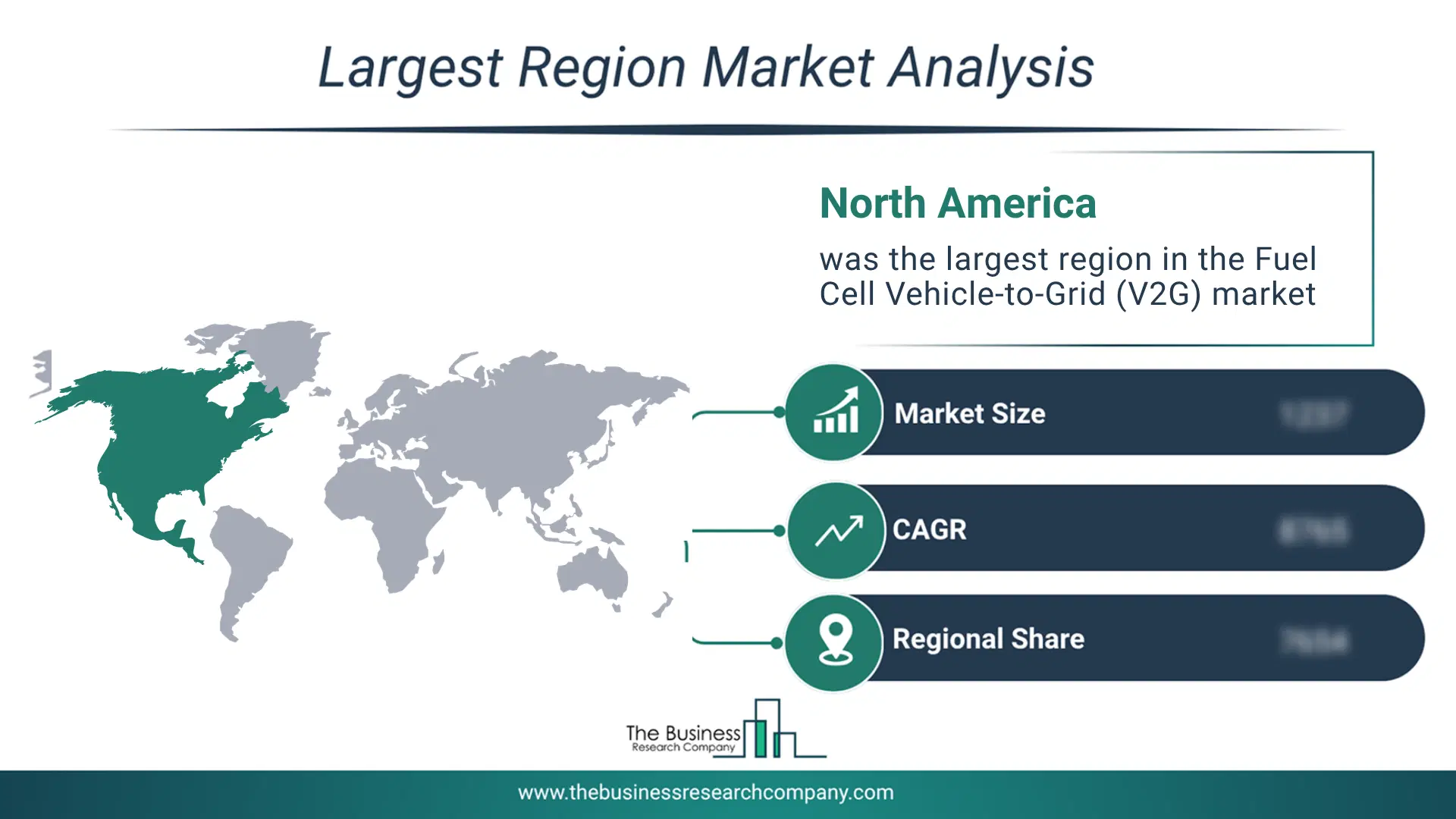
Regional Outlook
North America was the largest region in the fuel cell vehicle-to-grid (V2G) market in 2025. The regions covered in this market report include Asia-Pacific, South East Asia, Western Europe, Eastern Europe, North America, South America, Middle East, Africa. The countries covered in this market report include Australia, Brazil, China, France, Germany, India, Indonesia, Japan, Taiwan, Russia, South Korea, UK, USA, Canada, Italy, SpainWhat Defines the Fuel Cell Vehicle-to-Grid (V2G) Market?
The fuel cell vehicle-to-grid (V2G) market consists of revenues earned by entities by providing services such as electricity supply back to the grid, energy storage management, grid balancing, demand response, and ancillary services. The market value includes the value of related goods sold by the service provider or included within the service offering. The fuel cell vehicle-to-grid (V2G) system market also includes sales of fuel cell electric vehicles (FCEVs), bidirectional chargers, power conversion systems, energy management software, and related hardware components. Values in this market are ‘factory gate’ values, that is the value of goods sold by the manufacturers or creators of the goods, whether to other entities (including downstream manufacturers, wholesalers, distributors and retailers) or directly to end customers. The value of goods in this market includes related services sold by the creators of the goods.How is Market Value Defined and Measured?
The market value is defined as the revenues that enterprises gain from the sale of goods and/or services within the specified market and geography through sales, grants, or donations in terms of the currency (in USD unless otherwise specified). The revenues for a specified geography are consumption values that are revenues generated by organizations in the specified geography within the market, irrespective of where they are produced. It does not include revenues from resales along the supply chain, either further along the supply chain or as part of other products.
This chart presents market attractiveness based on a quantitative evaluation of growth, competition, strategic alignment, and risk, offering a clear view of opportunity areas for decision-making. This chart is for illustrative purposes; the full report contains the complete analysis.

This chart highlights the Total Addressable Market (TAM) by estimating the maximum revenue opportunity using an assumption-driven approach, supporting strategic planning and opportunity sizing across markets. The chart is illustrative; the full report provides a more comprehensive analysis.
What Key Data and Analysis Are Included in the Fuel Cell Vehicle-to-Grid (V2G) Market Report 2026?
The fuel cell vehicle-to-grid (v2g) market research report is one of a series of new reports from The Business Research Company that provides market statistics, including industry global market size, regional shares, competitors with the market share, detailed market segments, market trends and opportunities, and any further data you may need to thrive in the fuel cell vehicle-to-grid (v2g) industry. The market research report delivers a complete perspective of everything you need, with an in-depth analysis of the current and future state of the industry.Fuel Cell Vehicle-to-Grid (V2G) Market Report Forecast Analysis
| Report Attribute | Details |
|---|---|
| Market Size Value In 2026 | $1.55 billion |
| Revenue Forecast In 2030 | $4.18 billion |
| Growth Rate | CAGR of 28.4% from 2026 to 2030 |
| Base Year For Estimation | 2025 |
| Actual Estimates/Historical Data | 2020-2025 |
| Forecast Period | 2026 - 2030 - 2030 |
| Market Representation | Revenue in USD Billion and CAGR from 2026 to 2030 |
| Segments Covered | Vehicle Type, Technology, Power Rating, Application, End-User |
| Regional Scope | Asia-Pacific, Western Europe, Eastern Europe, North America, South America, Middle East, Africa |
| Country Scope | The countries covered in the report are Australia, Brazil, China, France, Germany, India, Indonesia, Japan, Taiwan, Russia, South Korea, UK, USA, Canada, Italy, Spain. |
| Key Companies Profiled | Toyota Motor Corporation, TotalEnergies SE, Ford Motor Company, BMW Group, Honda Motor Co. Ltd., Mitsubishi Corporation, Hyundai Motor Company, Nissan Motor Corporation, Kia Corporation, Panasonic Corporation, Renault Group, Contemporary Amperex Technology Co. Limited, Toshiba Corporation, GS Yuasa International Ltd., Doosan Fuel Cell Co. Ltd., SFC Energy AG, Ballard Power Systems Inc., Nuvera Fuel Cells LLC, AFC Energy plc, Automotive Energy Supply Corporation |
| Customization Scope | Request for Customization |
| Pricing And Purchase Options | Explore Purchase Options |