
Fuel Injection Systems Market Report 2026
Global Outlook – By Components (Electronic Control Unit, Fuel Injectors, Pressure Regulators, Sensors, Fuel Pumps), By Vehicle Type (Two-Wheelers, Passenger Vehicle, Heavy Vehicles, Other Vehicle Types), By Engine Type (Gasoline, Diesel Engines, Other Engine Types), By Technology (Direct, Multi-Point), By Sales Channel (Original Equipment Manufacturer (OEM), Aftermarket) – Market Size, Trends, Strategies, and Forecast to 2030
Fuel Injection Systems Market Overview
• Fuel Injection Systems market size has reached to $99.55 billion in 2025 • Expected to grow to $169.09 billion in 2030 at a compound annual growth rate (CAGR) of 11.4% • Growth Driver: Vehicle Production Surge Fuels Growth In The Fuel Injection Systems Market • Market Trend: Developing Hydrogen Fuel Injection System To Enhance Efficient Combustion • Asia-Pacific was the largest region in 2025.What Is Covered Under Fuel Injection Systems Market?
A fuel injection system refers to a mechatronic circuit consisting of mechanical and electronic circuits that are used to inject fuel into the engine cylinders while accurately adjusting injection time, fuel atomization, and other characteristics. The main types of components in fuel injection systems are electronic control units, fuel injectors, pressure regulators, sensors, and fuel pumps. Electronic control unit refers to a tiny component of a car's body in charge of managing a particular operation and it is used in fuel injectors, which control the injection of gasoline and, in gasoline engines, the ignition timing of the spark. Major vehicle types that use fuel injection systems are two-wheelers, passenger vehicles, heavy vehicles, and others and are used in different engine types such as gasoline, petrol engine, diesel engines, and other engine types with various technologies such as direct and multi-point. These are distributed via different sales channels such as original equipment manufacturer (OEM) and aftermarket.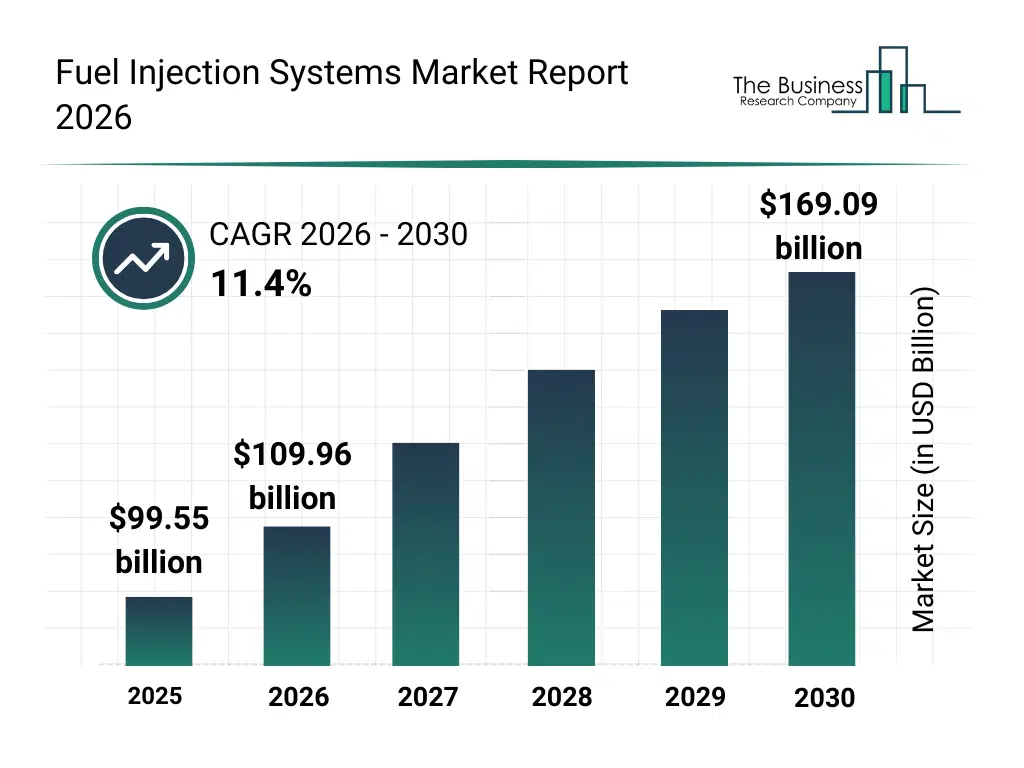
What Is The Fuel Injection Systems Market Size and Share 2026?
The fuel injection systems market size has grown rapidly in recent years. It will grow from $99.55 billion in 2025 to $109.96 billion in 2026 at a compound annual growth rate (CAGR) of 10.5%. The growth in the historic period can be attributed to engine efficiency regulations, growth of passenger vehicle production, evolution of ECU technology, fuel economy standards, demand for performance optimization.What Is The Fuel Injection Systems Market Growth Forecast?
The fuel injection systems market size is expected to see rapid growth in the next few years. It will grow to $169.09 billion in 2030 at a compound annual growth rate (CAGR) of 11.4%. The growth in the forecast period can be attributed to stringent emission norms, advancement in sensor technologies, hybrid powertrain compatibility, growth in vehicle parc, rising aftermarket servicing. Major trends in the forecast period include increasing precision in fuel delivery, rising adoption of direct injection systems, growing integration of electronic control units, improvement in fuel efficiency performance, expansion of aftermarket replacement demand.
Global Fuel Injection Systems Market Segmentation
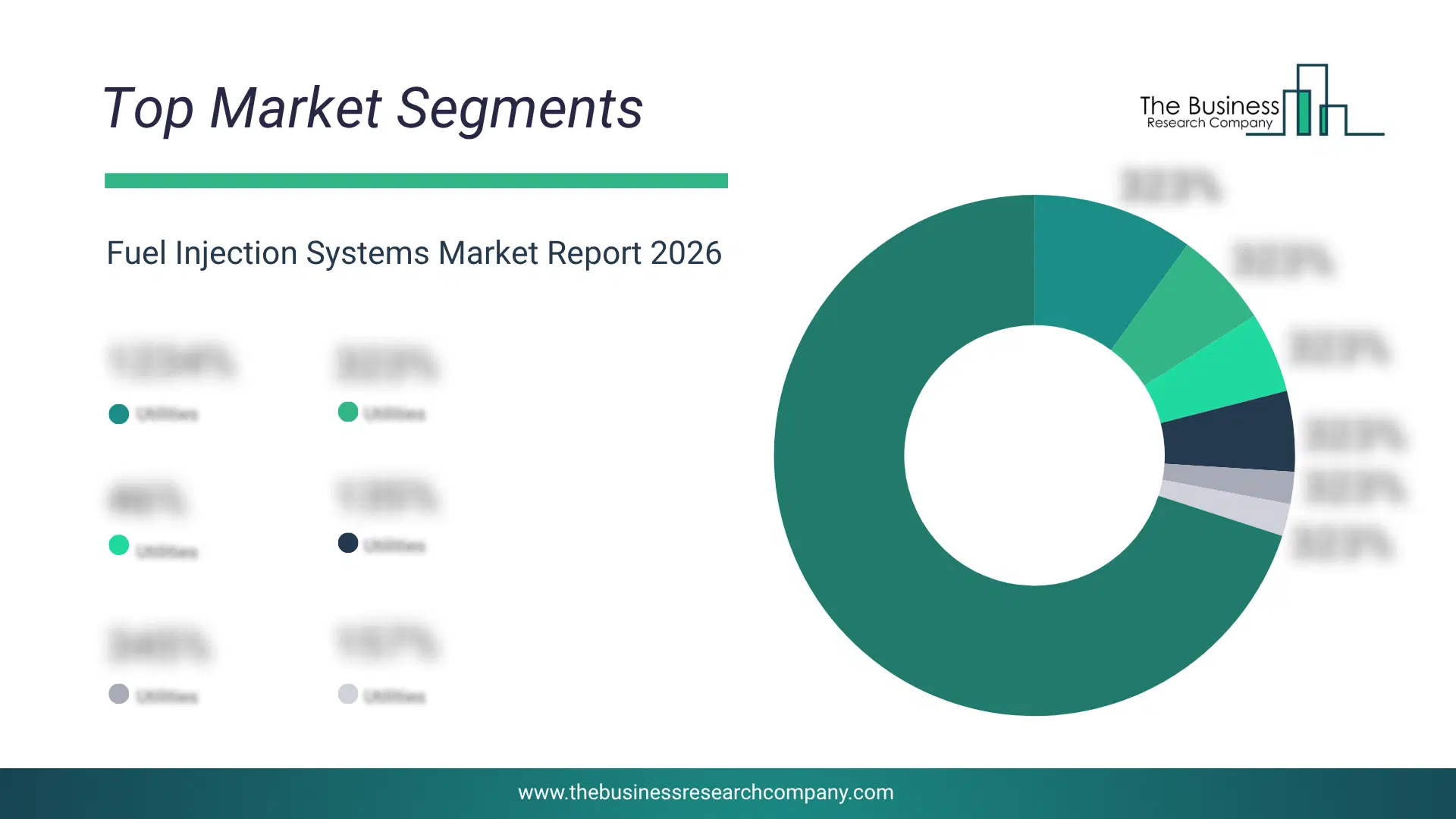
1) By Components: Electronic Control Unit, Fuel Injectors, Pressure Regulators, Sensors, Fuel Pumps 2) By Vehicle Type: Two-Wheelers, Passenger Vehicle, Heavy Vehicles, Other Vehicle Types 3) By Engine Type: Gasoline, Diesel Engines, Other Engine Types 4) By Technology: Direct, Multi-Point 5) By Sales Channel: Original Equipment Manufacturer (OEM), Aftermarket Subsegments: 1) By Electronic Control Unit (ECU): Engine Control Module (ECM), Transmission Control Module (TCM), Body Control Module (BCM), Other Control Units 2) By Fuel Injectors: Gasoline Direct Injectors, Port Fuel Injectors, Diesel Fuel Injectors, Other Types of Injectors 3) By Pressure Regulators: Return-Line Pressure Regulators, Non-Return Pressure Regulators, Electronic Pressure Regulators 4) By Sensors: Oxygen Sensors, Mass Airflow Sensors (MAF), Engine Temperature Sensors, Pressure Sensors, Other Sensors 5) By Fuel Pumps: Electric Fuel Pumps, Mechanical Fuel Pumps, Inline Fuel Pumps, Submersible Fuel PumpsWhat Is The Driver Of The Fuel Injection Systems Market?
Increasing vehicle production is expected to propel the growth of the fuel injection systems market going forward. A vehicle refers to any mode of transportation or conveyance in which someone travels or something is carried or conveyed. Fuel injectors are used to inject fuel into the engine cylinders while accurately adjusting injection time and fuel atomization and driving it directly into the combustion chamber at the precise period. For instance, in May 2023, according to the Global Association of European Automobile Manufacturers (ACEA), 85.4 million vehicles were manufactured worldwide, marking a 3% increase from 2024. Therefore, the increase in vehicle production is driving the growth of the fuel injection systems industry.Key Players In The Global Fuel Injection Systems Market
Major companies operating in the fuel injection systems market report include Robert Bosch GmbH, Denso Corporation, Continental AG, Cummins Inc., Eaton Corporation plc, BorgWarner Inc., Hitachi Automotive Systems Ltd., Tata AutoComp Systems Limited, Woodward Inc., Weifu High-Technology Group Co. Ltd., Mikuni Corporation, Delphi Technologies PLC, Holley Performance Products Inc., Walbro LLC, Keihin Corporation, Stanadyne LLC, Magneti Marelli S.p.A., Carter Fuel Systems LLC, Edelbrock LLC, Ucal Fuel Systems Limited, Rochester Gauges International LLC, ASNU Corporation Europe Ltd.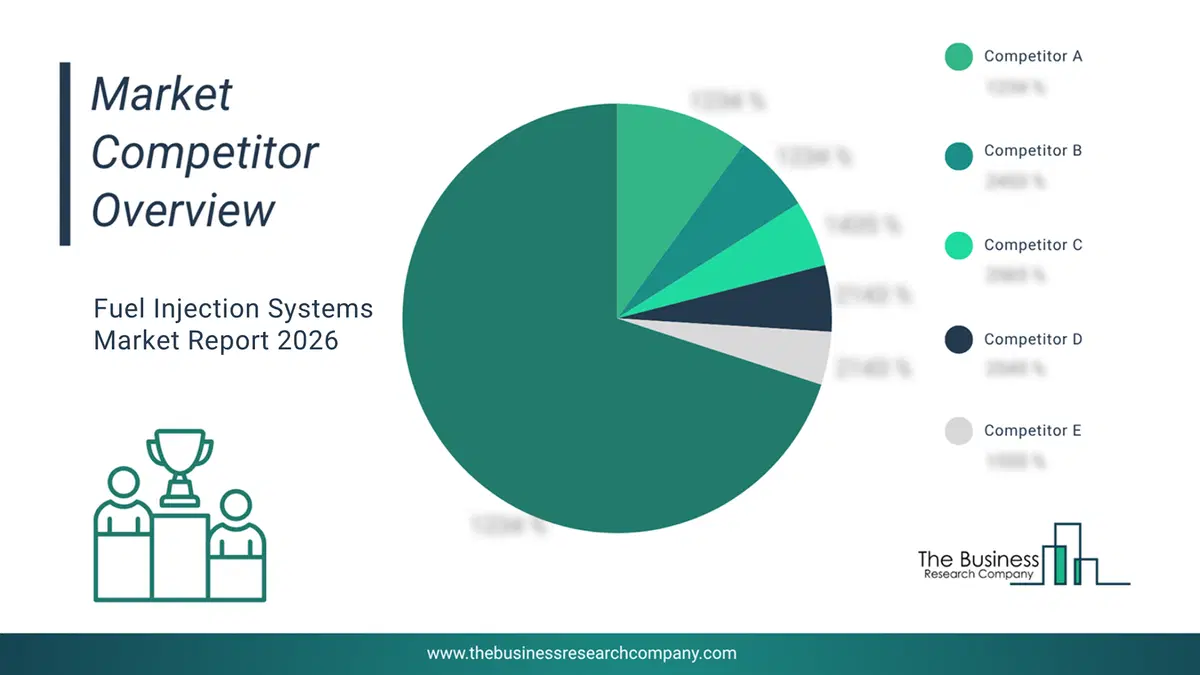
This chart is for illustrative purposes; the full report includes a detailed competitor analysis and comprehensive overview of the top 10 companies in the market.
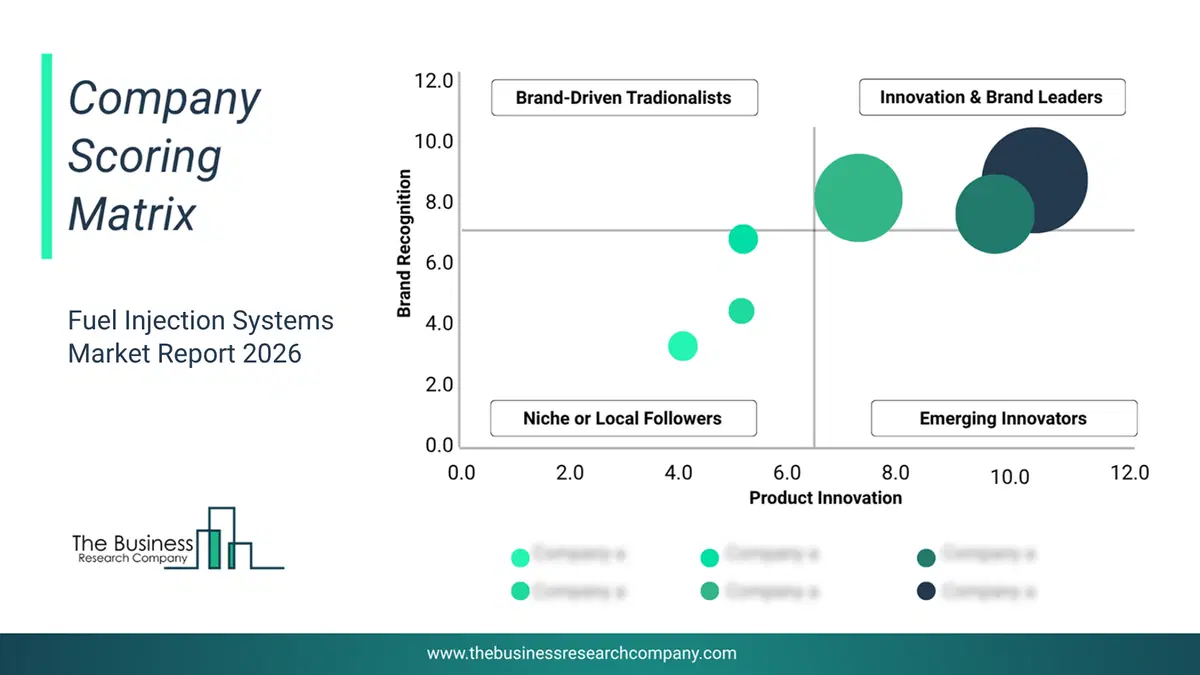
This chart maps companies by product innovation and brand strength, with bubble size indicating relative revenue, helping identify market leaders, challengers, and niche players. This is an illustrative chart; the full report provides a complete and accurate competitive analysis.
Global Fuel Injection Systems Market Trends and Insights
Major companies operating in the fuel injection systems market are developing hydrogen fuel injection system to enhance efficient combustion. A hydrogen fuel injection system is a technology that delivers hydrogen gas into the combustion chamber of an engine, enabling efficient combustion. For instance, in December 2023, Marelli, an Italy-based automotive technology company, introduced its hydrogen fuel system, which includes specially designed injectors with a patented design and an advanced Engine Control Unit (ECU). This cutting-edge system is specifically engineered for hydrogen engines that function like traditional internal combustion engines but use hydrogen as fuel, resulting in zero CO2 emissions and supporting eco-friendly mobility. Drawing on its expertise in high-pressure direct injection technology, Marelli's new fuel system guarantees precision, efficiency, and seamless integration into current automotive platforms.What Are Latest Mergers And Acquisitions In The Fuel Injection Systems Market?
In May 2023, Accelleron Industries AG, a Switzerland-based company in the development, manufacturing, sales, and servicing of turbochargers and digital solutions acquired OMT for an undisclosed amount. This acquisition enhances Accelleron's fundamental business, bolstering its appealing financial profile through sustained revenue growth, robust margins, and solid cash flow. OMT is a US-based manufacturer of fuel injection systems for marine engines.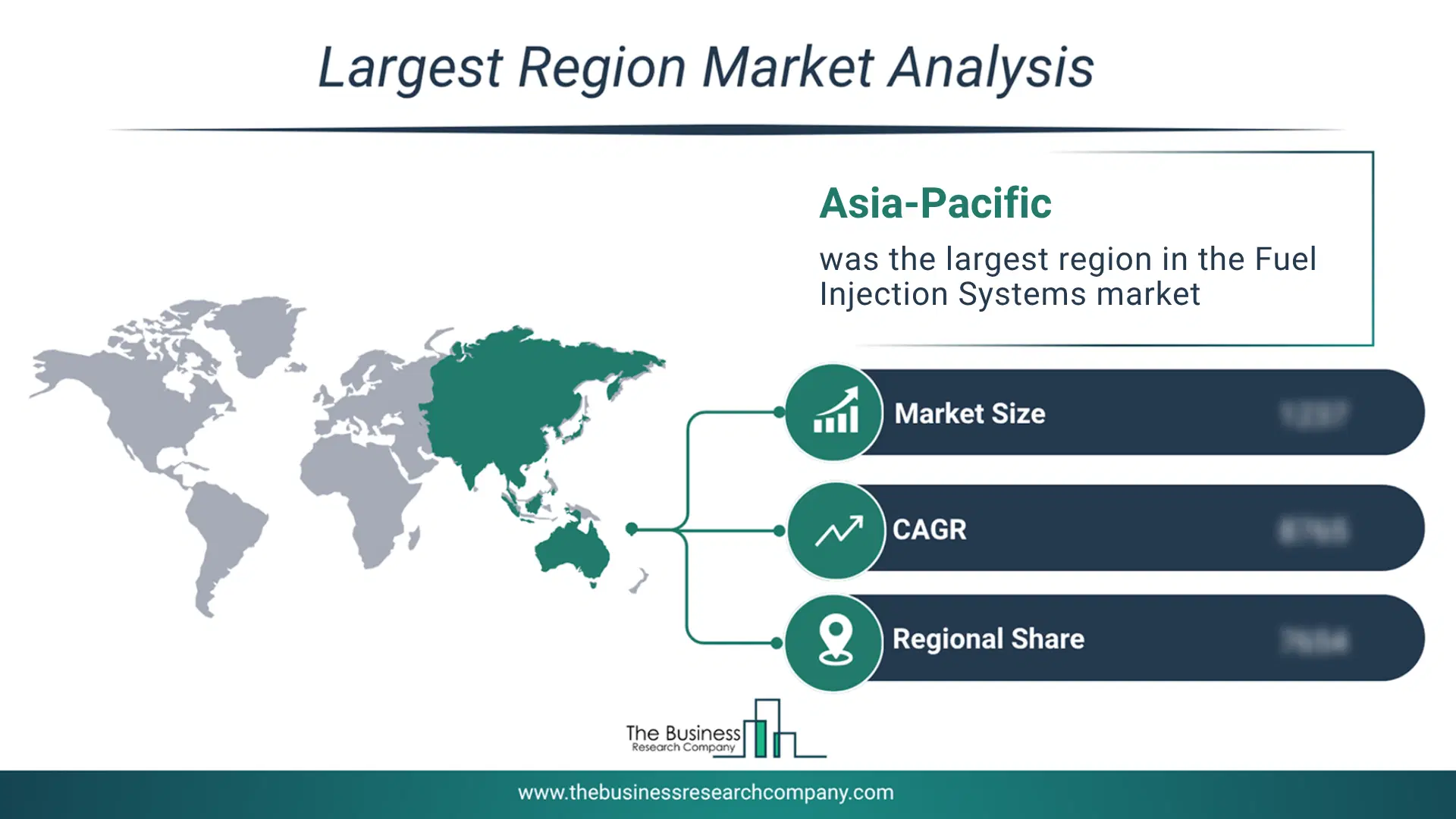
Regional Outlook
Asia-Pacific was the largest region in the fuel injection systems market in 2025. The regions covered in this market report include Asia-Pacific, South East Asia, Western Europe, Eastern Europe, North America, South America, Middle East, Africa. The countries covered in this market report include Australia, Brazil, China, France, Germany, India, Indonesia, Japan, Taiwan, Russia, South Korea, UK, USA, Canada, Italy, SpainWhat Defines the Fuel Injection Systems Market?
The fuel injection systems market consists of sales of direct injection, throttle body injection, semi-direct injection, pump-line-nozzle, unit injector, single-point fuel injection, multi-point fuel injection, sequential fuel injection, and direct fuel injection. Values in this market are ‘factory gate’ values, that is the value of goods sold by the manufacturers or creators of the goods, whether to other entities (including downstream manufacturers, wholesalers, distributors, and retailers) or directly to end customers. The value of goods in this market includes related services sold by the creators of the goods.How is Market Value Defined and Measured?
The market value is defined as the revenues that enterprises gain from the sale of goods and/or services within the specified market and geography through sales, grants, or donations in terms of the currency (in USD unless otherwise specified). The revenues for a specified geography are consumption values that are revenues generated by organizations in the specified geography within the market, irrespective of where they are produced. It does not include revenues from resales along the supply chain, either further along the supply chain or as part of other products.
This chart presents market attractiveness based on a quantitative evaluation of growth, competition, strategic alignment, and risk, offering a clear view of opportunity areas for decision-making. This chart is for illustrative purposes; the full report contains the complete analysis.

This chart highlights the Total Addressable Market (TAM) by estimating the maximum revenue opportunity using an assumption-driven approach, supporting strategic planning and opportunity sizing across markets. The chart is illustrative; the full report provides a more comprehensive analysis.
What Key Data and Analysis Are Included in the Fuel Injection Systems Market Report 2026?
The fuel injection systems market research report is one of a series of new reports from The Business Research Company that provides market statistics, including industry global market size, regional shares, competitors with the market share, detailed market segments, market trends and opportunities, and any further data you may need to thrive in the fuel injection systems industry. The market research report delivers a complete perspective of everything you need, with an in-depth analysis of the current and future state of the industry.Fuel Injection Systems Market Report Forecast Analysis
| Report Attribute | Details |
|---|---|
| Market Size Value In 2026 | $109.96 billion |
| Revenue Forecast In 2030 | $169.09 billion |
| Growth Rate | CAGR of 10.5% from 2026 to 2030 |
| Base Year For Estimation | 2025 |
| Actual Estimates/Historical Data | 2020-2025 |
| Forecast Period | 2026 - 2030 - 2030 |
| Market Representation | Revenue in USD Billion and CAGR from 2026 to 2030 |
| Segments Covered | Components, Vehicle Type, Engine Type, Technology, Sales Channel |
| Regional Scope | Asia-Pacific, Western Europe, Eastern Europe, North America, South America, Middle East, Africa |
| Country Scope | The countries covered in the report are Australia, Brazil, China, France, Germany, India, Indonesia, Japan, Taiwan, Russia, South Korea, UK, USA, Canada, Italy, Spain. |
| Key Companies Profiled | Robert Bosch GmbH, Denso Corporation, Continental AG, Cummins Inc., Eaton Corporation plc, BorgWarner Inc., Hitachi Automotive Systems Ltd., Tata AutoComp Systems Limited, Woodward Inc., Weifu High-Technology Group Co. Ltd., Mikuni Corporation, Delphi Technologies PLC, Holley Performance Products Inc., Walbro LLC, Keihin Corporation, Stanadyne LLC, Magneti Marelli S.p.A., Carter Fuel Systems LLC, Edelbrock LLC, Ucal Fuel Systems Limited, Rochester Gauges International LLC, ASNU Corporation Europe Ltd. |
| Customization Scope | Request for Customization |
| Pricing And Purchase Options | Explore Purchase Options |