
Fuel Line Disconnect Tools Market Report 2026
Global Outlook – By Product Type (Quick Disconnect Tools, Plier-Type Tools, Scissor-Type Tools, Specialty Disconnect Tools, Other Product Types), By Material (Plastic, Metal, Composite, Other Materials), By Distribution Channel (Online Retail, Automotive Aftermarket Stores, Specialty Stores, Other Distribution Channels), By Application (Automotive, Aerospace, Marine, Industrial, Other Applications), By End-User (Do-It-Yourself Consumers, Professional Technicians, Workshops, Other End-Users) – Market Size, Trends, Strategies, and Forecast to 2035
Fuel Line Disconnect Tools Market Overview
• Fuel Line Disconnect Tools market size has reached to $0.92 billion in 2025 • Expected to grow to $1.28 billion in 2030 at a compound annual growth rate (CAGR) of 7% • Growth Driver: The Rising Vehicle Ownership And Production Is Fueling The Growth Of Market Due To Increasing Vehicle Manufacturing And Servicing Requirements • North America was the largest region in 2025 and Asia-Pacific is the fastest growing region.What Is Covered Under Fuel Line Disconnect Tools Market?
Fuel line disconnect tools are specialized instruments designed to safely separate fuel lines from fittings without causing damage to the connectors or surrounding components. They are typically made from durable materials such as plastic or metal and are engineered to fit various fuel line sizes and locking mechanisms used in automotive systems. These tools help technicians perform maintenance and repairs efficiently while minimizing the risk of fuel leakage or component damage. The main product types of fuel line disconnect tools include quick disconnect tools, plier-type tools, scissor-type tools, specialty disconnect tools, and other product types. Quick disconnect tools refer to hand tools specifically designed to safely separate fuel lines and connectors during vehicle maintenance and repair operations. These tools are manufactured using materials such as plastic, metal, composite, and other materials and are distributed through online retail, automotive aftermarket stores, specialty stores, and other distribution channels. They find application in automotive, aerospace, marine, industrial, and others, serving end users including do-it-yourself consumers, professional technicians, workshops, and others.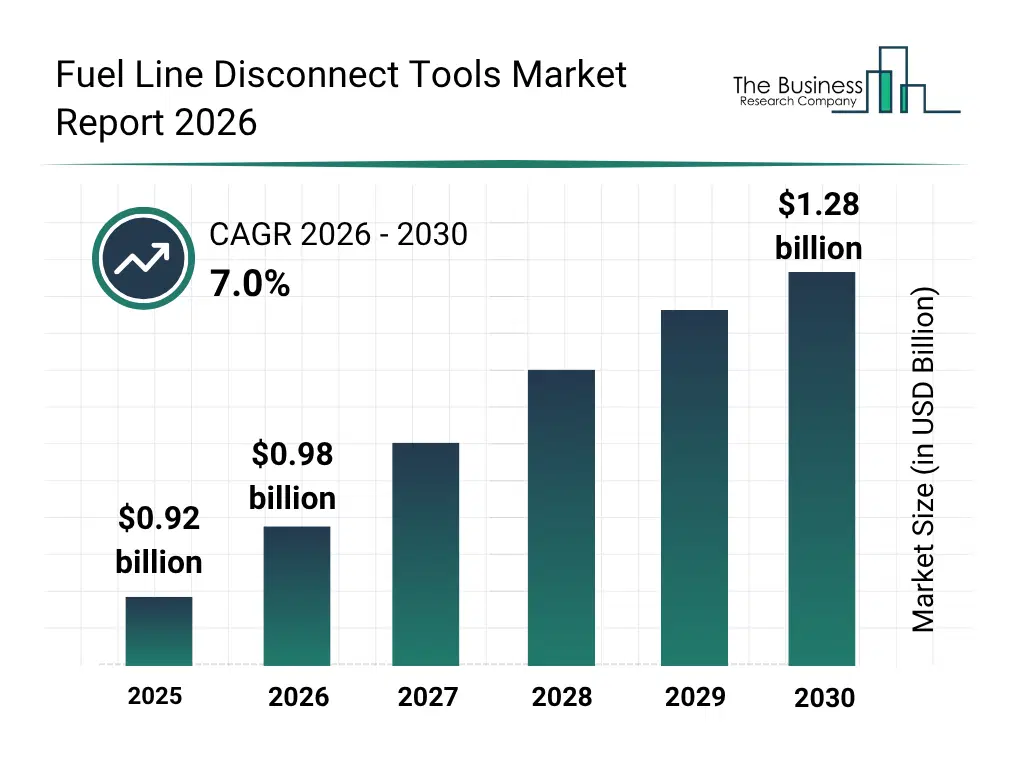
What Is The Fuel Line Disconnect Tools Market Size and Share 2026?
The fuel line disconnect tools market size has grown strongly in recent years. It will grow from $0.92 billion in 2025 to $0.98 billion in 2026 at a compound annual growth rate (CAGR) of 6.7%. The growth in the historic period can be attributed to growth of automotive aftermarket repair services, increasing vehicle parc and engine complexity, expansion of professional workshop networks, rising need for efficient fuel system maintenance tools, development of standardized fuel line connector systems in vehicles.What Is The Fuel Line Disconnect Tools Market Growth Forecast?
The fuel line disconnect tools market size is expected to see strong growth in the next few years. It will grow to $1.28 billion in 2030 at a compound annual growth rate (CAGR) of 7.0%. The growth in the forecast period can be attributed to rising adoption of electric and hybrid vehicles increasing tool specialization needs, expansion of automotive service and repair industry in emerging markets, increasing demand for lightweight and ergonomic professional tools, innovation in precision engineered automotive maintenance instruments, growth of DIY automotive repair culture supported by online tutorials and e-commerce. Major trends in the forecast period include rising demand for precision automotive maintenance tools in modern vehicles, increasing adoption of multi size universal fuel line disconnect tool kits, growth of lightweight ergonomic and safety enhanced tool designs, expansion of EV compatible maintenance tool requirements, rising preference for durable corrosion resistant composite and metal hybrid tools.
Global Fuel Line Disconnect Tools Market Segmentation
1) By Product Type: Quick Disconnect Tools, Plier-Type Tools, Scissor-Type Tools, Specialty Disconnect Tools, Other Product Types 2) By Material: Plastic, Metal, Composite, Other Materials 3) By Distribution Channel: Online Retail, Automotive Aftermarket Stores, Specialty Stores, Other Distribution Channels 4) By Application: Automotive, Aerospace, Marine, Industrial, Other Applications 5) By End-User: Do-It-Yourself Consumers, Professional Technicians, Workshops, Other End-Users Subsegments: 1) By Quick Disconnect Tools: Single Size Disconnect Tools, Multi Size Disconnect Tools, Angled Head Disconnect Tools, Straight Head Disconnect Tools 2) By Plier-Type Tools: Standard Jaw Pliers, Long Reach Pliers, Locking Pliers, Ergonomic Grip Pliers 3) By Scissor-Type Tools: Compact Scissor Tools, Heavy Duty Scissor Tools, Spring Loaded Scissor Tools, Precision Cut Scissor Tools 4) By Specialty Disconnect Tools: Fuel Rail Disconnect Tools, Air Conditioning Line Disconnect Tools, Heavy Duty Line Disconnect Tools, Multi Purpose Disconnect Tools 5) By Other Product Types: Universal Disconnect Tools, Flexible Cable Disconnect Tools, Magnetic Assist Disconnect Tools, Combination Tool SetsWhat Are The Drivers Of The Fuel Line Disconnect Tools Market?
The rising vehicle ownership And production are expected to propel the growth of the fuel line disconnect tools forward. Vehicle ownership and production refers to the combined measure of the number of vehicles owned and used by consumers and businesses, along with the total number of vehicles manufactured within a specific period or region. The increase in vehicle ownership and production is rising due to growing urbanization, as expanding urban populations create higher demand for personal mobility and transportation, driving both vehicle purchases and manufacturing output. The growing demand for vehicle ownership and production is useful for fuel line disconnect tools as it increases the number of vehicles requiring assembly, maintenance, and fuel system servicing, driving the need for efficient and specialized tools for safe fuel line disconnection. For instance, in January 2025, according to The State Council Information Office of the People's Republic of China, a China-based chief information agency of the Chinese government, China’s automotive industry recorded total production of 31.28 million units, representing a 3.7% year-on-year increase compared to 2023, while vehicle sales reached 31.44 million units, reflecting a 4.5% annual growth. Therefore, rising vehicle ownership And production is driving the growth of the fuel line disconnect tools industry. The rising number of aging vehicles are expected to propel the growth of the fuel line disconnect tools forward. Aging vehicles refers to cars, trucks, and other automobiles that have been in use for an extended period, typically characterized by higher average age, increased wear and tear, and a greater need for maintenance and replacement parts. The increase in the number of aging vehicles is rising due to extended vehicle lifespans, as advancements in automotive technology and maintenance practices allow cars and trucks to remain operational for longer periods. Fuel line disconnect tools strenthen aged vehicles by enabling safe and efficient removal of worn or corroded fuel line connections, facilitating maintenance, repairs, and component replacements without causing damage to surrounding parts. For instance, in May 2024, according to S&P Global Inc., a UK-based traded corporation, the average age of cars and light trucks in the United States increased to a record 12.6 years in 2024, reflecting a year-on-year rise of approximately two months compared to 2023. Therefore, rising number of aging vehicles is driving the growth of the fuel line disconnect tools industry. The rising investments in automotive repair infrastructure are expected to propel the growth of the fuel line disconnect tools market going forward. Investments in automotive repair infrastructure are aimed at enhancing workshop capabilities, upgrading tools and equipment, and training personnel to efficiently service and maintain modern and advanced vehicles. The increase in investments in automotive repair infrastructure is rising due to the growing adoption of electric and advanced technology vehicles, which require specialized equipment, tools, and trained technicians for proper servicing and maintenance. Investments in automotive repair infrastructure support fuel line disconnect tools by increasing the availability of advanced service facilities and professional equipment, thereby driving the adoption of specialized tools required for efficient, safe, and precise fuel system maintenance and repairs. For instance, in September 2025, according to a survey conducted by the Society of Motor Manufacturers and Traders (SMMT), a UK-based automotive association, approximately 81.2 percent of automotive aftermarket workshops have made investments in training, skilled personnel, and advanced tooling to support servicing and maintenance of the latest vehicle safety and powertrain technologies. Therefore, rising investments in automotive repair infrastructure is driving the growth of the fuel line disconnect tools industry.Key Players In The Global Fuel Line Disconnect Tools Market
Major companies operating in the fuel line disconnect tools market are Stanley Black & Decker Inc., Harbor Freight Tools Inc., Snap-on Incorporated, Dorman Products Inc., Sealey Power Products Limited, KNIPEX-Werk C. Gustav Putsch KG, Lisle Corporation, Hazet-Werk Hermann Zerver GmbH & Co. KG, Draper Tools Limited, Astro Pneumatic Tool Company, SP Air Corporation Pty. Ltd., Motion Pro Inc., King Tony Co. Ltd., CTA Manufacturing Corporation (CTA Tools), S&G Tool Aid Corporation, Powerbuilt Tools, Assenmacher Specialty Tools Inc., KS Tools Werkzeuge-Maschinen GmbH, AmPro Tools Corporation, Company23 LLC, Sunbright Automotive Tools Co. Ltd., Carlyle ToolsRegional Outlook/Insights
North America was the largest region in the fuel line disconnect tools market in 2025. Asia-Pacific is expected to be the fastest-growing region in the forecast period. The regions covered in this market report are Asia-Pacific, South East Asia, Western Europe, Eastern Europe, North America, South America, Middle East, Africa. The countries covered in this market report are Australia, Brazil, China, France, Germany, India, Indonesia, Japan, Taiwan, Russia, South Korea, UK, USA, Canada, Italy, Spain.What Defines the Fuel Line Disconnect Tools Market?
The fuel line disconnect tools market consists of sales of plastic fuel line disconnect tools, metal fuel line disconnect tools, aluminum fuel line disconnect tools, quick release fuel line disconnect tools, multi-size fuel line disconnect tools and scissor type fuel line disconnect tools. Values in this market are ‘factory gate’ values, that is, the value of goods sold by the manufacturers or creators of the goods, whether to other entities (including downstream manufacturers, wholesalers, distributors, and retailers) or directly to end customers. The value of goods in this market includes related services sold by the creators of the goods.How is Market Value Defined and Measured?
The market value is defined as the revenues that enterprises gain from the sale of goods and/or services within the specified market and geography through sales, grants, or donations in terms of the currency (in USD unless otherwise specified). The revenues for a specified geography are consumption values that are revenues generated by organizations in the specified geography within the market, irrespective of where they are produced. It does not include revenues from resales along the supply chain, either further along the supply chain or as part of other products.What Key Data and Analysis Are Included in the Fuel Line Disconnect Tools Market Report 2026?
The fuel line disconnect tools market research report is one of a series of new reports from The Business Research Company that provides market statistics, including industry global market size, regional shares, competitors with the market share, detailed market segments, market trends and opportunities, and any further data you may need to thrive in the fuel line disconnect tools industry. The market research report delivers a complete perspective of everything you need, with an in-depth analysis of the current and future state of the industry.Fuel Line Disconnect Tools Market Report Forecast Analysis
| Report Attribute | Details |
|---|---|
| Market Size Value In 2026 | $0.98 billion |
| Revenue Forecast In 2035 | $1.28 billion |
| Growth Rate | CAGR of 7.0% from 2026 to 2035 |
| Base Year For Estimation | 2025 |
| Actual Estimates/Historical Data | 2020-2025 |
| Forecast Period | 2026 - 2030 - 2035 |
| Market Representation | Revenue in USD Billion and CAGR from 2026 to 2035 |
| Segments Covered | Product Type, Material, Distribution Channel, Application, End-User |
| Regional Scope | Asia-Pacific, Western Europe, Eastern Europe, North America, South America, Middle East, Africa |
| Country Scope | The countries covered in the report are Australia, Brazil, China, France, Germany, India, Indonesia, Japan, Taiwan, Russia, South Korea, UK, USA, Canada, Italy, Spain. |
| Key Companies Profiled | Stanley Black & Decker Inc., Harbor Freight Tools Inc., Snap-on Incorporated, Dorman Products Inc., Sealey Power Products Limited, KNIPEX-Werk C. Gustav Putsch KG, Lisle Corporation, Hazet-Werk Hermann Zerver GmbH & Co. KG, Draper Tools Limited, Astro Pneumatic Tool Company, SP Air Corporation Pty. Ltd., Motion Pro Inc., King Tony Co. Ltd., CTA Manufacturing Corporation (CTA Tools), S&G Tool Aid Corporation, Powerbuilt Tools, Assenmacher Specialty Tools Inc., KS Tools Werkzeuge-Maschinen GmbH, AmPro Tools Corporation, Company23 LLC, Sunbright Automotive Tools Co. Ltd., Carlyle Tools |
| Customization Scope | Request for Customization |
| Pricing And Purchase Options | Explore Purchase Options |