
Fuels Market Report 2026
Global Outlook – By Product Type (Crude Oil, Natural Gas, Condensates, Liquefied Petroleum Gas (LPG), Natural Gas Liquids (NGLs)), By Extraction Source (Onshore Fuels, Offshore Fuels), By Application (Power Generation, Transportation, Heating, Industrial Operations), By End-User (Downstream Refiners, Industrial Or Chemical Plants, Utilities, Distributors And Traders) – Market Size, Trends, Strategies, and Forecast to 2030
Fuels Market Overview
• Fuels market size has reached to $4316.98 billion in 2025 • Expected to grow to $4472.54 billion in 2030 at a compound annual growth rate (CAGR) of 3.8% • Growth Driver: Rising Global Energy Demand Fueling The Growth Of The Market Due To Rapid Electrification Across Industries, Transportation, And Households • Market Trend: Advanced Geosteering Technologies Transform Well Placement And Resource Recovery • Asia-Pacific was the largest region and fastest growing region.What Is Covered Under Fuels Market?
Fuels refer to energy sources derived from hydrocarbon deposits that are extracted, processed, and refined for use in power generation, transportation, heating, and industrial operations. These fuels are produced through upstream oil and gas activities involving exploration, drilling, and extraction of crude oil and natural gas from onshore and offshore reserves. They are designed to provide high energy density and reliable combustion performance to support global energy demand across multiple applications. The main product types of fuels include crude oil, natural gas, condensates, liquefied petroleum gas (LPG), and natural gas liquids (NGLs). Crude oil refers to a naturally occurring unrefined petroleum product composed of hydrocarbons used as a primary source for producing fuels and petrochemicals. These fuels are categorized based on extraction source into onshore fuels and offshore fuels. The various applications involved are power generation, transportation, heating, and industrial operations and they are utilized by end users including downstream refiners, industrial or chemical plants, utilities, and distributors and traders.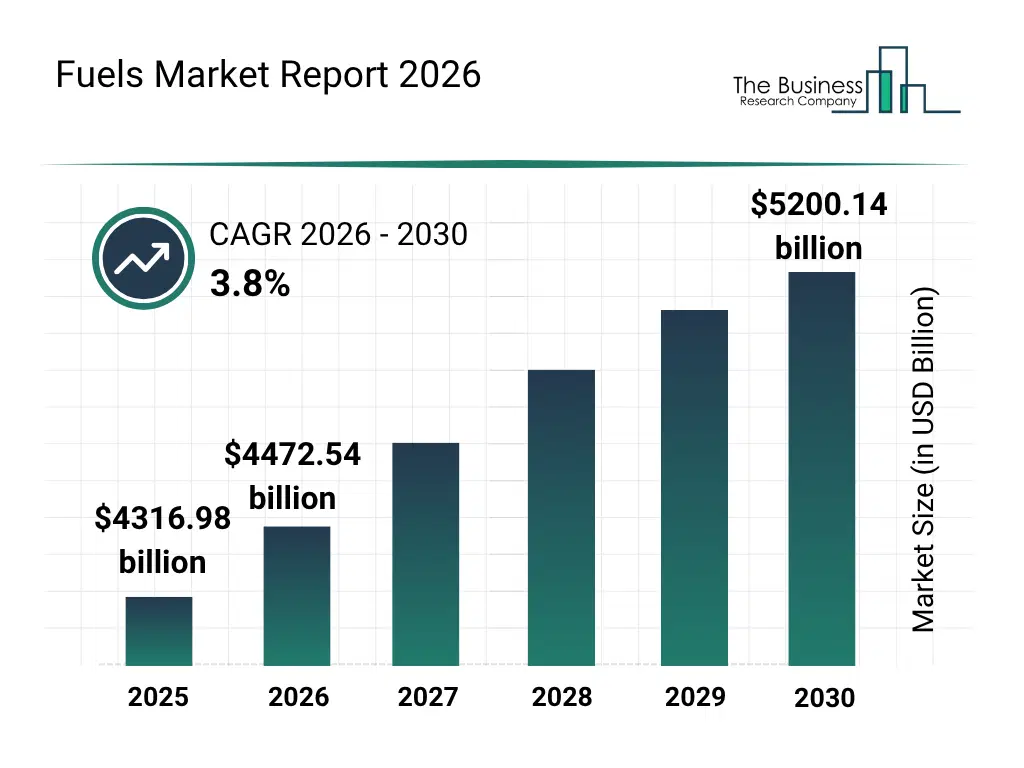
What Is The Fuels Market Size and Share 2026?
The fuels market size has grown steadily in recent years. It will grow from $4316.98 billion in 2025 to $4472.54 billion in 2026 at a compound annual growth rate (CAGR) of 3.6%. The growth in the historic period can be attributed to growth in global transportation fuel demand, expansion of industrialization and urbanization, rising crude oil exploration activities, development of offshore drilling technologies, increasing dependency on fossil fuels for power generation.What Is The Fuels Market Growth Forecast?
The fuels market size is expected to see steady growth in the next few years. It will grow to $5200.14 billion by 2030 at a compound annual growth rate (CAGR) of 3.8%. The growth in the forecast period can be attributed to transition toward low carbon fuels, rising demand for lng in industrial applications, digital transformation of upstream oil and gas operations, growth in energy storage and logistics infrastructure, increasing geopolitical focus on energy security and supply diversification. Major trends in the forecast period include increasing shift toward cleaner fuel alternatives and low sulfur fuel grades, rising investment in digital oilfield and smart exploration technologies, expansion of lng as a transitional fuel in global energy mix, growth of advanced refining technologies for higher yield efficiency, rising demand for flexible fuel supply chains and storage infrastructure.
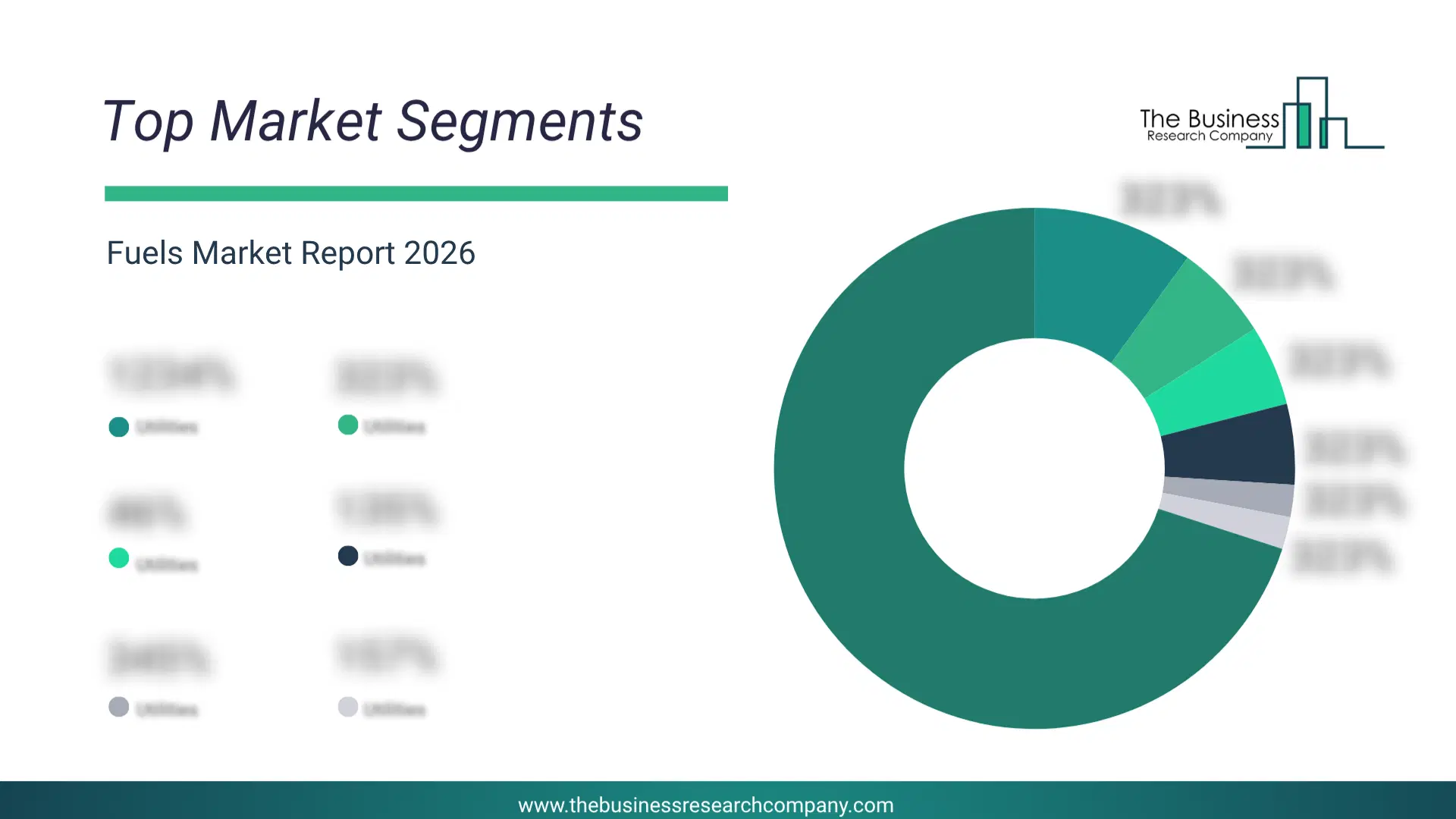
Global Fuels Market Segmentation
1) By Product Type: Crude Oil, Natural Gas, Condensates, Liquefied Petroleum Gas (LPG), Natural Gas Liquids (NGLs) 2) By Extraction Source: Onshore Fuels, Offshore Fuels 3) By Application: Power Generation, Transportation, Heating, Industrial Operations 4) By End-User: Downstream Refiners, Industrial Or Chemical Plants, Utilities, Distributors And Traders Subsegments: 1) By Crude Oil: Light Crude Oil, Medium Crude Oil, Heavy Crude Oil, Sweet Crude Oil, Sour Crude Oil 2) By Natural Gas: Associated Natural Gas, Non Associated Natural Gas, Conventional Natural Gas, Unconventional Natural Gas, Shale Gas 3) By Condensates: Lease Condensate, Plant Condensate, Field Condensate 4) By Liquefied Petroleum Gas (LPG): Propane, Butane, Isobutane, Propane Butane Mixture 5) By Natural Gas Liquids (NGLs): Ethane, Propane, Butane, Isobutane, PentaneWhat Is The Driver Of The Fuels Market?
The increasing energy demand is expected to propel the growth of the fuels market going forward. Energy demand refers to the total amount of energy required by consumers, industries, and economies to meet their consumption and operational needs over a given period. The increase in global energy demand is driven by rapid electrification, as expanding use of electricity across industries, transportation, and households significantly raises overall energy consumption. Fuels support energy demand by providing reliable and scalable energy sources that power electricity generation, transportation, and industrial activities across global economies. For instance, in December 2025, according to the Department for Energy Security and Net Zero, a UK-based government department, final energy consumption in the UK rose by 2.6% between 2023 and 2024, reaching 128.1 million tonnes of oil equivalent (mtoe). In the domestic sector, energy use in 2024 rebounded from the historic low recorded in 2023, increasing by 3.8% to 34.0 mtoe. Therefore, the increasing energy demand is driving the growth of the fuels industry.Key Players In The Global Fuels Market
Major companies operating in the fuels market are Saudi Arabian Oil Company, China Petroleum & Chemical Corporation, PetroChina Company Limited, Shell plc, TotalEnergies SE, BP p.l.c., Chevron Corporation, Equinor ASA, Eni S.p.A., Petróleo Brasileiro S.A., PJSC Rosneft Oil Company, CNOOC Limited, QatarEnergy, Exxon Mobil Corporation, PJSC LUKOIL, Occidental Petroleum Corporation, EOG Resources Inc., Devon Energy Corporation, Petróleos de Venezuela S.A., Apache Corporation, Murphy Oil Corporation.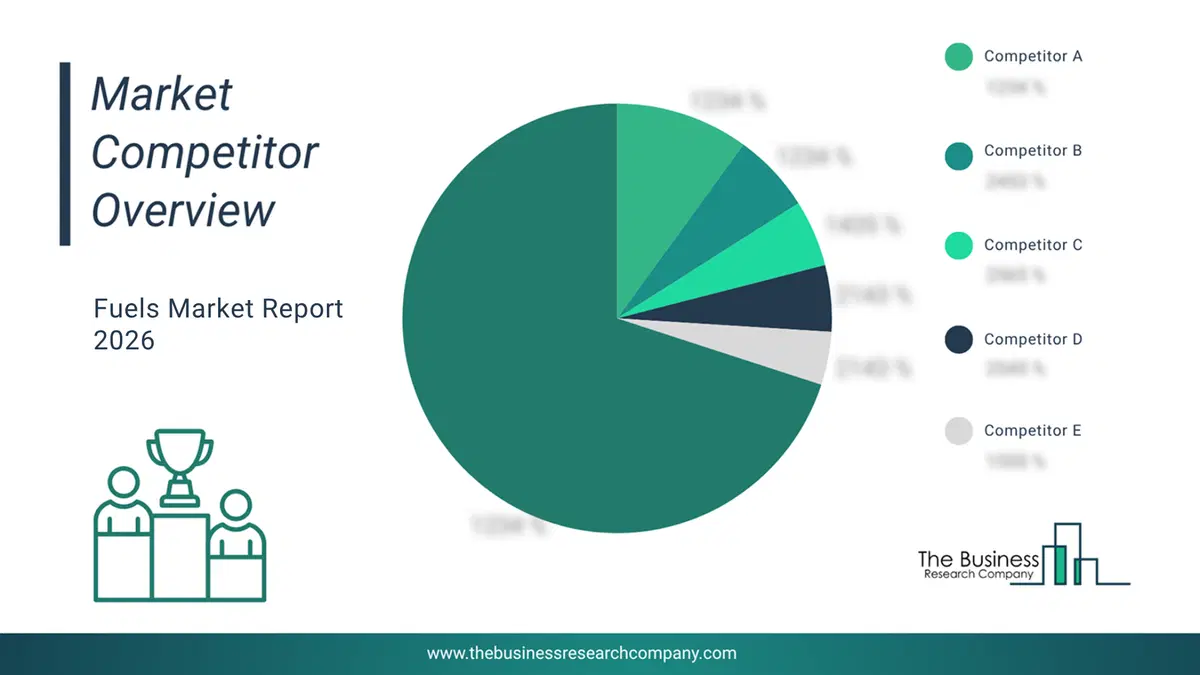
This chart is for illustrative purposes; the full report includes a detailed competitor analysis and comprehensive overview of the top 10 companies in the market.
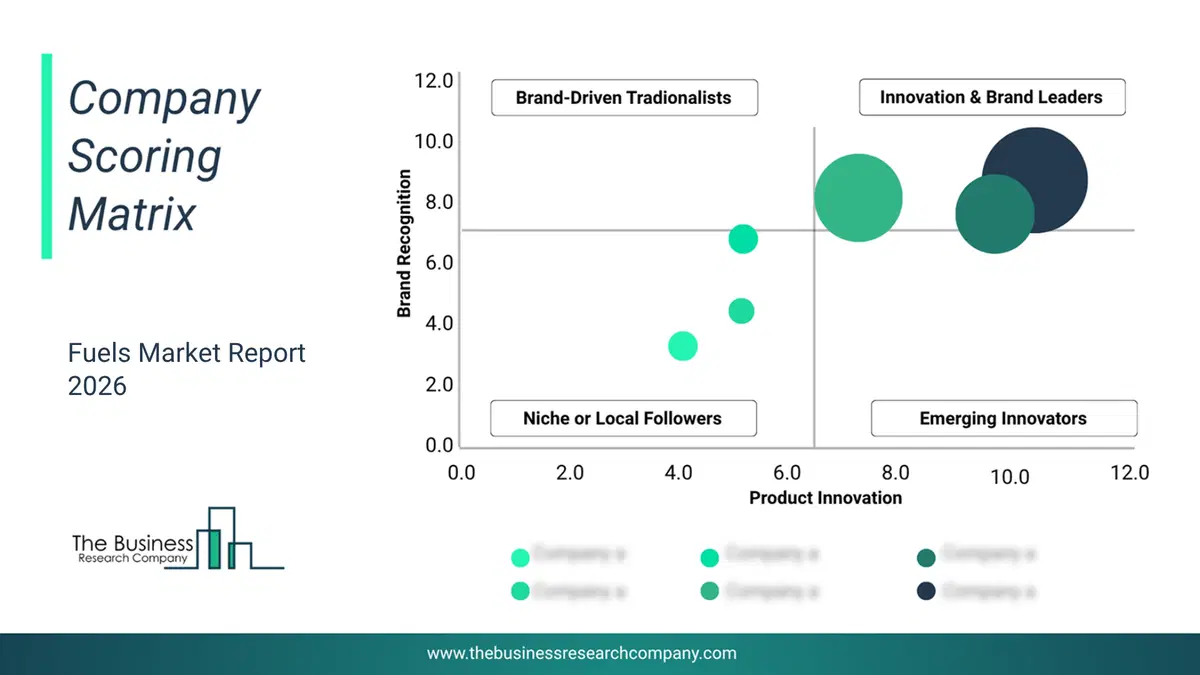
This chart maps companies by product innovation and brand strength, with bubble size indicating relative revenue, helping identify market leaders, challengers, and niche players. This is an illustrative chart; the full report provides a complete and accurate competitive analysis.
Global Fuels Market Trends and Insights
Major companies operating in the fuels market are focusing on developing advanced solutions, such as artificial intelligence-driven geosteering technologies, to enhance drilling accuracy, optimize resource extraction, and improve operational efficiency in fuel production. Artificial intelligence-driven geosteering refers to the use of artificial intelligence and real-time data analytics to guide drilling operations, enabling precise well placement and maximizing hydrocarbon recovery while reducing operational risks and costs. For instance, in December 2024, SLB, a US-based oilfield services provider, incorporated AI-powered geosteering into its autonomous drilling solutions portfolio. The technology is designed to support energy producers by enhancing drilling performance and enabling more informed decision-making. It facilitates real-time interpretation of subsurface conditions, allowing for more precise and adaptive drilling operations. This advancement improves well placement accuracy, ensuring better access to hydrocarbon reserves. Additionally, it boosts overall efficiency in fuel exploration and production activities, contributing to optimized resource utilization.What Are Latest Mergers And Acquisitions In The Fuels Market?
In July 2025, Chevron Corporation, a US-based energy company, acquired Hess Corporation for $53 billion. With this acquisition, Chevron aims to strengthen its upstream portfolio and expand its presence in high-growth oil regions, particularly by gaining access to strategic assets in Guyana, thereby enhancing long-term production capacity and competitive positioning. Hess Corporation is a US-based energy company that specializes in the exploration and production of crude oil and natural gas.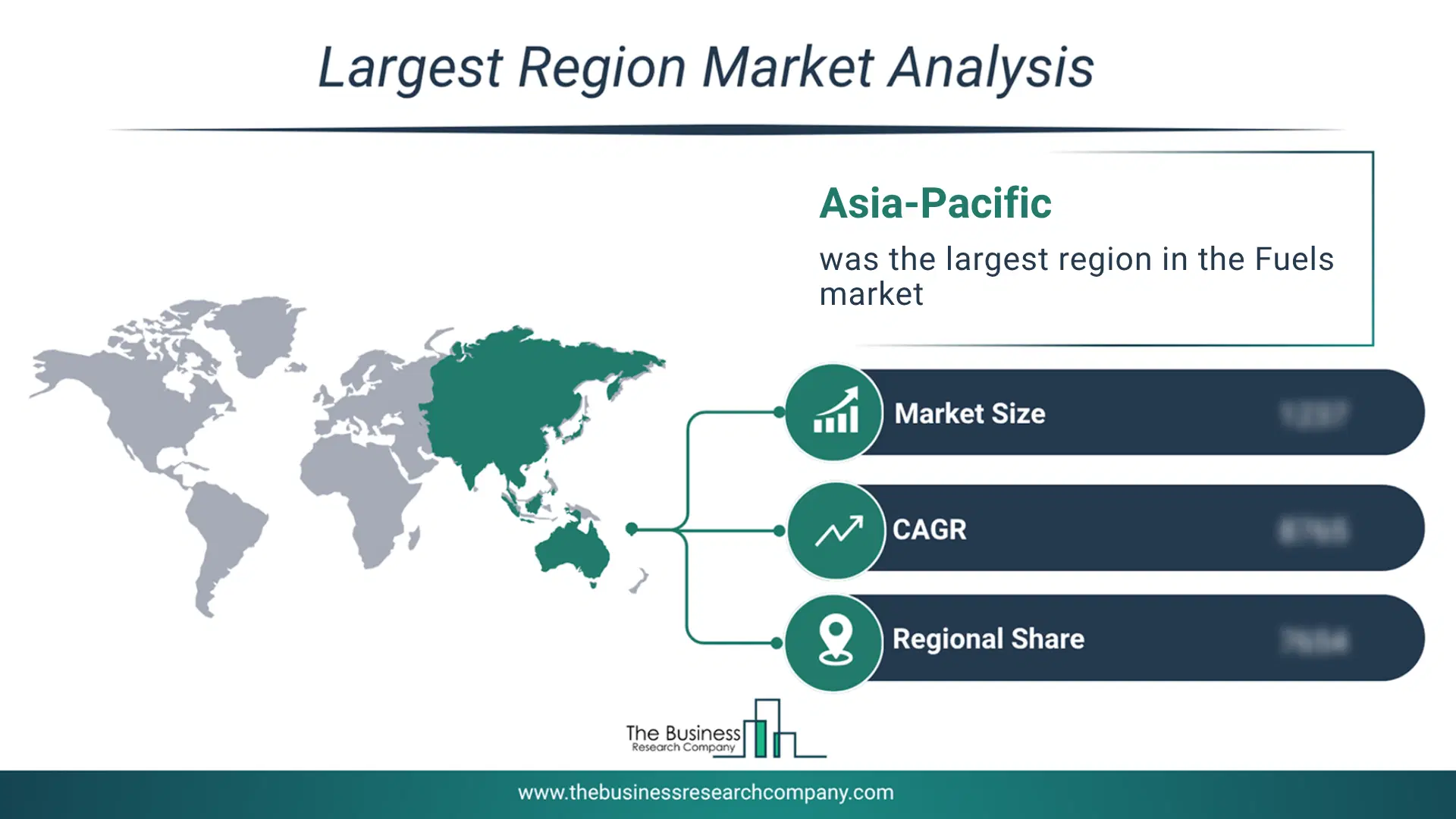
Regional Insights
Asia-Pacific was the largest region in the fuels market in 2025 and is expected to be the fastest-growing region in the forecast period. The regions covered in this market report are Asia-Pacific, South East Asia, Western Europe, Eastern Europe, North America, South America, Middle East, Africa. The countries covered in this market report are Australia, Brazil, China, France, Germany, India, Indonesia, Japan, Taiwan, Russia, South Korea, UK, USA, Canada, Italy, Spain.What Defines the Fuels Market?
The fuels market consists of sales of synthetic fuels, fuel pellets, coal briquettes, bitumen, paraffin wax, naphtha, furnace oil, gasoil, and shale oil. Values in this market are ‘factory gate’ values, that is, the value of goods sold by the producers or extractors of the goods, whether to other entities (including downstream refiners, processors, distributors, and traders) or directly to end customers. The value of goods in this market includes related services sold by the creators of the goods.How is Market Value Defined and Measured?
The market value is defined as the revenues that enterprises gain from the sale of goods and/or services within the specified market and geography through sales, grants, or donations in terms of the currency (in USD unless otherwise specified). The revenues for a specified geography are consumption values that are revenues generated by organizations in the specified geography within the market, irrespective of where they are produced. It does not include revenues from resales along the supply chain, either further along the supply chain or as part of other products.
This chart presents market attractiveness based on a quantitative evaluation of growth, competition, strategic alignment, and risk, offering a clear view of opportunity areas for decision-making. This chart is for illustrative purposes; the full report contains the complete analysis.

This chart highlights the Total Addressable Market (TAM) by estimating the maximum revenue opportunity using an assumption-driven approach, supporting strategic planning and opportunity sizing across markets. The chart is illustrative; the full report provides a more comprehensive analysis.
What Key Data and Analysis Are Included in the Fuels Market Report 2026?
The fuels market research report is one of a series of new reports from The Business Research Company that provides market statistics, including industry global market size, regional shares, competitors with the market share, detailed market segments, market trends and opportunities, and any further data you may need to thrive in the fuels industry. The market research report delivers a complete perspective of everything you need, with an in-depth analysis of the current and future state of the industry.Fuels Market Report Forecast Analysis
| Report Attribute | Details |
|---|---|
| Market Size Value In 2026 | $4472.54 billion |
| Revenue Forecast In 2030 | $5200.14 billion |
| Growth Rate | CAGR of 3.80% from 2026 to 2030 |
| Base Year For Estimation | 2025 |
| Actual Estimates/Historical Data | 2020-2025 |
| Forecast Period | 2026 - 2030 |
| Market Representation | Revenue in USD Billion and CAGR from 2026 to 2030 |
| Segments Covered | Product Type, Extraction Source, Application, End-User |
| Regional Scope | Asia-Pacific, Western Europe, Eastern Europe, North America, South America, Middle East, Africa |
| Country Scope | The countries covered in the report are Australia, Brazil, China, France, Germany, India, Indonesia, Japan, Taiwan, Russia, South Korea, UK, USA, Canada, Italy, Spain. |
| Key Companies Profiled | Saudi Arabian Oil Company, China Petroleum & Chemical Corporation, PetroChina Company Limited, Shell plc, TotalEnergies SE, BP p.l.c., Chevron Corporation, Equinor ASA, Eni S.p.A., Petróleo Brasileiro S.A., PJSC Rosneft Oil Company, CNOOC Limited, QatarEnergy, Exxon Mobil Corporation, PJSC LUKOIL, Occidental Petroleum Corporation, EOG Resources Inc., Devon Energy Corporation, Petróleos de Venezuela S.A., Apache Corporation, Murphy Oil Corporation. |
| Customization Scope | Request for Customization |
| Pricing And Purchase Options | Explore Purchase Options |