
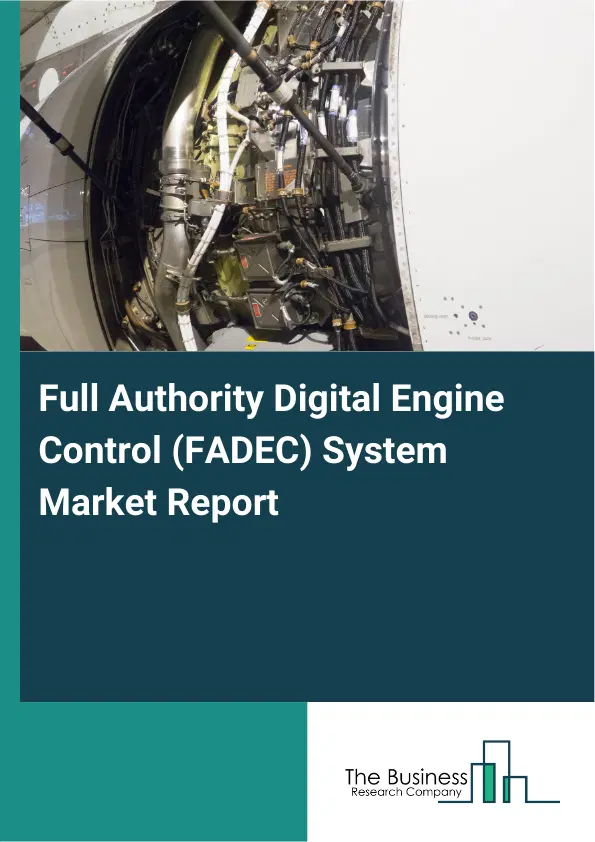
Full Authority Digital Engine Control (FADEC) System Market Report 2026
Global Outlook – By Type (Centralized, Distributed), By Engine Type (Turbofan Engines, Turboprop Engines, Turbojet Engines, Reciprocating Engines, Hybrid Engines), By Component Type (Control Units, Sensors, Actuators, Fuel Management Systems, Human-Machine Interface (HMI)), By Application Type (Aerospace, Military Aviation, Commercial Aviation, General Aviation, Unmanned Aerial Vehicles (UAVs)), By End-User (Aircraft Manufacturers, Maintenance, Repair, And Overhaul (MRO) Providers, Government Agencies, Research Institutions, Private Aircraft Operators) – Market Size, Trends, Strategies, and Forecast to 2030
Full Authority Digital Engine Control (FADEC) System Market Overview
• Full Authority Digital Engine Control (FADEC) System market size has reached to $4 billion in 2025 • Expected to grow to $6.05 billion in 2030 at a compound annual growth rate (CAGR) of 8.6% • Growth Driver: Rising Air Travel Volume Fueling The Growth Of The Market Due To Increasing Passenger Demand And Expansion Of Airline Networks • Market Trend: Advancement In Light Twin-Engined Helicopter Featuring FADEC For Enhanced Performance And Comfort • North America was the largest region in 2025 and Asia-Pacific is the fastest growing region.What Is Covered Under Full Authority Digital Engine Control (FADEC) System Market?
The full authority digital engine control (FADEC) system is an advanced electronic system that manages and controls all aspects of an aircraft engine’s performance. It optimizes fuel flow, ignition timing, and other engine parameters to maximize efficiency, reduce emissions, and enhance safety. FADEC eliminates the need for manual engine controls, allowing precise automatic adjustments under varying flight conditions. This system also provides monitoring and diagnostic capabilities, improving engine reliability and maintenance planning. The main types of full authority digital engine control (FADEC) systems are centralized and distributed. Turbofan engines refer to FADEC use in modern commercial and military aircraft propulsion systems where fuel efficiency and thrust control are optimized digitally. It is used for different engine types, such as turbofan engines, turboprop engines, turbojet engines, reciprocating engines, and hybrid engines, and uses various component types, including control units, sensors, actuators, fuel management systems, and human-machine interfaces (HMIs). It is applied for aerospace, military aviation, commercial aviation, general aviation, and unmanned aerial vehicles (UAVs) by several end-users, including aircraft manufacturers, maintenance, repair, and overhaul (MRO) providers, government agencies, research institutions, and private aircraft operators.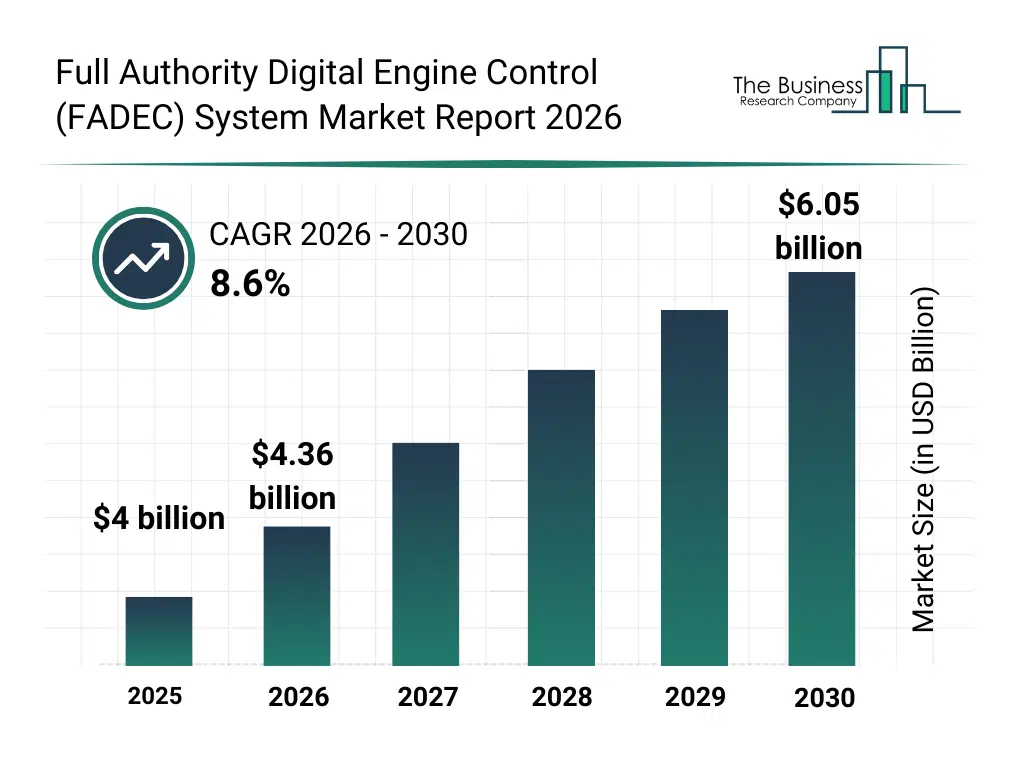
What Is The Full Authority Digital Engine Control (FADEC) System Market Size and Share 2026?
The full authority digital engine control (fadec) system market size has grown strongly in recent years. It will grow from $4 billion in 2025 to $4.36 billion in 2026 at a compound annual growth rate (CAGR) of 8.8%. The growth in the historic period can be attributed to adoption of digital engine controls in commercial and military aircraft, advancements in electronic sensors and actuators, focus on fuel efficiency and emission reduction, implementation of engine health monitoring systems, demand for automated engine performance optimization.What Is The Full Authority Digital Engine Control (FADEC) System Market Growth Forecast?
The full authority digital engine control (fadec) system market size is expected to see strong growth in the next few years. It will grow to $6.05 billion in 2030 at a compound annual growth rate (CAGR) of 8.6%. The growth in the forecast period can be attributed to integration with AI-driven predictive maintenance, development for next-generation aircraft engines, enhancements in diagnostic electronics and control algorithms, growth in retrofitting older aircraft, expansion in emerging aviation markets. Major trends in the forecast period include increased adoption of dual-channel and redundant fadec architectures, rising demand for fadec systems in hybrid and next-generation propulsion, expansion of fadec integration in uav and general aviation platforms, growth in aftermarket and mro-driven engine control upgrades, advancements in high-reliability sensors and engine-mounted actuation systems.
Global Full Authority Digital Engine Control (FADEC) System Market Segmentation
1) By Type: Centralized, Distributed 2) By Engine Type: Turbofan Engines, Turboprop Engines, Turbojet Engines, Reciprocating Engines, Hybrid Engines 3) By Component Type: Control Units, Sensors, Actuators, Fuel Management Systems, Human-Machine Interface (HMI) 4) By Application Type: Aerospace, Military Aviation, Commercial Aviation, General Aviation, Unmanned Aerial Vehicles (UAVs) 5) By End-User: Aircraft Manufacturers, Maintenance, Repair, And Overhaul (MRO) Providers, Government Agencies, Research Institutions, Private Aircraft Operators Subsegments: 1) By Centralized: Single-Channel Architecture, Dual-Channel Architecture, Redundant Channel Architecture, Engine-Mounted Control Unit, Airframe-Mounted Control Unit 2) By Distributed: Dual-Channel Redundant Modules, Sensor And Actuator Network-Based Modules, Modular Electronic Control Units (ECUS), Remote Data Concentrators, Integrated Distributed Computing NodesWhat Is Driver Of The Full Authority Digital Engine Control (FADEC) System Market?
The growing aerospace research and development investments are expected to propel the growth of the full authority digital engine control (FADEC) system market going forward. Aerospace research and development investment is the funding dedicated to advancing new technologies, designs, and innovations that enhance the performance and capabilities of aircraft and spacecraft. Aerospace research and development investments are rising due to the growing demand for fuel-efficient and sustainable aircraft, driving companies to innovate cleaner propulsion systems and lightweight materials to reduce environmental impact and operating costs. Aerospace research and development investments support full authority digital engine control (FADEC) systems by advancing digital technologies and engine integration methods that enhance engine performance, fuel efficiency, and real-time monitoring capabilities. For instance, in June 2025, according to the Department for Business and Trade, a UK-based government department, the UK aerospace industry generated an annual revenue of $46 billion (£34 billion) in 2024 and invested $2.6 billion (£1.9 billion) in research and development activities. Therefore, the growing aerospace research and development investments are driving the growth of the full authority digital engine control (FADEC) system industry.Key Players In The Global Full Authority Digital Engine Control (FADEC) System Market
Major companies operating in the full authority digital engine control (fadec) system market are GE Aerospace, BAE Systems, Rolls-Royce, Collins Aerospace Companies, Safran Aircraft Engines, Pratt & Whitney, Thales Group, Texas Instruments Inc., Liebherr International Deutschland GmbH, Textron Inc., Embraer SA, MTU Aero Engines AG, Triumph Group Inc., Safran Electronics & Defense, Honeywell Aerospace Technologies, Performance Software Corp., Primus Aerospace, Silver Atena GmbH, Electronic Concepts and Engineering Inc., FADEC International
This chart is for illustrative purposes; the full report includes a detailed competitor analysis and comprehensive overview of the top 10 companies in the market.
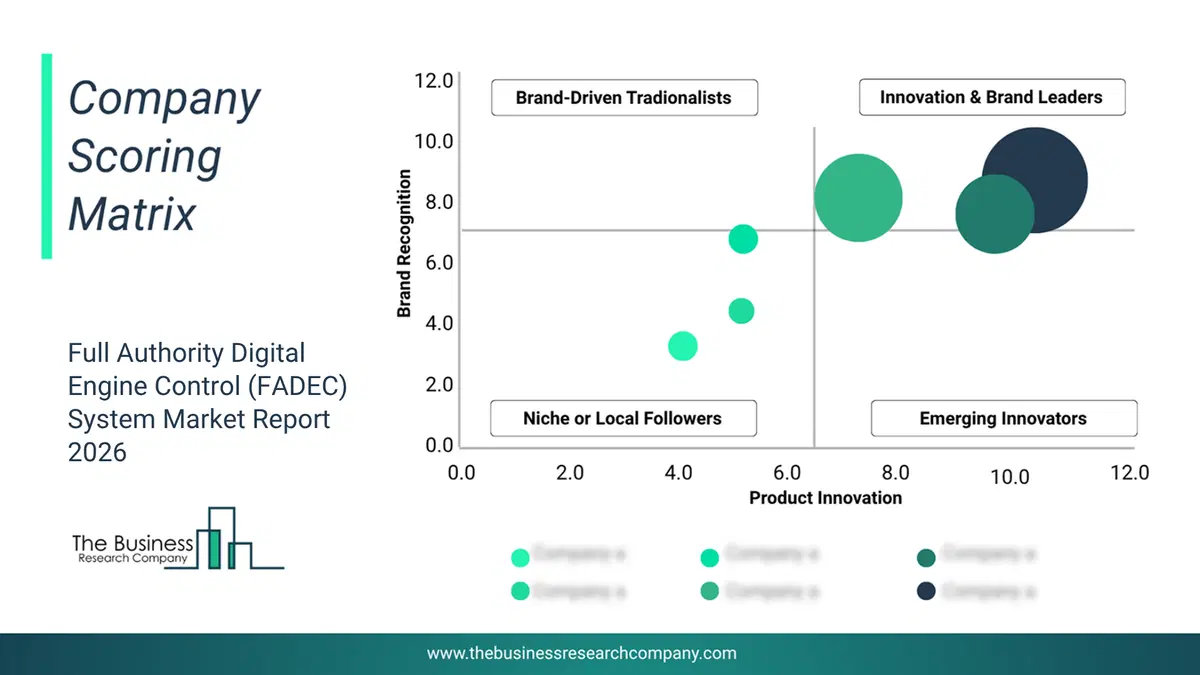
This chart maps companies by product innovation and brand strength, with bubble size indicating relative revenue, helping identify market leaders, challengers, and niche players. This is an illustrative chart; the full report provides a complete and accurate competitive analysis.
Global Full Authority Digital Engine Control (FADEC) System Market Trends and Insights
Major companies operating in the full authority digital engine control (FADEC) system market are focusing on developing advanced control solutions, such as next-generation FADEC-equipped propulsion systems, to enhance engine performance, fuel efficiency, and overall aircraft reliability. FADEC systems refer to integrated digital controls that manage all aspects of an aircraft engine’s operation, optimizing fuel flow, thrust, and engine parameters to ensure maximum efficiency and safety. For instance, in March 2025, Airbus Helicopters, a France-based rotary-wing aircraft manufacturer, unveiled its new H140 light twin-engined helicopter powered by two Safran Arrius 2E 700 shp engines featuring advanced FADEC. The system enables precise power management, reduced pilot workload, and simplified maintenance while enhancing safety and operational performance. Key innovations include improved engine response, automated fault detection, and integration with the Helionix avionics suite for enhanced situational awareness. Scheduled for entry into service in 2028, the H140 demonstrates how the adoption of advanced FADEC technology is supporting the development of efficient, reliable, and next-generation twin-engine platforms for emergency services, passenger transport, and private aviation.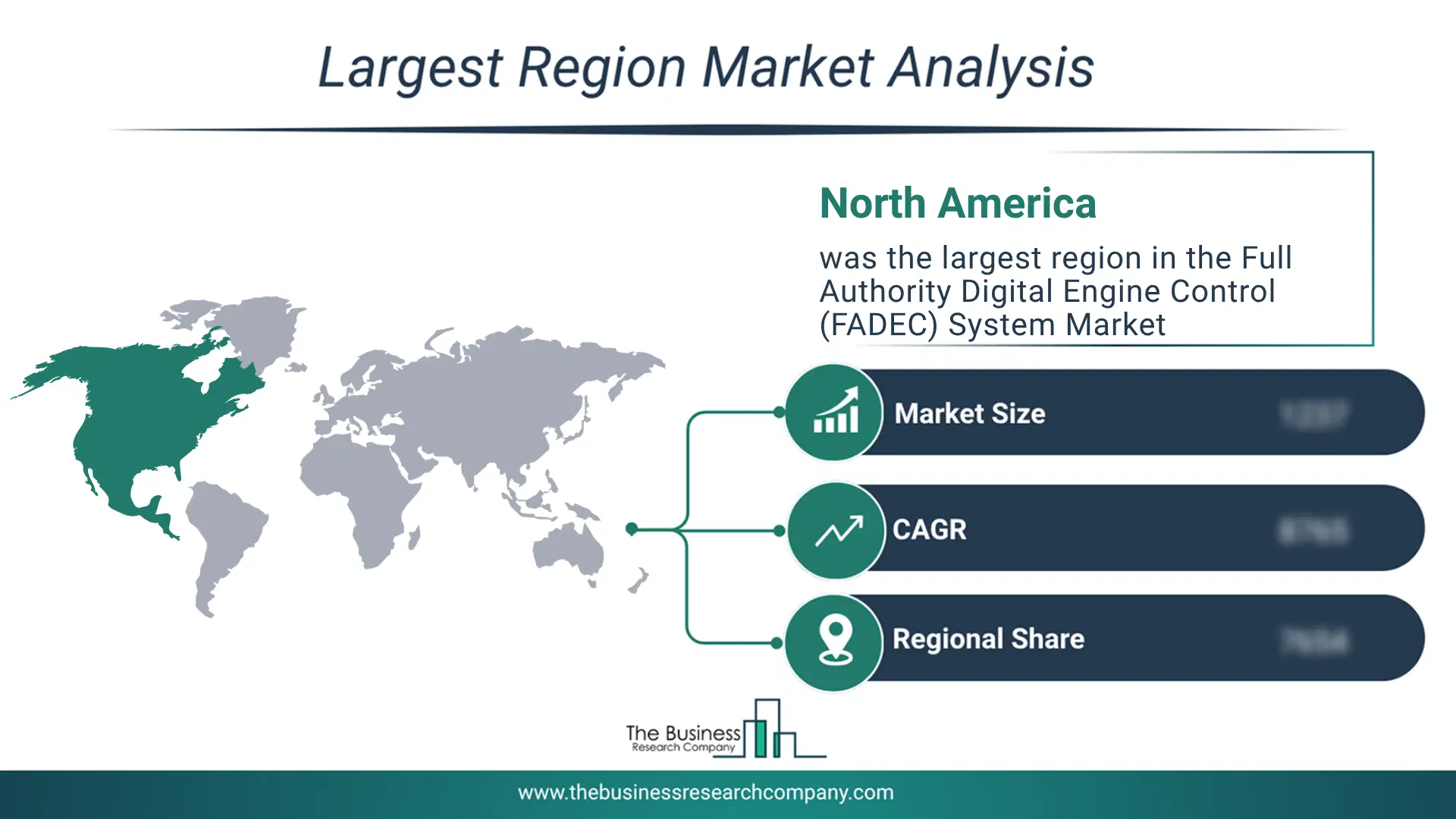
Regional Insights
North America was the largest region in the full authority digital engine control (FADEC) system market in 2025. Asia-Pacific is expected to be the fastest-growing region in the forecast period. The regions covered in this market report are Asia-Pacific, South East Asia, Western Europe, Eastern Europe, North America, South America, Middle East, Africa. The countries covered in this market report are Australia, Brazil, China, France, Germany, India, Indonesia, Japan, Taiwan, Russia, South Korea, UK, USA, Canada, Italy, SpainWhat Defines the Full Authority Digital Engine Control (FADEC) System Market?
The full authority digital engine control (FADEC) system market consists of sales of control valves, servo valves, health monitoring and diagnostic electronics. Values in this market are ‘factory gate’ values, that is the value of goods sold by the manufacturers or creators of the goods, whether to other entities (including downstream manufacturers, wholesalers, distributors and retailers) or directly to end customers. The value of goods in this market includes related services sold by the creators of the goods.How is Market Value Defined and Measured?
The market value is defined as the revenues that enterprises gain from the sale of goods and/or services within the specified market and geography through sales, grants, or donations in terms of the currency (in USD unless otherwise specified). The revenues for a specified geography are consumption values that are revenues generated by organizations in the specified geography within the market, irrespective of where they are produced. It does not include revenues from resales along the supply chain, either further along the supply chain or as part of other products.
This chart presents market attractiveness based on a quantitative evaluation of growth, competition, strategic alignment, and risk, offering a clear view of opportunity areas for decision-making. This chart is for illustrative purposes; the full report contains the complete analysis.

This chart highlights the Total Addressable Market (TAM) by estimating the maximum revenue opportunity using an assumption-driven approach, supporting strategic planning and opportunity sizing across markets. The chart is illustrative; the full report provides a more comprehensive analysis.
What Key Data and Analysis Are Included in the Full Authority Digital Engine Control (FADEC) System Market Report 2026?
The full authority digital engine control (fadec) system market research report is one of a series of new reports from The Business Research Company that provides market statistics, including industry global market size, regional shares, competitors with the market share, detailed market segments, market trends and opportunities, and any further data you may need to thrive in the full authority digital engine control (fadec) system industry. The market research report delivers a complete perspective of everything you need, with an in-depth analysis of the current and future state of the industry.Full Authority Digital Engine Control (FADEC) System Market Report Forecast Analysis
| Report Attribute | Details |
|---|---|
| Market Size Value In 2026 | $4.36 billion |
| Revenue Forecast In 2030 | $6.05 billion |
| Growth Rate | CAGR of 8.6% from 2026 to 2030 |
| Base Year For Estimation | 2025 |
| Actual Estimates/Historical Data | 2020-2025 |
| Forecast Period | 2026 - 2030 |
| Market Representation | Revenue in USD Billion and CAGR from 2026 to 2030 |
| Segments Covered | Type, Engine Type, Component Type, Application Type, End-User |
| Regional Scope | Asia-Pacific, Western Europe, Eastern Europe, North America, South America, Middle East, Africa |
| Country Scope | The countries covered in the full authority digital engine control (fadec) system market report are Australia, Brazil, China, France, Germany, India, Indonesia, Japan, Taiwan, Russia, South Korea, UK, USA, Canada, Italy, Spain |
| Key Companies Profiled | GE Aerospace, BAE Systems, Rolls-Royce, Collins Aerospace Companies, Safran Aircraft Engines, Pratt & Whitney, Thales Group, Texas Instruments Inc., Liebherr International Deutschland GmbH, Textron Inc., Embraer SA, MTU Aero Engines AG, Triumph Group Inc., Safran Electronics & Defense, Honeywell Aerospace Technologies, Performance Software Corp., Primus Aerospace, Silver Atena GmbH, Electronic Concepts and Engineering Inc., FADEC International |
| Customization Scope | Request for Customization |
| Pricing And Purchase Options | Explore Purchase Options |