
Full Truckload Market Report 2026
Global Outlook – By Truck Type (Dry Van, Refrigerated, Flatbed), By Cargo Type (General Freight, Perishable Goods, Hazardous Materials, Bulk Goods), By Distance (Short Haul, Medium Haul, Long Haul), By Vehicle Type (Heavy Commercial Vehicles, Medium Commercial Vehicles, Light Commercial Vehicles), By End Use (Manufacturing, Retail And E Commerce, Food And Beverage, Construction, Chemicals And Petroleum, Agriculture) – Market Size, Trends, Strategies, and Forecast to 2030
Full Truckload Market Overview
• Full Truckload market size has reached to $617.25 billion in 2025 • Expected to grow to $821.77 billion in 2030 at a compound annual growth rate (CAGR) of 5.8% • Growth Driver: Surge In Cross-border Trade Activities Fueling The Market Growth Due To Higher Freight Demand • Market Trend: Innovations In Autonomous Trucking Technology Enhance Full Truckload Transportation Efficiency • Asia-Pacific was the largest region in 2025 and North America is the fastest growing region.What Is Covered Under Full Truckload Market?
Full truckload refers to transportation in which an entire truck is dedicated to carrying a single shipment from one origin to one destination. It is typically used when the shipment is large enough to occupy most or all of the truck’s available capacity. Full truckload transportation provides direct movement with minimal handling, helping reduce transit time and the risk of damage or delays. The main truck types used for full truckload include dry vans, refrigerated trucks, and flatbed trucks. Dry vans are enclosed trailers designed to transport general cargo while protecting goods from weather and external conditions. The cargo types include general freight, perishable goods, hazardous materials, and bulk goods, while transportation distances are categorized into short haul, medium haul, and long haul. The vehicle types include heavy commercial vehicles, medium commercial vehicles, and light commercial vehicles, while end uses include manufacturing, retail and E commerce, food and beverage, construction, chemicals and petroleum, and agriculture.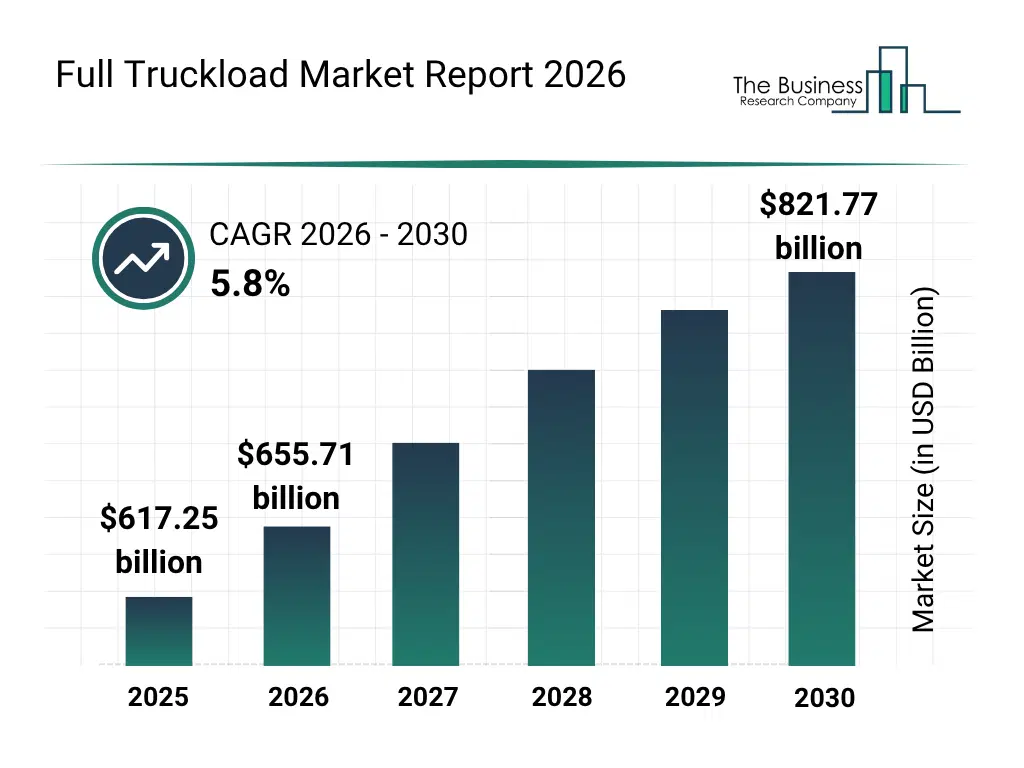
What Is The Full Truckload Market Size and Share 2026?
The full truckload market size has grown strongly in recent years. It will grow from $617.25 billion in 2025 to $655.71 billion in 2026 at a compound annual growth rate (CAGR) of 6.2%. The growth in the historic period can be attributed to growth of manufacturing activity, expansion of retail and e-commerce distribution, increasing domestic freight volumes, growth in food and beverage transportation, expansion of construction and infrastructure projects.What Is The Full Truckload Market Growth Forecast?
The full truckload market size is expected to see strong growth in the next few years. It will grow to $821.77 billion in 2030 at a compound annual growth rate (CAGR) of 5.8%. The growth in the forecast period can be attributed to rising cross-border freight movement, increasing demand for faster freight delivery, growth of temperature-sensitive shipments, expansion of supply chain outsourcing, increasing demand for specialized freight transportation. Major trends in the forecast period include increasing adoption of dedicated freight transportation, growing demand for expedited long-distance delivery, expansion of specialized truckload services, increasing use of drop-and-hook operations, rising demand for temperature-controlled full truckload transportation.Tariff Impact On Full Truckload Market
Tariffs are impacting the full truckload market by increasing the cost of imported vehicles, truck components, tires, fuel-related equipment, and transportation technology used in freight operations. This is raising operating and logistics costs across general freight, perishable goods, hazardous materials, and bulk goods transportation, particularly in trade-dependent regions such as North America, Asia-Pacific, and Europe. Long-haul operations and freight movements involving imported goods are among the most affected due to higher equipment and supply chain costs. However, tariffs are also encouraging domestic sourcing, regional manufacturing, supplier diversification, and greater reliance on domestic freight transportation networks, creating opportunities for stronger local logistics ecosystems.
Global Full Truckload Market Segmentation
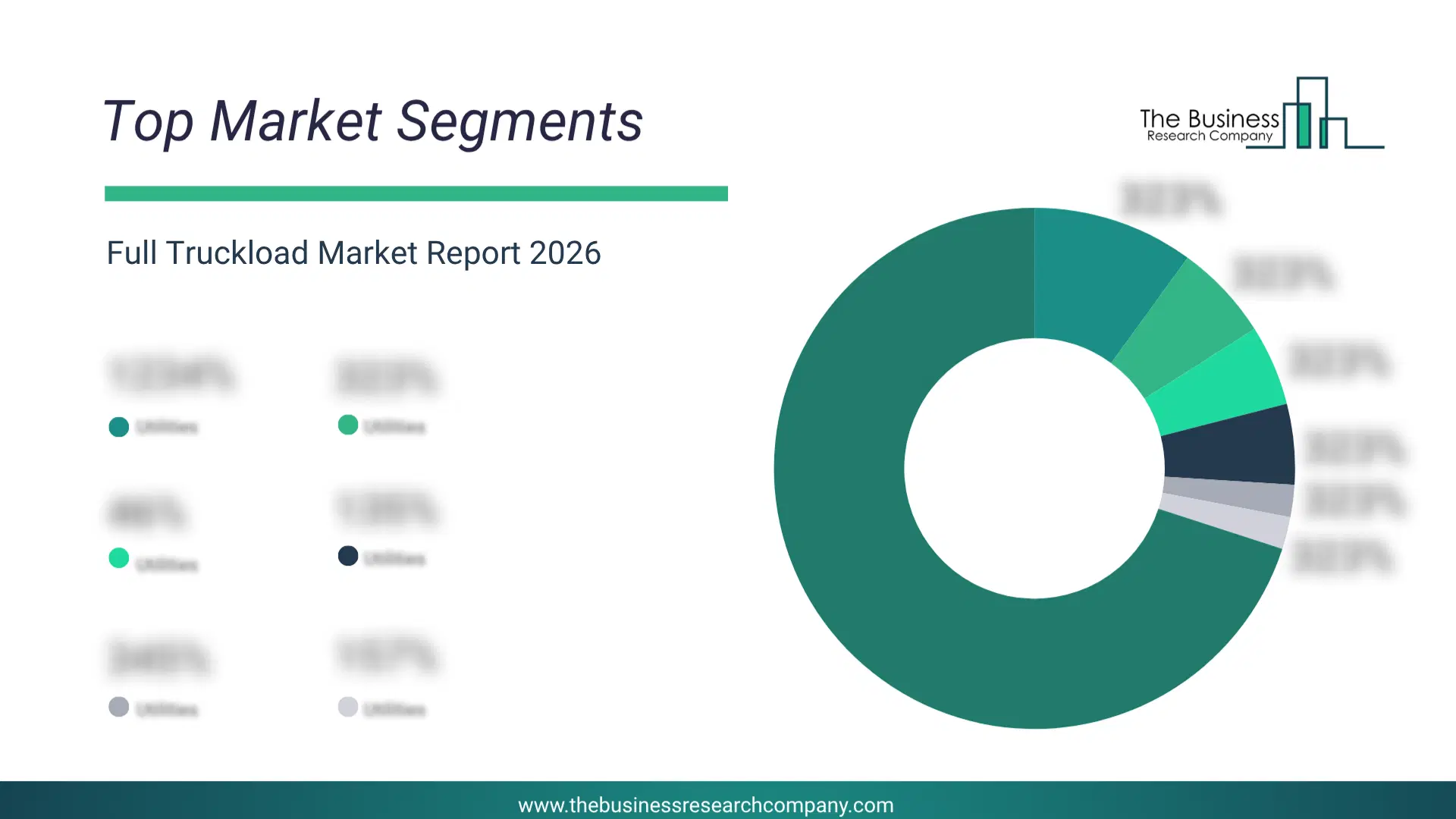
1) By Truck Type: Dry Van, Refrigerated, Flatbed 2) By Cargo Type: General Freight, Perishable Goods, Hazardous Materials, Bulk Goods 3) By Distance: Short Haul, Medium Haul, Long Haul 4) By Vehicle Type: Heavy Commercial Vehicles, Medium Commercial Vehicles, Light Commercial Vehicles 5) By End Use: Manufacturing, Retail And E Commerce, Food And Beverage, Construction, Chemicals And Petroleum, Agriculture Subsegments: 1) By Dry Van: Standard Dry Van, High Cube Dry Van, Pup Trailer, Conestoga Trailer 2) By Refrigerated: Standard Refrigerated Trailer, Multi Temperature Refrigerated Trailer, Frozen Refrigerated Trailer, Pharmaceutical Refrigerated Trailer 3) By Flatbed: Standard Flatbed, Step Deck Flatbed, Double Drop Flatbed, Extendable FlatbedWhat Is The Driver Of The Full Truckload Market?
The rising cross-border trade activities are expected to propel the growth of the full truckload market going forward. Cross-border trade activities refer to the movement of goods and services between two or more countries through international commercial transactions supported by transportation, customs, and trade agreements. The rise in cross-border trade activities is driven by globalization and expanding international supply chains, which increase the movement of goods across countries and create greater demand for efficient transportation and logistics services. The growth in cross-border trade activities supports the full truckload by increasing demand for dedicated long-haul freight transportation that enables the efficient movement of large import and export shipments with fewer handling points, reduced transit risks, and improved delivery reliability. For instance, in July 2026, according to the Department for Business & Trade, a UK-based government department, UK exports reached £946.6 billion (USD 1,278.15 billion), increasing by 3.1%, while imports reached £992.7 billion (USD 1,340.40 billion), increasing by 5.3%. Therefore, the rising cross-border trade activities are driving the growth of the full truckload industry.Key Players In The Global Full Truckload Market
Major companies operating in the full truckload market are J.B. Hunt Transport Services Inc., Knight-Swift Transportation Holdings Inc., TFI International Inc., Schneider National Inc., Ryder System Inc., XPO Inc., Old Dominion Freight Line Inc., Landstar System Inc., Werner Enterprises Inc., Penske Logistics LLC, ArcBest Corporation, Saia Inc., NFI Industries Inc., Prime Inc., Heartland Express Inc., Crete Carrier Corporation, CRST The Transportation Solution Inc., Mullen Group Ltd., Marten Transport Ltd., Covenant Logistics Group Inc., Ruan Transportation Management Systems Inc., Trimac Transportation Services Inc., PAM Transport Inc., KLLM Transport Services LLC, Bison Transport Inc., Challenger Motor Freight Inc.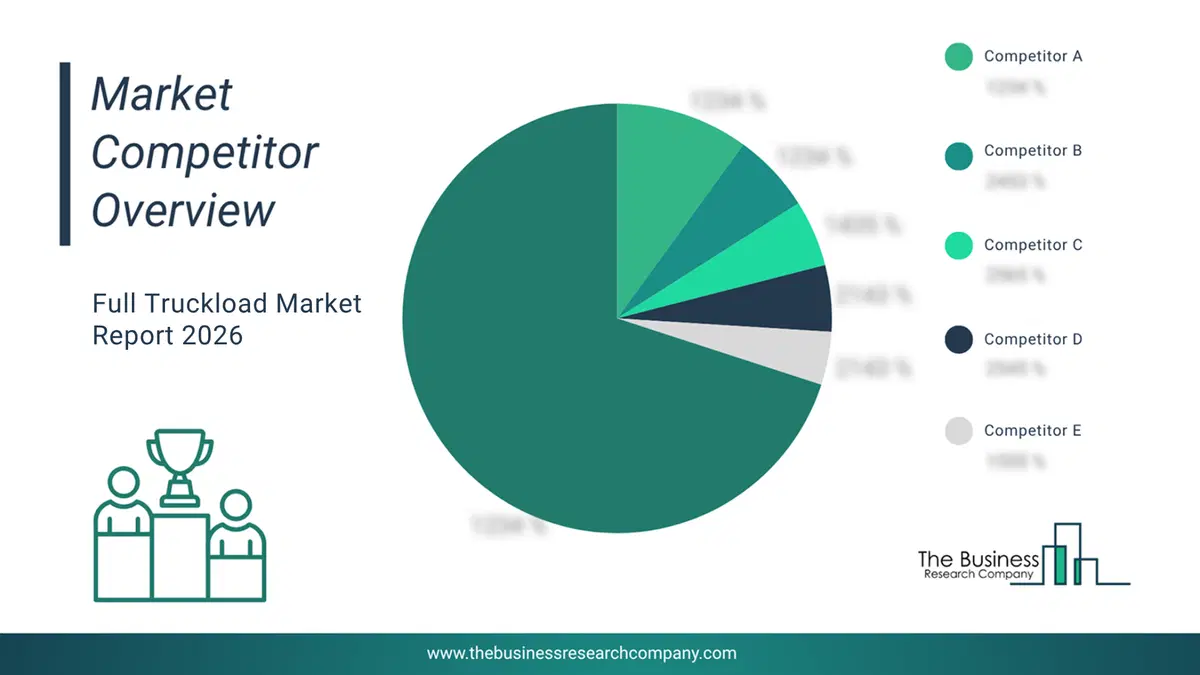
This chart is for illustrative purposes; the full report includes a detailed competitor analysis and comprehensive overview of the top 10 companies in the market.
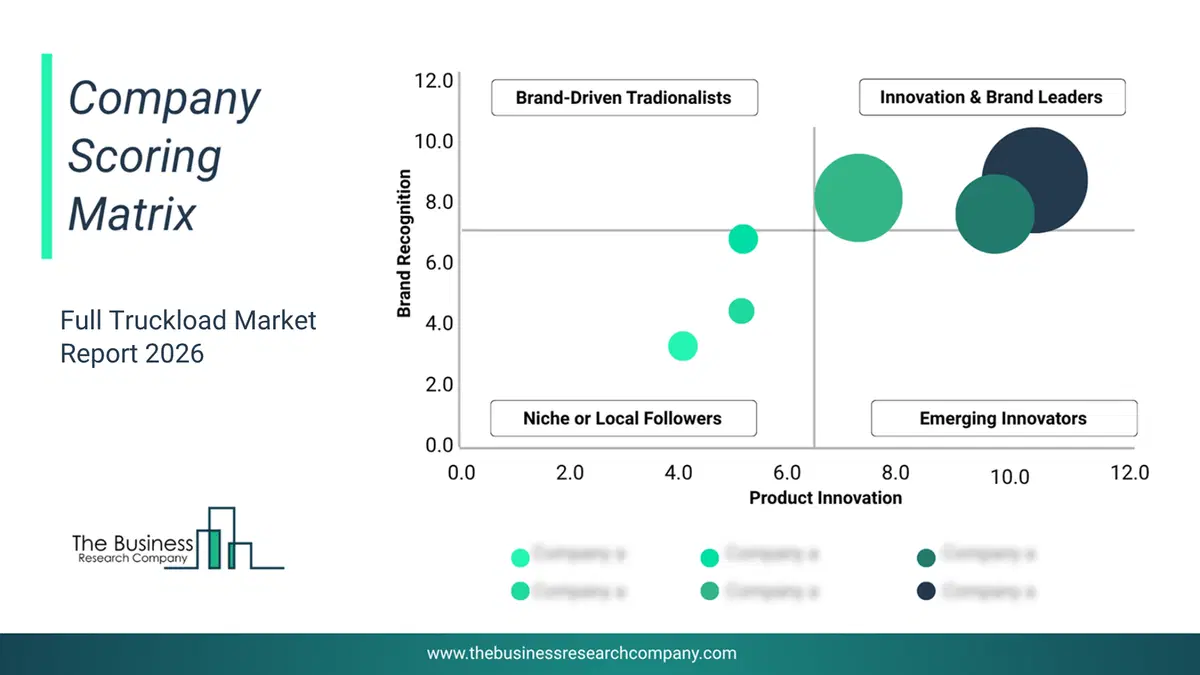
This chart maps companies by product innovation and brand strength, with bubble size indicating relative revenue, helping identify market leaders, challengers, and niche players. This is an illustrative chart; the full report provides a complete and accurate competitive analysis.
Global Full Truckload Market Trends and Insights
Major companies operating in the full truckload market are focusing on developing advanced autonomous trucking solutions to enhance transportation efficiency, improve safety, and address driver shortages. Autonomous trucking refers to the use of artificial intelligence (AI), sensors, and automated driving technologies to operate commercial trucks with limited or no human intervention. For instance, in April 2026, Bot Auto, a US-based autonomous trucking company, completed its first fully humanless over-the-road commercial truckload in Texas. The 230-mile delivery from Houston to Dallas was a paid commercial shipment completed without a safety driver, in-cab observer, or remote operator. The autonomous truck transported the freight independently, demonstrating the capability of autonomous technology in commercial freight operations. The deployment highlights the potential of autonomous trucking to improve efficiency and support continuous full truckload transportation.What Are Latest Mergers And Acquisitions In The Full Truckload Market?
In August 2026, Fastfrate Group, a Canada-based transportation and logistics company, acquired Jardine Transport Group for an undisclosed amount. Through this acquisition, Fastfrate Group aims to strengthen its truckload operations by adding more than 200 power units and expanding its transportation, logistics, warehousing, and distribution capabilities across Canada. Jardine Transport Group is a Canada-based transportation company that provides flatbed and dry van transportation services for domestic and cross-border freight.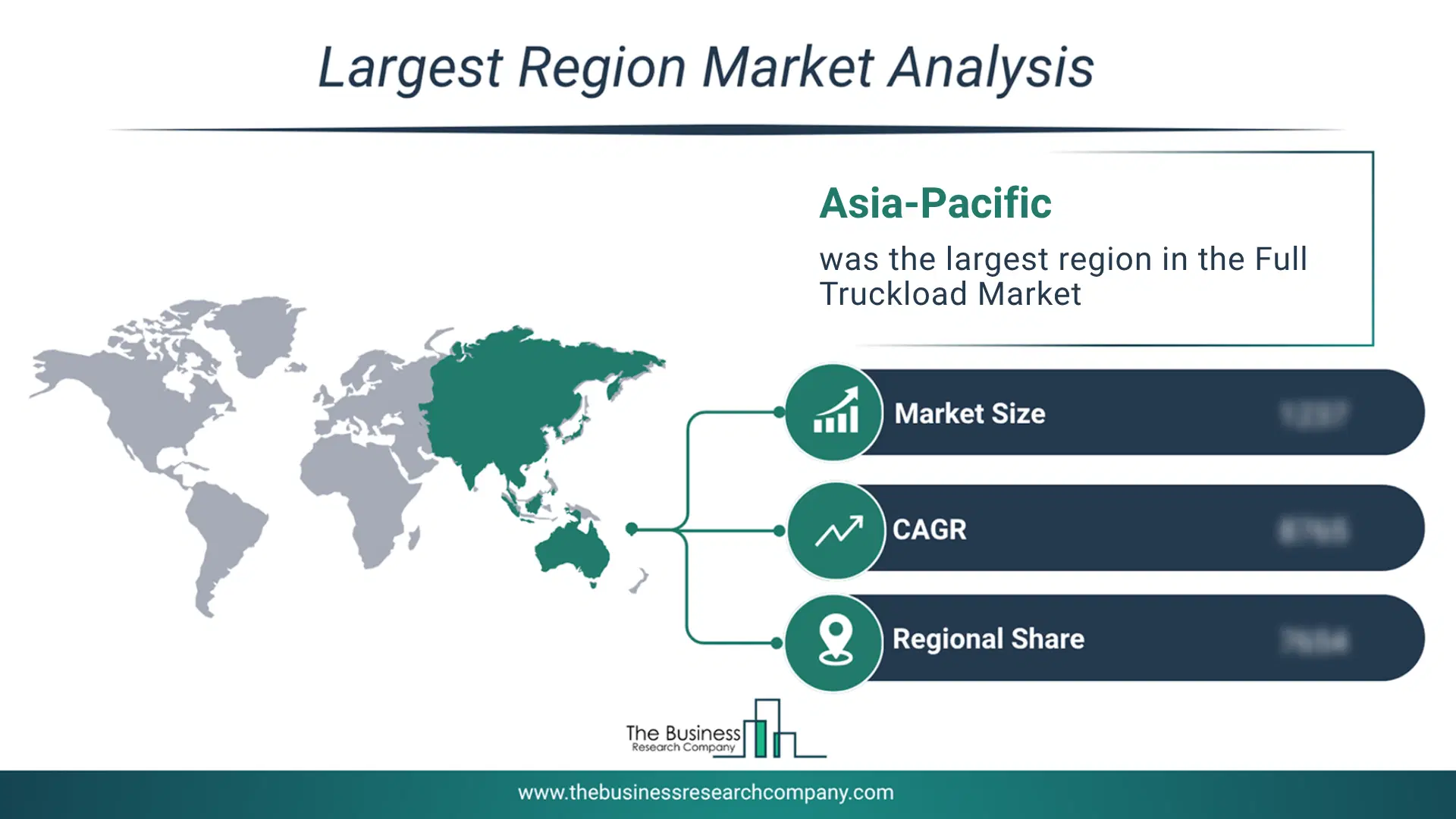
Regional Outlook
Asia-Pacific was the largest region in the full truckload market in 2025. North America is expected to be the fastest-growing region in the forecast period. The regions covered in this market report are Asia-Pacific, South East Asia, Western Europe, Eastern Europe, North America, South America, Middle East, Africa. The countries covered in this market report are Australia, Brazil, China, France, Germany, India, Indonesia, Japan, Taiwan, Russia, South Korea, UK, USA, Canada, Italy, Spain.What Defines the Full Truckload Market?
The full truckload market includes revenue earned by entities by providing services such as dedicated truck transportation, expedited freight transportation, regional freight transportation, and long haul freight transportation. Values in this market are ‘factory gate’ values, that is, the value of goods sold by the manufacturers or creators of the goods, whether to other entities (including downstream manufacturers, wholesalers, distributors, and retailers) or directly to end customers. The value of goods in this market includes related services sold by the creators of the goods.How is Market Value Defined and Measured?
The market value is defined as the revenues that enterprises gain from the sale of goods and/or services within the specified market and geography through sales, grants, or donations in terms of the currency (in USD unless otherwise specified). The revenues for a specified geography are consumption values that are revenues generated by organizations in the specified geography within the market, irrespective of where they are produced. It does not include revenues from resales along the supply chain, either further along the supply chain or as part of other products.
This chart presents market attractiveness based on a quantitative evaluation of growth, competition, strategic alignment, and risk, offering a clear view of opportunity areas for decision-making. This chart is for illustrative purposes; the full report contains the complete analysis.

This chart highlights the Total Addressable Market (TAM) by estimating the maximum revenue opportunity using an assumption-driven approach, supporting strategic planning and opportunity sizing across markets. The chart is illustrative; the full report provides a more comprehensive analysis.
What Key Data and Analysis Are Included in the Full Truckload Market Report 2026?
The full truckload market research report is one of a series of new reports from The Business Research Company that provides market statistics, including industry global market size, regional shares, competitors with the market share, detailed market segments, market trends and opportunities, and any further data you may need to thrive in the full truckload industry. The market research report delivers a complete perspective of everything you need, with an in-depth analysis of the current and future state of the industry.Full Truckload Market Report Forecast Analysis
| Report Attribute | Details |
|---|---|
| Market Size Value In 2026 | $655.71 billion |
| Revenue Forecast In 2030 | $821.77 billion |
| Growth Rate | CAGR of 5.8% from 2026 to 2030 |
| Base Year For Estimation | 2025 |
| Actual Estimates/Historical Data | 2020-2025 |
| Forecast Period | 2026 - 2030 |
| Market Representation | Revenue in USD Billion and CAGR from 2026 to 2030 |
| Segments Covered | Truck Type, Cargo Type, Distance, Vehicle Type, End Use |
| Regional Scope | Asia-Pacific, Western Europe, Eastern Europe, North America, South America, Middle East, Africa |
| Country Scope | The countries covered in the report are Australia, Brazil, China, France, Germany, India, Indonesia, Japan, Taiwan, Russia, South Korea, UK, USA, Canada, Italy, Spain. |
| Key Companies Profiled | J.B. Hunt Transport Services Inc., Knight-Swift Transportation Holdings Inc., TFI International Inc., Schneider National Inc., Ryder System Inc., XPO Inc., Old Dominion Freight Line Inc., Landstar System Inc., Werner Enterprises Inc., Penske Logistics LLC, ArcBest Corporation, Saia Inc., NFI Industries Inc., Prime Inc., Heartland Express Inc., Crete Carrier Corporation, CRST The Transportation Solution Inc., Mullen Group Ltd., Marten Transport Ltd., Covenant Logistics Group Inc., Ruan Transportation Management Systems Inc., Trimac Transportation Services Inc., PAM Transport Inc., KLLM Transport Services LLC, Bison Transport Inc., Challenger Motor Freight Inc. |
| Customization Scope | Request for Customization |
| Pricing And Purchase Options | Explore Purchase Options |