
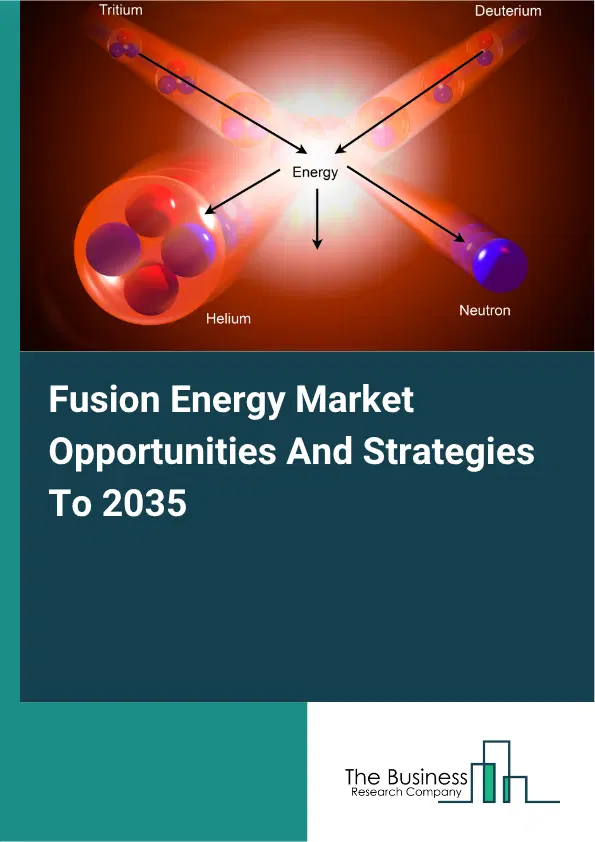
Fusion Energy Global Market Opportunities And Strategies To 2035
By Type (Magnetic Confinement Fusion, Inertial Confinement Fusion, Other Types), By System Type (Experimental Reactors, Pilot Plants), By Investment Type (Public Sector Investments, Private Sector Investments, International Collaborations), By Fuel Type (Deuterium-Tritium, Deuterium-Deuterium, Proton-Boron, Other Fuel Types), By Application (Power Generation, Space Propulsion, Industrial Applications, Other Applications), And By Region, Opportunities And Strategies – Global Forecast To 2035
Fusion Energy Market Definition
Fusion energy refers to the generation of energy through the process of nuclear fusion, in which two light atomic nuclei—typically isotopes of hydrogen such as deuterium and tritium—combine to form a heavier nucleus, releasing vast amounts of energy in the process. This reaction is the same that powers the sun and stars, and it offers a potential energy source that is clean, virtually limitless, and inherently safe. The primary purpose of fusion energy is to provide a clean, safe, and virtually limitless source of power with minimal greenhouse gas emissions and long-lived radioactive waste. The fusion energy market consists of sales by entities (organizations, sole traders, and partnerships) involved in the development, manufacturing, and commercialization of technologies and systems that enable nuclear fusion for energy generation. This includes revenues generated from fusion reactors and reactor components, plasma confinement systems, superconducting magnets, heating and fueling technologies, tritium breeding systems, diagnostics and control software, and associated engineering, construction, and maintenance services. The market also encompasses research services, pilot and demonstration projects, and public- and private-sector investments aimed at advancing fusion energy toward commercial power production.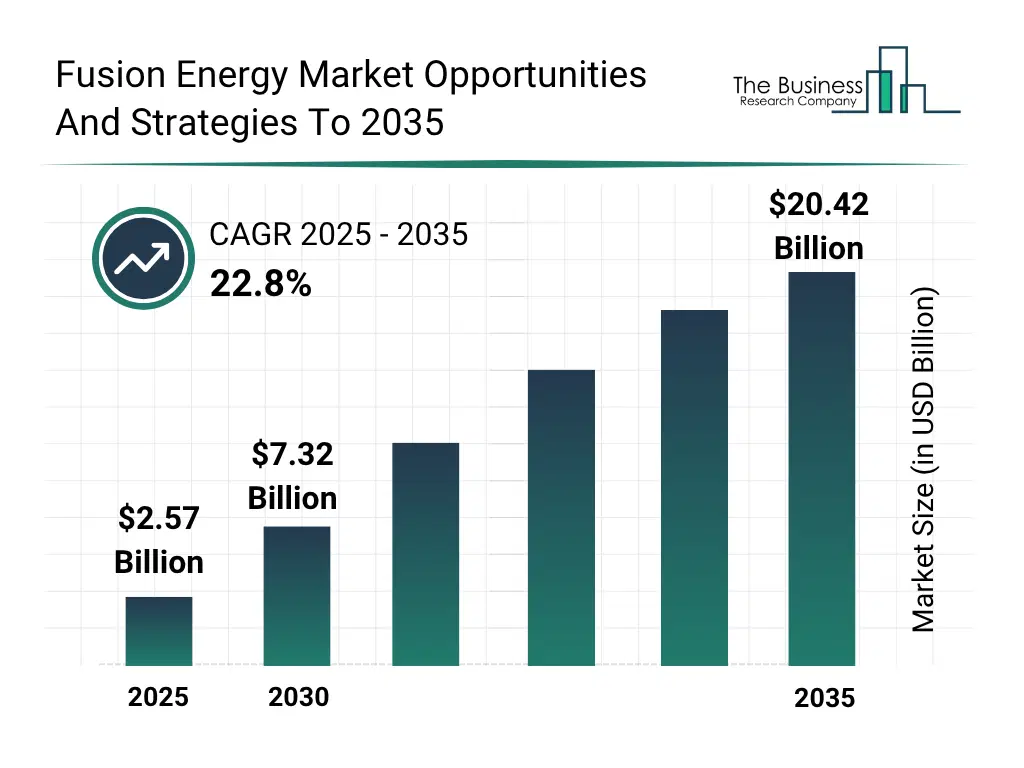
Fusion Energy Market Size
The global fusion energy market reached a value of nearly $2,569.0 million in 2025, having grown at a compound annual growth rate (CAGR) of 85.1% since 2020. The market is expected to grow from $2,569.0 million in 2025 to $7,322.7 million in 2030 at a rate of 23.3%. The market is then expected to grow at a CAGR of 22.8% from 2030 and reach $20,421.7 million in 2035. Growth in the historic period resulted from rising climate change concerns, rising shift from fossil fuels, strengthening government funding for advanced nuclear technologies and rising global sustainability commitments. Factors that negatively affected growth in the historic period were high capital and development costs and limited availability of specialized materials. Going forward, growing need to reduce carbon emissions, expansion of net-zero emission targets, increasing demand for clean energy source and increasing energy security needs will drive the growth. Factors that could hinder the growth of the fusion energy market in the future include regulatory and permitting uncertainty and insufficient trained workforce and impact of trade wars and tariffs.
Fusion Energy Market Segmentation
The fusion energy market is segmented by type, by system, by investment, by fuel and by application.By Type –
The fusion energy market is segmented by type into:
- a) Magnetic Confinement Fusion
- b) Inertial Confinement Fusion
- c) Other Types
By System –
The fusion energy market is segmented by system into:
- a) Experimental Reactors
- b) Pilot Plants
By Investment –
The fusion energy market is segmented by investment into:
- a) Public Sector Investments
- b) Private Sector Investments
- c) International Collaborations
By Fuel –
The fusion energy market is segmented by fuel into:
- a) Deuterium-Tritium
- b) Deuterium-Deuterium
- c) Proton-Boron
- d) Other Fuel Types
By Application –
The fusion energy market is segmented by application into:
- a) Power Generation
- b) Space Propulsion
- c) Industrial Applications
- d) Other Applications
By Geography - The fusion energy market is segmented by geography into:
- China
- India
- Japan
- Australia
- Indonesia
- South Korea
- USA
- Canada
- Brazil
- France
- Germany
- UK
- Italy
- Spain
- Russia
-
o Asia Pacific
o Africa